
Blown-In Insulation in Toronto & Ontario
Blown in insulation Toronto is a cost-effective solution for improving energy efficiency, comfort, and thermal performance in homes and buildings across Toronto and Ontario. It is commonly used in attics, wall cavities, and hard-to-reach areas where traditional insulation methods may fall short.
Spray Foam Kings provides professional blown-in insulation services for residential and commercial properties, helping reduce heat loss, control air leakage, and support long-term energy savings.
- Ideal for attics, wall cavities, and retrofit applications
- Helps reduce heat loss and improve indoor comfort
- Installed to meet Ontario Building Code requirements
- Suitable for residential and commercial properties

Code-Compliant Blown In Insulation Toronto & Ontario
Blown-in insulation installations must meet specific Ontario Building Code requirements related to thermal performance, coverage depth, and material safety. Proper installation is essential to ensure consistent insulation levels, effective air sealing support, and long-term durability.
At Spray Foam Kings, all blown-in insulation projects are completed in accordance with applicable Ontario Building Code standards and manufacturer specifications. We assess attic access, ventilation conditions, and existing insulation to ensure the final installation performs as intended.
Why Choose Blown-In Insulation in Toronto?
Toronto homes often experience heat loss through attics and wall cavities, especially in older houses and retrofit situations. Blown-in insulation is an effective solution for improving thermal performance in these areas without major renovations. It fills gaps, voids, and irregular spaces that traditional insulation may leave exposed.
For homeowners looking to improve comfort, reduce drafts, and lower energy costs, blown-in insulation offers a reliable and efficient option when installed correctly.
- Ideal for older Toronto homes and retrofit projects
- Helps improve energy efficiency and indoor comfort
- Even coverage in hard-to-reach areas
- Installed by licensed insulation professionals
- Installed by licensed & insured professionals

How Blown-In Insulation Works
Blown-in insulation is installed using specialized equipment that distributes loose-fill insulation evenly into attics or wall cavities. The material is blown through a hose, allowing it to settle around framing, wiring, and other obstructions to create consistent coverage.
This method is especially effective for retrofit applications and older homes where access may be limited. In some projects, blown-in insulation may be used alongside other solutions such as
spray foam insulation services to address specific air-sealing or moisture-control needs.
- Access points are prepared and protected
- Insulation material is blown evenly into target areas
- Coverage depth is verified to meet performance requirements
- Final inspection ensures consistent application
Ready to Upgrade Your Insulation?
Get professional spray foam insulation installed by licensed experts serving Toronto and communities across Ontario.
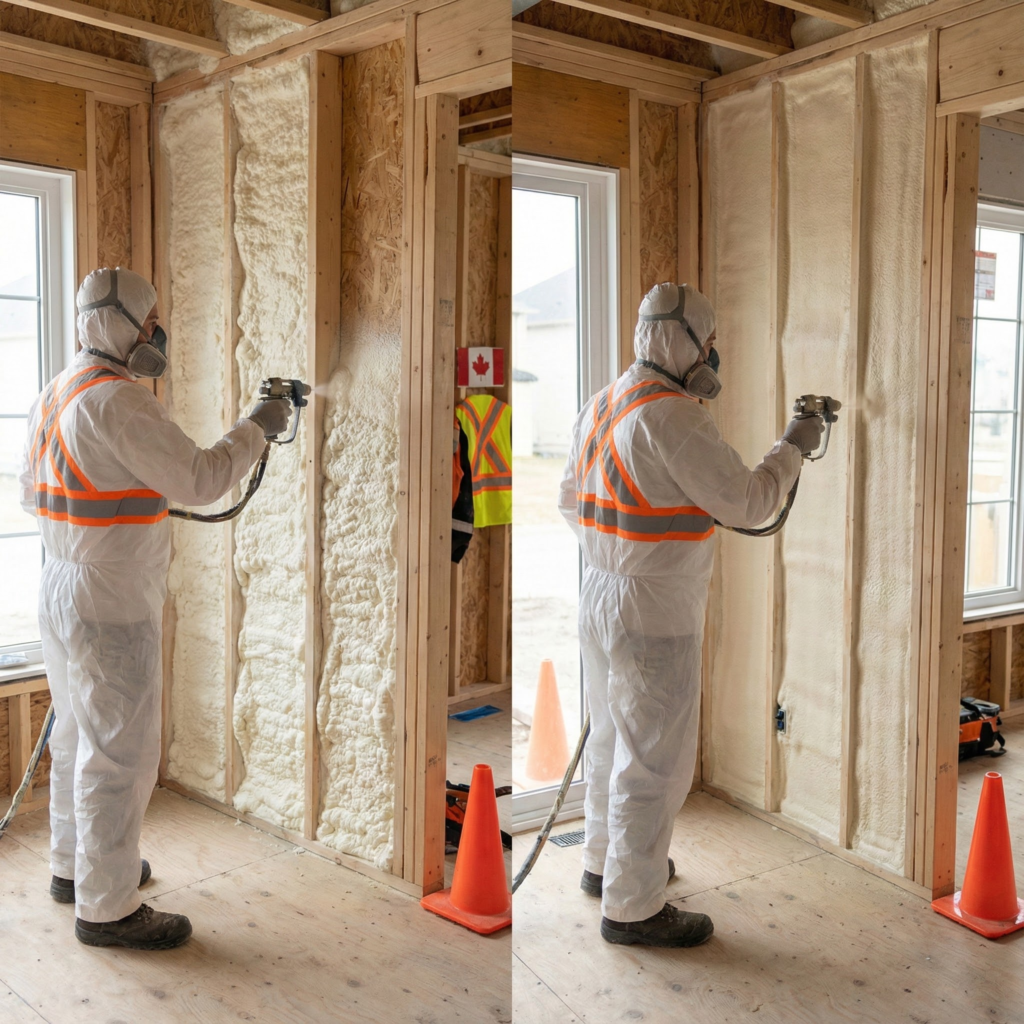
Open-Cell vs Closed-Cell Spray Foam
While blown-in insulation is effective for attics and retrofit applications, some projects may benefit from alternative solutions depending on air-sealing, moisture control, and structural requirements. In certain cases, blown-in insulation is used alongside spray foam insulation to address specific performance needs.
Open-Cell Spray Foam
Open-cell spray foam is a lighter, more flexible insulation that expands to fill wall cavities and irregular spaces. It provides excellent air sealing and sound reduction, making it a popular choice for interior walls, attics, and residential applications where breathability is important.
- Expands easily into wall cavities
- Excellent air sealing and sound reduction
- More flexible and breathable material
- Commonly used in attics and interior walls
Closed-Cell Spray Foam
Closed-cell spray foam is a dense, rigid insulation with a higher R-value per inch. It adds structural strength, resists moisture, and creates a strong vapour barrier, making it ideal for basements, crawl spaces, rim joists, and commercial or industrial buildings.
- Higher R-value per inch
- Acts as a moisture and vapour barrier
- Adds strength to walls and structures
- Ideal for basements, rim joists, and commercial buildings

Where We Install Spray Foam Insulation
Blown-in insulation is commonly installed in attics and enclosed wall cavities, and may be used as part of a broader insulation strategy depending on the structure and access points of the property.
Ideal for reducing heat loss, improving comfort, and increasing energy efficiency in homes.
Helps control moisture, air leaks, and temperature fluctuations in below-grade spaces.
Seals one of the most common sources of air leakage in residential homes.
Improves comfort and insulation performance in attached garages and home additions.
Designed for offices, retail spaces, warehouses, and commercial buildings.
Custom spray foam solutions for specialized and industrial insulation needs.
Spray Foam Insulation Pricing Factors
Blown-in insulation pricing depends on several factors including the size of the space, insulation depth required, accessibility, and existing insulation conditions. Each project is assessed individually to determine the appropriate coverage and material requirements.
- Area being insulated (attic, basement, rim joist, garage, or commercial space)
- Total square footage of the project
- Type of spray foam used (open-cell or closed-cell)
- Accessibility and condition of the space
- Residential vs commercial application
As a general reference, spray foam insulation projects in Toronto and across Ontario typically range from a few thousand dollars for smaller residential areas to higher costs for larger homes or commercial buildings. Final pricing depends on site conditions, insulation type, and project scope, which is why we provide custom estimates after an on-site assessment.
Spray Foam Insulation FAQs
How much does spray foam insulation cost per square foot in Toronto?
Most quotes depend on foam type, thickness, and access. As a general Toronto reference, professional installation is often cited in the range of about $1.50 to $4.90 per sq ft (varies by project and specs). The fastest way to get an accurate number is an on-site assessment.
How much does it cost to spray foam 1000 sq ft in Toronto / GTA?
For a 1,000 sq ft project in the Toronto area, you’ll commonly see totals in the $2,500 to $6,000 range depending on thickness, open vs closed-cell, and prep work. Exact pricing changes based on how many inches you need and what surfaces are being sprayed.
How much does it cost to spray foam a 24x24 garage?
A 24’ x 24’ (2-car) garage is commonly estimated around $3,000 to $8,000, with many examples citing an average near $6,000 when walls + ceiling + labor are included. Final cost depends on whether it’s attached, the coverage areas, and required R-value.
How much does 2 inches of spray foam cost?
Spray foam is often priced by the board foot (1 sq ft × 1 inch thick). At 2 inches, you’re using 2 board feet per sq ft. Published Canadian ranges often show roughly $0.50–$1.00/board foot (open-cell) and $1.25–$1.65/board foot (closed-cell) as reference pricing points—then installation, prep, and access affect your final installed rate.
Is open-cell or closed-cell spray foam more expensive?
Closed-cell is typically more expensive because it’s denser and delivers a higher R-value per inch. Common published references show open-cell around $0.50–$1.00/board foot and closed-cell around $1.25–$1.65/board foot, with installed project totals varying by thickness and scope.
What factors affect spray foam insulation pricing?
Pricing usually depends on:
Area type (attic, basement, rim joist, garage, commercial)
Square footage + thickness (inches / R-value)
Open-cell vs closed-cell
Access & prep work (old insulation removal, tight areas)
Residential vs commercial requirements
How thick should spray foam insulation be in Ontario?
Thickness depends on where it’s installed and target performance. Published guidance often suggests roughly 5–6 inches for open-cell or 3–4 inches for closed-cell for many Canadian climates, with adjustments based on code and building design. We confirm the right build-up during the estimate.
Are there rebates for insulation upgrades in Ontario?
Some Ontario homeowners may qualify for utility rebate programs (availability and eligibility vary). For example, Enbridge promotes home efficiency rebates that can apply to insulation/air sealing in certain cases.
Ready to Upgrade Your Insulation?
Get professional spray foam insulation installed by licensed experts serving Toronto and communities across Ontario.
Spray Foam Insulation Service Areas
Spray Foam Kings proudly serves Toronto, the GTA, and surrounding communities across Ontario. If you don’t see your city listed below, contact us to confirm availability.
- Toronto
- Mississauga
- Brampton
- Vaughan
- Markham
- Richmond Hill
- Oakville
- Milton
- Scarborough
- North York
Get a Blown In Insulation Estimate
Serving Toronto, the GTA, and communities across Ontario. Fast quotes. Licensed professionals. No obligation.
How Your Estimate Is Calculated
The cost of a blown‑in insulation project depends primarily on the total square footage of the area to be insulated and the depth of material required to meet Ontario Building Code performance standards. During our on‑site assessment we measure the accessible surface area (for example, the floor of an attic) and determine the required coverage depth based on the existing insulation level and the desired R‑value.
- Square footage – Larger areas require more insulation material and more time to install, which raises the labour component of the quote.
- Coverage depth – Deeper fills use more cellulose or fiberglass, increasing material costs.
- Access and obstacles – Limited access points, extensive framing, or many obstructions can add a modest labour surcharge.
After gathering these details we provide a free, written, itemised quote before any work begins. The quote lists material quantity, labour hours, and any additional services such as old‑insulation removal.
—
Do We Need to Remove Existing Insulation?
Whether the existing insulation must be removed depends on its type, condition, and the amount of additional coverage you need.
- Fiberglass or cellulose in good condition – If the current material is evenly distributed and not compressed, we can often top‑up the existing fill to reach the required depth. This avoids the extra labour and disposal cost of removal.
- Damaged, wet, or vermiculite insulation – Materials that are water‑logged, mould‑infested, or contain vermiculite must be removed first. Vermiculite requires licensed abatement before any new insulation is installed.
Our standard removal service for typical fiberglass or cellulose costs approximately $400–$800 for 1,200 sq ft, varying with depth and access difficulty. The removal cost is included as a separate line item in the quote, so you can see the impact on the overall price.
—
What Information We Need From You
To provide the most accurate quote, please be prepared to share the following details when you request an estimate:
- Location of the work – attic floor, wall cavities, or both.
- Approximate square footage of the area to be insulated.
- Current insulation type (fiberglass, cellulose, spray foam, etc.) and its estimated depth or R‑value, if known.
- Condition of existing insulation – any signs of moisture, mould, or vermiculite.
- Access considerations – number and size of attic hatch or wall openings.
If you are unsure about any of these points, our technician will measure and assess the space during the on‑site visit and adjust the quote accordingly.
—
Energy‑Rebate Opportunities
Spray Foam Kings is an Enbridge HER+ registered partner and can help you apply for rebates of up to $10,600. We also assist with eligibility for the Canada Greener Homes program.
- Eligibility – Most residential projects that meet Ontario Building Code requirements qualify, but the exact rebate amount depends on the total insulation improvement and the type of material used.
- Paperwork – Our team prepares and submits the required documentation on your behalf, reducing the administrative burden on you.
- Impact on price – The rebate is applied after the work is completed and the final invoice is issued; it does not affect the quoted price but can significantly reduce your out‑of‑pocket cost.
If you would like to explore rebate options, let us know during the quote request so we can include a preliminary rebate estimate.
—
Attic vs. Wall Applications
Blown‑in insulation is suitable for both attic floors and enclosed wall cavities.
- Attic floors – The material is blown through a hose placed in a central access point and spreads evenly across the attic surface, filling gaps around joists and wiring.
- Wall cavities – Small drilled holes are made in the interior wall surface; the insulation is then pumped into the cavity, filling the space around studs and any obstacles.
Both applications meet Ontario Building Code requirements for thermal performance when the proper depth is achieved. If you are considering insulation for exterior walls, we will verify that the cavity is closed and suitable for loose‑fill material; otherwise, we may recommend spray‑foam solutions for better air sealing.