
Attic Insulation in Toronto & Ontario
Improve your home’s comfort and energy efficiency with professional attic insulation services designed for Toronto’s climate. Proper attic insulation helps reduce heat loss, prevent ice damming, and lower energy costs by keeping indoor temperatures consistent year-round. Below is our full guide on : attic insulation Toronto
- Helps reduce heat loss and lower heating and cooling costs
- Improves indoor comfort during Toronto’s cold winters and hot summers
- Reduces drafts and uneven temperatures throughout the home
- Suitable for upgrades, retrofits, and older attic spaces
- Installed by licensed professionals serving Toronto and Ontario
Serving Toronto, the GTA, and surrounding Ontario communities.

Code-Compliant Attic Insulation in Ontario
Attic insulation plays a critical role in meeting energy efficiency and building performance standards for homes across Ontario. Our attic insulation installations are completed in accordance with applicable Ontario Building Code requirements and manufacturer guidelines to help ensure proper thermal performance, ventilation compatibility, and long-term durability.
Whether upgrading insulation in an older home or improving performance during a renovation, we assess attic conditions carefully to ensure insulation levels, coverage, and air sealing support both comfort and compliance.
Why Choose Attic Insulation in Toronto?
In Toronto’s climate, heat loss through the attic is one of the most common causes of high energy bills and uneven indoor temperatures. Proper attic insulation helps keep warm air inside during winter, reduces heat buildup in summer, and improves overall comfort throughout the home.
Upgrading attic insulation is one of the most effective ways to improve energy efficiency, especially in older homes with insufficient or deteriorated insulation.
- Helps lower heating and cooling costs year-round
- Improves comfort by reducing drafts and temperature swings
- Supports better indoor air quality and moisture control
- Ideal for older homes with under-insulated attics
- Installed efficiently with minimal disruption

How Attic Insulation Works
Attic insulation works by slowing heat transfer between your home and the outside environment. Properly installed attic insulation helps keep warm air inside during winter and limits heat buildup during summer, improving comfort and energy efficiency throughout the home. In many homes, attic insulation upgrades are completed alongside air sealing improvements to address common heat-loss areas and improve overall building performance.
1. Attic Inspection & Assessment
We begin by evaluating existing insulation levels, attic access, ventilation, and common air leakage points to determine the most effective insulation approach.
2. Preparation & Air Sealing
Before installing insulation, key gaps and penetrations are addressed to help reduce drafts and improve insulation performance. In some cases, this work is coordinated with spray foam insulation services for targeted air sealing.
3. Insulation Installation
Insulation is installed evenly across the attic floor or roofline to achieve consistent coverage and proper thermal resistance.
4. Final Check
Once installation is complete, insulation levels and coverage are reviewed to ensure performance goals are met.
Ready to Upgrade Your Insulation?
Get professional attic insulation services installed by licensed experts serving Toronto and communities across Ontario.
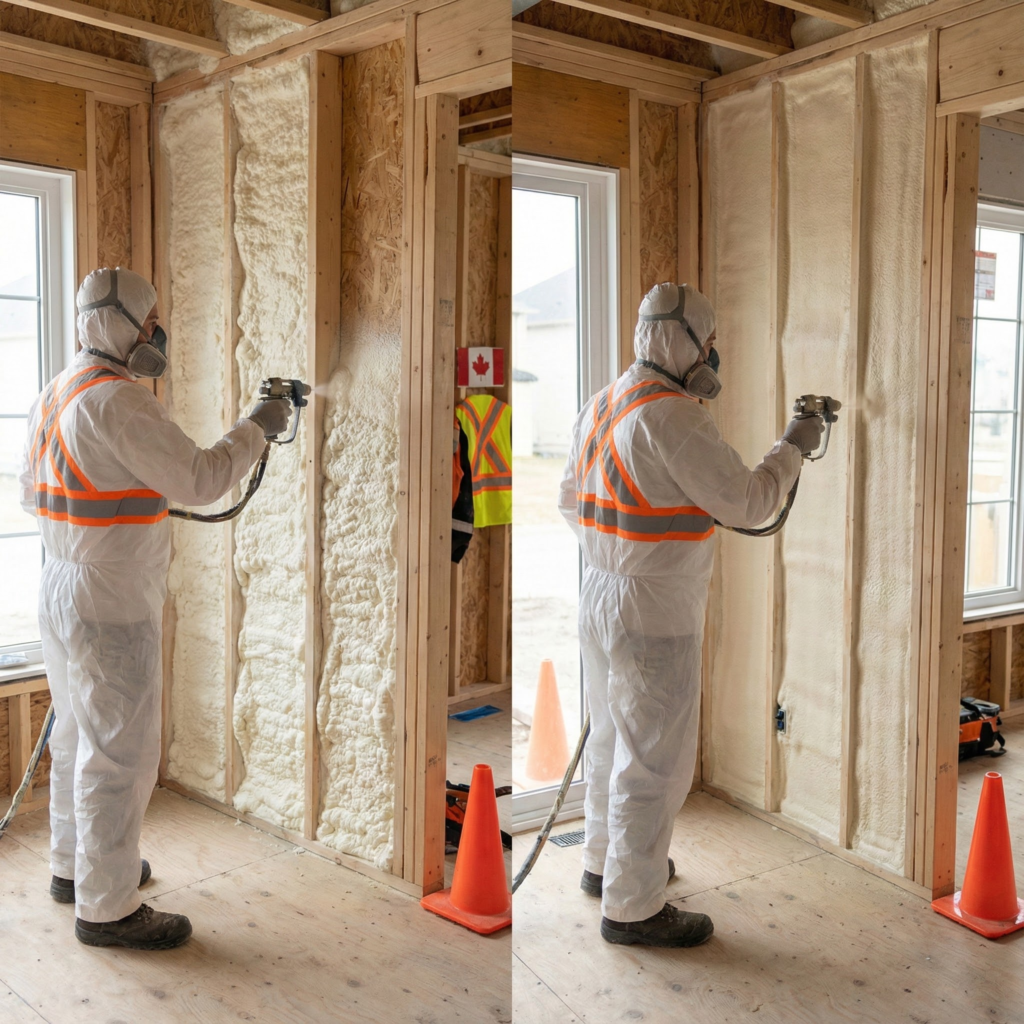
Open-Cell vs Closed-Cell Spray Foam
While attic insulation can be installed using different materials, spray foam is commonly used in attics where air sealing and moisture control are important performance considerations.
Open-Cell Spray Foam
Open-cell spray foam is a lighter, more flexible insulation that expands to fill wall cavities and irregular spaces. It provides excellent air sealing and sound reduction, making it a popular choice for interior walls, attics, and residential applications where breathability is important.
- Expands easily into wall cavities
- Excellent air sealing and sound reduction
- More flexible and breathable material
- Commonly used in attics and interior walls
Closed-Cell Spray Foam
Closed-cell spray foam is a dense, rigid insulation with a higher R-value per inch. It adds structural strength, resists moisture, and creates a strong vapour barrier, making it ideal for basements, crawl spaces, rim joists, and commercial or industrial buildings.
- Higher R-value per inch
- Acts as a moisture and vapour barrier
- Adds strength to walls and structures
- Ideal for basements, rim joists, and commercial buildings

Where We Install Spray Foam Insulation
In attic insulation projects, spray foam is commonly installed along attic floors, rooflines, and hard-to-seal areas to help improve energy efficiency and reduce air leakage.
Ideal for reducing heat loss, improving comfort, and increasing energy efficiency in homes.
Helps control moisture, air leaks, and temperature fluctuations in below-grade spaces.
Seals one of the most common sources of air leakage in residential homes.
Improves comfort and insulation performance in attached garages and home additions.
Designed for offices, retail spaces, warehouses, and commercial buildings.
Custom spray foam solutions for specialized and industrial insulation needs.
Spray Foam Insulation Pricing Factors
Attic insulation pricing depends on factors such as attic size, existing insulation levels, access conditions, and the type of insulation required to achieve proper thermal performance.
Spray foam insulation pricing can vary depending on the scope of the project and the conditions of the space. Rather than using flat pricing, we assess each job individually to ensure accurate estimates and long-term performance.
- Area being insulated (attic, basement, rim joist, garage, or commercial space)
- Total square footage of the project
- Type of spray foam used (open-cell or closed-cell)
- Accessibility and condition of the space
- Residential vs commercial application
As a general reference, spray foam insulation projects in Toronto and across Ontario typically range from a few thousand dollars for smaller residential areas to higher costs for larger homes or commercial buildings. Final pricing depends on site conditions, insulation type, and project scope, which is why we provide custom estimates after an on-site assessment.
Spray Foam Insulation FAQs
How do I know if my attic needs more insulation?
Common signs include high energy bills, uneven temperatures between floors, drafts, and ice buildup on the roof during winter. Older homes in Toronto often have insufficient attic insulation by today’s standards..
Can attic insulation be added over existing insulation?
In many cases, yes. Existing insulation is assessed to ensure it is dry, clean, and suitable to remain in place before adding new insulation to improve overall performance.
How much does spray foam insulation cost per square foot in Toronto?
Most quotes depend on foam type, thickness, and access. As a general Toronto reference, professional installation is often cited in the range of about $1.50 to $4.90 per sq ft (varies by project and specs). The fastest way to get an accurate number is an on-site assessment.
How much does it cost to spray foam 1000 sq ft in Toronto / GTA?
For a 1,000 sq ft project in the Toronto area, you’ll commonly see totals in the $2,500 to $6,000 range depending on thickness, open vs closed-cell, and prep work. Exact pricing changes based on how many inches you need and what surfaces are being sprayed.
How much does it cost to spray foam a 24x24 garage?
A 24’ x 24’ (2-car) garage is commonly estimated around $3,000 to $8,000, with many examples citing an average near $6,000 when walls + ceiling + labor are included. Final cost depends on whether it’s attached, the coverage areas, and required R-value.
How much does 2 inches of spray foam cost?
Spray foam is often priced by the board foot (1 sq ft × 1 inch thick). At 2 inches, you’re using 2 board feet per sq ft. Published Canadian ranges often show roughly $0.50–$1.00/board foot (open-cell) and $1.25–$1.65/board foot (closed-cell) as reference pricing points—then installation, prep, and access affect your final installed rate.
Is open-cell or closed-cell spray foam more expensive?
Closed-cell is typically more expensive because it’s denser and delivers a higher R-value per inch. Common published references show open-cell around $0.50–$1.00/board foot and closed-cell around $1.25–$1.65/board foot, with installed project totals varying by thickness and scope.
What factors affect spray foam insulation pricing?
Pricing usually depends on:
Area type (attic, basement, rim joist, garage, commercial)
Square footage + thickness (inches / R-value)
Open-cell vs closed-cell
Access & prep work (old insulation removal, tight areas)
Residential vs commercial requirements
How thick should spray foam insulation be in Ontario?
Thickness depends on where it’s installed and target performance. Published guidance often suggests roughly 5–6 inches for open-cell or 3–4 inches for closed-cell for many Canadian climates, with adjustments based on code and building design. We confirm the right build-up during the estimate.
Are there rebates for insulation upgrades in Ontario?
Some Ontario homeowners may qualify for utility rebate programs (availability and eligibility vary). For example, Enbridge promotes home efficiency rebates that can apply to insulation/air sealing in certain cases.
Ready to Upgrade Your Insulation?
Get professional spray foam insulation installed by licensed experts serving Toronto and communities across Ontario.
Attic Foam Insulation Service Areas
Attic insulation services are available for homes throughout Toronto, the GTA, and surrounding areas across Ontario.
- Toronto
- Mississauga
- Brampton
- Vaughan
- Markham
- Richmond Hill
- Oakville
- Milton
- Scarborough
- North York
Get a Free Spray Foam Insulation Estimate
Serving Toronto, the GTA, and communities across Ontario. Fast quotes. Licensed professionals. No obligation.
What Does Attic Insulation Removal Involve?
The removal process begins with a visual inspection to identify the type of existing material—fiberglass, cellulose, or other. Technicians then carefully extract the insulation, taking care to protect the roof deck and any finished surfaces. The material is bagged and taken off‑site for proper disposal in accordance with local regulations. If the attic contains vermiculite, we will flag the need for a licensed abatement service before any removal proceeds. Once the old insulation is cleared, the space is prepared for the new spray‑foam application, which may include sealing gaps, repairing damaged framing, and checking ventilation pathways. The entire removal and preparation phase typically takes 4–6 hours for a standard 1,200 sq ft attic, depending on access and depth of the existing insulation.
How Is the Cost Determined?
Pricing for attic insulation removal is based on several measurable factors:
- Attic size – larger square‑footage requires more labour and disposal capacity.
- Depth and type of existing insulation – thicker layers or dense cellulose can increase removal time.
- Access conditions – limited entry points, low headroom, or obstructed joists add labour.
- Special handling – presence of vermiculite or other hazardous material triggers additional licensing and safety steps.
Our published range for a typical 1,200 sq ft attic is $400 – $800, reflecting variations in the items above. For attics that differ significantly in size or present access challenges, the estimate will be adjusted accordingly.
Next Steps: From Quote to Installation
- Free, written quote – Contact us by phone or email for a no‑obligation, itemised estimate. The quote outlines removal costs, any required abatement, and the price of the chosen spray‑foam system (open‑cell or closed‑cell).
- On‑site assessment – A technician visits the property to verify attic dimensions, inspect existing insulation, and discuss ventilation and air‑sealing needs.
- Scheduling – Once you approve the quote, we arrange a convenient date for removal and subsequent foam installation.
- Re‑occupancy – After removal, the attic can be re‑entered within 24 hours with adequate ventilation. The full spray‑foam installation typically requires an additional 24–48 hours before the space is ready for normal use.
Our team carries $5 million in commercial general liability insurance and all crew members are WSIB‑covered, ensuring a safe and professional experience from start to finish.
Frequently Asked Questions About Attic Insulation Removal
How long will the removal take? A standard 1,200 sq ft attic usually requires 4–6 hours of labour. Larger or more complex spaces may take longer.
Do I need to be home during the work? Homeowners are not required to stay on‑site, but we recommend being available for any questions about access or ventilation.
Will the removal affect my HVAC system? We seal any penetrations discovered during removal, which can actually improve the overall performance of your heating and cooling system.
What if my attic contains vermiculite? Vermiculite is a hazardous material that must be handled by a licensed abatement contractor. We will identify its presence and coordinate the necessary steps before proceeding.
Can you remove both fiberglass and cellulose? Yes, our crew is trained to safely remove both common types of attic insulation.
Is there any cleanup after removal? All extracted material is bagged and removed from the property. The work area is left clean and ready for the next phase of insulation.
Estimating Your Project by Attic Square Footage
The size of your attic is the primary factor in calculating an estimate. Spray Foam Kings charges per square foot of installed foam:
- Open‑cell spray foam: $1.50 – $3.50 / sq ft (R‑3.7 per inch)
- Closed‑cell spray foam: $2.50 – $5.00 / sq ft (R‑6 per inch)
For example, a 1,200 sq ft attic insulated with open‑cell foam to an R‑20 level would typically fall between $2,800 – $4,200 CAD. Closed‑cell foam for the same area and R‑value would be roughly $6,000 – $8,400 CAD.
—
How Home Age and Existing Insulation Influence Scope
Older homes often contain fiberglass, cellulose, or vermiculite insulation. The condition and type of the existing material affect both preparation work and cost:
- Standard removal of fiberglass or cellulose is typically $400 – $800 CAD for a 1,200 sq ft attic, depending on depth and access.
- Vermiculite must be handled by a licensed abatement contractor before any new foam can be applied.
If the current insulation is compressed, wet, or contaminated, additional air‑sealing or moisture‑control measures may be required to meet the Ontario Building Code’s performance standards. Knowing the age of your home helps us anticipate these steps and provide a more accurate quote.
—
If You Have Received a Removal Order – What to Do
A removal order (for example, related to asbestos, vermiculite, or other hazardous material) is issued by a municipal or provincial authority. The general steps to address it are:
- Contact the issuing authority promptly to confirm the reason for the order and any deadlines.
- Gather documentation that shows compliance, such as inspection reports, material test results, or a qualified abatement plan.
- Request a review or appeal in writing, providing the supporting documents.
- Engage a licensed abatement professional if the order involves hazardous material; they can submit a remediation plan that satisfies the authority.
—
Common Attic Issues and Their Impact on the Job
| Issue | What it means for your project | Typical additional steps |
|---|---|---|
| Ice dams | Indicates heat is escaping into the attic and melting roof snow. | Increase R‑value, improve air sealing, and ensure proper ventilation. |
| High heating/cooling bills | Often a sign of insufficient or uneven insulation. | Verify current R‑value, fill gaps, and consider closed‑cell foam for higher R‑per‑inch. |
| Drafts or uneven temperatures | May be caused by gaps around joists, wiring, or recessed lights. | Perform targeted air‑sealing before foam application. |
| Mould or moisture | Suggests inadequate vapour control. | Closed‑cell foam can act as a Class‑II vapour retarder; additional moisture‑management measures may be required. |
Identifying these symptoms during the initial inspection helps us tailor the insulation system to address the root cause, which can affect both the scope of work and the final cost.
—
DIY vs. Hiring a Professional Contractor
| Consideration | DIY Approach | Professional Installation |
|---|---|---|
| Cost | Material cost only; no labour. | Labour included; rates are per sq ft (see pricing above). |
| Safety & Insurance | Must manage personal safety and liability. | Crew is WSIB‑covered, insured for $5 million, and holds CUFCA, NFCA, CAFCO 300 & ISOLATEK certifications. |
| Warranty | No manufacturer or workmanship warranty. | 25‑30 year material lifespan plus a workmanship warranty covering delamination, shrinkage, or adhesion failures. |
| Quality of Air‑Sealing | May miss hidden gaps or penetrations. | Professional air‑sealing is integrated before foam application for optimal performance. |
For most Toronto homeowners, hiring a certified contractor provides peace of mind, ensures code compliance, and includes a warranty that protects the investment.
—
Why Knowing Your Current Insulation Level Matters
Before we can give an accurate, itemised quote, we need to know how much insulation is already in place and its condition. This information allows us to:
- Determine whether removal is necessary and estimate that cost.
- Calculate the additional R‑value required to meet your target performance.
- Identify any moisture or mould concerns that may need remediation.
If you are unsure of your existing insulation, a quick visual inspection (looking at depth on joists or the type of material visible) can provide a rough idea. Our team will also perform a detailed assessment during the on‑site visit.
—
Common Signs Your Attic May Need Attention
- High heating or cooling bills – If your energy costs have risen without a change in usage, heat loss through the attic is a frequent cause in Toronto’s climate.
- Ice damming on the roof – Moisture that reaches the roof deck and refreezes can indicate insufficient insulation or air‑sealing.
- Visible mould or musty odour – Moisture that condenses on cold attic surfaces can promote mould growth, especially when insulation is old or damaged.
- Drafts or uneven temperatures – Noticeable cold spots near the ceiling or a feeling of heat rising quickly into the attic are typical signs of inadequate insulation.
These observations help us decide whether an inspection, removal of old material, or a full spray‑foam upgrade is appropriate.
—
Assessing Your Existing Insulation
- Measure the attic floor area – A quick visual estimate of square footage (e.g., “around 1,200 sq ft”) lets us prepare a rough cost range.
- Identify the insulation type and depth – Fiberglass batts, cellulose, or older vermiculite each have different performance levels and removal requirements.
- Check the age of the home – Homes built before the 1990s often have lower‑R insulation or gaps that no longer meet the Ontario Building Code.
During our free, written quote we document these findings and recommend either removal, retrofit, or a full spray‑foam installation. If vermiculite is present, we flag the need for licensed asbestos‑abatement before any spray‑foam work begins.
—
Cost Overview for Attic Insulation in Toronto
| Item | Typical Range (per 1,200 sq ft) | What’s Included |
|---|---|---|
| Open‑cell spray foam (R‑20) | $2,800 – $4,200 CAD | Foam, air‑sealing, cleanup |
| Closed‑cell spray foam (R‑20) | $6,000 – $8,400 CAD | Foam, vapour‑retarder, cleanup |
| Removal of existing fiberglass or cellulose | $400 – $800 CAD | Disposal, site preparation |
| Vermiculite (requires abatement) | *Not quoted – licensed abatement first* | Separate licensed contractor |
These figures are based on our standard pricing for open‑cell and closed‑cell spray foam, and for removal of common attic insulation types (Company Facts). Actual costs depend on attic size, access difficulty, and the condition of existing material. All projects receive a free, itemised written quote before any work begins.
—
Choosing the Right Insulation for Your Attic
- Open‑cell spray foam – Provides R‑3.7 per inch, excellent air‑sealing, and is breathable. It is well‑suited for attic floors where a separate vapour barrier is not required by code.
- Closed‑cell spray foam – Offers R‑6 per inch and acts as a class‑II vapour retarder when applied at 2 inches or more (Ontario Building Code). Choose this when you need superior moisture control, added structural strength, or when the attic space is prone to condensation.
- Fiberglass or cellulose (blown‑in) – May be appropriate for a cost‑effective retrofit, but they do not seal air leaks and can settle over time, reducing effective R‑value.
Our crew, all CUFCA‑trained and NFCA‑certified, can advise which product best matches your attic’s condition, your budget, and any local code requirements (Company Facts, Current Page).
—
FAQ – Removal Orders, DIY vs. Contractor, and Project Details
Q: How can I stop a municipal removal order for old insulation? A: The first step is to confirm the order’s basis (e.g., presence of vermiculite or asbestos). Engage a licensed abatement contractor to address the hazardous material, then submit the abatement completion report to the issuing authority. Our assessment will identify any hazardous insulation and advise you on the required steps.
Q: Should I attempt a DIY insulation upgrade? A: DIY kits are available for loose‑fill fiberglass or cellulose, but they do not provide the air‑sealing benefits of spray foam and may not meet Ontario Building Code requirements for vapour control. Professional installation ensures proper thickness, uniform coverage, and compliance with code and warranty conditions (Company Facts).
Q: What information do I need to provide for an accurate quote? A. Approximate attic square footage (e.g., 1,200 sq ft) B. Current insulation type and depth (visible batts, blown‑in, etc.) C. Approximate age of the home or last insulation upgrade D. Any known issues such as ice dams, mould, or vermiculite
Q: How long does an attic spray‑foam job take? A: A typical 1,200 sq ft open‑cell installation is completed in 4–6 hours on‑site, including preparation, spraying, and cleanup (Company Facts).
Q: When can I re‑occupy the space? A: Standard re‑occupancy is after 24 hours of ventilation; for whole‑home projects we recommend 24–48 hours (Company Facts).
Q: Are rebates available? A: Yes. As an Enbridge HER+ partner, we can help you apply for rebates up to $10,600, and we also handle paperwork for the Canada Greener Homes program (Company Facts).
—
Ready to assess your attic? Call us at 647‑641‑6881 or email info@sprayfoamkings.ca for a free, written estimate. Our insured, WSIB‑covered crew will walk you through the inspection, removal (if needed), and spray‑foam options that fit your home’s needs.
—