
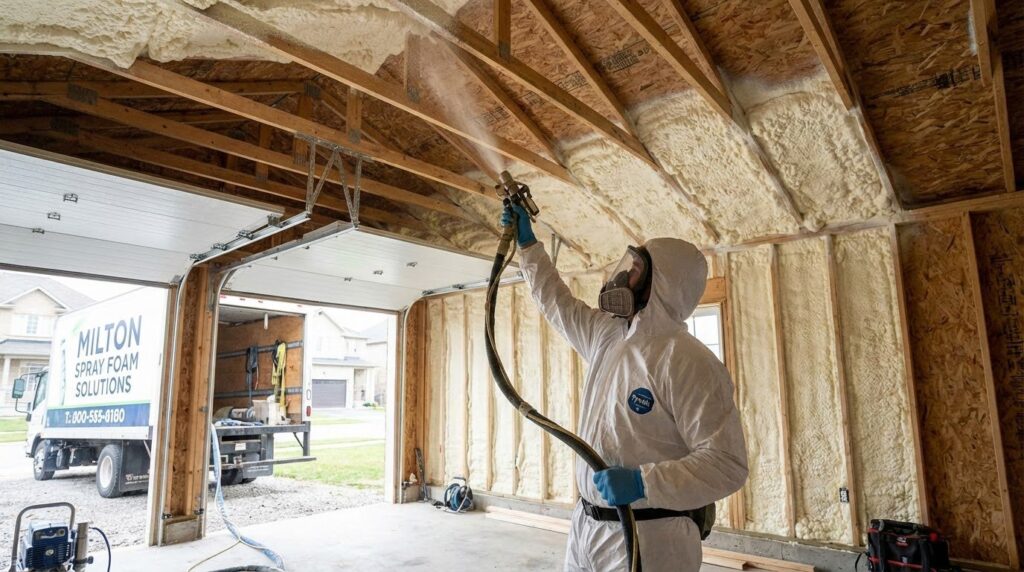
Spray foam insulation for garage ceilings and walls in Milton, Ontario provides R-20 to R-40 thermal resistance with complete air sealing. Professional installation costs $2.50-$4.50 per square foot for closed-cell foam, delivering 30-50% energy savings when garages are attached to heated spaces. Milton’s climate zone 6 requires minimum R-20 ceiling insulation for conditioned garages under Ontario Building Code requirements.
How Much Does Spray Foam Insulation Cost for Garage Ceilings and Walls in Milton?
Garage spray foam insulation costs in Milton range from $2,500 to $6,500 for a standard two-car garage (24×24 feet). Closed-cell spray foam averages $3.25 per square foot, while open-cell foam costs $2.75 per square foot installed. Ceiling insulation alone runs $800-$1,200, with walls adding $1,700-$2,800 depending on height and complexity.
Cost factors include garage size, wall height, existing conditions, and foam type selection. Detailed spray foam pricing guides show that Milton homeowners typically invest $4,200 for complete garage insulation including ceiling and walls.
Professional installation ensures proper thickness application – 2 inches for R-12 open-cell or 3 inches for R-20 closed-cell performance. DIY attempts often result in uneven coverage and poor adhesion, requiring costly professional remediation.
Which Type of Spray Foam Works Best for Milton Garage Insulation?
Closed-cell spray foam delivers superior performance for Milton garage applications, providing R-6.5 per inch thermal resistance plus moisture barrier properties. This foam type prevents condensation issues common in unheated garages during Ontario’s freeze-thaw cycles.
Open-cell spray foam at R-3.6 per inch works for heated garage spaces or when vapor permeability is desired. However, closed-cell foam’s structural strength and air sealing capabilities make it the preferred choice for most Milton garage projects.
Comparing open-cell versus closed-cell options reveals that closed-cell foam prevents ice dam formation and reduces heat loss to unheated garage spaces by 85% compared to traditional fiberglass insulation.
For fire-rated applications or commercial garages, specialized fireproofing spray foams meet Ontario Building Code requirements for flame spread and smoke development ratings.
What Energy Savings Does Garage Spray Foam Insulation Provide in Ontario?
Properly insulated garage ceilings and walls reduce heating costs by 25-40% for rooms above attached garages. Milton homeowners save $300-$600 annually on heating bills when garage insulation prevents cold air infiltration into living spaces.
Spray foam’s air sealing properties eliminate thermal bridging through garage walls, maintaining consistent temperatures in adjacent heated areas. This reduces furnace runtime and extends HVAC system lifespan by reducing thermal stress.
Temperature monitoring shows insulated garages maintain 10-15°C warmer temperatures than uninsulated spaces during Milton’s winter months. This protection prevents freeze damage to stored items and improves vehicle battery performance in cold weather.
Home value increases from garage insulation typically return 70-85% of installation costs at resale, making spray foam a sound investment for Milton property owners.
How Long Does Spray Foam Garage Insulation Last in Ontario Climate?
Professional spray foam insulation maintains performance for 30-50 years in garage applications when properly installed. Ontario’s temperature fluctuations and humidity changes don’t degrade quality foam materials, unlike traditional insulation that settles and loses R-value over time.
Closed-cell spray foam resists moisture absorption and prevents mold growth, crucial for garage environments where temperature differentials create condensation risks. The foam’s chemical bond to substrates remains intact through thousands of freeze-thaw cycles typical in Milton’s climate.
Regular inspection after 10-15 years identifies any minor repairs needed, typically costing less than $200 for touch-up applications. Long-term performance studies confirm spray foam’s durability advantage over fiberglass and other insulation materials.
Warranty coverage from professional installers protects against premature failure, with most reputable contractors offering 10-year performance guarantees on garage insulation projects.
What Building Code Requirements Apply to Garage Insulation in Milton Ontario?
Ontario Building Code requires R-20 minimum ceiling insulation for heated garage spaces, with R-12 minimum for walls adjacent to conditioned areas. Unheated garages attached to homes need insulated separation walls meeting R-12 thermal resistance standards.
Fire separation requirements mandate specific foam types and installation methods for garage applications. Spray foam must meet flame spread index below 25 and smoke development below 450 when exposed surfaces exceed code limitations.
Vapor barrier installation follows Ontario’s climate zone requirements, with closed-cell spray foam serving as combined insulation and vapor barrier when applied at sufficient thickness. Building permits may be required for extensive garage insulation projects in Milton.
Professional contractors ensure compliance with local building codes and obtain necessary permits. Building code compliance guides detail specific requirements for residential garage insulation projects across Ontario.
Frequently Asked Questions
Can I insulate my garage ceiling without insulating the walls?
Yes, ceiling-only insulation provides significant benefits for rooms above attached garages. However, wall insulation adds 20-30% more energy savings by eliminating thermal bridging through the garage structure.
Will spray foam insulation make my garage too warm in summer?
Properly ventilated insulated garages stay cooler in summer by preventing hot air infiltration and radiant heat gain through the roof. Spray foam’s air sealing properties improve garage door opener efficiency and reduce dust infiltration.
How thick should spray foam be on garage ceilings?
Closed-cell spray foam requires 3-4 inches thickness for R-20 performance meeting Ontario Building Code. Open-cell foam needs 5-6 inches for equivalent thermal resistance in garage ceiling applications.
Does garage insulation prevent ice dams on the roof above?
Yes, properly insulated garage ceilings prevent warm air from melting snow on roof sections above the garage, eliminating ice dam formation that can cause water damage and roof problems.
Professional spray foam insulation transforms garage spaces into comfortable, energy-efficient areas while protecting your home’s thermal envelope. Our experienced team ensures proper installation meeting all Ontario Building Code requirements.
Contact Spray Foam Kings for a free quote — serving Milton and all of Ontario with professional garage insulation services.