
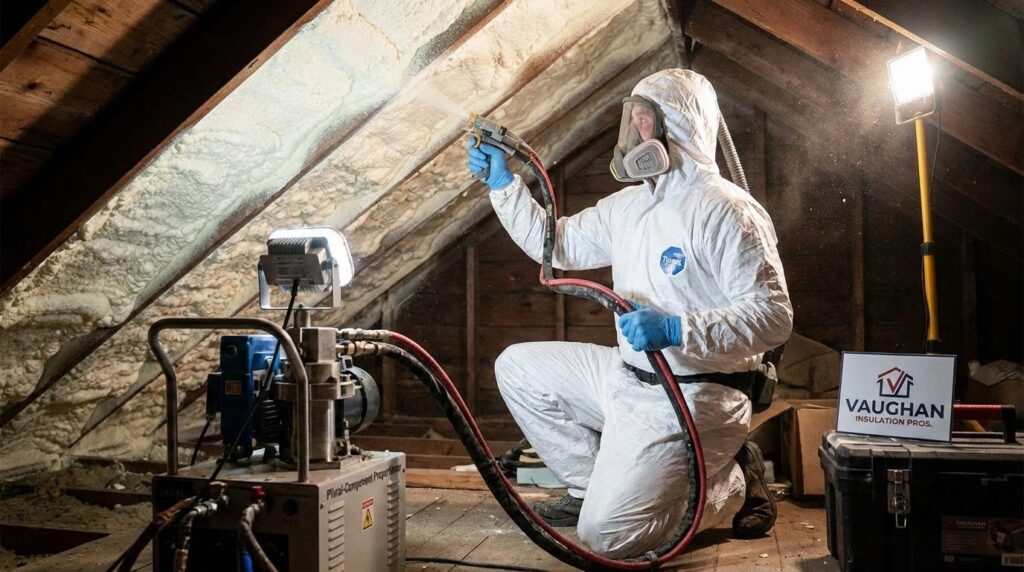
When choosing between spray foam insulation and fiberglass batts for your Vaughan home, spray foam delivers R-6.8 per inch compared to fiberglass batts at R-3.2 per inch. Closed-cell spray foam costs $2.50-$4.00 CAD per board foot in Ontario, while fiberglass batts cost $0.65-$1.20 per square foot. However, spray foam’s superior air sealing properties can reduce energy bills by 30-50% annually, making it the more cost-effective long-term solution for Canadian winters.
How Much Does Spray Foam Cost Compared to Fiberglass Batts in Ontario?
The upfront cost difference between spray foam insulation and fiberglass batts is significant, but the long-term value proposition favors spray foam. In Ontario, spray foam insulation costs range from $2.50-$4.00 CAD per board foot for closed-cell and $1.50-$2.50 for open-cell applications.
Fiberglass batts cost $0.65-$1.20 per square foot installed, making them initially cheaper. For a typical 2,000 square foot Vaughan home, fiberglass batts cost $3,500-$6,000 total, while spray foam ranges from $8,000-$15,000. However, spray foam’s energy savings of $800-$1,500 annually in heating and cooling costs means the investment pays for itself within 6-10 years.
When factoring in Ontario insulation rebates, spray foam becomes even more attractive, with potential savings of up to $5,000 on qualifying installations.
Which Insulation Type Performs Better in Canadian Winter Conditions?
Spray foam insulation significantly outperforms fiberglass batts in Canada’s harsh winter climate. Closed-cell spray foam maintains its R-6.8 per inch rating even at -40°C, while fiberglass batts lose up to 50% of their insulating value when air moves through them.
The key advantage lies in air sealing. Spray foam creates a continuous barrier that eliminates thermal bridging and air infiltration, while fiberglass batts allow air movement that reduces their effective R-value from R-3.2 to as low as R-1.5 in real-world conditions.
In Vaughan’s climate zone 6A, where winter temperatures regularly drop below -20°C, this performance difference translates to substantial energy savings. Spray foam’s winter benefits include eliminating ice dams, preventing condensation issues, and maintaining consistent indoor temperatures throughout Ontario’s six-month heating season.
Is Spray Foam Insulation Worth the Extra Cost for Long-Term Savings?
Spray foam insulation delivers superior return on investment when analyzed over its 50+ year lifespan. While fiberglass batts may need replacement every 15-25 years due to settling, moisture damage, and pest infiltration, spray foam insulation lasts the lifetime of the building without performance degradation.
The total cost of ownership analysis for a Vaughan home shows spray foam saves $25,000-$45,000 over 30 years compared to fiberglass batts. This includes energy savings, reduced HVAC maintenance, elimination of air sealing costs, and avoided replacement expenses.
Additionally, spray foam increases home value by $2,500-$5,000 in Ontario markets, while fiberglass batts add minimal resale value.
What Are the Installation Differences Between Spray Foam and Fiberglass Batts?
Professional spray foam installation requires specialized equipment and certified technicians, while fiberglass batts can be DIY-installed. However, proper spray foam application ensures complete coverage and eliminates gaps that commonly occur with batt installation.
Spray foam installation takes 1-2 days for most residential projects in Vaughan, with immediate curing and full performance within 24 hours. The process involves precise temperature and humidity control, making professional installation essential for optimal results.
Fiberglass batt installation appears simpler but achieving the rated R-value requires perfect fitting around obstacles, electrical boxes, and framing members. Studies show DIY fiberglass installations typically achieve only 60-80% of rated performance due to compression and air gaps.
For existing homes, spray foam can be applied over existing insulation, while fiberglass batt replacement requires complete removal of old materials.
Which Insulation Type Offers Better Moisture Control and Durability?
Closed-cell spray foam provides superior moisture protection with a vapor permeance of 3.5 perms per inch, effectively serving as both insulation and vapor barrier. This eliminates the need for separate vapor barriers required with fiberglass batts and prevents moisture-related problems common in Ontario basements and crawl spaces.
Fiberglass batts are hygroscopic, meaning they absorb moisture and lose insulating value. When wet, fiberglass can develop mold and mildew issues, particularly problematic in humid areas like crawl spaces throughout Ontario.
Spray foam’s closed-cell structure prevents pest infiltration and doesn’t provide nesting material for rodents or insects. Fiberglass batts are easily damaged by pests and require replacement when contaminated. In Ontario’s variable climate with frequent freeze-thaw cycles, spray foam’s durability and moisture resistance make it the superior choice for long-term building performance.
Frequently Asked Questions
Can I install fiberglass batts myself to save money compared to professional spray foam?
While fiberglass batts can be DIY-installed, proper installation requires precise fitting, vapor barriers, and air sealing to achieve rated performance. Professional spray foam installation ensures optimal R-values and air sealing that DIY fiberglass rarely achieves, making the cost difference less significant when factoring in performance.
How do R-values compare between spray foam and fiberglass in real Ontario conditions?
Closed-cell spray foam maintains R-6.8 per inch in all conditions, while fiberglass batts’ rated R-3.2 per inch drops to R-1.5-R-2.0 with air movement and moisture. In Ontario’s climate, spray foam consistently outperforms fiberglass by 200-300% in real-world applications.
Which insulation type works better for basement applications in Vaughan?
Spray foam is superior for basement insulation due to its moisture resistance and air sealing properties. Fiberglass batts in basements often develop mold issues and lose effectiveness due to Ontario’s humidity levels and potential water infiltration.
Do both insulation types meet Ontario Building Code requirements?
Both spray foam and fiberglass batts meet Ontario Building Code insulation requirements when properly installed. However, spray foam’s combined insulation and air barrier properties often exceed code requirements with a single application, while fiberglass requires additional air sealing measures to achieve code compliance.
Ready to upgrade your home’s insulation performance? Contact Spray Foam Kings for a free quote — serving Vaughan and all of Ontario with professional spray foam insulation solutions that deliver superior performance and long-term savings.