
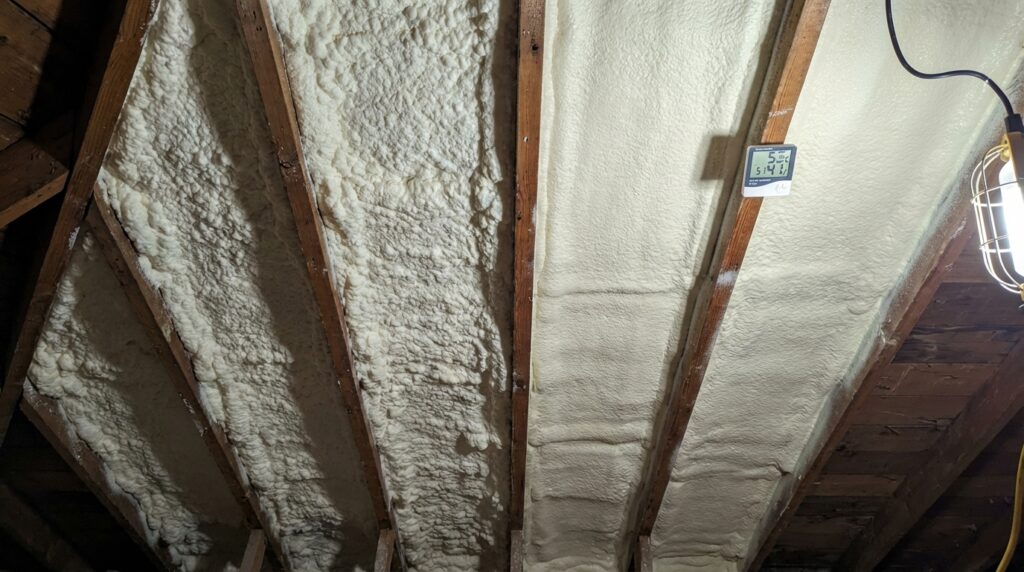
Open cell spray foam delivers R-3.5 to R-4 per inch at $0.75-$1.25 per square foot, while closed cell provides R-6 to R-7 per inch at $1.50-$2.50 per square foot in Aurora, Ontario. For most residential applications, closed cell spray foam offers superior moisture resistance and structural strength, making it the better choice for basements, crawl spaces, and exterior walls in Ontario’s climate. However, open cell excels in interior applications like attic floors where vapor permeability and sound dampening matter more than moisture resistance.
What Are the Key Differences Between Open Cell and Closed Cell Spray Foam?
Open cell spray foam has a spongy, flexible structure with interconnected air pockets, creating a density of 0.5 pounds per cubic foot. This structure allows air and moisture vapor to pass through, making it vapor permeable with a perm rating of 15-20. The foam expands significantly during application, filling cavities thoroughly and providing excellent sound absorption with a Noise Reduction Coefficient (NRC) of 0.70.
Closed cell spray foam features a rigid, dense structure with sealed cells, achieving 2 pounds per cubic foot density. This creates an impermeable barrier with a perm rating below 1.0, effectively blocking air and moisture infiltration. The foam adds structural strength to walls and provides superior insulation performance per inch of thickness.
For Aurora homeowners dealing with basement moisture issues, closed cell spray foam proves superior for basement applications due to its moisture-blocking properties and resistance to mold growth.
Which Type Offers Better Value for Aurora Ontario Homeowners?
Open cell spray foam costs $0.75-$1.25 per square foot installed in Aurora, delivering R-13 to R-15 in a 2×4 wall cavity (3.5 inches). This translates to approximately $2,625-$4,375 for insulating a 3,500 square foot home’s walls and attic.
Closed cell spray foam costs $1.50-$2.50 per square foot but provides R-21 to R-24.5 in the same 3.5-inch cavity. For the same 3,500 square foot home, expect costs of $5,250-$8,750. Despite the higher upfront investment, closed cell foam often delivers better long-term value through reduced heating costs and structural benefits.
Aurora’s average heating costs of $1,800-$2,400 annually mean closed cell foam’s superior R-value can save homeowners $400-$600 yearly compared to open cell applications. Understanding these cost differences helps homeowners make informed decisions about their insulation investment.
Where Should You Use Open Cell vs Closed Cell Spray Foam?
Open cell spray foam excels in interior applications where vapor permeability prevents moisture buildup. Use open cell for attic floors over conditioned spaces, interior partition walls requiring sound dampening, and vented crawl spaces where air circulation is desired. The foam’s expansion properties make it ideal for filling irregular cavities and around penetrations.
Closed cell spray foam is mandatory for exterior applications in Aurora’s climate. Install closed cell on exterior walls, basement foundations, unvented crawl spaces, and anywhere moisture resistance is critical. Crawl space applications particularly benefit from closed cell’s moisture-blocking properties, preventing mold and structural damage common in Ontario’s humid conditions.
For garage applications, closed cell provides better thermal performance and prevents automotive fumes from penetrating living spaces. Attic rooflines benefit from closed cell’s ability to create an unvented system, eliminating ice dam formation common in Aurora winters.
How Do Open Cell and Closed Cell Perform in Ontario’s Climate?
Ontario’s climate Zone 6A requirements demand continuous insulation strategies to handle temperature swings from -25°C winters to 30°C summers. Closed cell spray foam’s vapor impermeability prevents condensation within wall assemblies, crucial for avoiding mold growth during Ontario’s humid summers.
Open cell spray foam requires careful vapor barrier installation on the interior side in heating-dominated climates like Aurora. Without proper vapor control, warm humid interior air can condense within wall cavities during winter months, causing structural damage and mold growth.
Closed cell foam’s self-adhering properties and structural enhancement help buildings withstand Ontario’s freeze-thaw cycles and wind loads. The foam’s closed-cell structure maintains R-value performance even when subjected to temperature fluctuations, while open cell can experience slight R-value reduction in extreme cold.
Winter performance differences become apparent in heating bill reductions, with closed cell typically delivering 15-25% better energy savings in Aurora’s climate conditions.
What Are the Long-Term Performance Differences?
Closed cell spray foam maintains its R-value and structural integrity for 80+ years when properly installed, making it essentially a lifetime building component. The foam’s resistance to moisture, pests, and settling ensures consistent thermal performance throughout its service life.
Open cell spray foam provides reliable performance for 20-30 years but may experience slight settling over time, potentially creating thermal bridges. However, its vapor permeability allows moisture to escape, preventing trapped moisture issues when vapor barriers are properly installed.
Both foam types resist rodent intrusion better than traditional insulation materials. Lifespan considerations favor closed cell for basement and exterior applications where moisture exposure is likely, while open cell performs well in protected interior environments.
Professional installation by certified contractors like Spray Foam Kings ensures both foam types achieve their maximum performance potential and warranty coverage.
Frequently Asked Questions
Can you spray open cell foam over existing insulation in Aurora homes?
Yes, open cell spray foam can be applied over existing fiberglass or cellulose insulation if the existing material is dry and mold-free. However, closed cell foam requires removal of existing insulation for proper adhesion and vapor control. Professional assessment is essential to determine compatibility and building code compliance.
Which spray foam type is better for soundproofing in Aurora Ontario?
Open cell spray foam provides superior sound dampening with an NRC rating of 0.70 compared to closed cell’s 0.30 rating. For interior walls between rooms or floors requiring noise reduction, open cell delivers better acoustic performance while closed cell focuses on thermal and moisture control.
Does closed cell spray foam require vapor barriers in Ontario?
No, closed cell spray foam at 2+ inches thickness acts as its own vapor barrier with a perm rating below 1.0, meeting Ontario Building Code requirements. Open cell foam requires separate vapor barrier installation on the warm side of the assembly in heating-dominated climates.
Which foam type works better in unheated Aurora garages?
Closed cell spray foam performs better in unheated garages due to its superior R-value per inch and resistance to temperature fluctuations. The foam’s structural properties also help garage doors and framing withstand thermal cycling without losing insulation effectiveness.
Ready to choose the right spray foam insulation for your Aurora home? Contact Spray Foam Kings for a free quote — serving Aurora and all of Ontario. Our certified installers will assess your specific needs and recommend the optimal foam type for maximum energy savings and comfort.