
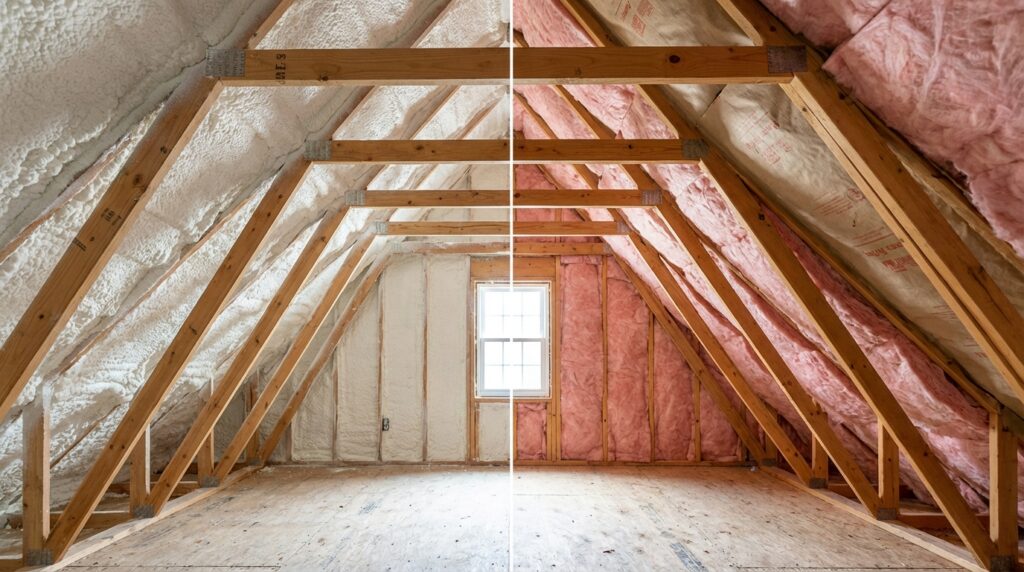
When Ontario homeowners start researching insulation upgrades, they face a critical decision: spray foam or fiberglass? As the founder of Spray Foam Kings, I’ve installed both materials across thousands of homes in Toronto, Mississauga, Brampton, and Oakville. The truth is, each has its place—but one delivers dramatically better performance for our harsh Canadian climate. Let me break down the real differences, costs, and long-term value so you can make an informed decision for your Ontario home.
The Short Answer
For Ontario’s extreme climate (-25°C winters to 30°C summers), closed-cell spray foam outperforms fiberglass in every metric that matters: R-6.5 per inch versus R-3.7, complete air sealing versus gaps and leaks, and 80+ year lifespan versus 15-20 years before replacement. However, spray foam costs $5-8 per square foot installed compared to fiberglass at $0.50-$1.50. For a typical 1,000 sq ft attic in Toronto, that’s $5,000-$8,000 for spray foam versus $500-$1,500 for fiberglass. The break-even point comes through 40-60% energy savings and eliminated air leakage—but only if you plan to stay in your home for 8+ years.
How Spray Foam Insulation Works
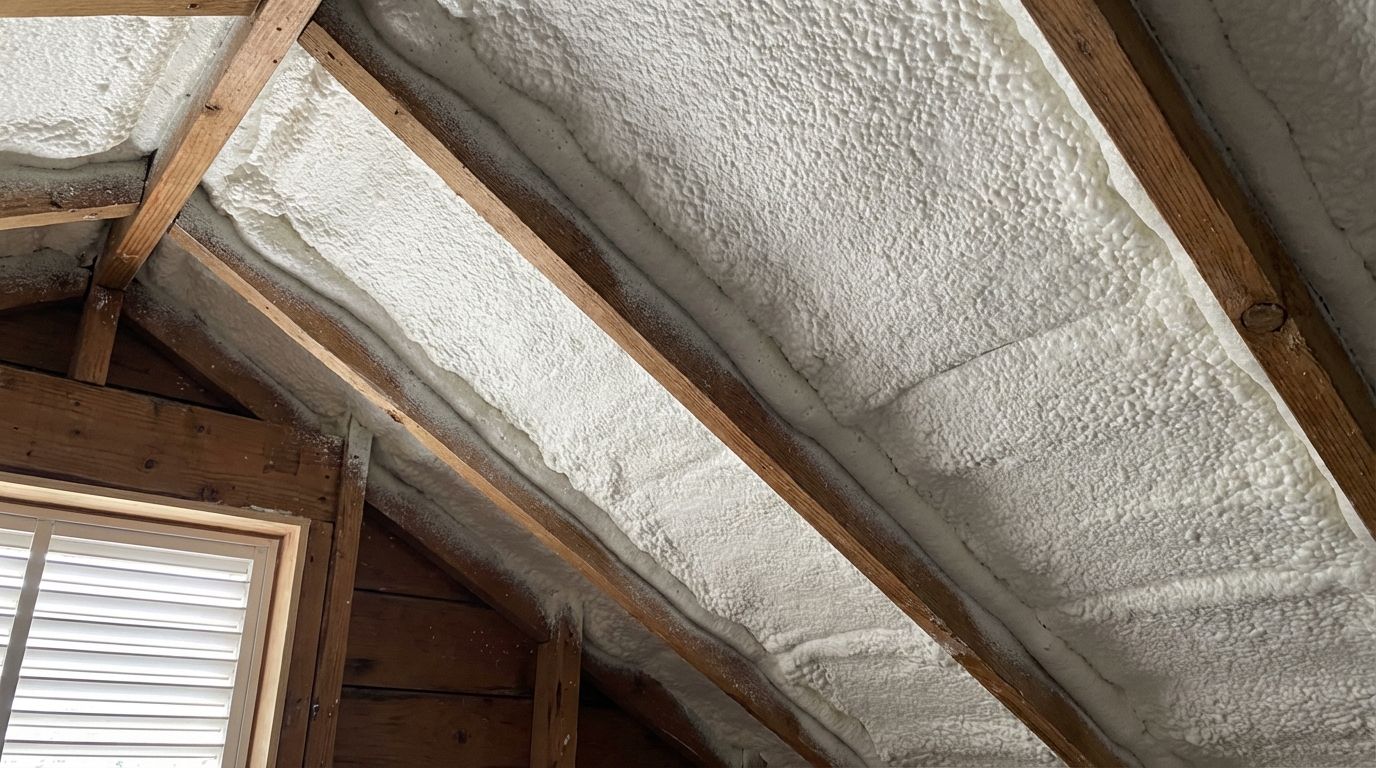
Spray foam is a two-component chemical system that expands on contact, filling every crack, gap, and cavity before curing into a rigid, airtight barrier. We apply it using specialized equipment that mixes the components at the spray gun, creating a chemical reaction that causes the foam to expand 30-100 times its liquid volume.
There are two types we install across Ontario homes:
- Open-Cell Foam ($3-5/sq ft): R-3.7 per inch, softer and more flexible, excellent for sound dampening, allows moisture permeability
- Closed-Cell Foam ($5-8/sq ft): R-6.5 per inch, rigid and dense, creates vapor barrier, adds structural strength
We recently completed a full attic spray foam installation in North York where the homeowners had struggled with ice dams and heat loss for years. The foam created a continuous air barrier from eave to ridge, eliminating the thermal bypasses that were causing their problems.
How Fiberglass Insulation Works
Fiberglass insulation consists of extremely fine glass fibers bound together to form batts, rolls, or loose-fill material. It works by trapping air pockets within the fiber matrix, slowing heat transfer through convection. R-values range from R-2.9 to R-4.3 per inch depending on density.
The material comes in several forms:
- Batts: Pre-cut sections fitting between standard 16″ or 24″ framing
- Rolls: Continuous material for long runs
- Loose-fill/Blown-in: Chopped fibers blown into attics or walls
In a Mississauga bungalow we inspected last month, the homeowners had DIY-installed fiberglass batts 8 years ago. While the material itself still had insulating value, compression at the edges and gaps around electrical boxes had reduced its effectiveness by an estimated 30%. This is typical—fiberglass only works when perfectly installed and maintained.
Performance Comparison: The Numbers That Matter
R-Value Per Inch
Ontario Building Code requires R-60 for attics. Here’s how each material achieves that:
- Closed-Cell Spray Foam: R-6.5 per inch = 9.2 inches needed
- Open-Cell Spray Foam: R-3.7 per inch = 16.2 inches needed
- Fiberglass Batts: R-3.7 per inch = 16.2 inches needed
In tight spaces like rim joists or shallow rafters, closed-cell foam’s superior R-value per inch is crucial. We often encounter situations in older Toronto homes where there’s only 6 inches of available space—impossible to code with fiberglass, but easily achieved with spray foam.
Air Sealing Capability
This is where the comparison becomes stark. Fiberglass does NOT stop air movement—it merely slows it. Air can flow right through fiberglass, carrying moisture and heat with it.
Spray foam, by contrast, creates an airtight seal. The expanding foam fills every crack, gap, and penetration, eliminating thermal bypasses. In a commercial building we insulated in Brampton, blower door testing showed a 65% reduction in air leakage after spray foam installation versus the same building’s previous fiberglass insulation.
Moisture Management
Ontario’s humidity swings challenge any insulation. Fiberglass absorbs moisture, losing R-value when wet and creating conditions for mold growth. We’ve pulled out soggy fiberglass batts from basements in Oakville that were performing at less than 50% of their rated R-value.
Closed-cell spray foam is impermeable to moisture—it’s actually rated as a Class II vapor retarder. It doesn’t absorb water, won’t support mold growth, and maintains its thermal properties regardless of humidity conditions.
Cost Comparison: Initial Investment vs. Long-Term Value
Let’s look at real numbers for a typical 1,000 square foot attic installation in the GTA:
Fiberglass Installation
- Material Cost: $300-$500
- Professional Installation: $500-$1,000
- Total Investment: $800-$1,500
- DIY Option: $300-$500 (materials only)
Spray Foam Installation
- Closed-Cell Foam: $5,000-$8,000 (professional only)
- Open-Cell Foam: $3,000-$5,000 (professional only)
- DIY Option: Not recommended (safety and code compliance issues)
Energy Savings Payback
Here’s where spray foam justifies its premium. A typical Toronto home spends $2,500-$3,500 annually on heating and cooling. Our cost calculator data shows:
- Fiberglass upgrade: 10-15% energy savings = $250-$525/year
- Spray foam upgrade: 40-60% energy savings = $1,000-$2,100/year
Payback period: Fiberglass pays for itself in 2-4 years. Spray foam pays for itself in 3-6 years—but continues delivering superior performance for 60+ years longer.
Installation Process: What to Expect
Fiberglass Installation
Relatively straightforward. For attics, installers lay batts between joists or blow loose-fill to desired depth. Walls require removing drywall or drilling holes for dense-packing. A typical attic takes 4-8 hours. Homeowners can DIY with basic safety equipment (gloves, mask, long sleeves).
Spray Foam Installation
Requires professional equipment and training. The process involves:
- Preparation and masking of surfaces not being sprayed
- Ventilation setup and safety equipment
- Chemical mixing at precise ratios
- Application in lifts (multiple thin layers)
- 24-hour curing and off-gassing period
Homeowners must vacate for 24 hours after installation. A typical residential project takes 1-2 days.
When Fiberglass Makes Sense
Despite spray foam’s superior performance, fiberglass remains appropriate in certain situations:
- Tight budgets: When upfront cost is the primary constraint
- Short-term ownership: If selling within 3-5 years, you won’t see the energy payback
- Interior walls: For sound dampening between rooms where air sealing isn’t critical
- DIY projects: When professional installation isn’t in the budget
A landlord client in Hamilton chooses fiberglass for rental properties because of the lower upfront cost, accepting higher utility bills as a trade-off.
When Spray Foam is the Right Choice
Spray foam is worth the investment when:
- Long-term homeownership: You’ll capture the full ROI through energy savings
- Air quality concerns: The airtight seal prevents dust, pollen, and allergens
- Moisture issues: Basements, crawl spaces, and rim joists benefit from closed-cell’s water resistance
- Space constraints: When you need high R-value in limited thickness
- Maximum comfort: Eliminating drafts and cold spots
Our Enbridge HER+ rebate can offset $600-$6,500 of spray foam costs, significantly improving the payback timeline.
Frequently Asked Questions
Can I mix spray foam and fiberglass?
Yes, this is called a “flash and batt” system. Apply 1-2 inches of closed-cell spray foam for air sealing, then fill remaining cavity with fiberglass. You get 80% of spray foam’s air sealing benefit at 60% of the cost. We use this approach frequently for budget-conscious clients in Mississauga and Brampton.
Is spray foam safe for my family?
Once cured (24-48 hours), spray foam is inert and safe. The chemicals fully react during curing, leaving no toxic residue. Professional installation ensures proper mixing ratios and curing. We recommend vacating during installation and for 24 hours after as a precaution.
Can I install spray foam myself?
DIY spray foam kits exist but we don’t recommend them for Ontario homes. The chemicals require precise mixing, professional equipment costs $15,000+, and improper installation can create health hazards. Additionally, DIY installations don’t qualify for Enbridge HER+ rebates.
Does spray foam off-gas forever?
No. Off-gassing occurs during the 24-48 hour curing period only. Once fully cured, the foam is chemically stable and doesn’t release VOCs. Modern spray foam formulations have eliminated the odor issues that plagued early products.
Will spray foam damage my roof?
When properly installed, spray foam actually protects your roof structure by preventing moisture accumulation. However, it’s crucial to maintain proper ventilation or use open-cell foam in roof assemblies to prevent moisture trapping. We assess each roof assembly individually.
Get Expert Advice for Your Ontario Home
Still unsure which insulation is right for your situation? Spray Foam Kings provides free consultations across Toronto, Mississauga, Brampton, Oakville, and the entire GTA. We’ll assess your home’s specific needs, discuss your budget and timeline, and recommend the solution that delivers the best value for your situation.
Call or text: (647) 641-6881
Google Maps: https://g.page/sprayfoamkings
Use our online cost calculator for instant estimates.