
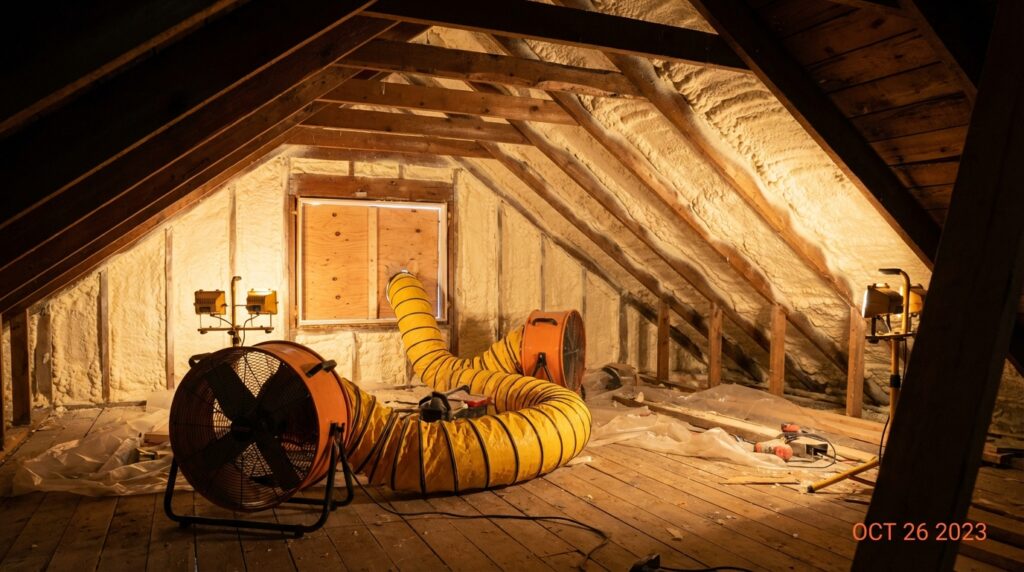
The Short Answer
Yes, you can sleep in your house after spray foam insulation — but not immediately. Most homeowners in Toronto and the GTA need to wait 24 to 48 hours after installation before re-entering their home. Open-cell foam typically cures faster (24 hours), while closed-cell foam may require up to 48-72 hours depending on ventilation, temperature, and humidity. Once fully cured, spray foam becomes an inert, non-toxic material that’s safe for everyday living — including sleeping just inches away from insulated walls.
Understanding the Spray Foam Curing Process
Spray foam insulation isn’t ready for occupancy the moment it’s applied. The product undergoes a chemical reaction called “curing,” where liquid components transform into solid foam. During this process, the foam releases volatile organic compounds (VOCs) and isocyanates — chemicals that can irritate eyes, throat, and lungs.
What’s happening chemically:
- Two components (polyol resin and isocyanate) mix at the spray nozzle
- The reaction produces heat and expansion (foam can expand 30-100x)
- Off-gassing occurs as byproducts escape during curing
- Once cured, the foam becomes chemically stable and inert
Tack-free time vs. Full cure:
- Tack-free: 20-30 seconds (surface isn’t sticky)
- Full cure: 12-72 hours depending on foam type and conditions
How Long Should You Stay Out of Your House?
The re-entry timeline depends on several critical factors. Here’s what to expect based on foam type:
| Factor | Open-Cell Foam | Closed-Cell Foam |
|---|---|---|
| Minimum Re-entry | 24 hours | 24-48 hours |
| Safe Occupancy | 24-48 hours | 48-72 hours |
| Full Cure | 24-48 hours | 48-72 hours |
| Odor Dissipation | Faster | Slower |
Key determinants:
- Ventilation quality — Homes with open windows and exhaust fans clear 2-3x faster
- Temperature — 65-85°F is optimal; colder = slower cure
- Humidity — High humidity can extend cure times
- Foam thickness — Thicker applications take longer to cure completely
What Is Off-Gassing and Why Does It Matter?
Off-gassing is the release of chemical fumes during the curing process. While normal and expected, these fumes require careful management:
What’s being released:
- Isocyanates (eye/respiratory irritants)
- Volatile organic compounds (VOCs)
- Amine catalysts
- Blowing agents (closed-cell)
Health symptoms from premature exposure:
- Eye and throat irritation
- Headaches and dizziness
- Nausea
- Respiratory difficulty
- Skin sensitivity
Professional installers wear respirators for a reason — these chemicals are actively dangerous during application and curing.
Watch This Quick Guide
Can You Enter the House During Installation?
Absolutely not. Professional spray foam contractors in Ontario require all occupants — including pets — to vacate the premises before work begins. This isn’t a suggestion; it’s a safety requirement backed by:
- Ontario Building Code compliance requirements
- CCMC (Canadian Construction Materials Centre) guidelines for spray foam application
- Insurance and liability protocols
Contractors install ventilation systems to exhaust fumes outdoors during application, but these aren’t sufficient to protect occupants inside.
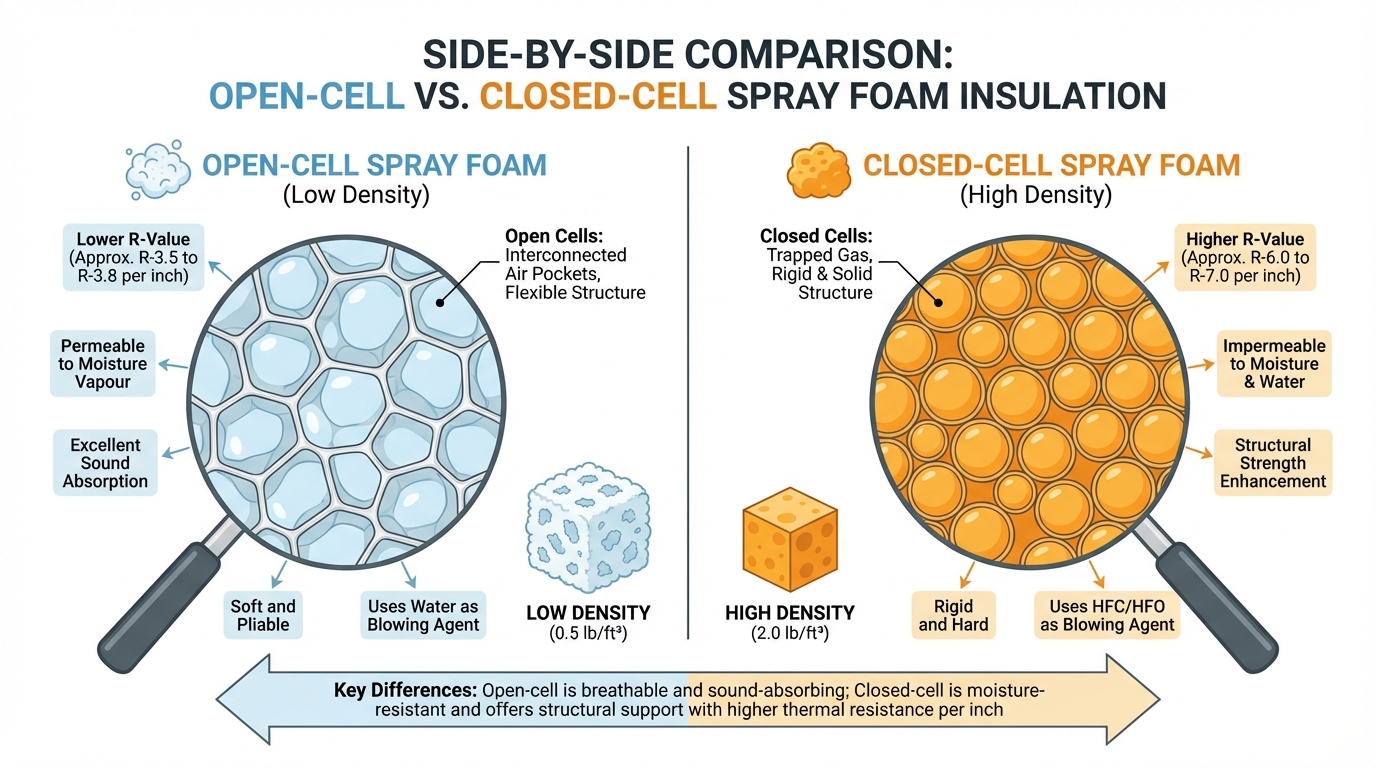
Open-Cell vs. Closed-Cell: Does Foam Type Affect Re-Entry Time?
Open-Cell Foam:
- Lighter, more breathable structure
- Faster cure time (typically 24 hours)
- Lower density allows fumes to dissipate more quickly
- Common for attic and wall applications
Closed-Cell Foam:
- Denser, more rigid structure
- Longer cure time (24-72 hours)
- Higher R-value per inch but slower off-gassing
- Better for basements and moisture-prone areas
For Toronto homes dealing with humid summers and cold winters, contractors often recommend closed-cell for basements and open-cell for attics. Your re-entry plan should account for these different cure times.
Pro tip: Ask your installer specifically: “What type of foam are you using, and what’s the minimum re-entry time for my family?”
What If You Enter Too Early? Accidental Exposure Protocol
If you accidentally enter your home before the recommended cure time:
Immediate steps:
- Exit immediately if you smell strong chemical odors
- Increase ventilation — open all windows and turn on exhaust fans
- Wait an additional 12-24 hours before re-entry
- Consider running an air purifier with activated carbon filter
When to seek medical attention:
- Persistent coughing or wheezing
- Eye irritation that doesn’t resolve within hours
- Difficulty breathing
- Skin rashes or hives
Most accidental exposures result in temporary irritation, but sensitive individuals (asthma sufferers, young children, elderly) should be especially cautious.
How to Speed Up the Curing Process
Accelerate safe re-entry with these strategies:
1. Pre-installation preparation
- Schedule installation when you can stay elsewhere 48-72 hours
- Arrange for pets to stay with friends/boarding
2. Maximize ventilation during curing
- Keep windows open (weather permitting)
- Run exhaust fans continuously
- Set up box fans to create cross-ventilation
3. Temperature control
- Maintain heating at moderate levels (don’t turn heat off completely)
- Avoid extreme cold that slows curing
4. Post-cure verification
- Walk through and smell for any chemical odors
- Check with your contractor before bringing children/elderly back
Is Spray Foam Safe to Sleep Near After Curing?
Once fully cured, spray foam insulation is chemically inert and safe for long-term proximity. Here’s what “cured” means chemically:
- No more active chemical reactions
- VOC emissions drop to negligible levels
- The foam becomes dimensionally stable
- No ongoing off-gassing under normal conditions
Sleeping directly against spray-foamed walls is perfectly safe after the cure period. The foam won’t release chemicals, won’t “leak,” and won’t degrade in a way that affects air quality. In fact, spray foam can improve sleep quality by:
- Eliminating drafts and temperature fluctuations
- Reducing outdoor noise transmission
- Preventing moisture issues that cause mold
Special Considerations for Sensitive Populations
Children and infants: More susceptible to VOC exposure due to developing respiratory systems. Wait the full 72 hours for closed-cell installations.
Asthma and allergy sufferers: Even low-level irritants can trigger symptoms. Consider 48-72 hours minimum regardless of foam type.
Pregnant women: While cured foam is safe, avoid any exposure during the off-gassing period as a precaution.
Elderly individuals: Reduced lung capacity makes caution advisable. Extended cure times recommended.
Questions to Ask Your Spray Foam Contractor
Before installation, confirm these safety protocols:
- “What’s your recommended re-entry time for my specific application?”
- “Are you using low-VOC or ultra-low-VOC foam products?”
- “What ventilation will you set up during and after installation?”
- “Do you provide written safety guidelines for post-installation?”
- “What’s your protocol if I smell chemicals after the cure time?”
Licensed contractors like Spray Foam Kings follow strict safety protocols and provide clear re-entry timelines based on your specific project conditions.
Cost of Temporary Accommodations vs. Safety
Many Toronto homeowners ask: “Is staying elsewhere for 2-3 days really necessary?”
Consider these factors:
- Hotel costs for 2 nights: ~$200-400
- Peace of mind: Priceless
- Potential health costs from exposure: Far higher than temporary housing
- Most homeowners schedule installation before vacations or long weekends
Calculate your spray foam project costs and factor in potential temporary accommodation to plan your project timeline effectively.
Frequently Asked Questions
How long do I need to wait before sleeping in my house after spray foam insulation?
Most homeowners need to wait 24 to 48 hours before re-entering their home after spray foam installation. Open-cell foam typically cures in 24 hours, while closed-cell foam requires 24-72 hours depending on ventilation and environmental conditions.
Is spray foam insulation toxic after it cures?
No. Once fully cured (24-72 hours after installation), spray foam becomes chemically inert and non-toxic. The off-gassing of volatile organic compounds (VOCs) occurs only during the curing process.
Can I stay in my house during spray foam installation?
No. All occupants, including pets, must vacate the premises during spray foam installation. The application process releases toxic chemicals that require professional ventilation and the curing period before safe re-entry.
What’s the difference between open-cell and closed-cell foam cure times?
Open-cell foam typically cures in 24 hours and allows fumes to dissipate faster due to its breathable structure. Closed-cell foam is denser and may require 48-72 hours to fully cure and off-gas.
What are the symptoms of exposure to uncured spray foam?
Symptoms of exposure to uncured spray foam include eye and throat irritation, headaches, dizziness, nausea, respiratory difficulty, and skin sensitivity. Anyone experiencing these symptoms should exit the area immediately and seek fresh air.
Is it safe to sleep near spray foam walls after curing?
Yes. Once fully cured, spray foam is chemically inert and safe to sleep directly against. It won’t release chemicals, off-gas, or degrade in a way that affects air quality.
Ready to Upgrade Your Home’s Insulation? Contact Spray Foam Kings Today
Don’t let re-entry concerns stop you from enjoying the energy savings and comfort of professional spray foam insulation. Spray Foam Kings serves Toronto, the GTA, and all of Ontario with licensed, bonded, and insured spray foam insulation services that prioritize your family’s safety.
✓ Licensed & Insured Installers
✓ Low-VOC Product Options
✓ Clear Safety Protocols & Written Re-Entry Guidelines
✓ 24-48 Hour Installation Completion
Get Your Free Quote Today
Call Spray Foam Kings: 647-641-6881
Or request a free quote online — we serve Toronto, Mississauga, Brampton, Vaughan, Markham, and throughout the GTA.
Licensed, insured, and certified spray foam insulation contractors serving Ontario since 2015.