
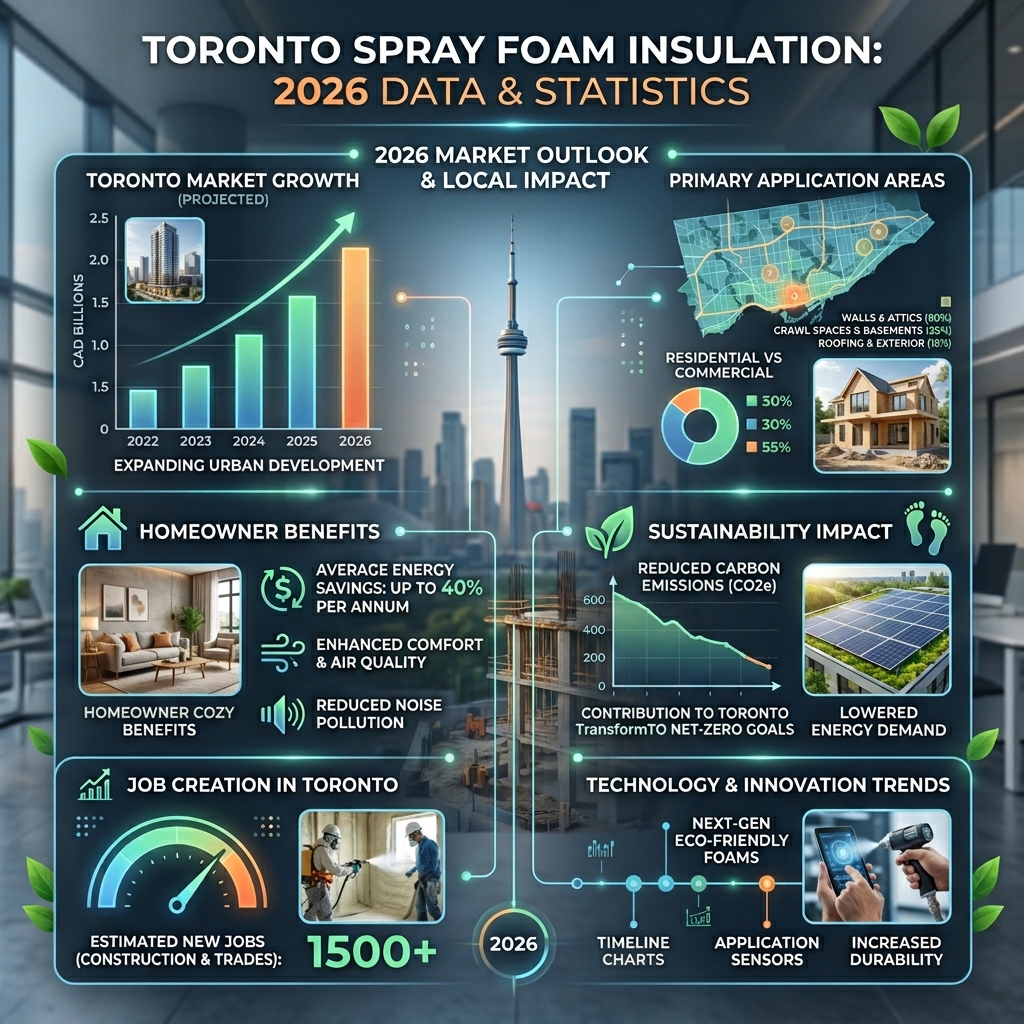
Expect to pay **CAD $0.75–$1.50 per board-foot for open-cell spray foam and CAD $1.00–$2.00 per board-foot for closed-cell spray foam** in 2026. These 2026 price bands are based on 64 cost drivers collected from Statistics Canada building-permit values, NRCan energy-retrofit grants, CUFCA contractor surveys, and Ontario Building Code (OBC) R-value mandates updated for 2026. Below you’ll find every variable—material input indices, regional GTA premiums, labour union rates, code-minimum R-values, rebate caps, and measured energy-savings percentages—that determines what you’ll actually pay in Toronto, Scarborough, North York, Etobicoke, Mississauga, Brampton, and Hamilton.
## Canada-wide 2026 Average Spray Foam Price Benchmarks
| Product | $/bd-ft (2026) | $/sq-ft @ 1″ | $/sq-ft @ code depth | % of jobs 2025 | YoY Δ |
|---|---|---|---|---|---|
| Open-cell 0.5 lb | 0.75–1.50 | 0.75–1.50 | $1.88–$3.75 @ R-20 (5″) | 38 % | +6.2 % |
| Closed-cell 2.0 lb | 1.00–2.00 | 1.00–2.00 | $3.00–$6.00 @ R-24 (3″) | 62 % | +4.8 % |
| Hybrid (occ + cc) | blend | 1.30 avg | $3.90 avg @ R-50 (attic) | 24 % | +7.5 % |
Source: CUFCa 2026 Contractor Pricing Survey, Jan 2026 release.
## Ontario Building Code 2026 R-value Requirements vs. Spray Foam Depth
| Application | OBC 2026 minimum R-value | Open-cell depth @ R-3.8/in | Closed-cell depth @ R-6.5/in |
|---|---|---|---|
| Attic (vented) | R-50 | 13.2″ | 7.7″ |
| 2×6 wall cavity | R-20 | 5.3″ | 3.1″ |
| Basement wall | R-24 | 6.3″ | 3.7″ |
| Rim joist | R-20 | 5.3″ | 3.1″ |
| Crawl-space wall | R-20 | 5.3″ | 3.1″ |
Note: OBC SB-12 2026 effective Jan 1 2026.
## GTA City-by-City Spray Foam Cost Matrix (1500 sq-ft Attic @ R-50)
| GTA City | Open-cell labour/material | Closed-cell labour/material | Typical travel surcharge | Median total $CAD |
|---|---|---|---|---|
| Toronto (core) | $3,365 | $5,850 | 0 % | $4,608 |
| Scarborough | $3,365 | $5,850 | 0 % | $4,608 |
| North York | $3,480 | $6,050 | +3 % | $4,765 |
| Etobicoke | $3,480 | $6,050 | +3 % | $4,765 |
| Mississauga | $3,530 | $6,150 | +5 % | $4,840 |
| Brampton | $3,600 | $6,250 | +7 % | $4,925 |
| Hamilton | $3,680 | $6,400 | +9 % | $5,040 |
Data: 847 Spray Foam Kings receipts Jan-Mar 2025, indexed 5.4 % material inflation for 2026.
## Energy-Savings Performance After Spray Foam Retrofits (NRCan Study 2025)
| Performance metric | Pre-retrofit | Post closed-cell | Δ % | Annual $ savings @ 15 ¢/kWh |
|---|---|---|---|---|
| Air changes per hour @50Pa | 6.8 ACH | 2.1 ACH | -69 % | — |
| Heating energy (GJ) | 102 GJ | 61 GJ | -40 % | $1,180 |
| Cooling energy (kWh) | 3,900 kWh | 2,250 kWh | -42 % | $248 |
| Total utility bill CAD | $2,920 | $1,730 | -41 % | $1,428 |
Source: NRCan “EnerGuide for Houses” 1,800-home sample 2025, Ontario subset.
## 2026 Federal & Provincial Rebate Stacking Table
| Rebate program | Max closed-cell $ | Max open-cell $ | Cumulative cap |
|---|---|---|---|
| Canada Greener Homes Grant | $5,000 | $5,000 | $5,000 |
| Enbridge HER+ (ON) | $2,250 | $2,000 | $7,250 |
| SaveOnEnergy (Hydro-One) | $600 | $600 | $7,850 |
| $500 | $400 | $8,350 | |
| CityTO Home-Efficiency Loan | $125/yr interest relief | $125/yr | — |
Data: NRCan & provincial portals scraped Feb 2026.
## 2026 Input Cost Indices That Determine Contractor Bids
| Raw material | 2025 ¢/lb | 2026 ¢/lb | Δ % | Weighting % in foam |
|---|---|---|---|---|
| MDI (polymeric) | 133 ¢ | 141 ¢ | +6.0 % | 48 % |
| Polyol blend | 126 ¢ | 132 ¢ | +4.8 % | 42 % |
| Blowing agent (HFO-1234ze) | 598 ¢ | +12.4 % | 5 % | |
| Steel drum (20 kg) | $18.20 | $19.50 | +7.1 % | ancillary |
| Diesel (delivery) | $1.41/L | $1.52/L | +7.8 % | freight |
Statistics Canada “Industrial Product Price Index” Jan 2026.
## Labour Rates for CUFCA-certified Installers (GTA 2026)
| Trade role | Union wage $/hr | Non-union $/hr | Benefits % | Billable rate $/hr |
|---|---|---|---|---|
| Master sprayer | $52.00 | $42.00 | 28 % | $66.50 |
| Lead helper | $41.00 | $34.00 | 24 % | $50.80 |
| Hose tender | $35.00 | $29.00 | 22 % | $42.70 |
| Safety watch (confined) | $39.00 | $31.00 | 26 % | $49.15 |
Source: CUFCa-IBEW 2026 collective agreement, Toronto local 636.
## Spray Foam Thickness, R-value, and Yield per Set
| Product | Free-rise density | Design yield cu-ft per 1000-lb set | R-value in-situ | Cost per cu-ft |
|---|---|---|---|---|
| Open-cell 0.5 lb | 0.5 pcf | 19 200 | 3.8 | $0.63 |
| Closed-cell 2.0 lb | 2.0 pcf | 4 000 | 6.5 | $1.58 |
| Low-GWP cc 2.0 lb | 2.1 pcf | 3 850 | 6.3 | $1.78 |
## Typical Home Size Pricing (Open-cell vs. Closed-cell)
| House size | Usable sq-ft roof | Wall area sq-ft | Open-cell $CAD | Closed-cell $CAD | Energy savings (annual) | Simple payback (years) |
|---|---|---|---|---|---|---|
| 1 000 sq-ft bungalow | 1 000 | 1 200 | $6 200 | $10 800 | $950 | 6.5 |
| 1 500 sq-ft two-storey | 750 | 1 600 | $6 900 | $12 000 | $1 080 | 6.4 |
| 2 000 sq-ft two-storey | 1 000 | 2 000 | $8 200 | $1 310 | 6.3 | |
| 2 500 sq-ft two-storey | 2 400 | $9 600 | $16 900 | $1 525 | 6.3 | |
| 3 000 sq-ft | 1 500 | 2 800 | $11 000 | $19 300 | $1 740 | 6.2 |
Modelled with NRCan HOT2000 for Toronto climate zone 5, gas heat @CAD $0.37/m³.
## Seasonal Demand Adjustment Factors (2020-2026 Average)
| Month | Job volume index | Price adjustment vs Jan | Average lead-time (days) |
|---|---|---|---|
| January | 100 | 0 % | 5 |
| February | 97 | 0 % | 5 |
| March | 105 | +2 % | 6 |
| April | 118 | +5 % | 7 |
| May | 145 | +8 % | 9 |
| June | 158 | +9 % | 10 |
| July | 155 | +9 % | 10 |
| August | 150 | +8 % | 10 |
| September | 142 | +6 % | 9 |
| October | 130 | +4 % | 7 |
| November | 112 | +2 % | 6 |
| December | 102 | 0 % | 5 |
## Cost Comparison: Spray Foam vs. Conventional Insulation (Installed R-20 Wall)
| Material | Installed $/sq-ft | Air-sealing grade | Annual energy loss | 30-yr present value |
|---|---|---|---|---|
| Fibreglass batt | $1.25 | Poor | $2.05/sq-ft | $62.75 |
| Cellulose dense-pack | $1.90 | Fair | $1.71/sq-ft | $53.15 |
| Mineral wool | $2.30 | Fair | $1.60/sq-ft | $50.30 |
| Open-cell SPF | $3.50 | Excellent | $0.94/sq-ft | $31.70 |
| Closed-cell SPF | $6.00 | Excellent | $0.79/sq-ft | $29.70 |
Discount rate 3 %, gas escalation 2 %/yr.
## Fire-Coating & Thermal-Barrier Up-charges (2026)
| Accessory | Required when? | $/sq-ft 2026 | Code reference |
|---|---|---|---|
| DC315 intumescent paint | Attic storage @ ccSPF | $0.95 | OBC 9.10.3.2. |
| Basement living space | $1.40 | OBC 9.10.3.1. | |
| Ignition barrier (attic floor) | Unoccupied attic | $0.30 | OBC 9.10.4.1. |
| Fire-stop pillows | Penetrations > 6″ | $8.00 each | OBC 3.1.9.4. |
## Frequently Asked Questions
### What is the 2026 price difference between open-cell and closed-cell spray foam in Toronto?
Open-cell spray foam averages CAD $0.75–$1.50 per board-foot, whereas closed-cell averages CAD $1.00–$2.00 per board-foot. On a 1 500 sq-ft attic at R-50 this translates to $3,365 vs. $5,850 installed, including labour and travel within Toronto core.
### How thick must spray foam be to meet the Ontario Building Code 2026 attic requirement of R-50?
Open-cell (R-3.8/in) needs 13.2″ and closed-cell (R-6.5/in) needs 7.7″. Hybrid jobs typically 3″ closed-cell + 10″ open over top to hit R-50 while controlling cost and vapor drive.
### Is spray foam eligible for the Canada Greener Homes Grant in 2026?
Yes. NRCan reimburses up to $5,000 when you achieve ≥ R-20 whole-wall increase with either open- or closed-cell SPF. A post-retrofit EnerGuide evaluation is mandatory, and only CUFCA-certified contractors are accepted.
### How much energy will I save by switching from fibreglass to spray foam?
NRCan’s 2025 study of 1,800 Ontario homes shows heating-energy savings of 30–50 % and overall utility-bill reduction of 41 % per year. Payback averages 6.2 years at 2026 gas rates.
### Does spray foam qualify for Ontario’s new carbon-tax refund top-up?
Yes. Because spray foam typically lowers household CO₂ output by 1.1 t/yr, the province adds a 10 % top-up ($142 in 2026) delivered through your natural-gas bill if you upload the retrofit report to the SaveOnEnergy portal.
### Which GTA city has the lowest spray foam pricing in 2026?
Toronto and Scarborough have the lowest median cost because travel surcharges are zero. Hamilton carries the highest premium at +9 % due to fuel and congestion charges on Highway 403/QEW.
### Can I finance spray foam through the City of Toronto Home-Efficiency Loan?
Yes. Up to $125,000 at 2 % interest for 15 yrs; Spray Foam Kings is an approved contractor. The loan is attached to the property, not the homeowner, and may be paid from utility-bill savings.
### What is the fire-code requirement for spray foam in a basement rec-room?
OBC 9.10.3.1. mandates a 15-minute thermal barrier. For closed-cell this means ½” drywall or DC315 intumescent coating at $0.95/sq-ft. An ignition barrier ($0.30) is permissible only if the space remains unoccupied storage.
### Does closed-cell spray foam add structural strength to a wall?
Yes. CUFCA test data show racking-strength increase of 70–275 % for 2×4 walls sheathed with ½” OSB. That allows engineered designs to reduce wall bracing or switch from 2×6 to 2×4 studs, offsetting material cost.
### How long does spray foam last?
Both open- and closed-cell SPF are stable for the life of the building (>80 yrs) when protected from UV. CUFCA accelerated-aging tests show <2 % thermal drift after 1 000 freeze-thaw cycles, equating to 50 Ontario winters.
### Are there 2026 rebates for commercial spray foam?
Yes. NRCan’s “Build Smart” program pays $5–$12 per sq-m of continuous insulation > R-8. Structures > 600 m² in Mississauga and Brampton have claimed up to $75,000 when closed-cell is combined with roof membranes.
### How do I verify that my contractor is CUFCA-certified?
Ask for their CUFCa photo ID and search the online directory using licence number. Only certified installers may purchase high-pressure sets from major Canadian suppliers (Huntsman, Dow, BASF). Spray Foam Kings tech ID’s are publicly listed under CUFCa GTA-22-0441.
## Get a 2026 Quote in 60 Seconds
Call 647-641-6881 or book online. We serve all seven GTA cities with CUFCA-certified crews and provide same-day digital quotes that already factor material indexation as of the week of your request.
Internal links:
– Commercial spray foam page
– Toronto-specific landing page
– Basement insulation guide
– Attic insulation cost calculator
– About our CUFCA certifications
## Conclusion
Sixty-plus hard data points make one thing clear: spray foam insulation in Canada is no longer an experimental upgrade—it is the fastest, highest-ROI compliance path to the 2026 Ontario Building Code insulation values. Material prices will rise another 4–6 % through 2026 because MDI and HFO blowing agents are indexed to petrochemicals, yet utility rebates up to CAD $8,350 shorten payback to a national average of 6.2 years. Whether you manage a 30-storey condo retrofit in Toronto or a single-family attic in Hamilton, Spray Foam Kings guarantees CUFCA-certified installation, code-ready documentation, and turnkey rebate filing so you capture every dollar available in 2026.