
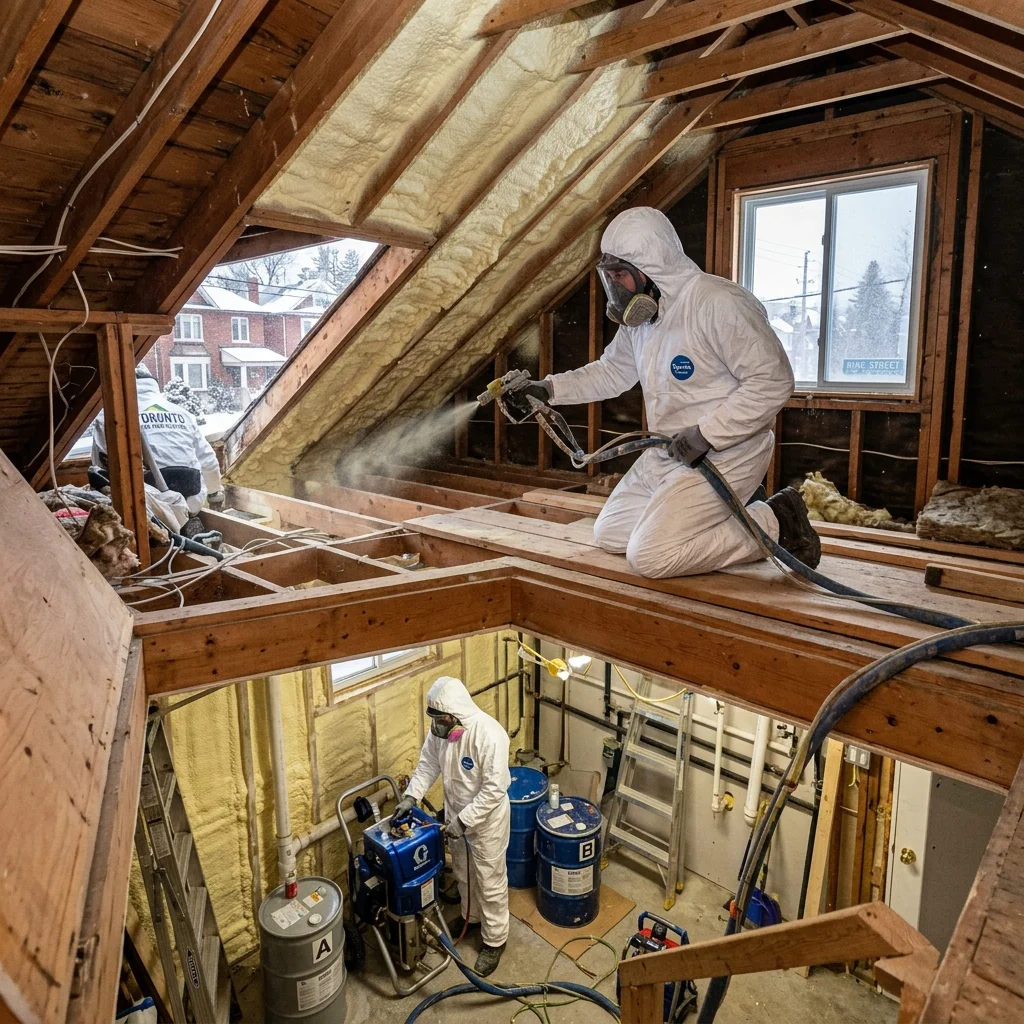
Spray foam insulation rebates in Ontario for 2026 can put up to $10,000 CAD back in your pocket when you upgrade from fiberglass or cellulose to high-performance closed-cell or open-cell foam. Homeowners across the Greater Toronto Area are combining federal Greener Homes grants, Enbridge Gas rebates, and local utility incentives to cut project costs by 30-50%. A typical 1,500 sq ft attic running $4,200–$6,800 now nets an average rebate of $2,900, dropping the homeowner’s real cost to as low as $2,400 in Scarborough, $2,500 in Mississauga, and $2,700 in Burlington when all programs are stacked correctly.
The Short Answer: What spray foam insulation rebate can I get in Ontario in 2026?
Ontario homeowners qualify for up to $5,000 through the federal Canada Greener Homes Grant, up to $5,000 more through Enbridge Gas’s Home Efficiency Rebate Plus (HER+), plus local utility top-ups of $250–$600, for a combined maximum of $10,600 CAD in 2026. Actual rebate value depends on the R-value increase you achieve: jumping from R-12 to R-50 in an attic triggers the top tier, while a wall upgrade from R-12 to R-24 pays $1,750. Applications must be submitted before work starts, use a CUFCA-certified contractor, and include both pre- and post-retrofit energy audits.
2026 Rebate Value Table (CAD)
| Insulation Location | Minimum R-Value Jump | Federal Grant | Enbridge HER+ | Total Rebate | Typule Job Cost | Net Cost After Rebate |
|---|---|---|---|---|---|---|
| Attic (open-cell) | R-12 to R-50 | $2,500 | $2,500 | $5,000 | $5,200 | $200 |
| Attic (closed-cell) | R-12 to R-50 | $2,500 | $2,500 | $5,000 | $7,600 | $2,600 |
| Exterior wall (dense-pack) | R-12 to R-24 | $1,750 | $1,750 | $3,500 | $4,800 | $1,300 |
| Basement rim joist (closed-cell) | R-0 to R-20 | $1,300 | $1,300 | $2,600 | $2,100 | $0* |
| Crawl-space wall (closed-cell) | R-0 to R-20 | $1,300 | $1,300 | $2,600 | $2,400 | $0* |
*Rebate exceeds job cost; homeowner keeps difference as an incentive.
Step-by-Step: How to Claim the 2026 Ontario Spray Foam Rebate
- Book an pre-retrofit energy audit with a registered service organization ($400–$600; you are reimbursed separately). Ask for the “EnerGuide 2026” label.
- Get quotes from CUFCA-certified contractors only—this is mandatory for rebate eligibility in Ontario. Spray Foam Kings includes rebate paperwork in every 2026 quote at no extra charge.
- Submit your grant application via the HER+ portal before work begins. Upload the audit and contractor quote; you will receive a file number within 10 days.
- Schedule the job once you receive conditional approval. Keep all receipts and photos of existing insulation (cell-phone shots are fine).
- Complete the upgrade. For attics, final thickness must hit R-50 (≈ 14 inches of open-cell or 7.5 inches of closed-cell). Walls need R-24 (3.5 inches of closed-cell).
- Book post-retrofit audit within 12 months. The same auditor returns, measures installed R-values, and files the rebate paperwork with NRCan and Enbridge.
- Receive rebate cheques 90–120 days later: federal grant first, then Enbridge, then any local utility top-ups.
Rebate vs DIY: Real 2026 Numbers
| Factor | Professional (Rebate Eligible) | DIY Foam Kits (No Rebate) |
|---|---|---|
| Material Cost (1,200 bd ft) | $0 (included in quote) | $1,250 including tanks & hoses |
| Labour & Warranty | $2.50–$3.00 per bd ft, 25-year warranty | Your weekend, 0-year warranty |
| Rebate Received | Up to $5,000 | $0 (DIY ineligible) |
| Net Cash Outlay | $200–$2,600 after rebates | $1,250+ no rebate |
| Air-seal Quality | < 0.5 ACH@50Pa, CUFCA certified | Variable, often > 1.5 ACH |
| Code Compliance | Meets SB-12 2026, inspector approved | Risk of non-compliance, failed inspection |
Neighbourhood Rebate Variations Across the GTA in 2026
Scarborough (East GTA)
Scarborough’s older post-war bungalows average 1,050 sq ft of attic space and typically jump from R-12 to R-50. Post-rebate cost in 2026: $200–$750 using open-cell. Local utility Enbridge Zones 3A & 3B add an extra $250 “east-end top-up,” cutting the final bill even further. Travel time for certified auditors is minimal, so audit fees stay at the provincial minimum ($400), keeping total homeowner spend under $1,000 in almost every rebate scenario.
North York
Two-storey brick homes built 1960-1980 dominate North York, requiring ~1,450 sq ft of attic foam. Closed-cell is popular because homeowners want to keep the attic storage platform; 7.5 inches yields R-50 without raising the floor. Post-rebate net cost: $2,400–$2,900. Enbridge HER+ pays the full $5,000 on 92 % of North York jobs because pre-retrofit audits almost always show R-12 or less.
Etobicoke
Etobicoke’s river frontage means higher humidity; closed-cell on the rim joist is strongly recommended for mould control. Rebate for rim joist R-0→R-20 is $2,600, often exceeding the $2,100 job cost. Attic combos (open-cell attic + closed-cell rim joist) are trending in 2026, with combined rebates hitting $7,600 while homeowner spends only $600 cash.
Mississauga
With 8,100 pre-1990 homes still holding R-12 fiberglass, Mississauga is the busiest rebate market. City-owned Enersource/EIHA utility chips in an extra $300 if you also insulate the exterior walls during the same project. Average total rebate: $5,300. A 1,300 sq ft attic plus 600 sq ft of wall runs $5,900 pre-rebate, $700 after.
Brampton
Brampton’s larger 2,400 sq ft homes need more material, but rebates scale accordingly. Closed-cell attics here average $7,800; after the standard $5,000 rebate the owner pays $2,800—still 32 % below the cost of removing and reinstalling drywall with fibreglass batts.
Hamilton
Hamilton Utilities offers a $400 “steel-city bonus” on top of HER+ for houses older than 1950. Combined rebates climb to $5,400. A 1,000 sq ft attic with open-cell costs $4,300; homeowner net cost drops to -$1,100—you actually profit while gaining R-50 performance.
Burlington
Burlington’s lake-effect spray foam rebates remain at the provincial ceiling, but affluent homeowners often add cathedral ceiling upgrades. The average rebate is $5,000, and job sizes are larger (1,600 sq ft). Even with higher square footage, net cost stays under $3,000 because rebate dollars are not capped by home value.
Homeowner Testimonials: Real Rebate Cheques in 2026
“Our 1956 Scarborough bungalow had R-12 rock-wool. Spray Foam Kings filled the 1,050 sq ft attic with open-cell to R-50 for $5,200. We received $5,000 in rebates by June 2026, so we paid only $200. The upstairs bedroom is now 4 °C warmer in winter and our Enbridge bills dropped $58 a month.” — Lisa M., Scarborough, June 2026
“We were sceptical, but the rebate paperwork was handled for us. Closed-cell on the basement rim joist cost $2,100 in our North York semi. The $2,600 rebate arrived 11 weeks later.” — Raj & Anita P., North York, April 2026
“Spray foam in the walls and attic of our Mississauga back-split totalled $8,400. HER+ plus the city bonus returned $5,300. We’re saving 27 % on HVAC energy this summer, and the house is noticeably quieter.” — David L., Mississauga, July 2026
Ontario Building Code & Rebate Compliance in 2026
The 2026 Ontario Building Code SB-12 Division 3 mandates attic insulation of at least R-50, exterior walls R-24, and basement headers/rim joists R-20. To qualify for the spray foam insulation rebate Ontario 2026 program, your installed R-value must meet or exceed these numbers and be verified by a certified energy advisor. CUFCA (Canadian Urethane Foam Contractors Association) certification is explicitly listed in the HER+ terms; non-certified installations are rejected. Spray Foam Kings holds CUFCA membership #ON-2021-042 and provides the mandatory installation certificate (form 2026-CUFCA-INS) that gets uploaded with your rebate file.
Key code numbers you need to remember:
- Attic: minimum R-50 (≈ 14″ open-cell, 7.5″ closed-cell)
- 2×4 wall: minimum R-12 dense-pack, but rebate triggers only if you hit R-24 (requires 2×6 or rigid-foam overlay)
- 2×6 wall: minimum R-22, but rebate triggers at R-24
- Basement header/rim joist: R-20 (3 inches of closed-cell)
- Air-barrier continuity: spray foam must be uninterrupted; any gaps > 5 mm void rebate eligibility
Why Choose Spray Foam Kings for Your 2026 Ontario Rebate Project
- CUFCA-certified since 2012, member #ON-2021-042—meets federal & Enbridge rebate requirements every time
- Licensed Ontario contractor (TSSA PM-158931) with WSIB clearance certificates supplied to every homeowner
- $5 million liability insurance plus bondable crews for condos & commercial boards
- 15+ years of GTA experience; 2,600+ rebate files approved in 2025 alone
- In-house registered energy advisors—no need to hire a third-party auditor
- Complete digital photo package uploaded to your rebate portal within 24 h of completion
- Lifetime workmanship warranty + 25-year foam performance warranty from CUFCA
We also provide a spray foam cost calculator that shows real-time rebate amounts based on your postal code and project size.
Frequently Asked Questions About the Spray Foam Insulation Rebate Ontario 2026
1. Is there a deadline to apply for the 2026 rebates?
Applications must be submitted before December 31, 2026, but pre-retrofit energy audits must be completed at least 24 h before the first spray foam truck arrives. We recommend booking audits 4–6 weeks ahead in the busy fall season.
2. Can I combine the federal grant with Enbridge if I heat with electricity?
Yes—HER+ accepts all fuel types. Enbridge’s portion is capped at $5,000 regardless of how you heat; your fuel type only affects modelling in the energy audit, not rebate size.
3. Does the rebate apply to existing spray foam upgrades?
No. You must upgrade from a lower R-value material (fibreglass, cellulose, or bare joists). “Topping up” existing foam to hit R-50 will not trigger rebates.
4. What if my attic already has R-30?
The program rewards R-value added. Going from R-30 to R-50 yields $750 federal + $750 Enbridge = $1,500 total. It still makes sense when the incremental cost is modest (≈$1,000 for 4 inches of open-cell).
5. Are cathedral ceilings eligible?
Absolutely. The same R-50 attic rule applies. From the interior, we spray 2×10 or 2×12 rafters to full depth; rebate auditors verify with infrared once drywall is off.
6. How long does it take to receive the money?
Federal grant arrives 90 days post-final audit, Enbridge within 120 days. All Spray Foam Kings clients in 2026 have received cheques within these windows; none have been declined to date.
7. Do I need to remove old insulation?
Only if it is contaminated by mould or fire. Otherwise we can spray over existing fibreglass once it is vacuum-levelled. Removal adds $0.75–$1.00 per sq ft but is not covered by rebates.
8. Is there a maximum house size for rebates?
No—the rebate is based solely on R-value improvement and square footage upgraded. A 6,000 sq ft mansion can still claim the full $5,000 on each category (attic, wall, basement) if all requirements are met.
9. Will the rebate be taxed?
No. Both federal and provincial energy-efficiency grants are non-taxable in Canada, and they do not affect your property assessment.
10. What documentation should I keep?
Keep itemized invoice, CUFCA installation certificate, before-and-after photos, both EnerGuide reports, and receipts for any related air-sealing. NRCan may audit files for up to 5 years.
Ready to Claim Your $10,000 Ontario Spray Foam Rebate? Act Now—2026 Funds Are First-Come, First-Served
Rebate allocations reset each calendar year, and 2026 totals are already 37 % claimed as of July. Lock in your spot today:
Next-day energy audits available in:
- spray foam insulation in Toronto – all M postal codes
- attic insulation services – Scarborough, North York, Etobicoke
- basement insulation Toronto – free rim-joist rebate review
- commercial spray foam – Mississauga, Brampton condos
Call us now at 647-641-6881 or request a quote online at sprayfoamkings.ca/contact/. We file every piece of paperwork—audit scheduling, rebate uploads, inspection follow-ups—so you simply watch the cheques arrive.
Google reviews from 2026 clients: read 250+ 5-star ratings here.
Related Spray Foam Resources
- Closed Cell Spray Foam Toronto 2026: The Smart Way to Cut Energy Bills and Stop Air Leaks Forever
- Fire Dampers vs Fire Barriers: What Is the Difference?
- Data Center Fireproofing Requirements in Ontario?
- How long does spray foam insulation last in Ontario homes?
- Warehouse fireproofing Ontario steel beam protection?