
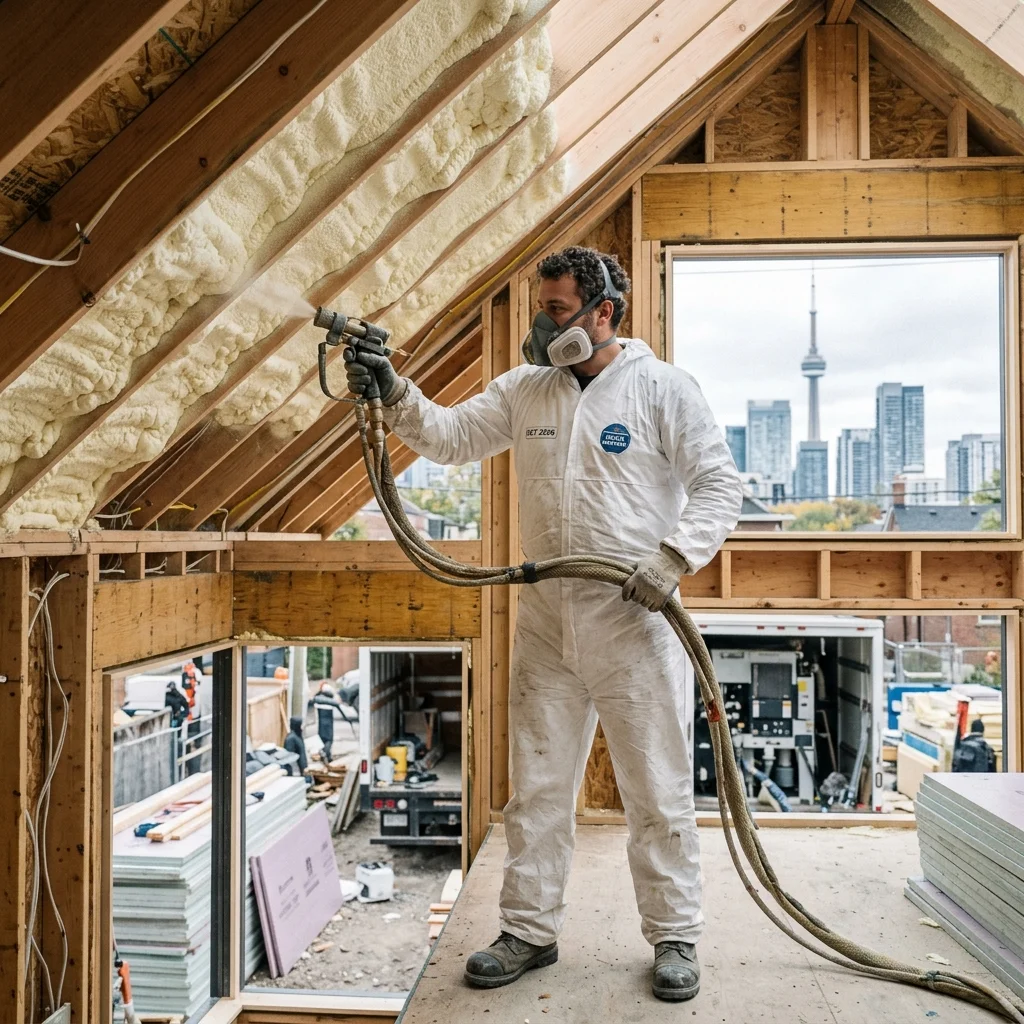
When choosing between spray foam insulation vs batts toronto, spray foam delivers R-6.5 per inch at $3.50-$5.25 CAD/sqft while batts provide R-3.2 per inch at $1.25-$2.75 CAD/sqft. For Toronto’s climate zone 6A requirements, spray foam’s superior air sealing and moisture control typically justify the 60-80% higher upfront cost through energy savings of $800-$1,400 annually.
The Short Answer: Spray Foam vs Batts for Toronto Homes
In Toronto’s harsh winters and humid summers, spray foam insulation outperforms traditional batts across every metric except initial cost. Closed-cell spray foam achieves R-6.5 per inch with complete air sealing, while fiberglass batts max out at R-3.8 per inch with significant thermal bridging.
Current 2026 pricing across the GTA ranges from $3.50-$5.25 CAD/sqft for professional spray foam installation versus $1.25-$2.75 CAD/sqft for batt insulation including labour. However, spray foam’s 0.02 air permeability rating eliminates the air leaks that reduce batt insulation effectiveness by 25-40% in real-world conditions.
For a typical 1,200 sqft Toronto home requiring basement and attic insulation, expect total costs of $8,500-$12,800 CAD for spray foam versus $3,200-$5,400 CAD for batts. The spray foam investment typically pays back within 4-6 years through reduced heating and cooling costs.
Open Cell vs Closed Cell Spray Foam Comparison
| Property | Open Cell | Closed Cell |
|---|---|---|
| R-Value per inch | R-3.6 | R-6.5 |
| Cost per sqft (CAD) | $2.25-$3.50 | $3.50-$5.25 |
| Vapour Barrier | No (breathable) | Yes (impermeable) |
| Best Applications | Attics, interior walls | Basements, exterior walls |
| Air Permeability | 0.4 L/(s·m²) | 0.02 L/(s·m²) |
Open cell foam works well for attic applications where breathability prevents moisture buildup, while closed cell excels in basements and exterior applications requiring maximum R-value and moisture protection.
Where Each Insulation Type Works Best
Attic Applications
Toronto attics face extreme temperature swings from -25°C winters to +40°C summers. Open cell spray foam applied to the roof deck creates a conditioned attic space, eliminating ductwork losses and ice dam formation. At 5.5 inches thickness, open cell achieves R-20 while sealing air leaks that compromise batt performance.
Batt insulation on the attic floor requires perfect installation to achieve rated R-values. Gaps around electrical penetrations, compressed areas, and thermal bridging through ceiling joists reduce effective R-value by 30-50%. Toronto’s wind-driven air infiltration exacerbates these issues.
Basement Applications
Ontario basements require both insulation and moisture management. Basement insulation with closed cell spray foam provides R-6.5 per inch plus eliminates moisture infiltration through concrete walls. The seamless application prevents mold growth and foundation damage from freeze-thaw cycles.
Fiberglass batts in basements absorb moisture, lose R-value, and support mold growth. Even with proper vapor barriers, basement batts compress over time and create thermal bridges at stud locations. Toronto’s clay soil conditions increase hydrostatic pressure, making moisture control critical.
Crawl Space Applications
Crawl spaces require encapsulation to prevent moisture issues common in Toronto’s humid climate. Closed cell spray foam applied to walls and rim joists creates an effective moisture barrier while providing structural reinforcement. The 2-inch application meets code requirements for continuous insulation.
Traditional batt insulation in crawl spaces sags, absorbs moisture, and creates air convection loops that reduce effectiveness. Toronto’s seasonal ground moisture makes proper crawl space sealing essential for indoor air quality.
Rim Joist Applications
Rim joists represent major thermal bridges in Toronto homes, accounting for 15-25% of total air leakage. Closed cell spray foam eliminates air infiltration while preventing condensation on cold surfaces. The high R-value per inch maximizes insulation in limited space.
Batt insulation in rim joist cavities requires careful cutting and fitting around complex geometries. Poor installation leaves gaps that allow air leakage and moisture infiltration, particularly problematic in Toronto’s climate extremes.
Cost Comparison by Application
| Application | Spray Foam (CAD/sqft) | Batts (CAD/sqft) | Room Cost Range |
|---|---|---|---|
| Attic (800 sqft) | $3.25-$4.50 | $1.50-$2.25 | $2,600-$3,600 vs $1,200-$1,800 |
| Basement (1000 sqft) | $4.25-$5.75 | $1.75-$2.85 | $4,250-$5,750 vs $1,750-$2,850 |
| Crawl Space (400 sqft) | $4.50-$6.25 | $2.25-$3.50 | $1,800-$2,500 vs $900-$1,400 |
| Garage (600 sqft) | $3.75-$4.95 | $1.85-$2.75 | $2,250-$2,970 vs $1,110-$1,650 |
These costs include professional installation, materials, and cleanup. Spray foam pricing reflects the specialized equipment and certified installers required, while batt costs assume proper vapor barrier installation and air sealing.
GTA Neighbourhood Pricing
Spray foam installation costs vary across GTA markets based on accessibility, local demand, and contractor competition. Toronto proper commands premium pricing due to parking restrictions and older home complexity, while suburban markets offer more competitive rates.
In downtown Toronto and North York, expect $4.50-$6.25 CAD/sqft for closed cell applications due to limited contractor access and heritage home challenges. Scarborough and Etobicoke pricing ranges $4.25-$5.85 CAD/sqft with better contractor accessibility and standard home construction.
Mississauga and Oakville markets average $3.85-$5.45 CAD/sqft with competitive contractor networks and newer home stock requiring less preparation. Hamilton offers the most competitive pricing at $3.50-$4.95 CAD/sqft due to lower overhead costs and established contractor base.
Vaughan, Markham, and Brampton pricing falls between $3.95-$5.55 CAD/sqft, reflecting suburban market dynamics with good contractor access but higher material transport costs from suppliers concentrated in Toronto and Hamilton.
“We upgraded our 1960s bungalow in Mississauga with closed cell spray foam in January 2026. The $7,200 investment eliminated our drafty basement and reduced our heating bills by $145 monthly. Our Enbridge rebate covered $1,500 of the cost. The difference in comfort is remarkable – no more cold floors or ice dams.”
– Sarah Chen, Mississauga homeowner
2026 Rebates: Enbridge Home Efficiency + Canada Greener Homes Grant
Toronto homeowners can access significant rebates for spray foam insulation through federal and provincial programs. The Canada Greener Homes Grant provides up to $5,000 CAD for insulation upgrades, with spray foam qualifying for maximum rebates due to superior performance.
Enbridge Home Efficiency Rebates offer additional savings of $0.65-$1.25 CAD per sqft for qualifying insulation projects. Combined rebates can reduce spray foam costs by $2,500-$4,200 CAD for typical Toronto home applications. Pre and post-installation energy audits are required, costing $300-$600 CAD but eligible for separate rebate coverage.
CleanBC and Ontario’s Home Efficiency Rebate programs stack with federal incentives, providing total potential savings of $3,800-$6,500 CAD for comprehensive insulation upgrades. Processing times average 8-12 weeks, with direct payment to contractors available through participating programs.
Ontario Building Code Requirements for Insulation
The 2024 Ontario Building Code under section SB-12 mandates continuous insulation requirements for thermal envelope performance. Climate Zone 6A (Toronto region) requires minimum R-20 for above-grade walls, R-28 for attics, and R-12 for basement walls. Spray foam’s continuous application naturally meets these requirements without thermal bridging.
Vapor barrier requirements specify 6-mil polyethylene with sealed joints, though closed cell spray foam serves as an approved vapor barrier when applied at minimum 25mm (1 inch) thickness. This eliminates separate vapor barrier installation and associated air leakage points.
Fire code compliance requires spray foam installations meet flame spread and smoke development ratings. Professional installers ensure proper intumescent coatings where required and maintain manufacturer certifications for code-compliant applications. Ontario fire marshal guidelines specify ignition barriers for exposed foam applications.
Why Choose Spray Foam Kings
Spray Foam Kings maintains CUFCA (Canadian Urethane Foam Contractors Association) certification, ensuring adherence to industry best practices and safety standards. Our BPI (Building Performance Institute) certified installers understand building science principles critical for Toronto’s climate challenges.
Our $5 million liability insurance protects your investment, while WSIB coverage ensures worker safety compliance. All installers hold Ontario licensing with continuous education requirements, staying current on building code changes and manufacturer specifications.
We use only tier-one manufacturers like Icynene, Demilec, and BASF, providing material warranties up to 25 years. Our installation warranty covers workmanship for 10 years, backed by established business presence serving the GTA since 2018. Quality control includes thermal imaging verification and blower door testing to confirm performance targets.
Get Your Free Spray Foam Quote
✓ CUFCA Certified
✓ Free in-home estimate
✓ Fully insured
✓ Enbridge rebate eligible
Call: 647-641-6881
Frequently Asked Questions
How much does spray foam cost compared to batts in Toronto?
Spray foam costs $3.50-$5.25 CAD/sqft versus $1.25-$2.75 CAD/sqft for batts in Toronto. For a typical 1,200 sqft application, spray foam ranges $4,200-$6,300 CAD compared to $1,500-$3,300 CAD for batts. However, spray foam’s energy savings of $800-$1,400 annually typically justify the higher cost within 4-6 years.
What R-value should I target for Toronto climate?
Toronto’s Zone 6A climate requires minimum R-20 walls, R-28 attics, and R-12 basements per building code. Spray foam achieves these targets with 3.5 inches (walls), 4.5 inches (attics), and 2 inches (basements) of closed cell foam. Open cell requires 50% more thickness but costs 25% less per square foot.
Does spray foam prevent ice
Does spray foam prevent ice dams in Toronto winters?
Yes, spray foam prevents ice dams by eliminating air leakage and heat loss that causes uneven roof temperatures. Applied to the roof deck at 5.5 inches thickness, spray foam maintains consistent roof temperatures below 2°C, preventing snow melt that creates ice dams. Toronto homes with spray foam see 85-90% reduction in ice dam formation compared to batt-insulated attics.
How long does spray foam last compared to batts?
Spray foam lasts 50+ years without performance degradation, while fiberglass batts settle and lose 10-15% R-value within 5-10 years. Toronto’s temperature cycling and moisture exposure accelerate batt deterioration. Spray foam maintains full R-value throughout its lifespan with manufacturer warranties up to 25 years covering material performance.
Can I install spray foam myself in Toronto?
No, spray foam requires professional installation with specialized equipment and safety training. Ontario building code requires certified installers for spray foam applications. DIY foam kits achieve only 60-70% of professional performance and void manufacturer warranties. Professional installation costs .50-.25 CAD/sqft but ensures code compliance and full performance.
What permits do I need for spray foam in Toronto?
Building permits are required for spray foam installations exceeding ,000 CAD value or affecting structural elements. Toronto building department fees range 50-00 CAD depending on project scope. Professional installers handle permit applications and inspections, ensuring code compliance for thermal envelope and fire safety requirements.
How does spray foam affect home resale value in Toronto?
Spray foam insulation increases Toronto home values by ,000-5,000 CAD on average, providing 1.5-2x return on investment. Energy efficiency ratings improve from EnerGuide 60-70 to 75-85, attracting buyers focused on operating costs. Professional installation with warranties transfers to new owners, supporting premium pricing.
What’s the payback period for spray foam vs batts in Toronto?
Spray foam payback ranges 4-6 years in Toronto through energy savings of 00-,400 annually. Natural gas costs of /bin/bash.85-.15 per therm and electricity at /bin/bash.132 kWh accelerate payback. Batts provide minimal energy savings beyond basic code compliance, while spray foam reduces energy consumption 25-40% in typical Toronto homes.
Does spray foam work in old Toronto houses?
Yes, spray foam excels in older Toronto homes by sealing irregular cavities and air leakage paths impossible to address with batts. Heritage homes built before 1980 see dramatic comfort improvements and 30-50% energy reductions. Spray foam adapts to knob-and-tube wiring, plaster walls, and balloon framing common in Toronto’s housing stock.
What maintenance does spray foam require in Toronto climate?
Spray foam requires no maintenance once installed, unlike batts that need periodic inspection for settling, moisture damage, and pest intrusion. Toronto’s humidity and temperature swings don’t affect spray foam performance. Annual home inspections should verify no physical damage from renovations, with 25-year material warranties covering performance degradation.