
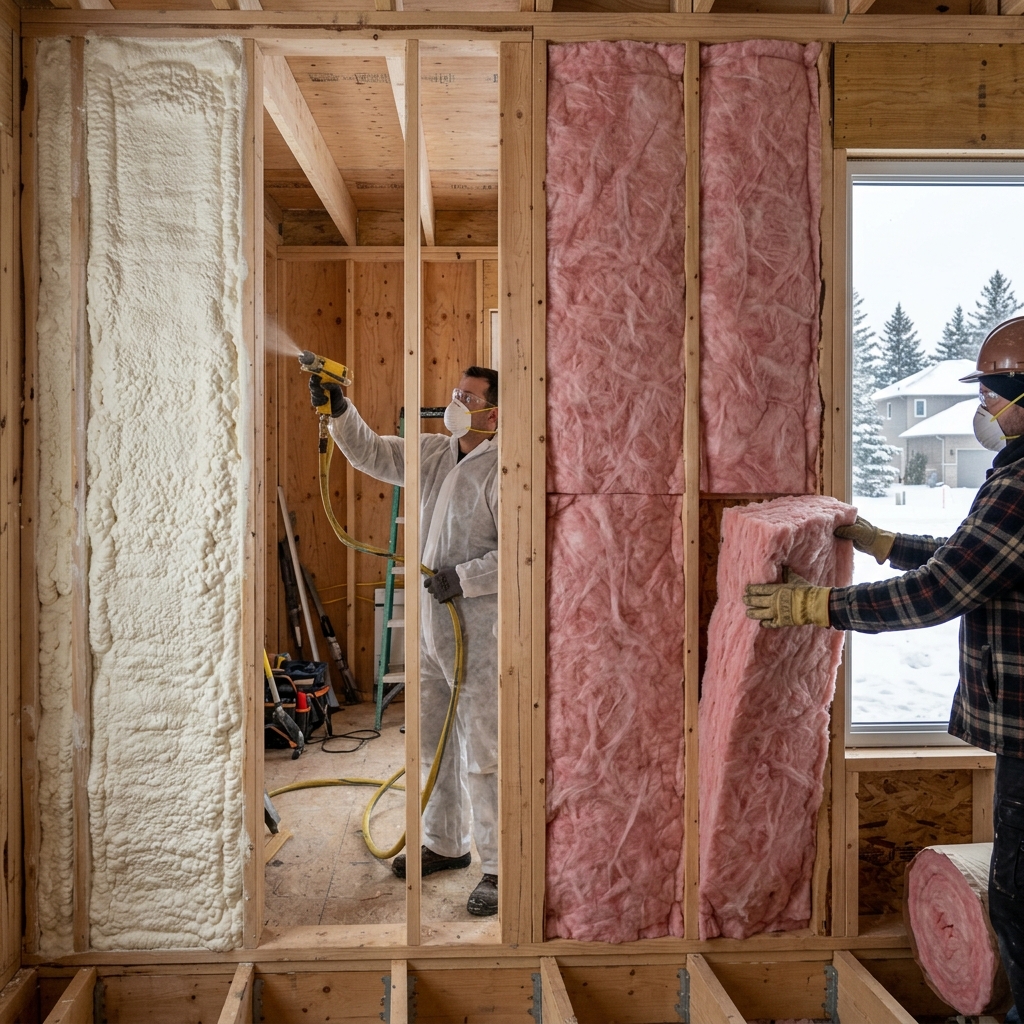
What’s the difference?
If you own a home in the GTA and you’re thinking about insulation—whether for a basement renovation, attic upgrade, or new build—you’ll hear two names constantly: spray foam and fiberglass batts. Both work. Both are installed across the region every day. But they solve different problems, cost different amounts, and come with different trade-offs. Spray foam creates an air-tight seal by expanding into cavities and gaps; fiberglass batts are rolled or fitted into wall studs, joists, and rafter spaces, relying on passive thermal resistance. The choice between them often comes down to your budget, the scope of your project, how much air leakage matters in your specific space, and what local building codes allow. In 2026, with energy costs climbing and GTA homes aging, making the right call here can mean the difference between a comfortable, efficient home and one that leaks heat or develops moisture problems. This guide walks through both options so you can decide which one fits your situation.
Side-by-side comparison
| Criterion | Spray Foam Insulation | Fiberglass Batt Insulation |
|---|---|---|
| Material Cost (per sq. ft., GTA 2026) | $1.50–$3.00 CAD (open-cell); $3.00–$6.00 CAD (closed-cell) | $0.40–$1.00 CAD |
| Installation Labour (per sq. ft.) | $2.00–$4.50 CAD | $0.50–$1.50 CAD |
| Total Project Cost (500 sq. ft. basement) | $1,750–$3,750 CAD | $450–$750 CAD |
| Installation Timeline | 1–3 days (curing varies) | 1–2 days |
| Building Permit Required (GTA) | Usually yes (insulation + air seal work) | Usually no (standard material) |
| When to Choose This Option | Irregular cavities, basement moisture concerns, air-sealing priority, high energy savings target | Budget-conscious, straightforward wall/attic, moisture not a primary concern, quick turnaround |
| Risk If Wrong Choice | Over-budget; moisture trap if vapour barrier misapplied; off-gassing concerns if improperly installed | Poor air seal; heat loss at gaps; moisture migration in basements; settling over time |
Spray foam insulation — when it’s the right call
Spray foam is your answer when you need an air-tight, moisture-resistant seal in complex or hard-to-reach spaces. Open-cell spray foam (lighter, more flexible, around $1.50–$3.00 CAD per sq. ft.) works well in interior walls and attics where vapour permeability is desired; closed-cell spray foam (denser, more rigid, $3.00–$6.00 CAD per sq. ft.) is engineered for basements, crawlspaces, and exterior walls where moisture barrier performance is critical. In the GTA, where basement dampness is a frequent headache and many homes have irregular rafter angles or complex joist spacing, spray foam excels at filling voids that batts would leave. It also provides structural reinforcement—the foam adds rigidity to walls and can help with sound dampening. If your project involves basement insulation, you’re dealing with an older home with shifting framing, or you want to minimize air infiltration (a major driver of heating costs in winter), spray foam’s upfront cost is often recovered through energy savings within 5–10 years. The drawback: it requires specialized equipment, licensed applicators, and typically a permit from your local GTA municipality. You also need to account for curing time and ensure proper ventilation during and after application. If budget is your only constraint, spray foam may feel expensive—but if comfort, durability, and energy efficiency matter, it’s a premium investment that pays dividends in a GTA winter.
Fiberglass batt insulation — when it’s the right call
Fiberglass batts are the tried-and-true, cost-effective backbone of residential insulation across Canada. At $0.40–$1.00 CAD per sq. ft. and labour rates of $0.50–$1.50 CAD per sq. ft., a 500 sq. ft. attic project can be completed for $450–$750 CAD, making them ideal for homeowners on tight budgets or renovating on a phased timeline. Installation is straightforward: cut to fit, staple or friction-fit between studs, and go. No permits, no specialized equipment, no curing wait. Batts come in standard R-values (R-12, R-20, R-30, R-40) and fit neatly into standard framing, making them perfect for attic insulation projects, interior wall infill, or above-grade rim joist wrapping. They’re also easier to remove if you need to access wiring, plumbing, or HVAC later. However, fiberglass batts are passive: they don’t seal air leaks at seams, corners, or where studs meet rim joists. Over time, they settle and lose R-value. In humid or damp environments (like basements or crawlspaces), they can absorb moisture and lose effectiveness—or worse, harbour mold. They also do nothing to reduce sound transmission. For a simple, code-compliant attic top-up or interior bedroom wall in a new construction home with tight framing, batts are sensible. But for a basement, a home with significant air leakage, or a retrofit where thermal performance is critical, batts alone usually fall short.
Edge cases and GTA-specific factors
GTA municipalities—Toronto, Mississauga, Brampton, Durham Region, and others—each have their own building bylaws, energy codes, and permit requirements. Toronto’s updated energy code increasingly encourages high-performance insulation in new builds and major renovations, which often nudges builders toward spray foam for air-sealing compliance. Some municipalities require air-sealing as part of the insulation specification; fiberglass alone may not satisfy this. Insurance considerations also matter: some older GTA homes with asbestos-contaminated batts require professional abatement before new insulation can be installed—a cost that spray foam projects sidestep by working around existing material. Moisture is a GTA-specific wildcard. Our climate means freeze-thaw cycles and seasonal humidity swings; basements and crawlspaces are particularly vulnerable. Spray foam’s vapour-barrier properties are an advantage here. Neighbourhood considerations include renovation trends—if your street is seeing new builds or renovations with spray foam, it may signal that local contractors are equipped and experienced with it, potentially reducing your timeline. Conversely, in older established neighbourhoods, fiberglass contractors are plentiful and may offer faster service. Finally, resale perception: homes marketed as energy-efficient often list spray foam insulation as a feature, which can influence buyer appeal in the GTA’s competitive market. Budget, local code compliance, and the specific moisture profile of your space should drive the choice, but these context factors are worth weighing too.
Frequently asked questions
Q: Is spray foam insulation toxic?
Spray foam off-gasses isocyanates during application and for a short period after; this is why professionals use respirators and homeowners should vacate during installation. Once cured (typically 24 hours), modern spray foam products approved for residential use are inert and safe. Always ensure your contractor follows provincial guidelines and uses products certified for indoor use in Canada.
Q: Will fiberglass batt insulation settle and lose its R-value?
Yes, over 10–20 years, batts can settle by 10–20%, reducing effective R-value by a similar margin. Spray foam, being rigid and adhered to framing, does not settle. If long-term thermal performance is a priority, spray foam maintains its rated R-value over decades.
Q: Do I need a permit for spray foam in my GTA home?
Most GTA municipalities require a permit for spray foam insulation, especially if it involves air-sealing or structural work. Fiberglass typically does not. Check with your local building department; permits usually cost $200–$500 CAD and take 1–3 weeks to issue.
Q: Can I install fiberglass batts in my basement myself?
Technically yes, but moisture is a risk. GTA basements are prone to dampness; if moisture wicks into batts, they lose R-value and can develop mold. If you DIY, use a moisture barrier and ensure good drainage and ventilation. Many homeowners find hiring a professional worth the peace of mind, especially for basements.
Q: How much energy will I save by upgrading from old insulation to spray foam?
Savings vary widely based on climate, home size, and current insulation state. GTA homeowners upgrading an attic from R-12 to R-40 typically see 15–25% reduction in heating costs. Spray foam’s air-sealing adds another 5–10% savings compared to batt-only upgrades. Your exact savings depend on your utility rates and system efficiency; get a professional energy audit for a precise estimate.
Q: What’s the lifespan of spray foam versus fiberglass?
Spray foam lasts 80+ years if protected from UV and mechanical damage; fiberglass batts typically last 15–30 years before settling and degradation become noticeable. In a GTA basement or attic with stable conditions, spray foam offers superior longevity and represents better long-term value despite higher upfront cost.
Bottom line
Choose spray foam if: You’re insulating a basement or crawlspace where moisture is a concern; your home has irregular framing or hard-to-reach cavities; you want to maximize air sealing and energy efficiency; you’re doing a comprehensive retrofit; or you prioritize long-term durability and don’t mind paying more upfront. Spray foam is the premium choice for complex GTA projects where performance and moisture resilience matter.
Choose fiberglass batts if: Budget is your primary constraint; you’re upgrading a straightforward attic or interior wall with standard framing; you need a quick installation with minimal disruption; permits and specialized contractors are a hassle; or your project is low-risk for moisture. Batts are the practical, no-fuss option for simple jobs.
Neither choice is universally “right”—it depends on your space, your budget, and your priorities. If you’re leaning toward spray foam and want to explore options specific to your GTA home, get a free quote to see how the numbers work for your project. Whether you choose foam or batts, the key is to insulate—an uninsulated or under-insulated GTA home loses money every winter.