
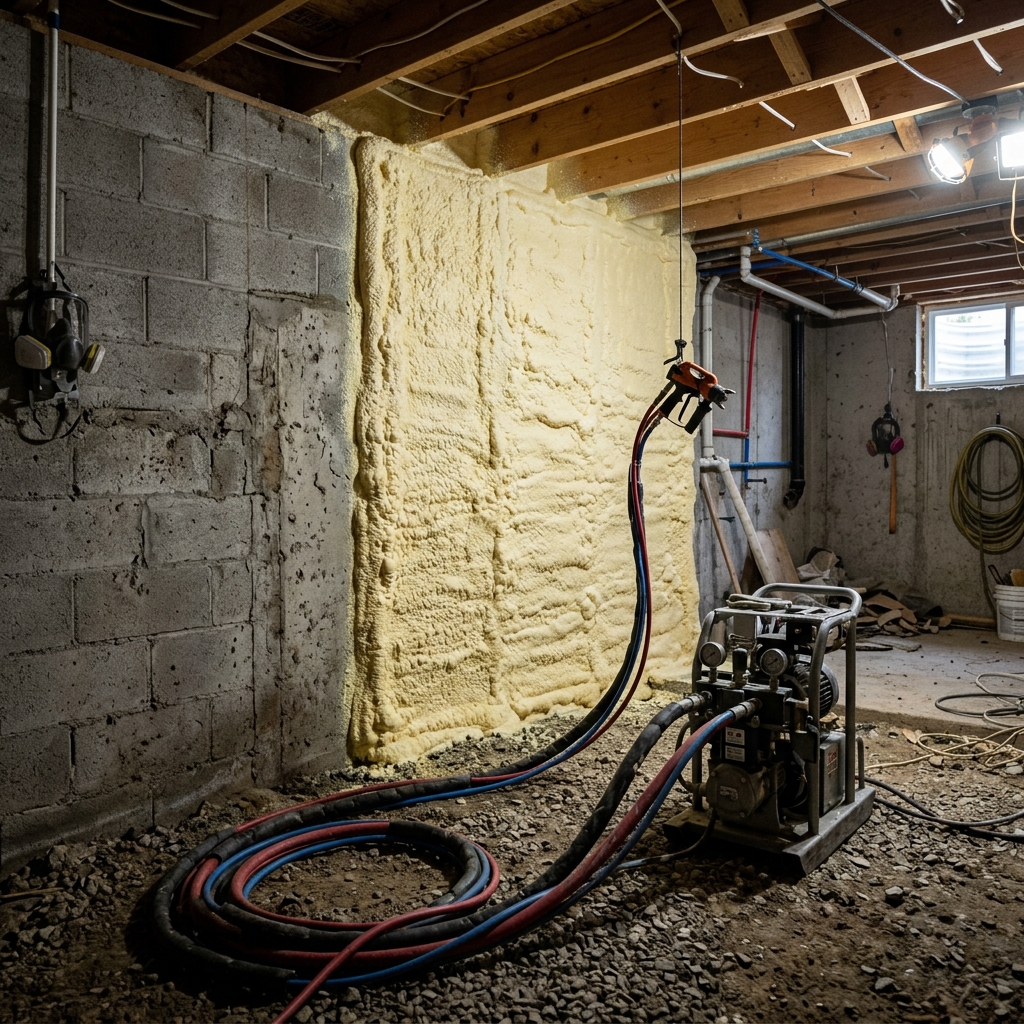
Choosing the right insulation strategy for a new build in the GTA is one of the highest-leverage decisions a builder or general contractor makes before drywall goes up. Spray foam applied to an open frame performs fundamentally differently from spray foam installed as a retrofit — different adhesion dynamics, different vapor management requirements, and a completely different cost-per-unit-of-performance calculation. This guide breaks down every factor that matters for your GTA project: material costs, framing schedule impact, Ontario Building Code SB-12 compliance paths, moisture strategy, and the volume economics that make spray foam the dominant specification choice for multi-house developers in Markham, Mississauga, and beyond.
New Construction vs Retrofit Spray Foam: Which Is Right for Your GTA Build?
New construction and retrofit spray foam installations share the same chemistry but diverge sharply in application context, cost structure, and performance ceiling. In a new frame, cavities are open and accessible — a technician can cover every rim joist, every stud bay, and every rafter cavity in a single mobilization before any trades compete for access. The result is a continuous air-barrier with zero penetrations that a retrofit installation can rarely match because walls, ceilings, and floors are already enclosed.
Retrofit applications require drilling, injection, or teardown to reach cavities. Labor costs rise, coverage is never perfect, and code compliance depends on what was originally installed. For homeowners upgrading a 1980s bungalow in North York, retrofit is the only option. For builders framing 10 townhouses in Scarborough, new construction spray foam is the decision that drives framing schedule, code sign-off speed, and long-term warranty exposure — all at once.
The cost premium for spray foam over blown cellulose is real: roughly $1.90–$2.80/sqft more at application. That number looks different when you account for schedule savings, vapor barrier elimination, and the 30-year builder warranty exposure that comes with a blown-in product that settles.
Cost Comparison: Spray Foam vs Blown Cellulose for New Construction
The table below compares the two primary insulation choices GTA builders use for new construction framing. Prices are in CAD per square foot of wall, floor, or ceiling surface covered, based on current GTA contractor rates.
| Insulation Type | Material Cost (CAD/sqft) | Labor (CAD/sqft) | Total Installed (CAD/sqft) | Vapor Barrier Required? | Settling Risk |
|---|---|---|---|---|---|
| Open-Cell Spray Foam | $0.80–$1.60 | $0.70–$1.90 | $1.50–$3.50 | Yes (attic with drainage design) | None |
| Closed-Cell Spray Foam | $1.50–$2.80 | $1.00–$2.20 | $2.50–$5.00 | No (acts as Class II VB at 2″+) | None |
| Blown Cellulose | $0.20–$0.50 | $0.40–$0.70 | $0.60–$1.20 | Yes (kraft paper or poly required) | 6–8% over 6 months |
| Fiberglass Batts | $0.25–$0.55 | $0.35–$0.65 | $0.60–$1.20 | Yes (poly vapour barrier required) | Moderate (compression risk) |
Builder bottom line: On a 2,500 sqft new home with 3,500 sqft of insulated surface (walls + attic + foundation), closed-cell spray foam adds approximately $4,200–$8,750 over blown cellulose. That premium needs to be offset by schedule savings, vapor barrier elimination, and warranty certainty — and for most GTA builders running multi-unit specs, it is.
For a deeper look at spray foam against fiberglass batts, see our Spray Foam vs Fiberglass Insulation Toronto guide. For blown-in alternatives, our Spray Foam vs Blown-In Insulation comparison covers the full trade-off. For cellulose-specific analysis, read our Spray Foam vs Cellulose Insulation Toronto guide.
Spray Foam vs Fiberglass vs Cellulose: Full Performance Comparison
| Factor | Closed-Cell Spray Foam | Open-Cell Spray Foam | Fiberglass Batts | Blown Cellulose |
|---|---|---|---|---|
| R-Value per inch | R-6.0–6.5 | R-3.5–3.8 | R-3.1–3.7 | R-3.4–3.8 |
| Air Sealing | Excellent (monolithic) | Very Good | Poor (gaps at framing) | Moderate (settling gaps) |
| Moisture Resistance | Excellent (Class II VB) | Moderate | Poor (absorbs moisture) | Moderate (treated for mold) |
| Settling Over Time | None | None | 5–10% compression | 6–8% (critical at rim joists) |
| OBC SB-12 Compliance Path | Straightforward (R-6/in) | Achievable (R-3.7/in) | Requires thick cavity + CI | Settling delay, re-inspection risk |
| Structural Benefit | Yes (+200–300% racking) | None | None | None |
| Vapor Barrier Needed? | No (≥2″) | Yes | Yes | Yes |
| New Construction Schedule Impact | 2–3 days faster vs cellulose | 1–2 days faster vs cellulose | Neutral | Slowest (settling buffer required) |
Timeline Impact: Does Spray Foam Speed Up or Slow Down Framing?
Spray foam’s biggest competitive advantage over blown cellulose in new construction is the framing-to-drywall schedule compression. Here is how the sequence compares:
Blown cellulose new construction sequence:
- Frame complete → cellulose installed in cavities (Day 1–2)
- Mandatory 6-month settling buffer before accurate R-value measurement — or inspector signs off at nominal depth with note flagging potential settling
- Poly vapor barrier installed over cellulose (adds 1 day)
- Pre-drywall inspection → drywall
Spray foam new construction sequence:
- Frame complete → spray foam applied (Day 1)
- Cure time: 24 hours (closed-cell) or 4–8 hours (open-cell)
- Pre-drywall inspection next morning — foam is measurable, certified R-value confirmed on-site
- Drywall begins Day 3
The net schedule advantage is 2–3 days per house for closed-cell, and 1–2 days for open-cell. On a 10-house GTA spec where each day of delay costs $800–$1,200 in carrying costs (financing plus labor standby), the schedule savings alone can recover $16,000–$36,000 of the spray foam premium across the development.
Code Compliance: OBC SB-12 Requirements & R-Value Achievement Paths
Ontario Building Code Supplementary Standard SB-12 sets effective thermal resistance targets for new residential construction across Ontario’s climate zones. GTA municipalities fall within Climate Zone 5. The following table maps each assembly location to the SB-12 prescriptive minimum and the path each insulation type takes to compliance:
| Assembly Location | OBC SB-12 Min. Effective R | Closed-Cell Solution | Open-Cell Solution | Cellulose Solution |
|---|---|---|---|---|
| Attic (above top plate) | R-31 (Zone 5 prescriptive) | 5″ = R-30 + sheathing CI | 8.5″ = R-31.5 ✓ | 9.5″ nominal (settling risk after 6 months) |
| Cathedral Ceiling / Rafter Cavity | R-31 effective | 5″ closed-cell = R-30; add 1″ CI = R-36 ✓ | Not recommended (moisture risk) | Not feasible (no air gap) |
| Above-Grade Walls (2×4) | R-22 effective (Zone 5) | 3.5″ closed-cell = R-21 + sheathing = R-23 ✓ | Requires 2×6 framing for compliance | Requires external CI (R-7.5 board) ✓ |
| Basement Walls | R-17 (above slab) | 3″ closed-cell = R-18 ✓ | 5″ open-cell = R-18.5 ✓ | Moisture risk — not recommended below grade |
| Rim Joist | R-10 minimum | 2″ closed-cell = R-12 ✓ (continuous seal) | 3″ open-cell = R-11 ✓ | Not continuous — settling gaps persist |
Critical compliance note: Blown cellulose carries a real inspection risk in new construction. Because cellulose settles 6–8% within the first six months, an inspector who signs off at Day-1 nominal depth may be approving a product that falls below required depth by occupancy. Spray foam achieves its rated R-value on day one and holds it permanently — no settling, no re-inspection, no warranty exposure. Learn more about our spray foam insulation services and closed-cell spray foam options.
Moisture Control Strategy: Vapor Barriers in New Framing vs Retrofit
Ontario’s climate (Climate Zone 5) requires a Class II or better vapor barrier on the warm-in-winter side of any insulated assembly. Spray foam simplifies this requirement significantly for new construction:
- Closed-cell foam at 2″+ acts as a Class II vapor retarder (perm rating ≤1.0) — no separate poly sheet required in above-grade walls when using closed-cell at that thickness.
- At slabs and foundation walls: closed-cell is mandatory for new construction. It resists liquid water and soil-side moisture. Open-cell and cellulose absorb moisture and are not appropriate below-grade without a separate drainage membrane.
- Attics: open-cell is acceptable in vented attic assemblies when combined with proper soffit/ridge ventilation. In conditioned (unvented) attics — the configuration GTA builders increasingly specify for future attic conversion — closed-cell in the rafter cavity is the appropriate solution.
- New construction vs retrofit moisture distinction: in a new frame, you control the moisture history from Day 1. Spray foam locked in at framing stage seals the assembly permanently before any occupant activity introduces moisture load — a significant advantage over retrofit where prior water events may have left hidden damage behind existing drywall.
Attic Conditioned-Space: Why Spray Foam Wins for Future Conversions
GTA builders increasingly specify conditioned attics in new construction for one reason: resale value. An attic insulated at the rafter cavity with closed-cell spray foam — rather than at the flat ceiling with blown cellulose — creates a dry, thermally controlled space that can be converted to a bonus room, home office, or legal bedroom without insulation replacement.
Blown cellulose at the ceiling line cannot stay exposed once the attic is accessed for conversion. It is loose, dusty, not vapor-managed, and triggers a full re-insulation project. Spray foam in the rafter cavity stays in place permanently, requires no upgrade, and adds racking strength to the roof structure.
The builder upsell conversation with GTA buyers is straightforward: “Your attic is already conditioned — you can finish it yourself in five years without touching the insulation.” That feature commands a $15,000–$30,000 premium on resale in Toronto, Markham, and Mississauga markets. Our attic insulation service covers both new construction rafter-cavity and retrofit ceiling applications.
Rim Joist New Construction: Spray Foam vs Cellulose Air-Sealing
The rim joist is the single highest-loss thermal bridge in a new GTA home. It sits where the floor framing meets the foundation wall — cold concrete on one side, conditioned basement air on the other — and runs the entire perimeter of the structure. In a typical 2,400 sqft GTA home, the rim joist perimeter covers 160–180 linear feet across two floors.
Blown cellulose at the rim joist is a poor substitute for spray foam because:
- Cellulose cannot self-adhere to the foundation top plate or rim board. It requires a rigid-foam backer cut into each bay before cellulose is blown over it, adding labor and creating cut-joint air-leak paths.
- Settling leaves gaps at the top and sides of the rim joist cavity over the first heating season, creating exactly the cold-air infiltration the insulation was meant to stop.
- Spray foam is applied as a liquid and expands to fill every gap — around wiring, joist hangers, and anchor bolts — forming a continuous, rigid air barrier that does not settle or shrink.
For GTA new construction with poured-concrete or block foundations, Spray Foam Kings applies 2″ closed-cell (R-12) to all rim joist bays as part of every full new-construction package. See our crawl space insulation page for foundation-specific application detail.
Volume Discount Economics: 4+ House Specs & Contractor Negotiation
Single-home retrofit customers pay standard spray foam rates. Builders running multi-unit developments have genuine negotiating leverage — and GTA-area spray foam contractors structure volume pricing accordingly.
| Project Volume | Pricing Tier | Mobilization Cost | Scheduling Priority | Estimated Savings vs Single-Home |
|---|---|---|---|---|
| 1 house (custom or retrofit) | Standard retail | $250–$400 per visit | Standard queue (2–5 weeks) | — |
| 2–3 houses (small spec) | 5–8% volume discount | $150–$250 (shared mobilization) | Priority scheduling | $800–$2,100 across project |
| 4–7 houses (mid-tier developer) | 10–14% volume discount | Included in project cost | Dedicated crew slots | $2,500–$6,000 across project |
| 8–12+ houses (developer spec) | 15–20% volume discount | Included | Exclusive scheduling window | $5,000–$14,000+ across project |
The break-even calculation for a GTA developer running 10 houses: at 15% volume discount on closed-cell, the per-house spray foam cost drops to approximately $7,200–$9,500 per 2,500 sqft home. The cellulose equivalent (with separate vapor barrier plus longer framing schedule) runs $3,100–$4,800 all-in. Net premium: $3,000–$5,500 per house. At 2.5 days of schedule savings × $1,000/day carrying cost, the net cost premium narrows to $500–$3,000 per house — while delivering code certainty, zero settling, and a conditioned-attic upsell on every unit.
For GTA developers in Markham townhouse developments, Mississauga low-rise subdivisions, or Vaughan custom spec projects, Spray Foam Kings offers dedicated bulk quoting. Call 647-641-6881 for a volume estimate.
Installation Coordination: Inspector, Permit, & Schedule Handoffs
For GTA builders and GCs, the spray foam installation window is tightly constrained by the framing inspection sequence:
- Framing permit inspection must be signed off before any insulation is installed (OBC Section 10.3). This applies equally to spray foam and cellulose.
- Spray foam installation window: 1–2 days after framing pass. All rough-in electrical and plumbing must be complete — spray foam locks wiring in place and cannot be re-run once cured.
- Pre-drywall inspection: the building inspector verifies insulation depth and coverage. Spray foam provides an inspectable, measurable surface. Certifications from SPFA-qualified installers — which Spray Foam Kings holds — are accepted at all GTA municipal permit offices.
- WSIB and liability on-site: spray foam contractors working on active construction sites must carry WSIB clearance and site-specific liability insurance. Spray Foam Kings carries $5M liability coverage and is WSIB-compliant — documentation provided before mobilization.
- Scheduling in Markham, Mississauga, and Vaughan subdivisions: municipal permit queues in these areas typically run 10–15 days for framing inspection. Book spray foam installation 7 days in advance of expected framing pass to avoid crew scheduling gaps.
Ontario Rebates for New Construction Spray Foam
New construction homes are generally ineligible for retrofit rebate programs, but GTA builders and buyers should know which programs apply to their situation:
- IESO Better Homes Loan (Ontario): Available to homeowners of newly completed homes taking ownership. Up to $40,000 at 0% interest for energy upgrades including insulation — relevant if a new-home buyer wants to upgrade insulation specifications post-occupancy.
- Enbridge HER+ (Home Efficiency Rebate Plus): Applies to existing homes only. However, if a new build transitions to owner-occupancy and the owner subsequently retrofits (attic top-up, basement wall addition), HER+ rebates up to $10,600 apply to those upgrades.
- Net Zero new construction incentives: Builders targeting NZE certification via Natural Resources Canada can access NZE builder incentive programs. Spray foam is typically the specified insulation system for NZE envelopes due to its air-sealing performance.
- HST new housing rebate: The federal and provincial HST new housing rebate reduces the effective cost of the entire construction project — including spray foam — for homes qualifying under the program threshold.
For retrofit rebates on existing GTA homes, see our full Ontario Spray Foam Rebates guide covering Greener Homes, HER+, and OAIR programs in detail.
Serving GTA Builders Across Every Major Market
Spray Foam Kings provides new construction spray foam insulation across the Greater Toronto Area with dedicated capacity for builders and general contractors in:
- Toronto & North York: Infill new builds, semi-detached and detached custom homes, legal duplex and triplex conversions on narrow lots
- Scarborough: New detached construction, basement apartment legal-suite new builds, post-frame commercial conversions
- Markham & Vaughan: Subdivision spec homes, townhouse rowblock developments, 8–12 unit developer multi-unit projects with dedicated scheduling windows
- Mississauga & Brampton: Low-rise residential subdivisions, custom builds, commercial-residential mixed projects, developer specs with permit-queue coordination
- Etobicoke: Custom new-build homes, infill lots, above-garage conditioned-space applications, coach-house additions
Whether you’re a custom-home builder framing a single property or a developer running 12 units through permit simultaneously, our crew capacity and SPFA-certified technicians are available for your schedule window.
What GTA Builders Say About Spray Foam Kings
“We spec’d 8 townhouses in Markham last spring and had Spray Foam Kings handle all of them. Closed-cell on the rim joists and open-cell in the attic rafters — every unit passed pre-drywall inspection on the first walk. Schedule held, pricing was sharp on volume, and the WSIB paperwork was waiting for us before crew arrived on day one. We’ve added them to our standard sub list.”
— M. Delacroix, General Contractor, Markham residential developer (8-unit townhouse spec)
Why Choose Spray Foam Kings for New Construction
- SPFA Certified: All technicians certified by the Spray Polyurethane Foam Alliance — the standard accepted by GTA municipal inspectors at permit sign-off across Toronto, Markham, Mississauga, and Vaughan
- $5M Liability Insurance + WSIB Compliant: Required documentation for all active construction sites provided before first day on-site — no paperwork delays on your framing schedule
- 15+ Years GTA Experience: Including new construction, developer specs, custom builds, and multi-unit retrofit projects across all eight GTA service municipalities
- OBC SB-12 Expertise: We know which foam type, depth, and configuration achieves your required R-value on the first inspection — no re-spray, no schedule delays, no warranty exposure
- Volume Pricing for Developers: Dedicated bulk-quote process for 4+ house projects; dedicated crew windows and exclusive scheduling for 8+ house specs during peak building season
- HFO Blowing Agent: Low global-warming-potential blowing agent available — relevant for developers targeting green certification, Net Zero specs, or ESG reporting requirements
Frequently Asked Questions (Builder-Specific)
How much faster is spray foam than blown-in cellulose for new construction scheduling?
Spray foam installation in a new frame takes 1 day (closed-cell cures in 24 hours; open-cell in 4–8 hours). Blown cellulose requires a 6–8% settling buffer before accurate R-value verification, adding 1–3 days to the pre-drywall inspection sequence. Net schedule advantage for spray foam: 2–3 days per house. On a 10-house GTA spec with $1,000/day carrying costs, that’s $20,000–$30,000 in schedule savings across the development.
Does spray foam meet Ontario Building Code SB-12 requirements for new construction?
Yes. Closed-cell spray foam at R-6/inch meets or exceeds SB-12 prescriptive R-values at all assembly locations in Ontario Climate Zone 5. For above-grade walls: 3.5″ in a 2×4 stud bay equals R-21, which combined with sheathing reaches SB-12 Zone 5 effective R-22 requirements. For rim joists: 2″ closed-cell equals R-12, exceeding the R-10 SB-12 minimum. SPFA-certified documentation supports permit sign-off at all GTA municipal offices.
What is the cost per house for a 10-house spray foam spec in the GTA?
For a standard 2,500 sqft two-storey GTA detached (approximately 3,500 sqft of insulated surface including walls, attic, and rim joists), closed-cell spray foam at volume pricing runs approximately $7,500–$11,000 per house (15–18% volume discount applied to a 10-unit spec). Blown cellulose equivalent: $3,100–$4,600 per house. The spray foam premium of $3,500–$6,500 per unit is partially offset by schedule savings, vapor barrier elimination, and resale premium from conditioned-attic specification.
Can spray foam stay exposed in an attic without an ignition barrier?
No. Ontario Building Code and the National Building Code require all spray polyurethane foam installed in occupied or accessible spaces to be covered with a thermal or ignition barrier — typically 12.7mm drywall or an approved intumescent coating. In conditioned attic rafter-cavity applications, foam must be covered by drywall (finished attic) or an approved spray-on thermal barrier. Spray Foam Kings specifies and applies the appropriate barrier for every conditioned-attic new construction project.
How do builders coordinate spray foam installation with the framing inspection sequence?
Recommended sequence: (1) Book spray foam installation 7 days before expected framing inspection pass; (2) Confirm rough-in electrical and plumbing are complete before foam day; (3) Framing inspection signed off → spray foam crew mobilizes next business day; (4) Installation complete same day; (5) 24-hour cure → pre-drywall inspection booked; (6) Inspection pass → drywall. Total window from framing pass to drywall start: 2–3 days with spray foam vs 5–6 days with blown cellulose.
What is the settling risk with cellulose in new construction framing?
Blown cellulose settles 6–8% of installed depth over the first 6 months post-installation, driven by vibration from HVAC operation, framing movement, and thermal cycling. In a new construction attic with 9.5″ of cellulose (nominal R-36), the settled depth at Month 6 is approximately 8.7″–8.9″ (effective R-33–34). At rim joists, settling creates air gaps at the top and sides of each cavity that are difficult to detect and remediate post-drywall. Spray foam has zero settling — the R-value on Day 1 is the R-value in Year 30.
How do you handle vapor barriers with spray foam in new construction?
Closed-cell spray foam at 2″ or greater acts as a Class II vapor retarder (≤1.0 US perm) and satisfies the OBC vapour barrier requirement for above-grade walls and rim joists — no separate poly sheet required. Below-grade and slab applications require closed-cell (not open-cell) as the primary moisture-control layer. In attic rafter-cavity conditioned applications, a Code-compliant air-barrier design is required — Spray Foam Kings designs each application to meet the specific OBC assembly requirements for your project.
What R-value difference exists between spray foam and cellulose for OBC compliance?
At equal thickness in a 2×6 stud bay (5.5″ cavity): closed-cell spray foam = R-33; open-cell = R-20.5; blown cellulose = R-20.9 nominal, settling to R-19.3. In a 2×4 wall: closed-cell at 3.5″ = R-21 (meets effective R-22 with sheathing); cellulose at 3.5″ = R-12.6 (requires additional CI to reach SB-12 compliance). For 2×4 above-grade wall construction — still common in GTA builder-grade single detached — closed-cell is the only single-product path to SB-12 compliance without external continuous insulation.
Does spray foam for new construction qualify for any Ontario rebates?
New construction homes do not qualify for the Canada Greener Homes Grant or Enbridge HER+ (both require existing homes). However, new-home buyers who take occupancy and subsequently upgrade insulation (attic top-up, basement wall) qualify for retrofit rebate programs — up to $10,600 in combined HER+ rebates. Net Zero new construction projects may access NRCan builder incentive programs. The HST new housing rebate reduces all-in build costs including spray foam for qualifying projects.
How does spray foam affect structural performance in new construction framing?
Closed-cell spray foam adheres to framing lumber and sheathing, adding measurable racking resistance to the wall assembly. Engineering studies demonstrate a 200–300% increase in racking strength in spray-foam-filled wall panels vs empty cavity. For GTA builders in high-wind-load applications, this structural contribution can reduce the number of required shear-panel locations — a framing labor saving that partially offsets the spray foam premium. Open-cell foam does not provide structural benefit due to its flexible, low-density matrix.
How far in advance should GTA builders book spray foam for new construction?
Book 2–4 weeks ahead of expected framing inspection pass during peak GTA construction season (May–August). Spray Foam Kings reserves dedicated crew windows for volume (4+ house) projects. Single-home custom builds can typically be accommodated with 1–2 weeks notice outside peak season (September–April). For developer specs of 8–12 units, call 647-641-6881 for a project schedule integration call.
What is the volume discount for spray foam on a multi-house GTA developer spec?
Spray Foam Kings structures volume pricing at approximately 5–8% discount for 2–3 house specs, 10–14% for 4–7 houses, and 15–20% for 8–12+ house developer specs. Mobilization costs are included in project pricing for volume contracts. On a 10-house GTA spec, the volume discount saves $5,000–$14,000 compared to single-home retail pricing, significantly narrowing the premium gap over blown cellulose while retaining all schedule, code, and quality advantages.
Get Your Free Quote Today
Call: 647-641-6881
Spray Foam Kings serves builders, general contractors, and developers across the GTA — Toronto, Scarborough, North York, Etobicoke, Vaughan, Mississauga, Markham, and Brampton. SPFA certified, $5M liability, WSIB compliant. Volume pricing available for 4+ house specs. Request your bulk quote today.