
What’s the difference?
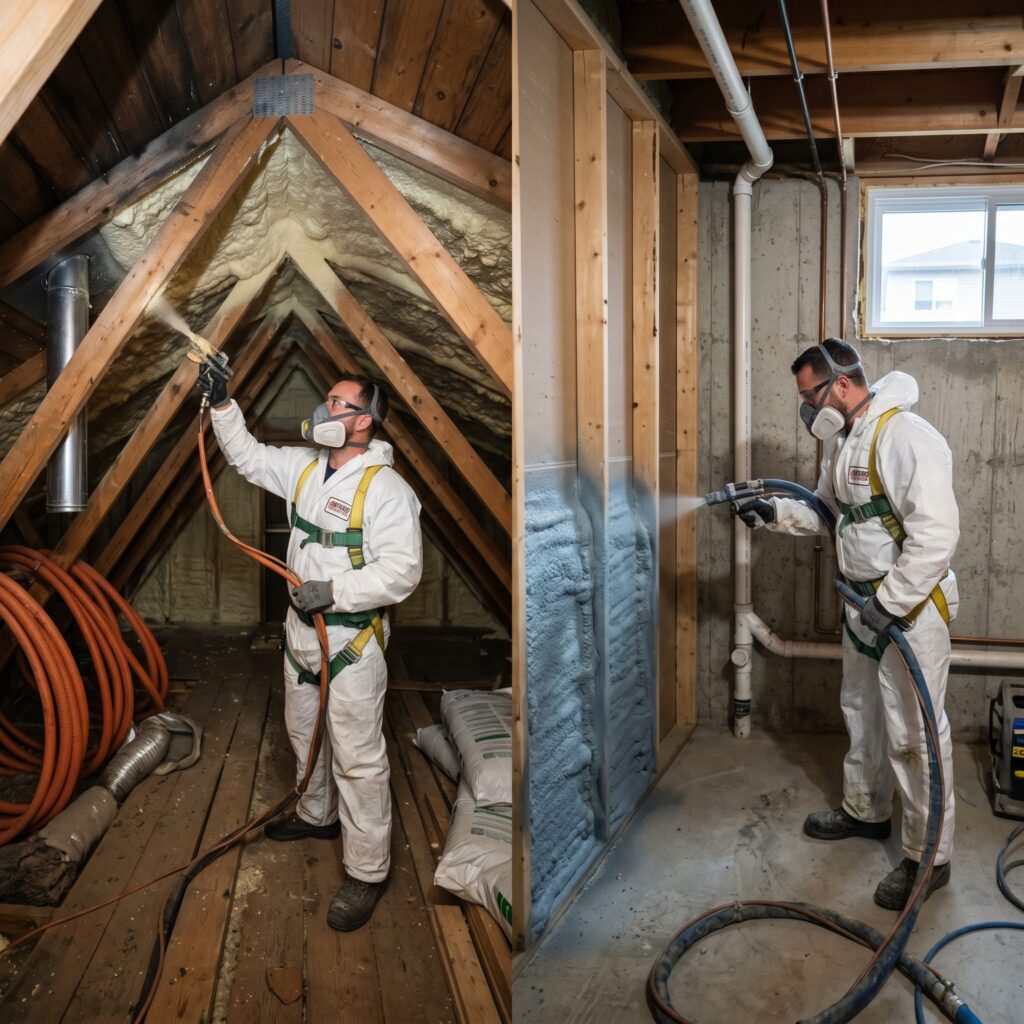
Toronto homeowners in 2026 face a critical insulation decision: attic or basement spray foam. Both use closed-cell or open-cell polyurethane to seal gaps and improve thermal performance, but the application context—temperature swings, moisture exposure, and building code compliance—differs sharply. Attic spray foam combats heat loss through your roof and guards against winter draft infiltration; basement spray foam addresses ground-level dampness, radon risk, and foundation heat escape. Your choice hinges on three factors: which space loses the most energy in your home’s profile, which project aligns with current renovations or permit cycles, and which poses the greater indoor air quality or structural risk if left untreated. This guide walks Toronto homeowners through real-world scenarios, current CAD pricing, permit timelines, and neighborhood-specific bylaw traps so you can make a decision grounded in your home’s actual performance gaps, not generic advice.
Side-by-side comparison
| Scenario | Attic Spray Foam | Basement Spray Foam |
|---|---|---|
| Typical Cost (CAD) | $2,500–$5,500 (500–1,000 sq ft) | $3,000–$7,200 (600–1,200 sq ft) |
| Installation Timeline | 1–3 days (depends on attic access) | 2–5 days (moisture prep, ventilation setup) |
| City of Toronto Permit Required | No (minor work exemption applies) | Yes, if foundation or structural work involved |
| When to Choose | High winter heating bills, drafty upper floors, roof leaks or ice damming | Damp basement smells, radon concerns, finishing basement, foundation cracks |
| Risk If Wrong Choice | Trapped moisture, mold on rafters; closed-cell blocks air movement needed for venting | Over-sealing basement without dehumidification leads to condensation and trapped radon |
| R-Value per Inch (Closed-Cell) | R-6.5–R-7 | R-6.5–R-7 (same material, different context) |
Attic spray foam — when it’s the right call
Attic spray foam is your priority if heating dominates your winter utility bill or if your roof shows signs of ice damming. Toronto’s climate—where January temperatures drop to –5°C and wind chill pushes perceived cold lower—means uninsulated or poorly insulated attics hemorrhage warmth through the ceiling plane. A typical 800-square-foot attic with existing fiberglass batts (R-20, often compressed over decades) can be upgraded to R-40+ closed-cell spray foam for $3,200–$4,500, cutting heating demand by 15–25 percent over a heating season. Closed-cell foam adheres directly to roof decking, blocking air leakage and providing secondary weather defense—critical in Toronto’s freeze-thaw cycles. Attic work avoids most permit red tape; City of Toronto classifies attic insulation as minor work. Timing matters: spray foam attics in late spring or early fall to avoid extreme heat (which slows foam cure) and winter weather that complicates roofer access. If your home has cathedral ceilings, unfinished attic spaces with exposed framing, or irregular joist spacing that defeats standard batts, attic spray foam shines. One caution: closed-cell foam in attics must still allow roof ventilation. Installers should leave soffit and ridge vents clear; blocking them traps moisture and voids the benefit. Open-cell foam is cheaper ($1,500–$3,000 for the same space) but less effective against air infiltration and drying-time sensitive in Ontario’s humid summers.
Basement spray foam — when it’s the right call
Basement spray foam becomes essential when moisture, radon, or unfinished square footage enters the picture. Toronto’s clay-heavy soils and high water table in neighborhoods like Leslieville and Scarborough mean basement walls absorb hydrostatic pressure, especially in spring thaw. Spray foam—closed-cell preferred—bonds to concrete and rim joists, sealing the capillary breaks where water traditionally wicks into framing. A 1,000-square-foot basement wall sealed with 2 inches of closed-cell foam costs $4,500–$6,500 CAD, but prevents thousands in mold remediation or structural rot later. Radon, colorless and odorless, accumulates in basements and poses long-term lung cancer risk; spray foam reduces radon entry by 20–40 percent when combined with sub-slab depressurization. Basements also represent unlocked equity—finishing a sealed, insulated basement adds $20,000–$50,000 to home value and increases livable square footage. Winter basement temperatures matter too: an uninsulated rim joist and band board lose 20–30 percent of heat; spray foam here improves comfort in finished basements and rec rooms. Basement spray foam almost always requires a Toronto permit if you’re finishing the space or altering the foundation envelope; budget 2–3 weeks for approval. Key risk: over-sealing a basement without active dehumidification (ERV or dedicated dehumidifier) traps humid indoor air and causes condensation on spray foam surfaces, inviting mold. Always pair basement spray foam with ventilation strategy review.
Edge cases and Toronto-specific factors
Toronto’s 2023 updates to the Ontario Building Code tightened air-sealing and radon-resistant construction standards. If you’re in North York, Etobicoke, or Scarborough (higher radon-risk zones per Health Canada maps), basement spray foam qualifies as radon-mitigation infrastructure and may attract municipal rebates—check your local Toronto district office. Neighborhoods with heritage designations (Rosedale, Yorkville, the Annex) sometimes restrict attic modifications visible from street view; foam itself is hidden, but new venting or roof penetrations might trigger heritage review. Insurance: some older home policies flag spray foam as a liability if applied improperly; notify your insurer before work, and ensure your contractor carries $2M liability coverage. Older Toronto homes (pre-1980s) often have asbestos in original insulation, pipe wrap, or roof shingles—remediation adds $800–$1,500 before foam work and is legally required. Humidity control matters: Toronto summers are humid (60–75 percent RH common). Attics need ridge and soffit vents open; basements need continuous dehumidification or ERV if spray foam is applied. Finally, closed-cell vs. open-cell: closed-cell is vapor-impermeable and best for basements and attics where moisture control is critical; open-cell is cheaper but absorbs water and suits only interior walls or attics with excellent venting. For free site assessment and permit guidance tailored to your postal code, contact a qualified local installer.
Frequently asked questions
1. Do I need a permit for attic spray foam in Toronto?
No, attic insulation is exempt under the City of Toronto’s minor work classification. However, if your attic work involves adding roof vents, altering electrical wiring, or touching the roof structure, a permit becomes necessary. Your installer should clarify scope before work begins.
2. How long does basement spray foam take to cure in a Toronto winter?
Closed-cell foam cures in 24–48 hours year-round, but Ontario winter humidity and temperature swings slow the process. Open-cell foam takes 7–14 days to cure and is riskier in winter; choose closed-cell for winter basement work. Schedule basement projects September through April if possible to avoid high summer humidity.
3. Will spray foam in my basement trap radon gas?
Spray foam seals entry points and reduces radon infiltration by 20–40 percent alone, but does not eliminate radon risk. Pair foam with sub-slab depressurization (a simple PVC vent pipe and fan drawing air from beneath the foundation) for 99 percent radon reduction. Cost: $1,200–$2,000 CAD for depressurization system installation in Toronto.
4. Can I use open-cell spray foam in a Toronto attic?
Open-cell is cheaper ($1.50–$2.50 per board-foot vs. $2.50–$4.00 for closed-cell) but absorbs moisture and is vulnerable to ice damming risk in Toronto’s climate. If you choose open-cell, ensure ridge and soffit vents are unobstructed and add a vapor barrier below the foam. Closed-cell is the safer choice for attics here.
5. What happens if I spray foam my basement without a dehumidifier?
Sealed basements without dehumidification trap indoor humidity (40–60 percent typical in finished basements). Spray foam surfaces cool below dew point in spring and fall, condensing moisture and promoting mold growth. Install a dedicated dehumidifier ($400–$800 CAD) or ERV system ($2,500–$4,500 CAD) alongside basement foam.
6. How much energy will I save with attic spray foam vs. basement spray foam?
Attic insulation typically saves 15–25 percent on winter heating; basement spray foam saves 8–15 percent depending on whether the basement is finished or unfinished. Attics have greater immediate impact on heating bills, but basements matter more if you’re finishing the space or have chronic dampness. A blower-door test (cost: $300–$500 CAD) identifies your home’s biggest air leaks and prioritizes your spending.
Bottom line
Choose attic spray foam if: your winter heating bills are high, your upper floors feel drafty, you see ice damming on your roof, or you’re planning attic storage or mechanical upgrades. Budget $2,500–$5,500 CAD, allow 1–3 days for installation, and expect no permit delays.
Choose basement spray foam if: your basement is damp or musty, you’re finishing the space for livable square footage, radon concerns apply to your postal code, or your rim joists and band boards are exposed. Budget $3,000–$7,200 CAD, allow 2–5 days plus 2–3 weeks for permits, and commit to dehumidification or mechanical ventilation.
Choose both if: your home is 40+ years old, you’re planning major renovations, or a blower-door test shows balanced air leaks top and bottom. Many Toronto homeowners benefit most from staged approach: attic first (faster ROI and no permits), then basement during a kitchen or bathroom renovation when contractors are already on-site.
For a free in-home energy audit, permit consultation, and pricing tailored to your address, visit attic insulation services or basement insulation services on sprayfoamkings.ca. Ask about radon-resistant construction packages, moisture control strategies, and pre-work energy audits. Licensed installers will walk you through permit timelines, heritage district rules, and insurance notifications specific to your neighborhood.