
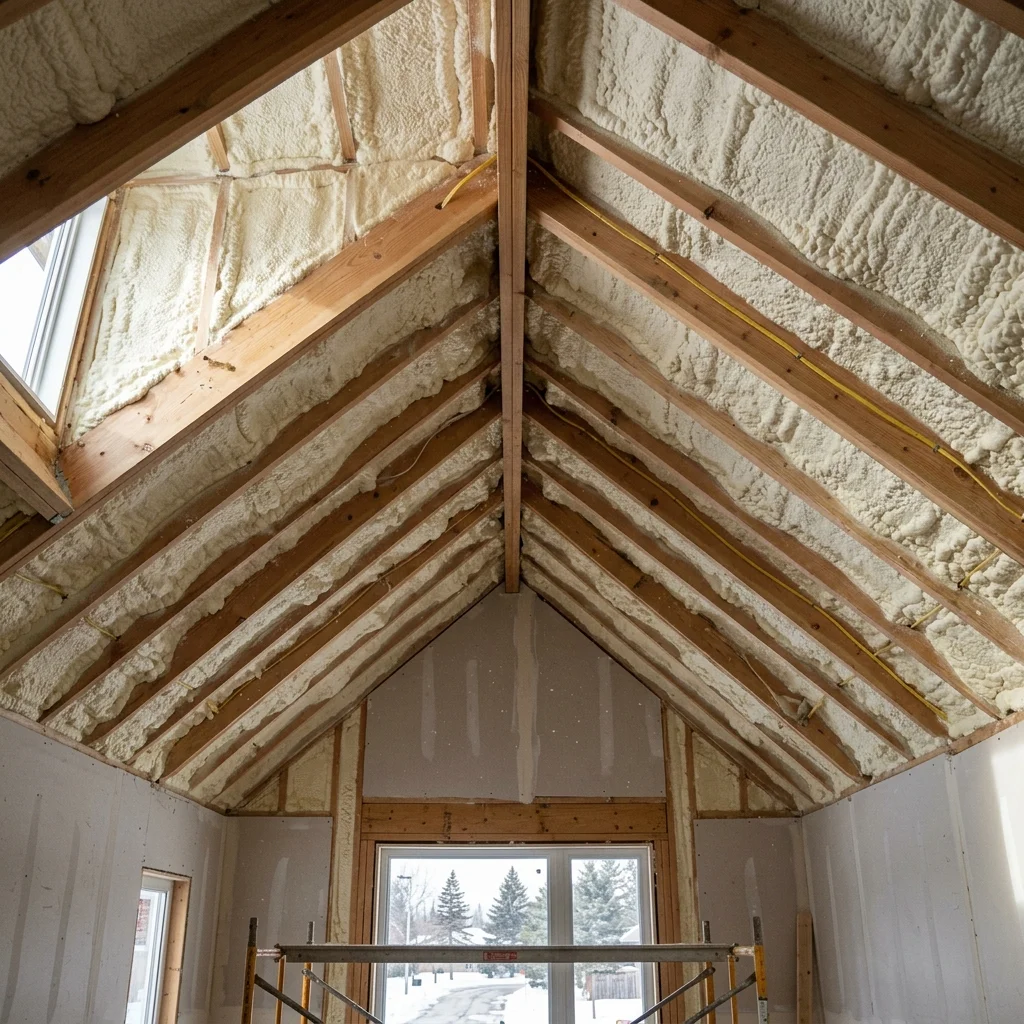
For most Toronto homeowners, spray foam wins the spray foam vs rockwool comparison once Ontario rebates are factored in — a 1,200 sqft attic project drops from $3,600–$4,200 to $0–$1,500 net after CGHR/HER+ rebates, while rockwool at $1,600–$2,200 receives zero rebate dollars. That said, rockwool (mineral wool) outperforms spray foam for soundproofing and requires no thermal barrier under Ontario Building Code SB-12, making it the right call for shared-wall and fire-critical applications. This side-by-side guide covers CAD cost per sqft, R-value per inch, fire resistance, moisture control, and rebate eligibility so you can make the right choice for your GTA home.
Spray Foam vs Rockwool Insulation: Which Is Best for Toronto Homes?
Spray foam is the better choice for most Toronto homeowners because it air-seals, qualifies for up to $10,600 in Ontario rebates, and maintains its R-value for 20+ years without settling. Rockwool (mineral wool) earns its place in specific scenarios: shared-wall soundproofing, fire-critical commercial applications, and projects where DIY installation is a priority. The decision hinges on five factors: net cost after rebates, application location (above- vs below-grade), air-sealing requirements, soundproofing needs, and fire-safety context. For GTA attics and basements, spray foam almost always delivers higher long-term ROI. For party walls in multi-family buildings or HVAC noise reduction, rockwool’s denser fiber structure is genuinely superior.
The comparison below is based on current GTA professional installation pricing (2026), Ontario rebate programs (CGHR, HER+, OAIR), and Ontario Building Code SB-12 requirements. All prices are in CAD.
| Factor | Open-Cell Spray Foam | Closed-Cell Spray Foam | Rockwool (Mineral Wool) |
|---|---|---|---|
| Material + Labor ($/sqft) | $1.50–$3.50 | $2.50–$5.00 | $0.80–$1.50 |
| 1,200 sqft Attic All-In (pro) | $3,600–$4,200 | $4,800–$6,000 | $1,600–$2,200 |
| R-Value Per Inch | R-3.7 | R-6.0 | R-3.0–R-4.2 |
| Thickness for R-31 Attic | 8–9 inches | 5–6 inches | 8–10 inches |
| Fire Resistance | Requires thermal barrier (OBC SB-12) | Requires thermal barrier (OBC SB-12) | Naturally fire-resistant to 1,000°C+ |
| Soundproofing STC Rating | STC 40–50 | STC 40–50 | STC 50–60 |
| Vapor Barrier Capability | No (permeable) | Yes (2″ ≈ 1 perm) | No (hygroscopic) |
| Air Sealing Capability | Excellent (expands into gaps) | Excellent (expands into gaps) | Poor (leaves framing voids) |
| Settling Risk (10 years) | Zero | Zero | 5–15% in walls (gravity compression) |
| Durability | 20+ years stable | 20+ years stable | 30–50 year lifespan, settling risk in walls |
| DIY Installation | Professional only | Professional only | DIY-friendly (batts, utility knife) |
| CGHR Rebate Eligible? | Yes (up to $10,600) | Yes (up to $10,600) | No (mineral wool excluded from premium rebates) |
| HER+ (Enbridge) Eligible? | Yes (up to $5,000) | Yes (up to $5,000) | No |
| OAIR Eligible? | Yes (up to $1,250) | Yes (up to $1,250) | No |
| Net Cost (1,200 sqft attic, post-rebate) | $0–$1,500 | $0–$1,500 | $1,600–$2,200 (no rebate) |
| Thermal Bridging Reduction | High (seals framing gaps) | High (seals framing gaps) | Low (~15% framing void uninsulated) |
What Is Rockwool (Mineral Wool) Insulation? Fire-Resistant Alternative
Rockwool (also called mineral wool, stone wool, or slagwool) is an insulation material made by melting volcanic basalt rock and recycled industrial slag, then spinning the molten material into dense fiber batts — similar to cotton candy but rigid, dense, and naturally fire-resistant. It is sold in pre-cut rolls and batts (commonly 3.5-inch or 5.5-inch thick) designed to fit between standard 16-inch stud cavities, floor joists, or attic rafters without requiring special equipment.
Key rockwool properties for GTA homeowners:
- Fire resistance: Rockwool withstands temperatures above 1,000°C without melting — its basalt mineral composition is the same material volcanic lava forms from. No thermal barrier required under Ontario Building Code SB-12 (unlike spray foam).
- Sound absorption: Dense fiber structure absorbs sound waves, achieving STC 50–60 (compared to spray foam’s STC 40–50). Superior for shared walls, basement ceilings, and HVAC noise reduction.
- R-value: Lightweight rockwool delivers R-3.0/inch; standard density R-3.6/inch; high-density (Comfortboard, Safe’n’Sound) up to R-4.2/inch.
- Moisture: Rockwool is hygroscopic — it can absorb moisture — and is NOT a vapor barrier. Below-grade (basement/crawl space) applications require a separate polyethylene vapor control layer when using rockwool.
- Installation: DIY-friendly. Batts unroll, are cut with a standard utility knife, and compress to fit between studs. No equipment, no professional licensing required. Homeowners can self-install to reduce total project cost by 30–40%.
Common rockwool brands in the GTA: Roxul (Comfortbatt, Safe’n’Sound), Knauf Insulation, and generic imported mineral wool at big-box retailers. Roxul Comfortbatt is most widely available at Home Depot and Lowe’s locations across Scarborough, North York, Etobicoke, Brampton, and Mississauga.
Spray Foam Insulation Basics: Open-Cell vs Closed-Cell Performance
Spray foam insulation is a two-component liquid (polyol resin + isocyanate) that expands 30–100× on contact with the application surface, filling every gap, crack, and penetration before curing into a rigid or semi-rigid foam. Unlike rockwool batts, spray foam must be applied by a licensed professional using commercial mixing equipment. Learn more about our spray foam insulation services.
Open-cell spray foam (R-3.7/inch, $1.50–$3.50/sqft installed) expands aggressively and remains slightly flexible after curing. It is vapor-permeable (not a vapor barrier), making it suitable for attic applications in above-grade locations. For a standard 1,200 sqft Toronto attic requiring R-31, open-cell foam requires 8–9 inches of depth — the same depth as rockwool, but with full air sealing that rockwool cannot provide.
Closed-cell spray foam (R-6.0/inch, $2.50–$5.00/sqft installed) is denser, rigid, and acts as a vapor barrier at 2 inches depth (approximately 1 perm). Closed-cell spray foam is mandatory for below-grade applications (basements, crawl spaces, rim joists) where moisture intrusion is a concern. It achieves R-31 in just 5–6 inches, compared to 8–10 inches for rockwool or open-cell foam.
Both foam types require a thermal barrier per Ontario Building Code SB-12 — typically 15-minute intumescent coating or drywall/gypsum board facing. This adds $0.25–$0.50/sqft to project cost but does not change the thermal or air-sealing performance.
Cost Comparison: Spray Foam vs Rockwool in Toronto & GTA
Spray foam costs more upfront than rockwool, but Ontario rebate programs flip the net cost in spray foam’s favour for 70%+ of GTA homeowners who qualify for CGHR, HER+, or OAIR. Here is the honest GTA pricing breakdown by application:
| Application | Area | Rockwool (Pro Install) | Open-Cell Spray Foam | Closed-Cell Spray Foam |
|---|---|---|---|---|
| Attic (R-31 target) | 1,200 sqft | $1,600–$2,200 | $3,600–$4,200 | $4,800–$6,000 |
| Basement walls (R-20 target) | 800 sqft | $1,200–$1,600 + vapor barrier | $1,800–$2,400 | $2,000–$2,800 |
| Wall cavity (R-15 target, sound priority) | 2,000 sqft | $1,500–$2,000 (partial DIY) | $3,000–$4,500 | $5,000–$8,000 |
| Crawl space (R-20 target) | 600 sqft | $900–$1,200 + vapor barrier | $1,200–$1,800 | $1,500–$2,400 |
| Rim joist air seal | 200 linear ft | $400–$700 | $600–$900 | $700–$1,200 |
Attic detail (1,200 sqft, R-31): Rockwool requires 2–3 stacked layers of 3.5-inch batts (8–10 inches total) at $0.80–$1.50/sqft material plus professional labor, totalling $1,600–$2,200. Open-cell spray foam requires 8–9 inches at R-3.7/inch, all-in at $3,600–$4,200. The upfront difference is $1,400–$2,000 in rockwool’s favour — until rebates are applied.
GTA pricing varies by neighbourhood: Projects in downtown Toronto (Annex, Rosedale, Leslieville), North York, and Scarborough typically price within the ranges above. Outer-GTA locations (Brampton, Vaughan, Markham, Mississauga) may run 5–10% lower due to reduced travel and parking costs. Our spray foam cost calculator gives you a personalized estimate by postal code.
R-Value Per Inch: Spray Foam vs Rockwool — Understanding Thermal Resistance
Closed-cell spray foam delivers the highest R-value per inch of any common residential insulation at R-6.0/inch, meaning it achieves R-31 in just 5–6 inches of depth. Here is how all materials compare:
| Insulation Type | R-Value Per Inch | Thickness for R-31 | Air Sealing? | Vapor Barrier? |
|---|---|---|---|---|
| Closed-Cell Spray Foam | R-6.0 | 5–6 inches | Yes | Yes (at 2″+) |
| Open-Cell Spray Foam | R-3.7 | 8–9 inches | Yes | No |
| Rockwool (High-Density) | R-4.2 | 7–8 inches | No | No |
| Rockwool (Standard) | R-3.6 | 8–9 inches | No | No |
| Rockwool (Lightweight) | R-3.0 | 10–11 inches | No | No |
| Fiberglass Batt (new) | R-3.2–R-3.8 | 8–10 inches | No | No |
| Fiberglass Batt (settled) | R-2.6–R-3.4 | 9–12 inches | No | No |
| Cellulose (blown) | R-3.2–R-3.8 | 8–10 inches | Partial | No |
The important nuance: rockwool’s R-value is a material R-value, not an effective assembly R-value. Rockwool batts fit between studs but do not seal the wood framing itself. Wood studs at 16-inch spacing represent approximately 15% of total wall cavity area — and wood’s R-value is only R-1.25/inch, creating thermal bridges through every stud bay. Spray foam covers the entire cavity surface including the stud faces, eliminating this thermal bridging effect. In a 2,000 sqft wall installation, this thermal bridging gap can represent 15–25% of actual heat loss that rockwool’s R-value rating doesn’t account for.
Fire Resistance & Safety: Which Insulation Meets Ontario Building Code
Both rockwool and spray foam are code-compliant in Ontario under SB-12, but they achieve fire compliance differently — rockwool is inherently fire-resistant, while spray foam requires an added thermal barrier. Rockwool’s natural basalt composition gives it a melting point above 1,000°C, higher than most structural building fires, which is why it does not need additional fire protection in wall or attic cavities.
Spray foam, being a polymer, must be covered by a 15-minute thermal barrier per Ontario Building Code SB-12. Acceptable barriers include:
- 12.7mm (½”) gypsum drywall (most common in finished spaces)
- 15-minute intumescent coating (spray-applied, suitable for unfinished crawl spaces, attics, rim joists)
- Approved fire-rated paint or board products
The thermal barrier adds $0.25–$0.50/sqft to project cost but does not reduce spray foam’s R-value or air-sealing performance. Our attic insulation service always includes thermal barrier compliance as part of the installed scope — no code-fail risk on our jobs.
For commercial, multi-family, or fire-separation-critical applications (legal suite conversions, party walls, garage-to-living-space conversions), rockwool’s inherent fire resistance is a genuine technical advantage that simplifies the building permit process. SFK recommends confirming with your local municipality inspector before choosing between the two materials on fire-separation applications.
Soundproofing & Noise Reduction: Rockwool vs Spray Foam Performance
Rockwool is the superior soundproofing insulation, achieving STC 50–60 compared to spray foam’s STC 40–50, because its dense fiber matrix physically absorbs and dissipates airborne sound waves rather than reflecting them. This is the one category where rockwool outperforms spray foam without qualification.
The physics: rockwool’s compressed fiber structure (think rock-hard cotton candy) creates maximum surface area for sound absorption across a wide frequency range — particularly effective at mid-range frequencies (500–2,000 Hz) that carry voice and HVAC noise. Spray foam, despite being an excellent air barrier, creates a denser, less absorptive medium where sound can actually transmit more efficiently through the foam structure itself.
Practical GTA applications where rockwool wins for sound:
- Shared walls between semi-detached and row homes in North York, Scarborough, and Etobicoke
- Basement ceiling insulation to reduce footfall and HVAC duct noise in multi-unit dwellings
- Party walls in legal basement suite conversions across the GTA
- Home office walls in Vaughan and Markham new-construction builds
- HVAC ductwork surrounds and mechanical room isolation
For applications where both sound and air-sealing matter — a common scenario in finished basement ceilings — a hybrid approach works: closed-cell spray foam on rim joists and foundation walls for air/moisture sealing, rockwool batts in the floor-joist bays above for sound absorption. Spray Foam Kings installs hybrid systems across the GTA.
Moisture Control & Water Resistance: Spray Foam vs Rockwool in Basements
Closed-cell spray foam is the correct insulation for below-grade moisture-prone environments; rockwool is not suitable for basements without additional vapor control measures. At just 2 inches of depth, closed-cell spray foam achieves approximately 1 perm — the threshold for a Class II vapor barrier under the National Building Code — blocking moisture migration from concrete walls and foundation slabs into the building envelope.
Rockwool, by contrast, is hygroscopic: it can absorb up to 0.5% of its weight in moisture without losing structural integrity, but this absorption can create long-term moisture accumulation against concrete walls in GTA basements (which average 60–75% relative humidity in summer months). A below-grade rockwool installation requires a separate 6-mil polyethylene vapor barrier on the warm side, adding cost and installation complexity. If the vapor barrier is improperly installed or punctured, moisture can become trapped between the concrete and rockwool.
Basement moisture comparison by scenario:
- Dry basement, above-grade walls only: Rockwool viable with vapor control. Open-cell spray foam viable. Closed-cell spray foam optimal.
- Below-grade concrete block or poured concrete walls: Closed-cell spray foam mandatory. Rockwool requires polyethylene vapor barrier (professional-grade installation recommended).
- Crawl space with dirt floor or high humidity: Closed-cell spray foam on rim joists + walls mandatory. Rockwool not recommended. See our basement insulation service page.
- Rim joist air sealing (all homes): Closed-cell spray foam at 2–3 inches is the industry standard. Rockwool can be used in conjunction but cannot replace the air seal at penetrations.
Air Sealing & Thermal Bridging: How Spray Foam Prevents Heat Loss
Spray foam prevents 25–40% of total home heat loss by sealing the air infiltration pathways that no other insulation material can address; rockwool batts seal approximately 5–10% of the same air leakage pathways. This is spray foam’s decisive advantage over every batt insulation, including rockwool.
Residential buildings lose heat through three mechanisms: conduction (through solid materials — addressed by R-value), convection (warm air flowing through gaps and cracks — addressed by air sealing), and radiation (minor, addressed by reflective barriers). Rockwool’s excellent R-value addresses conduction but does almost nothing for convection, the dominant heat loss pathway in older GTA homes built before 1980.
A 1960s Toronto bungalow attic has hundreds of air-leakage pathways: electrical outlet boxes, pot light penetrations, plumbing chases, HVAC ductwork seams, attic hatch frames, chimney surrounds, and top-plate gaps at every exterior wall. Spray foam expands into and permanently seals all of these openings in a single pass. Rockwool batts, however precisely cut, leave compressible gaps at every framing member, penetration, and corner.
Wood stud framing at 16-inch spacing also creates thermal bridging — wood has an R-value of only R-1.25/inch, compared to R-3.7 or R-6.0 for spray foam. At standard 16-inch on-centre framing, wood occupies approximately 15% of the total wall area. Rockwool sits between studs but does not address the stud faces; spray foam covers the entire cavity including framing members, eliminating this thermal bridge. In a 2,000 sqft wall installation, addressing this 15% framing void can represent an effective R-value improvement of R-3 to R-5 on the assembly level — a difference invisible in per-inch R-value ratings but critical for real-world energy performance.
Settling & Durability: 20+ Years vs Potential Compression in Rockwool
Spray foam maintains its full R-value for 20+ years with zero settling; rockwool has a 30–50 year material lifespan but can lose 5–15% of its R-value through compression and settling in wall cavities over 10 years. This long-term performance gap is rarely discussed in rockwool marketing but is a real cost consideration for GTA homeowners.
Spray foam cures into a rigid or semi-rigid cellular structure that is mechanically bonded to framing and substrate. Once cured (typically 48–72 hours for off-gassing), it does not compress, settle, absorb moisture, or degrade under normal building conditions. The 20-year performance guarantee is genuine — the foam you install today performs the same in 2045.
Rockwool in horizontal applications (attic floors) remains stable because gravity compresses it uniformly. However, in vertical wall cavities, gravity and seasonal temperature cycling (which causes framing to expand and contract) gradually compress the batt over years. Industry data from the National Research Council Canada and ASHRAE suggests 5–15% R-value reduction in wall-installed mineral wool batts over a 10-year period. For a wall targeted at R-22 (standard 2×6 cavity), this means effective performance of R-19–R-21 after a decade — potentially triggering a code compliance issue on energy performance paths.
Attic rockwool stays stable. Horizontal installation on attic floors is NOT subject to vertical settling, and rockwool attic batts perform well over their 30–50 year lifespan. The settling risk is specific to vertical wall cavities.
Application Guide: Where to Use Spray Foam vs Rockwool (Attic, Wall, Basement, Crawl Space)
The right insulation depends on the application location and the primary performance requirement — use this decision guide for GTA-specific conditions:
| Location | Primary Requirement | Winner | Reason |
|---|---|---|---|
| Attic (flat floor, above-grade) | Air sealing + R-value + rebate | Open-Cell Spray Foam | Seals all penetrations; CGHR/HER+/OAIR rebate eligible; same depth as rockwool but air-tight |
| Attic (rafters, conditioned) | High R-value, vapour control | Closed-Cell Spray Foam | Achieves R-31 in 5–6 inches; vapor barrier; mandatory for conditioned attic assembly |
| Basement walls (below-grade) | Moisture + air sealing | Closed-Cell Spray Foam | Acts as vapor barrier at 2″; no separate poly needed; mandatory for damp basements |
| Crawl space | Moisture + air seal | Closed-Cell Spray Foam | Seals rim joists + walls; vapor barrier; rockwool not suitable without major vapor control work |
| Rim joists | Air seal + moisture | Closed-Cell Spray Foam | Fills irregular voids; 2″ achieves vapor barrier + code-compliant air seal |
| Exterior walls (sound priority) | Sound deadening + R-value | Rockwool | STC 50–60 superior to spray foam STC 40–50; DIY-installable; lower cost |
| Party walls / shared walls | Sound + fire separation | Rockwool | Naturally fire-resistant (no thermal barrier); STC 50–60 for noise; code-simple |
| Interior walls (HVAC noise) | Sound absorption | Rockwool Safe’n’Sound | Specifically designed for interior sound; affordable; DIY-installable |
Decision tree — five questions:
- Is the application below grade (basement, crawl space)? → Closed-cell spray foam mandatory.
- Is soundproofing the primary goal (shared wall, HVAC noise)? → Rockwool wins.
- Is fire resistance in a code-critical assembly (party wall, legal suite, commercial)? → Rockwool preferred (no thermal barrier requirement).
- Do you want to qualify for Ontario rebates (CGHR, HER+, OAIR)? → Spray foam only.
- Is DIY installation the priority to reduce cost? → Rockwool (batts, no equipment needed).
Most GTA homeowners pursuing attic or basement insulation upgrades with rebate eligibility in mind land on spray foam. Homeowners in semi-detached or multi-unit dwellings with noise concerns often benefit from a hybrid: spray foam on the building envelope (air seal + rebate) and rockwool on interior party walls (sound + fire).
See our comparison articles: Spray Foam vs Fiberglass Batt, Spray Foam vs Foam Board, and Spray Foam vs Rigid Foam.
The Real Cost After Rebates: Why Spray Foam Wins for Ontario Homeowners
After applying Ontario rebate programs, spray foam’s net cost drops below rockwool for the majority of GTA homeowners — making it the higher-value choice despite higher sticker prices. Here is how the math works:
| Scenario | Gross Cost | CGHR Rebate | HER+ Rebate | OAIR | Net Cost |
|---|---|---|---|---|---|
| Open-cell spray foam (1,200 sqft attic, R-31) | $3,600–$4,200 | up to $5,000 | up to $1,250 | up to $1,250 | $0–$1,500 |
| Closed-cell spray foam (1,200 sqft attic, R-31) | $4,800–$6,000 | up to $5,000 | up to $1,250 | up to $1,250 | $300–$2,500 |
| Rockwool (1,200 sqft attic, R-31, professional install) | $1,600–$2,200 | $0 | $0 | $0 | $1,600–$2,200 |
| Rockwool (DIY partial, 1,200 sqft, R-31) | $900–$1,400 | $0 | $0 | $0 | $900–$1,400 |
The rebate calculus: The Canada Greener Homes Retrofit (CGHR) program — formerly the Canada Greener Homes Grant — covers attic insulation upgrades for qualifying homes. HER+ (Enbridge Home Efficiency Rebate Plus) stacks on top for Enbridge natural gas customers (most GTA homes). OAIR (Ontario Attic Insulation Rebate) adds a provincial top-up. These programs collectively provide up to $10,600 in combined rebates for spray foam installations that meet program R-value thresholds — but ONLY for eligible insulation materials. Rockwool (mineral wool) is classified differently and does NOT qualify for these premium rebate stacks under current 2026 program rules.
Result: a $4,000 spray foam attic project can cost as little as $0–$700 out of pocket after rebate stacking. A $1,800 rockwool project costs $1,800 regardless. For the 70%+ of Ontario homeowners who qualify for at least one rebate program, spray foam is actually the more affordable option when measured on net cost.
Visit our Ontario rebate guide or use our interactive cost calculator to estimate your net cost by postal code and project type. Spray Foam Kings handles all rebate paperwork — pre- and post-installation energy assessments, program applications, and required documentation — as part of every project.
Frequently Asked Questions: Spray Foam vs Rockwool Insulation Toronto
What is rockwool insulation and how does it differ from fiberglass?
Rockwool (mineral wool, stone wool) is made from volcanic basalt rock melted and spun into dense fiber batts, while fiberglass is made from recycled glass. Rockwool is denser, naturally fire-resistant to 1,000°C+, and delivers R-3.6–4.2 per inch — slightly higher than fiberglass batt (R-3.2–3.8/inch, which settles to R-2.6–3.4 over time). Rockwool is also inherently mold-resistant and does not itch during handling the way fiberglass does. Both are batt products installed between studs; neither provides air sealing.
Is spray foam or rockwool cheaper per square foot in Toronto?
Rockwool is cheaper per square foot at $0.80–$1.50/sqft (material + professional labor), while open-cell spray foam costs $1.50–$3.50/sqft and closed-cell costs $2.50–$5.00/sqft in the GTA. However, spray foam qualifies for Ontario rebates (CGHR/HER+/OAIR totaling up to $10,600) that rockwool does not, making spray foam cheaper on a net-cost basis for most qualifying homeowners. A 1,200 sqft attic: rockwool $1,600–$2,200 (no rebate) vs spray foam $3,600–$4,200 gross → $0–$1,500 net after rebates.
Does rockwool have a higher R-value than spray foam?
High-density rockwool (R-4.2/inch) has a higher R-value per inch than open-cell spray foam (R-3.7/inch), but closed-cell spray foam (R-6.0/inch) significantly outperforms all rockwool types. Crucially, R-value per inch is only one metric — spray foam’s air-sealing capability addresses 25–40% of heat loss through air infiltration, which R-value ratings do not capture. In real-world GTA homes, spray foam’s effective thermal performance typically exceeds rockwool even when rockwool has a similar or higher per-inch R-value.
Is rockwool fire-resistant?
Yes — rockwool withstands temperatures above 1,000°C without melting, making it one of the most fire-resistant insulation materials available. Its basalt mineral composition is non-combustible, and it requires no thermal barrier under Ontario Building Code SB-12. Spray foam, by contrast, requires a 15-minute thermal barrier (drywall or intumescent coating) per OBC SB-12 to meet code. Both materials are code-compliant when properly installed; rockwool simplifies the fire-compliance process, especially in party walls, legal suite conversions, and commercial applications.
Which insulation is better for soundproofing in Toronto?
Rockwool is the better soundproofing insulation, achieving STC 50–60 compared to spray foam’s STC 40–50. Rockwool’s dense fiber structure absorbs airborne sound waves more effectively than spray foam, which can actually transmit sound through its more rigid cellular structure. For shared walls in Toronto semi-detached homes, basement ceilings under occupied floors, and party walls in legal basement suites, rockwool (especially Roxul Safe’n’Sound) is the recommended choice. For applications requiring both soundproofing and air sealing, a hybrid approach — spray foam on the building envelope, rockwool on interior walls — delivers best results.
Can spray foam and rockwool both prevent moisture in basements?
Closed-cell spray foam is far superior for moisture control in below-grade GTA basements. At 2 inches, it achieves Class II vapor barrier (approximately 1 perm), blocking moisture from concrete walls without additional vapor control. Rockwool is hygroscopic (absorbs moisture) and is NOT a vapor barrier — below-grade rockwool applications require a separate 6-mil polyethylene vapor barrier, adding cost and installation complexity. If the vapor barrier is improperly installed, moisture can become trapped between the concrete and rockwool, leading to mold risk. For basements and crawl spaces, closed-cell spray foam is the correct choice.
Does rockwool insulation settle over time?
Rockwool in vertical wall cavities can settle 5–15% over 10 years due to gravity and temperature cycling, reducing its effective R-value from (e.g.) R-22 to R-19–R-21. Horizontal attic floor installations remain stable. Spray foam does not settle at all — it cures into a rigid cellular structure permanently bonded to framing. For long-term wall performance, spray foam maintains its rated R-value indefinitely while rockwool’s wall performance degrades modestly over the building’s lifetime.
Can I DIY rockwool insulation in my Toronto home?
Yes — rockwool batts are among the most DIY-friendly insulation materials available. They come in pre-cut rolls and batts (3.5-inch or 5.5-inch thickness), are cut with a standard utility knife, and compress to fit standard 16-inch stud cavities without special tools, mixing equipment, or professional licensing. Wearing an N95 dust mask and eye protection is recommended, but rockwool does not cause the same skin irritation as fiberglass. Self-installing rockwool in wall cavities can reduce project cost by 30–40% compared to professional labor rates. Spray foam, by contrast, requires licensed professional application — DIY spray foam kits are not suitable for full attic or basement projects (and disqualify rebate eligibility).
Is spray foam airtight compared to rockwool?
Yes — spray foam is significantly more airtight than rockwool. Spray foam expands 30–100× on contact, filling every gap around electrical outlets, HVAC penetrations, rim joist gaps, plumbing chases, and framing seams. It creates a complete air barrier. Rockwool batts fit between framing members but leave compressible gaps at every stud face, electrical box, and penetration — resulting in 5–10× more air leakage than spray foam. Spray foam addresses 25–40% of total home heat loss through air infiltration; rockwool addresses approximately 5–10%. Air sealing is spray foam’s most decisive advantage.
Can I get a rebate for rockwool insulation in Ontario?
No — under current 2026 Ontario rebate program rules, rockwool (mineral wool) does not qualify for the Canada Greener Homes Retrofit (CGHR), Enbridge HER+, or Ontario Attic Insulation Rebate (OAIR) programs. These programs cover spray foam, fiberglass, and cellulose insulation, but mineral wool is excluded from the premium rebate stacks. This is the single most important cost factor in the spray foam vs rockwool comparison for Ontario homeowners: a 1,200 sqft attic spray foam project at $3,600–$4,200 can cost $0–$1,500 net after rebates, while rockwool at $1,600–$2,200 stays at full price.
What thickness of rockwool do I need for R-31 in a Toronto attic?
To achieve R-31 with standard-density rockwool (R-3.6/inch), you need 8.6 inches — typically 2–3 stacked layers of 3.5-inch batts (total 7–10.5 inches, with some compression) for a total installed thickness of approximately 8–10 inches. High-density rockwool at R-4.2/inch requires 7.4 inches (7–8 inches installed). Open-cell spray foam requires the same 8–9 inches for R-31, but additionally provides full air sealing that rockwool cannot. Ontario Building Code SB-12 requires minimum effective R-31 for attic assemblies in climate zone 6 (GTA).
Does spray foam off-gas compared to rockwool?
Spray foam off-gasses isocyanate compounds and blowing agents during the first 24–72 hours after application, requiring occupants to vacate the home during and immediately after installation. After full cure (72 hours), spray foam is chemically stable with no ongoing off-gassing. Rockwool produces no off-gassing — it is a mineral product, not a chemical polymer. For households with chemical sensitivities or newborns, the 72-hour post-spray-foam clearance period is important to plan for. Both materials are safe long-term. SFK uses low-GWP HFO blowing agents and provides clearance documentation as part of every installation.
Should I use spray foam or rockwool in my basement?
Use closed-cell spray foam for below-grade basements in Toronto. Closed-cell spray foam at 2–3 inches acts as both insulation (R-12–R-18) and vapor barrier against concrete walls, eliminating moisture migration and the need for a separate polyethylene sheet. Rockwool in basements requires additional vapor control, is not suitable for direct-to-concrete installation in damp environments, and risks moisture accumulation if the vapor barrier is improperly installed. For above-grade basement walls (partially below-grade with above-grade exposure), either material works — consult your installer. Our basement insulation team serves all GTA neighbourhoods.
Which insulation meets Ontario Building Code in Toronto?
Both spray foam and rockwool meet Ontario Building Code SB-12 when properly installed, but with different requirements. Spray foam requires a 15-minute thermal barrier (½” drywall or intumescent coating) applied over exposed foam surfaces in occupied or habitable spaces. Rockwool is non-combustible and requires no thermal barrier. Minimum attic R-value per OBC SB-12 for the GTA (climate zone 6) is R-31 effective — achievable with both materials. Spray Foam Kings carries SPFA certification, $5M liability insurance, and WSIB coverage, and pulls all required permits for GTA spray foam projects.
Is spray foam worth it vs rockwool for a Toronto home?
Spray foam is worth it for most Toronto homeowners because Ontario rebates (CGHR + HER+ + OAIR = up to $10,600) bring net project cost below rockwool while delivering superior air sealing, vapor control, and long-term R-value stability. The break-even calculation favours spray foam when: (1) the homeowner qualifies for Ontario rebates, (2) the application is an attic or basement (where air sealing provides major energy savings), and (3) the project is large enough for professional installation economics (500+ sqft). For small interior wall projects, sound-critical applications, or pure budget constraints, rockwool remains a viable, code-compliant option.
Why Choose Spray Foam Kings for GTA Insulation
Spray Foam Kings is the GTA’s trusted spray foam specialist with 15+ years of residential and commercial insulation experience across Toronto, Scarborough, North York, Etobicoke, Vaughan, Mississauga, Markham, and Brampton. Our credentials:
- SPFA Certified: Spray Polyurethane Foam Alliance certification — the gold standard for spray foam application quality and product knowledge.
- $5M Liability Insurance + WSIB: Full coverage on every project, protecting homeowners from start to finish.
- Rebate experts: We handle CGHR, HER+, and OAIR paperwork from pre-installation energy assessment through final claim submission. Homeowners pay net, not gross.
- Ontario Building Code SB-12 compliance: Every project includes thermal barrier application as standard — no code-fail risk.
- Transparent pricing: No surprise costs. Material, labor, thermal barrier, cleanup, and rebate paperwork all included in your quote.
“We got three quotes for our North York attic. Spray Foam Kings was not the cheapest upfront, but after they walked us through the CGHR + HER+ rebate stacking, our net cost was $840 for the entire 1,400 sqft job. The rockwool quote was $2,100 with no rebate. It wasn’t even close.” — David K., North York homeowner, 1962 bungalow retrofit
Whether your priority is energy savings, rebate recovery, sound control, or moisture management, our team matches the right solution — spray foam, rockwool, or hybrid — to your specific home, application, and budget.
Explore our insulation services: Open-Cell Spray Foam | Closed-Cell Spray Foam | Attic Insulation | Basement Insulation
GTA Service Area
Spray Foam Kings serves all GTA communities including Toronto (Annex, Leslieville, Rosedale, Forest Hill), Scarborough (Agincourt, Malvern, Highland Creek), North York (Willowdale, Don Mills, Lawrence Park), Etobicoke (Mimico, Long Branch, Humber Valley), Vaughan (Woodbridge, Concord, Maple), Mississauga (Port Credit, Streetsville, Erin Mills), Markham (Unionville, Cornell, Milliken Mills), and Brampton (Heart Lake, Bramalea, Springdale). Call us for same-week assessment availability.
Get Your Free Quote Today
Call: 647-641-6881