
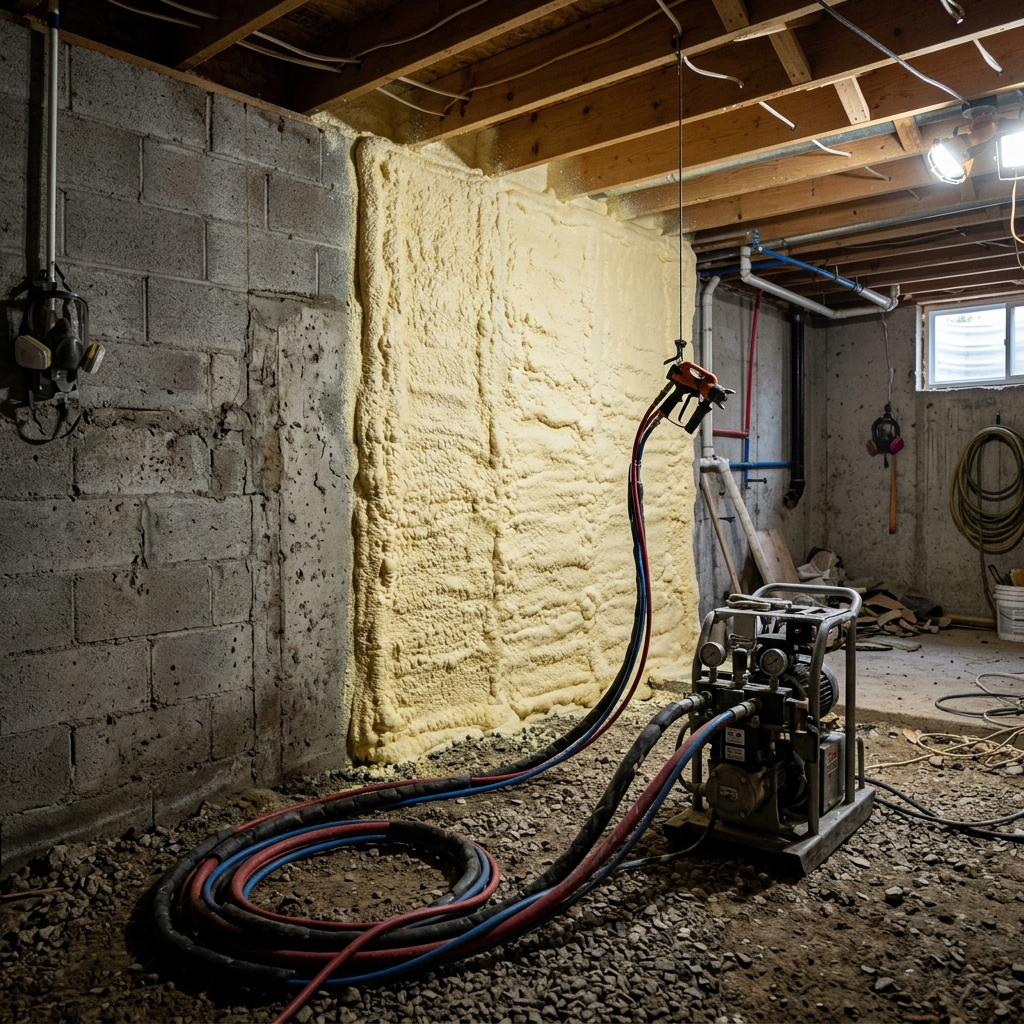
Yes — in most Ontario applications, spray foam insulation must be covered by a thermal barrier providing a 15-minute fire resistance rating, as required by Ontario Building Code Supplementary Standard SB-12. This applies to attics, unfinished basements, crawl spaces, and anywhere spray foam faces an occupied interior space. The cost-smart solution: many premium closed-cell spray foam systems include a factory-applied thermal barrier coating at only $0.30–$0.50/sqft extra at install — far less than the $1,500–$4,000 remediation bill GTA homeowners face when an inspector flags non-compliant foam after the fact.
If you’re planning a spray foam project in Toronto, Scarborough, Mississauga, or anywhere in the GTA — or if a building inspector has already flagged your existing installation — this guide answers every question: what OBC SB-12 requires, exactly which locations need thermal barrier coverage, material and labour costs, and how to spec correctly the first time. Use our spray foam cost calculator to model the full thermal barrier cost impact on your project budget.
Do I Need a Thermal Barrier on Spray Foam in Ontario?
Yes — Ontario Building Code SB-12 requires spray polyurethane foam (SPF) to be separated from occupied living spaces by a thermal barrier providing a minimum 15-minute flame-spread rating in all residential applications where the foam faces an interior space. Uncovered spray foam is combustible; without a thermal barrier, it can ignite and contribute to rapid fire spread. The barrier slows that ignition by 15 minutes — enough time for safe occupant evacuation.
The most common thermal barriers used in Ontario homes are:
- ½-inch drywall (Type X or standard) — the most cost-effective and universally accepted option; satisfies OBC SB-12 automatically when installed over spray foam
- Intumescent paint — a ULC-listed coating spray-applied over exposed foam at $0.50–$1.50/sqft material cost; expands under heat to form a fire-retarding char layer
- Factory-applied polyurethane thermal barrier coatings — integrated into select closed-cell foam systems at manufacture; adds only $0.30–$0.50/sqft at install
The requirement is location-specific. Spray foam fully enclosed behind drywall in a finished basement already meets the standard — the drywall is the barrier. The issue arises in conditioned attics (foam applied to the underside of the roof deck), exposed basement walls, rim joists, and garage-to-house separations. Section 3 maps out every common GTA application.
What Is OBC SB-12 and How Does It Apply to Spray Foam?
OBC Supplementary Standard SB-12 (Energy Efficiency for Housing) is Ontario’s prescriptive energy code for residential buildings — and its thermal barrier mandate for spray foam is one of the most frequently triggered compliance flags on GTA renovation permits. The requirement flows from Section 9.10 of the Ontario Building Code, which SB-12 supplements: spray polyurethane foam must be protected from the interior by a material that achieves a 15-minute fire-resistance rating when tested to CAN/ULC-S101.
Key SB-12 thermal barrier facts every GTA homeowner and builder needs to know:
- The 15-minute flame-spread rating is a minimum performance threshold — ½-inch drywall meets it; ½-inch Type X (fire-rated) drywall exceeds it
- Intumescent paint must be applied at the manufacturer’s specified thickness — typically 1.5–3 wet mils — to achieve the listed protection; a single brush coat does not qualify
- Pre-coated closed-cell spray foam systems with a ULC listing or FM Approval can satisfy the requirement directly at the foam surface, eliminating the need for any additional on-site barrier application
- The standard applies to new construction and significant renovations that require a building permit in all Ontario municipalities — every GTA city including Toronto, Mississauga, Markham, Vaughan, Brampton, and North York enforces it
- Commercial buildings, industrial metal structures, and some renovation classes (Class 3 or Class 4 under Ontario Building Code Part 11) may have different — sometimes stricter — thermal barrier rules based on occupancy and construction type
SB-12 compliance is also a prerequisite for Ontario rebate eligibility. The Canada Greener Homes Rebate (up to $10,600), IESO programs, and Enbridge HER+ all require code-compliant installation — a thermal barrier violation can void your rebate application entirely. More on that in the Ontario Rebates section below.
When Is a Thermal Barrier Required? Application-by-Location Matrix
A thermal barrier is required wherever spray foam is exposed to an occupied or conditioned interior space — but the specific requirement varies significantly by location. The matrix below gives a definitive YES/NO for the most common GTA residential applications.
| Application Location | Thermal Barrier Required? | Notes |
|---|---|---|
| Attic — spray-to-deck (conditioned attic) | YES | Foam exposed to interior; intumescent paint or pre-coated foam required. Top GTA inspection flag. |
| Attic floor (between joists, not deck) | YES | Foam faces occupied living space below; must be covered by subfloor or intumescent coating. |
| Basement walls — finished with drywall | NO (drywall satisfies) | ½-inch drywall provides the 15-minute rating. No additional coating required. |
| Basement walls — unfinished / exposed foam | YES | Exposed foam in any occupied basement space must be covered. Intumescent paint is the standard solution. |
| Rim joist / band joist | Depends on exposure | If accessible from finished basement interior: YES. If enclosed in wall assembly with drywall cover: NO. |
| Crawl space — conditioned (sealed, unvented) | YES | Treated as occupied/conditioned space. GTA inspectors enforce this strictly on new builds. |
| Crawl space — unconditioned (vented) | NO | Not treated as occupied space. OBC SB-12 thermal barrier requirement does not apply. |
| Exterior walls — spray foam behind drywall | NO (drywall covers) | Standard framing with drywall finishes automatically satisfies requirement. |
| Garage ceiling / garage-to-house walls | YES | Fire separation requirement between attached garage and living space mandates thermal barrier on spray foam. |
| Commercial cold storage (residential cold room) | Check occupancy class | Residential cold room adjacent to living space: typically YES. Commercial cold storage: Part 3 fire code rules apply — different compliance path. |
Rule of thumb: If spray foam is visible from any occupied or conditioned area, it needs a thermal barrier. If it’s fully enclosed behind drywall or sheathing, the drywall itself satisfies OBC SB-12. For a full breakdown of how thermal barrier costs differ between attic and basement applications, see our guide to attic vs. basement spray foam costs in Toronto.
Thermal Barrier Materials and On-Site Application Cost
On-site intumescent paint application costs $0.50–$1.50/sqft in materials plus 2–3 hours of professional labour per 1,200 sqft of attic — translating to $600–$1,800 total for thermal barrier coverage on a standard GTA attic project when bundled with original installation.
| Thermal Barrier Method | Material Cost (CAD/sqft) | Labour (1,200 sqft attic) | OBC SB-12 Compliant? |
|---|---|---|---|
| ½-inch standard drywall | $0.40–$0.70 | 4–6 hrs (cutting + fastening) | Yes |
| Intumescent paint (airless spray-applied) | $0.50–$1.50 | 2–3 hrs | Yes — at specified mil thickness only |
| Factory-coated closed-cell foam | +$0.30–$0.50/sqft at install | 0 hrs additional | Yes — when ULC or FM listed |
| ½-inch Type X drywall (fire-rated) | $0.60–$0.90 | 4–6 hrs | Yes (exceeds minimum) |
Critical note on intumescent paint: GTA building inspectors know the product — and they know a single thin coat doesn’t satisfy the rating. A compliant intumescent application requires professional-grade airless spraying at a certified mil thickness. Any reputable contractor provides spec sheets showing product name, ULC listing number, and application rate. If your contractor can’t produce these, that’s a red flag. See our cost calculator to include thermal barrier as a line item in your project estimate.
Pre-Coated Spray Foam vs. On-Site Thermal Barrier Application
Specifying factory-coated closed-cell spray foam at installation is almost always the most cost-effective path to thermal barrier compliance — the premium is only $0.30–$0.50/sqft versus $0.80–$2.00/sqft for a retrofit intumescent application, delivering $900–$2,500 in net savings on a typical GTA attic project.
Cost Comparison: Pre-Coated Foam vs. Retrofit Thermal Barrier
| Specification Choice | Added Cost at Install (1,200 sqft) | Retrofit Cost if Skipped | Net Position |
|---|---|---|---|
| Pre-coated closed-cell foam | $360–$600 (+$0.30–$0.50/sqft) | — | Saves $900–$2,500 vs retrofit |
| Standard closed-cell + on-site intumescent (bundled) | $600–$1,800 (+$0.50–$1.50/sqft) | — | Baseline — code compliant at install |
| Standard closed-cell — no thermal barrier at install | $0 | $1,500–$4,000 (inspector flag + mobilization) | Net loss $1,500–$3,400 |
Spray Foam Kings routinely recommends pre-coated product options during the quoting phase for any GTA attic project that will be subject to a building permit inspection. Premium closed-cell systems with integrated thermal barriers include BASF Walltite EC+, Huntsman Heatlok Soy 200 Plus, and Icynene-Lapolla ProSeal CC — all carrying ULC listings recognized by Ontario building departments.
Remediation Cost: What If an Inspector Flags No Thermal Barrier?
A GTA inspector compliance order for missing thermal barrier on spray foam typically results in $1,500–$4,000 in total remediation cost — 2–4× more than addressing it at original installation, because of contractor remobilization, documentation requirements, and re-inspection fees.
The cost escalates for three reasons:
- Contractor remobilization: A standalone thermal barrier job carries a minimum call-out fee. A typical GTA contractor charges $500–$800 in mobilization alone for a one-off return visit.
- Re-inspection fees: Toronto, Mississauga, and North York building departments charge $150–$300 for re-inspection after a failed compliance order. Some projects require two re-inspections.
- Access complications: In some cases, finishing work (framing, subfloor, drywall on adjacent surfaces) must be partially removed to access the foam — adding $300–$800 in ancillary work.
Real Remediation Scenario — Scarborough
“We had spray foam installed in our attic by another company and didn’t think about the thermal barrier. The inspector failed our rough-in and gave us 30 days to fix it. Spray Foam Kings came out, assessed the situation, and applied intumescent coating to the full 1,100 sqft deck. Done in one day — but the total bill was about $2,200. We were told upfront it would have been under $700 had the pre-coated product been specified from the start. Lesson learned.”
— R. Osei, Scarborough homeowner (detached two-storey renovation)
If you’re uncertain whether your existing spray foam installation has a compliant thermal barrier, Spray Foam Kings offers site assessments across the GTA. For basement spray foam scenarios specifically, see our Scarborough spray foam service page.
Building Code Enforcement in the GTA: What Inspectors Check
GTA building inspectors specifically audit for spray foam thermal barrier compliance during rough-in, insulation, and final occupancy inspections — and “no thermal barrier on exposed spray foam” is one of the most common compliance failures on GTA renovation projects.
Here’s what inspectors across Toronto, Mississauga, Markham, North York, and Vaughan audit:
- Exposed foam in conditioned attic space: Spray foam applied to the underside of roof decking without intumescent paint or drywall is the top flag. Inspectors use a flashlight during rough-in walk-throughs.
- Product documentation: If you claim factory-applied thermal barrier or on-site intumescent coating was applied, inspectors will request the ULC listing sheet and application specification. Verbal confirmation is not accepted in any GTA municipality.
- Rim joist areas in open basements: Rim joist spray foam left exposed in an occupied basement space is frequently flagged, especially on open-permit renovations where the basement is habitable.
- Garage-to-house separation walls: Ontario fire code requires proper fire separation between attached garages and living space. Spray foam here without thermal barrier is an automatic fail.
- Mil thickness for intumescent coatings: Some inspectors request wet-mil gauge documentation to confirm proper application thickness. Professional contractors provide this as standard.
Best practice for GTA homeowners: Before spray foam is installed on any permitted project, contact your building department and confirm exactly what documentation they’ll require for thermal barrier compliance at inspection. This 15-minute call eliminates the majority of re-inspection delays. Spray Foam Kings prepares complete compliance documentation packages — product data sheets, ULC listing numbers, application records, and post-install photographs — for every permitted project.
Ontario Rebates and Thermal Barrier Compliance
Ontario rebate programs require code-compliant spray foam installation — thermal barrier non-compliance can disqualify your project from rebates worth up to $10,600 CAD, so getting the thermal barrier right isn’t just about inspectors; it directly protects your rebate cheque.
Current Ontario programs that require OBC-compliant installation:
| Rebate Program | Max Rebate (CAD) | Requires Code Compliance? | Notes |
|---|---|---|---|
| Canada Greener Homes Rebate (CGHR) | Up to $10,600 | Yes | Registered energy advisor pre/post audit required; non-compliant installation disqualifies claim |
| Enbridge HER+ (Home Efficiency Rebate Plus) | Up to $5,000 | Yes | Requires OBC SB-12 compliance documentation on permit applications |
| IESO Programs | Varies by program | Yes | Code compliance is a prerequisite for energy efficiency program participation |
| Toronto Home Energy Loan Program (HELP) | Up to $125,000 (0% loan) | Yes | Permit-required projects must demonstrate full OBC compliance |
SFK installations are structured from the quoting phase to meet all OBC SB-12 and rebate compliance requirements simultaneously. Learn more in our Ontario insulation rebate guide.
Spray Foam vs. Other Insulation: Cost and Thermal Barrier Overview
Spray foam is the only residential insulation type that requires a thermal barrier for exposed interior applications — fiberglass, cellulose, and mineral wool are either non-combustible or inherently lower risk, giving them a code advantage in exposed applications but a performance disadvantage in air sealing and R-value per inch.
| Insulation Type | Installed Cost (CAD/sqft) | R-Value per Inch | Thermal Barrier Required (Exposed)? | Air Sealing Performance |
|---|---|---|---|---|
| Open-Cell Spray Foam | $1.50–$3.50 | R-3.5–3.8 | Yes (exposed to interior) | Excellent |
| Closed-Cell Spray Foam | $2.50–$5.00 | R-6.0–7.0 | Yes — or specify pre-coated | Excellent + vapour barrier |
| Fiberglass Batt | $0.80–$1.50 | R-3.0–3.8 | No | None (separate air barrier needed) |
| Cellulose (blown-in) | $0.60–$1.20 | R-3.5–3.7 | No | Good (when dense-packed) |
| Mineral Wool (Rockwool) | $1.50–$3.50 | R-3.0–4.2 | No (inherently non-combustible) | None (separate air barrier needed) |
Note: Mineral wool is inherently non-combustible and does not require a thermal barrier for exposed applications — one reason some builders choose it for uncovered crawl space or attic applications. However, it cannot match closed-cell spray foam for vapour control, continuous air sealing, or R-value per inch. For a detailed comparison, see our spray foam vs. Rockwool Toronto guide.
FAQ: 10 Questions on Spray Foam Thermal Barrier Requirements in Ontario
Do all spray foam products need a thermal barrier in Ontario?
No — only spray foam exposed to occupied or conditioned interior spaces requires a thermal barrier under OBC SB-12. Spray foam fully enclosed behind ½-inch drywall already satisfies the requirement because the drywall itself provides the 15-minute fire resistance rating. Pre-coated closed-cell spray foam systems with a ULC listing also satisfy the requirement at the foam surface without any additional on-site treatment.
What happens if my spray foam doesn’t have a thermal barrier and an inspector sees it?
Your inspector will issue a compliance order giving you 30–60 days to remediate before the inspection can pass. Remediation for a standard GTA attic (1,000–1,500 sqft) typically costs $1,500–$4,000 CAD, including contractor mobilization, intumescent paint materials, labour, and re-inspection fees ($150–$300 in most GTA municipalities). Non-compliance can also delay or deny your occupancy permit.
Can I apply intumescent paint myself after spray foam installation?
Technically yes, but it’s unlikely to satisfy a GTA inspector without professional documentation. Intumescent paint must be applied at a specified wet-mil thickness to achieve its 15-minute fire rating — uneven DIY application leaves thin spots that fail the standard. Inspectors require the product specification sheet, ULC listing number, and application rate documentation. Professional application includes this package; DIY rarely does.
How much does it cost to add a thermal barrier after spray foam is installed in an Ontario home?
Retrofit thermal barrier application costs $0.80–$2.00 CAD per sqft in combined materials and labour — $960–$2,400 for a 1,200 sqft attic. With inspector re-visit fees and contractor mobilization, total project cost runs $1,500–$4,000. This is 2–4× more expensive than specifying pre-coated foam ($0.30–$0.50/sqft extra) or bundled on-site coating ($0.50–$1.50/sqft) at original installation.
Which spray foam brands include a factory thermal barrier coating for Ontario projects?
Several closed-cell spray foam manufacturers offer ULC-listed systems with integrated thermal barrier coatings available in Ontario, including BASF (Walltite EC+), Huntsman Building Solutions (Heatlok Soy 200 Plus), and Icynene-Lapolla (ProSeal CC). Spray Foam Kings specifies these products for Ontario projects where code compliance sign-off is required — confirm product availability and pricing during your free consultation.
Is a thermal barrier required in basements finished with drywall?
No — ½-inch drywall applied over spray foam in a finished basement satisfies the OBC SB-12 thermal barrier requirement entirely. The drywall provides the 15-minute fire resistance rating without any additional coating. The requirement only applies when spray foam is directly exposed to an occupied interior space, such as an unfinished basement where the foam is visible on the walls.
What is the difference between intumescent paint and a factory-applied thermal barrier coating?
Intumescent paint is a reactive coating applied on-site to cured spray foam; it expands under heat to form a charred insulating layer that slows flame spread. Factory-applied thermal barrier coatings are polyurethane-based compounds integrated into closed-cell foam systems at the manufacturer, providing the same protective function as part of the foam product itself. Both satisfy OBC SB-12 when ULC-listed and properly applied — factory coatings eliminate on-site application steps entirely.
How long does thermal barrier application take for a typical Ontario attic?
For a 1,200 sqft conditioned attic, professional intumescent paint application takes 2–3 hours with an airless sprayer, including masking, product mixing, spray application, and cleanup. Add 2–4 hours drying time before inspection. Bundled with original spray foam installation, the thermal barrier adds approximately half a day to the overall project timeline.
Can I skip the thermal barrier on spray foam in my crawl space?
It depends on whether your crawl space is conditioned or unconditioned. An unconditioned (vented) crawl space is not considered an occupied space — OBC SB-12 thermal barrier requirements do not apply. A conditioned (sealed, unvented) crawl space is treated like a basement — spray foam on its walls must be covered by drywall or intumescent coating. Spray Foam Kings confirms crawl space classification during every site assessment.
What does OBC SB-12 actually require for spray foam insulation in Ontario?
OBC Supplementary Standard SB-12 requires spray polyurethane foam in interior-facing assemblies to be covered by a thermal barrier providing a minimum 15-minute fire resistance rating tested to CAN/ULC-S101. Standard ½-inch drywall satisfies this. Intumescent paint satisfies it when applied at rated thickness with a valid ULC listing. Pre-coated spray foam systems with FM Approval or ULC listing satisfy it directly at the foam surface. The code applies to all new construction and significant renovations requiring a permit across all Ontario municipalities.
Why Choose Spray Foam Kings for OBC SB-12 Compliance in the GTA
Spray Foam Kings is the GTA’s thermal barrier compliance specialist — every project includes full OBC SB-12 documentation, pre-coated product specification where applicable, and inspector-ready application records so your project passes on the first inspection.
- SPFA-certified applicators — the Spray Polyurethane Foam Alliance certification is North America’s leading credential for SPF work, recognized by all GTA municipal building departments
- $5M liability insurance + WSIB coverage — fully insured for all permitted residential and commercial projects across the GTA
- 15+ years of Ontario OBC compliance — extensive experience with SB-12 thermal barrier requirements in every GTA municipality: Toronto, Scarborough, North York, Etobicoke, Vaughan, Mississauga, Markham, and Brampton
- Pre-coated product specification — we proactively recommend factory-coated closed-cell systems for attic projects subject to permit inspection, typically saving customers $900–$2,500 versus retrofit intumescent application
- Full documentation packages — ULC listing sheets, intumescent product spec sheets, application records, and post-install photo documentation provided for every permitted project
- Rebate-eligible installations — all SFK projects are structured to qualify for the Canada Greener Homes Rebate (up to $10,600) and IESO programs; thermal barrier compliance is built into our standard workflow, not an add-on. See our Ontario insulation rebate guide for stacking strategies.
GTA service area: Toronto · Scarborough · North York · Etobicoke · Vaughan · Mississauga · Markham · Brampton. Whether you’re planning a new attic spray foam project, retrofitting an existing installation to meet OBC SB-12, or responding to an inspector compliance order — Spray Foam Kings provides the materials, expertise, and documentation GTA homeowners and builders need.
Get Your Free Quote Today
Call: 647-641-6881