
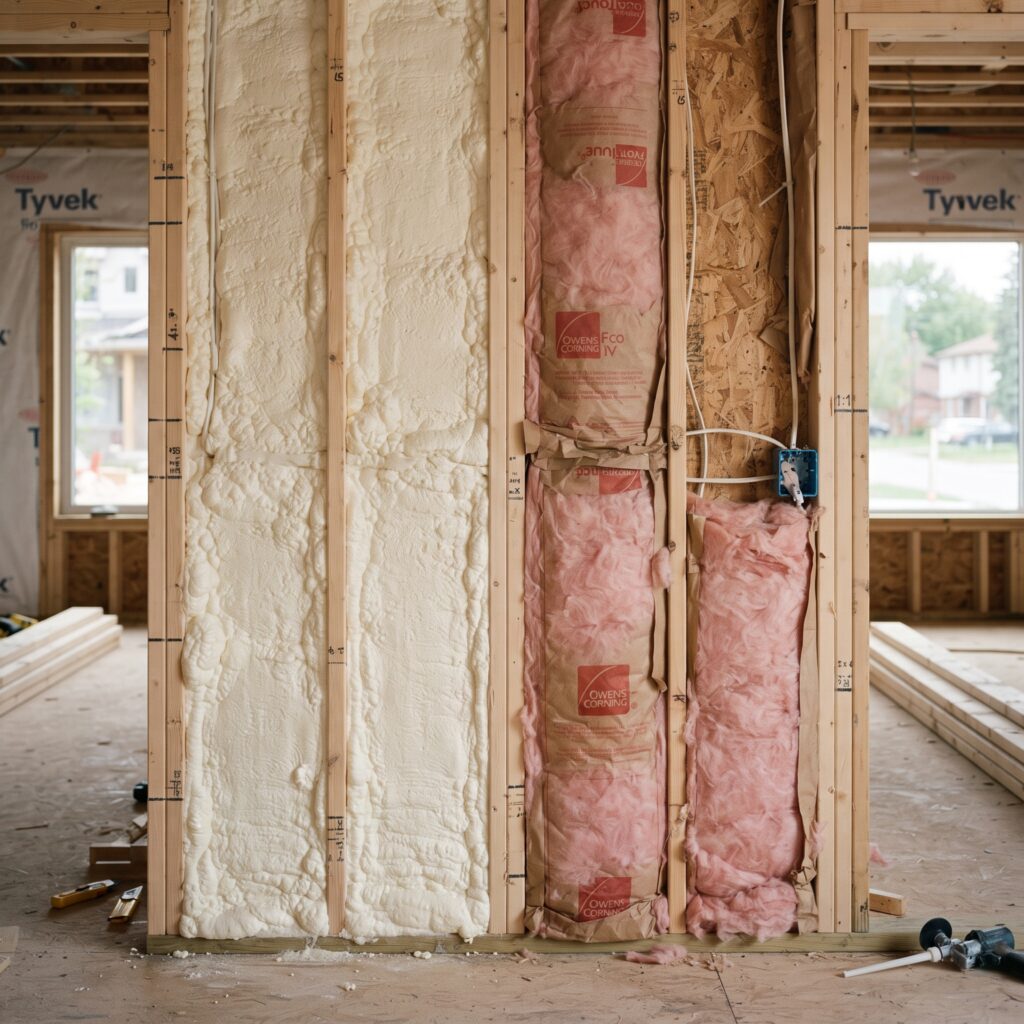
Spray Foam Insulation vs Batts: Which is Right for Your Toronto Home in 2026?
Published: January 2026 | Service Area: Greater Toronto Area
What’s the difference?
Toronto homeowners in 2026 face a clear choice when insulating basements, attics, or new walls: spray foam or fiberglass batts. Both work, but they solve problems differently. Fiberglass batts—those pink rolls you’ve seen—are the traditional choice: affordable, DIY-friendly, and installed between studs or joists. Spray foam (open-cell or closed-cell) expands on contact, filling gaps, sealing air leaks, and creating a continuous thermal and air barrier in one step. The decision isn’t just about R-value; it’s about your home’s age, your budget, Toronto’s climate demands, and long-term energy goals. A 1980s semi in Leslieville has different needs than a new townhouse in Liberty Village. This guide cuts through the noise so you invest in the right insulation the first time—and avoid costly retrofits or moisture problems later.
Side-by-side comparison
| Scenario | Cost (CAD) | Timeline | Permit Needed? | When to Choose | Risk If Wrong |
|---|---|---|---|---|---|
| Spray Foam – Basement Wall (500 sq ft) | $3,500–$5,500 | 1–2 days | No (most cases) | Existing moisture, air leaks, irregular surfaces | Over-spec’d for needs; higher upfront cost |
| Batts – Basement Wall (500 sq ft) | $1,200–$2,000 | 3–5 days (+ framing) | Possibly (if structural) | Tight budget, new framing, dry basement | Poor air sealing; moisture trap if no VB |
| Spray Foam – Attic (1,200 sq ft) | $8,000–$12,000 | 1–2 days | Check with City (often waived) | Unfinished attic, ductwork, complex geometry | Cost exceeds energy savings in mild winters |
| Batts – Attic (1,200 sq ft) | $2,500–$4,000 | 2–3 days | No | Simple flat layout, tight budget, no venting issues | Settling over 10 years; gaps around penetrations |
| Spray Foam – New Wall Framing (600 sq ft) | $4,200–$6,500 | 1 day (before drywall) | No | Air-tight envelope priority, energy code compliance | Blocks future electrical/plumbing reroutes |
| Batts – New Wall Framing (600 sq ft) | $1,500–$2,500 | 1 day | No | Budget renovation, standard code minimum | Thermal bridging; lower long-term energy performance |
Spray foam insulation — when it’s the right call
Spray foam excels in three scenarios that Toronto homeowners encounter regularly. First: basement retrofits. If your basement is damp or you’ve had seepage, closed-cell foam seals the concrete rim joist and walls, blocking both moisture and air infiltration in one pass. It’s waterproof and won’t degrade if contacted by minor moisture. Second: attics with complex geometry, HVAC ducts, or recessed lights. Spray foam molds around obstacles, eliminating the gaps that batts leave, and reduces the conditioned air loss that plagues older Toronto homes with poor attic air-sealing. Third: new construction or major renovations where you’re prioritizing energy code compliance and long-term resale value. Open-cell foam (2–2.5 lb/cf) costs less and allows vapor diffusion; closed-cell (3–4 lb/cf) adds structural strength and vapor resistance. A 2,000 sq ft Toronto home that moves from R-20 batts to R-24 closed-cell spray foam in the attic can reduce heating costs 15–20% in severe winters. The payback is longer in mild years, but increased home value and comfort justify the premium for many homeowners. Spray foam also eliminates the thermal bridging problem: studs conduct cold into the home, but foam wraps them. One warning: improper application traps moisture, so hire certified installers with Toronto-area references.
Batts — when it’s the right call
Batts remain the logical choice for budget-conscious Toronto homeowners and simple builds. If you’re insulating a finished basement with new framing in a dry space, batts between studs cost one-third what spray foam costs and perform identically once the vapor barrier and rim joist are sealed separately. For attics in newer homes (built 2000+) with simple rectangular layouts and no active moisture, batts hit the R-value target efficiently. They’re also DIY-friendly—you can handle it yourself or train a handy friend—saving labor costs. Batts work best paired with air-sealing tape and caulk at seams and penetrations; this dual-layer approach costs less than spray foam but demands care and follow-through. The fiberglass itself is lighter on the environment (recycled content available) and poses no off-gassing concerns—a selling point if health-sensitive buyers worry about isocyanate fumes from spray foam. In a tight market, that transparency matters. Batts also allow you to upgrade later: if you add a bathroom exhaust or rewire a wall, you can pull them back without damaging the structure. A Toronto bungalow in Roncesvalles doing a modest attic top-up in 2026 will find batts and standard installation a smart, reversible move. Just commit to proper air-sealing and verify no air leaks remain above the top plate.
Edge cases and Toronto-specific factors
Toronto’s bylaw and permit landscape matters. The City of Toronto doesn’t mandate insulation type for residential retrofit, but if your scope triggers a “major renovation” (typically >25% of exterior wall area), energy code compliance kicks in—often favoring spray foam for its superior air tightness. Older neighborhoods like Cabbagetown and the Annex have Character Conservation Districts (CCDs) that may restrict exterior work; interior spray foam avoids those issues, while batts sometimes require framing that eats interior space. Insurance is rarely a problem with either method, but some policies incentivize energy-efficient upgrades; check your provider’s 2026 terms. Toronto’s winters are cold (average –5°C January lows, but dips to –20°C), so high R-value pays dividends—this favors spray foam in attics and rim joists. Humidity is a hidden risk: if your basement stays damp, batts absorb moisture and lose R-value; closed-cell foam sheds it. Conversely, closed-cell in an unvented attic can trap warm-season moisture, so open-cell or hybrid approaches suit Toronto better unless you install a proper vapor barrier and ventilation. Talk to your insulation contractor about your specific address’s moisture history and foundation type; a Victorian home with a stone foundation has different needs than a 1990s brick semi.
Frequently asked questions
1. Does spray foam really save $500–$800 per year on heating?
Not always. A Toronto home gaining R-24 spray foam in a 1,200 sq ft attic (vs. R-20 batts) might save 8–12% of heating energy, or $150–$300 annually at 2026 rates. The math depends on your baseline insulation, furnace efficiency, usage, and winter severity. Spray foam ROI exceeds 10 years for most homeowners; energy savings alone don’t justify cost, but resale value and comfort do.
2. Can I install batts myself in Toronto?
Yes, if the space is accessible and dry. Measure twice, cut carefully (dust masks required), and staple the vapor barrier flange every 16 inches. Many Toronto homeowners save $1,500–$2,500 in labor. However, missed gaps and improper VB placement are common, so consider a pro if your attic is complex or you’re uncomfortable in tight spaces.
3. Is spray foam safe after it cures?
Once cured (24–48 hours), closed-cell foam is inert and does not off-gas. Open-cell foam has minimal VOC risk post-cure. If you’re sensitive, ensure good ventilation during application and stay out of the home for a full day; Toronto’s ventilation standards align with provincial guidelines that confirm safety once cured.
4. What’s the R-value difference at Toronto’s climate?
Closed-cell spray foam yields R-6.5 to R-7 per inch; open-cell yields R-3.6 per inch. Fiberglass batts (standard 3.5-inch) deliver R-11 to R-15 depending on density. For a 6-inch spray foam layer: R-39–R-42 closed-cell vs. R-19 batts in a 2×6 wall. The premium is real but narrows if you use open-cell.
5. Do Toronto building codes prefer one over the other?
No explicit preference. Toronto’s 2026 building code (based on the National Building Code) specifies minimum R-values and air-tightness; both products meet code if installed correctly. Energy code (TEEB) increasingly favors continuous insulation and air-sealing, making spray foam attractive for major renos but not mandatory.
6. What happens if batts get wet in Toronto’s humid fall?
Wet fiberglass loses R-value immediately and promotes mold if it doesn’t dry within 24–48 hours. In basements or risk zones, a proper sump pump, interior drain, and vapor barrier are essential; consider closed-cell foam if moisture history is poor. Spray foam sheds water and dries quickly, a major advantage in problem basements.
Bottom line
Choose spray foam if: your basement has a moisture history, you’re insulating an attic with complex geometry (HVAC, recessed lights, irregular joists), or you’re doing a major renovation and energy performance is a top priority. The upfront cost is higher, but you gain air-sealing, moisture resistance, durability, and long-term resale appeal. Choose batts if: you’re on a tight budget, your space is simple and dry (finished basement with new framing, flat attic), or you value reversibility and environmental footprint. Batts paired with careful air-sealing tape work well for modest upgrades and meet code in most cases. In Toronto’s cold winters, neither choice is wrong—it’s about matching the product to your home’s specific needs, timeline, and financial reality. For professional guidance tailored to your address, visit sprayfoamkings.ca to request a free quote. Our team can assess your basement moisture risk, attic geometry, and energy goals, then recommend the best path forward.
Service areas: spray foam insulation for attic insulation, basement insulation, rim joist sealing, crawl space insulation, and air sealing across the Greater Toronto Area.