
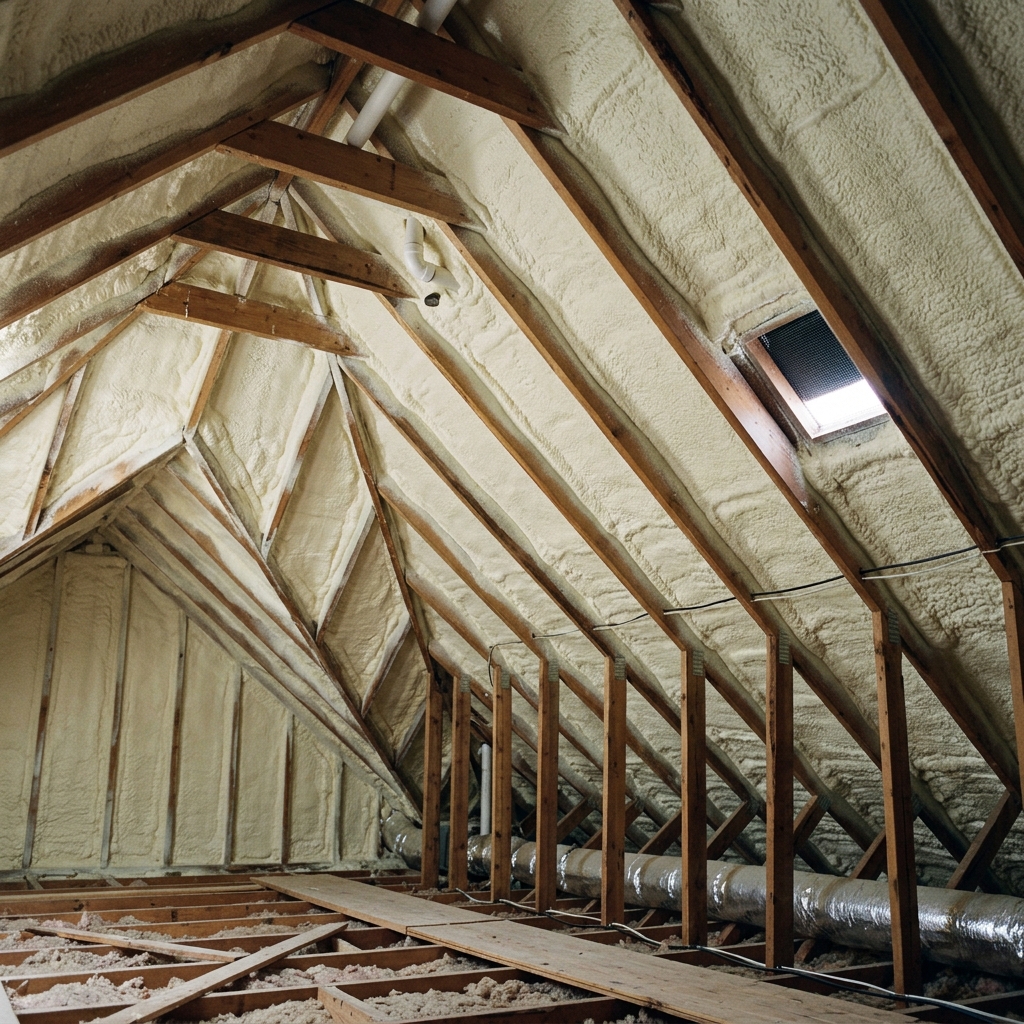
Your basement is cold at the rim joist because uninsulated wood framing at the basement-to-main-floor transition conducts outdoor cold directly into your home — and closed-cell spray foam is the only solution that stops thermal bridging, blocks moisture, and meets Ontario Building Code SB-12 compliance in a single application. Toronto and GTA homeowners who insulate their rim joists with closed-cell spray foam eliminate 15–25% of whole-home heat loss, cut annual heating bills by $300–$600, and qualify for SFK’s included pre-spray moisture assessment. Total all-in cost for a typical 100–200 linear-foot GTA rim joist: $1,200–$2,000, with a payback period of 2–6 years depending on your fuel type.
Why Is My Basement Cold at the Rim Joist?
Your basement corners and perimeter wall feel cold in winter because the rim joist — the band of wood framing that runs around the top of your foundation — is acting as a direct thermal bridge between frigid outdoor air and your conditioned living space. In an uninsulated rim joist, winter temperatures of -15 to -20°C outside reduce the interior rim joist surface to -2 to -5°C. That’s cold enough to create condensation, frost, and persistent cold drafts throughout the entire basement level.
The rim joist is the most thermally vulnerable location in a typical Ontario home because it combines three compounding problems: (1) minimal wood mass — dimensional lumber conducts cold far better than concrete; (2) no factory insulation — unlike foundation walls, rim joists are rarely insulated at time of construction in homes built before 2012; (3) air leakage gaps — sill plate joints, fastener penetrations, and utility penetrations allow uncontrolled air infiltration directly at the basement perimeter. Closed-cell spray foam addresses all three simultaneously.
If you feel cold coming from your basement walls in the area just below the main floor — especially at the corners — your rim joist is uninsulated or inadequately insulated. Signs to look for: visible wood framing behind your basement drywall, frost or moisture staining on the rim joist band, and a basement that’s noticeably colder than the rest of your home during the GTA heating season (October through April).
Understanding Rim Joist Thermal Bridging: 15–25% of Home Heat Loss
The rim joist accounts for 15–25% of a typical Ontario home’s total heat loss — more than any single assembly other than an uninsulated attic, and disproportionately high relative to its small surface area.
Why so much loss from such a small zone? Wood has an R-value of approximately R-1.25 per inch. A standard 2×10 rim joist is 9.25 inches wide — total R-value: about R-11.5. That sounds reasonable, but the rim joist is continuously exposed to exterior temperatures through the foundation sill, and any air gaps around penetrations or at the sill plate joint eliminate even that modest R-value. Effective R-value of an uninsulated rim joist with air leakage: R-3 to R-5 in practice.
Ontario Building Code SB-12 requires effective thermal resistance of R-14 minimum for basement assemblies in Climate Zone 6 (Toronto, Mississauga, Brampton) and R-17 in Zone 7 (Barrie, northern GTA). Most existing homes fall well below this at the rim joist.
| Home Type | Rim Joist Heat Loss % | Annual Heating Cost Impact (GTA Gas Baseline) | Estimated Annual Savings After Insulation |
|---|---|---|---|
| Bungalow (larger perimeter exposure) | 18–22% | $360–$550/yr | $300–$500/yr |
| 2-Storey (standard GTA detached) | 15–20% | $300–$500/yr | $275–$450/yr |
| Split-Level (elevated rim joist exposure) | 22–25% | $440–$625/yr | $350–$550/yr |
| Semi-Detached / Row Home | 10–15% | $200–$375/yr | $180–$330/yr |
GTA heating baseline: $2,000–$2,500/yr natural gas. Oil heat baseline: $3,000–$4,200/yr. Savings based on 15–25% reduction in heat loss at rim joist assembly.
Rim Joist Anatomy: Poured Concrete, Block, & Sill Plate Variations
Rim joist geometry varies significantly by foundation type, which affects spray foam depth, coverage area, and per-linear-foot cost — understanding your foundation type before getting a quote prevents surprise pricing.
There are three primary rim joist configurations in GTA homes:
- Poured concrete foundation (most common, post-1970 GTA): Rim joist sits on a concrete ledge (sill plate). Width: 8–16 inches from the top of the foundation wall to the underside of the main floor. Spray foam depth: 2–3 inches closed-cell fills the cavity between sill plate and floor joists. Cost: $12–$18/linear foot all-in.
- Concrete block (CMU) foundation (pre-1960 homes, east York, older Etobicoke): Rim joist band beam spans across the top of block courses. Width: 6–12 inches. More air infiltration points due to mortar joint gaps. Spray foam seals both rim and top course of block simultaneously. Cost: $14–$20/linear foot all-in.
- Pony wall / crawl space scenarios (split-levels, additions): Variable height. Spray foam applied to wood frame pony wall above partial-height concrete. Most complex geometry, highest material use. Cost: $18–$28/linear foot all-in.
| Foundation Type | Rim Joist Width | Foam Depth Required | Cost per Linear Foot (All-In) | Typical 100 Lin. Ft. Project Cost |
|---|---|---|---|---|
| Poured Concrete | 8–16 inches | 2–3 inches CC | $12–$18 | $1,200–$1,800 |
| Concrete Block (CMU) | 6–12 inches | 2–4 inches CC | $14–$20 | $1,400–$2,000 |
| Pony Wall / Crawl Space | Variable | 3–5 inches CC | $18–$28 | $1,800–$2,800 |
A quick note on pricing confusion: GTA contractors quote rim joist projects in linear feet (measured around the perimeter) rather than square feet, because rim joist width varies. When comparing quotes, always confirm whether the price is per linear foot or per square foot — the math differs significantly depending on rim joist depth.
Use our spray foam cost calculator to estimate your rim joist project cost by entering your home’s perimeter and foundation type.
Closed-Cell vs Open-Cell Spray Foam for Rim Joist (Why Only Closed-Cell Works)
Closed-cell spray foam is the only appropriate product for rim joist insulation in Ontario — open-cell foam fails at this location because it cannot block water vapour, which condenses at the cold rim joist surface and causes mould growth within 6–12 months.
Here’s the technical reason: the rim joist sits at the interface between warm interior air and the cold exterior foundation. In winter, warm humid indoor air migrates toward the cold rim joist surface. Closed-cell foam (R-6.0–7.0/inch, vapour permeance <1 perm) acts as both thermal insulation and a vapour barrier — stopping moisture migration before it reaches the cold wood. Open-cell foam (R-3.7/inch, vapour permeance 10–16 perms) is breathable — moisture passes right through it and condenses on the cold wood behind, creating ideal mould conditions.
Choosing open-cell to save $1–$2/sqft at the rim joist is a false economy. Mould remediation costs $500–$1,500 when caught early, and $2,000–$5,000 if left to spread behind finished basement walls. The table below makes the comparison definitive:
| Property | Closed-Cell Foam | Open-Cell Foam | Verdict |
|---|---|---|---|
| R-value per inch | R-6.0–7.0 | R-3.5–3.7 | CC wins |
| Vapour barrier (moisture blocking) | Yes (<1 perm at 2″) | No (10–16 perms) | CC mandatory |
| Air sealing | Excellent | Good | Tie |
| Structural rigidity (adds stiffness to rim) | Yes (rigid foam) | No (soft foam) | CC advantage |
| Mould risk if moisture present | Low (moisture blocked) | High (moisture transmits through) | CC mandatory |
| GTA installed cost (foam only) | $4–$6/sqft | $2.50–$3.50/sqft | OC cheaper upfront |
| OBC SB-12 R-value compliance (2″ depth) | R-12–14 ✓ | R-7–7.4 ✗ | CC required |
| Suitable for rim joist application | YES — mandatory | NO — not suitable | CC only |
See our full comparison of attic vs basement spray foam applications to understand where open-cell foam is appropriate (hint: above-grade attics with no moisture risk) vs where closed-cell is required.
Pre-Spray Assessment: Moisture Testing, Mold Detection & Remediation Cost (GTA)
40–60% of rim joist spray foam jobs in GTA homes uncover pre-existing moisture or mould during the contractor’s inspection — making a pre-spray assessment not optional, but essential before any foam is applied.
Here’s why this matters: if spray foam is applied over a damp or mouldy rim joist, the foam encapsulates the moisture and organic material. Mould continues to grow underneath, hidden from view. The spray foam warranty is void if applied over pre-existing moisture issues. Worse, the mould is now sealed inside your wall assembly, creating a health and structural problem that’s far more expensive to remediate later.
SFK’s pre-spray assessment protocol includes:
| Assessment Step | Method | Cost to Homeowner | Timeline | Action if Positive |
|---|---|---|---|---|
| Visual inspection | Flashlight + moisture meter probe | Included in SFK quote | Day 1 | Proceed to moisture test or mould test |
| Moisture meter reading | Pin-type moisture meter (<19% = safe, >19% = at-risk) | Included in SFK quote | Day 1 | If >19%, schedule mould test before foam |
| Mould surface test | Tape lift / swab test sent to lab | $200–$500 | 3–5 business days for results | If positive, schedule mould remediation |
| Mould remediation (if required) | HEPA removal, antimicrobial treatment, encapsulant | $500–$1,500 (small rim joist area) | 2–5 days treatment + 2–4 weeks clearance | Clearance test before foam application |
| Post-remediation clearance test | Air quality + surface test | $150–$300 | 1–2 days | Foam application proceeds on clearance |
SFK’s warranty clause is transparent upfront: if active mould is found, remediation must be completed before foam application and is a separate contract. This is the honest approach — it protects the homeowner and ensures the spray foam warranty (covering foam performance and thermal barrier integrity) is valid from day one. For a deeper dive on moisture control before and after spray foam, see our spray foam basement moisture control guide.
OBC SB-12 Thermal Barrier Requirement on Rim Joist Spray Foam
Ontario Building Code (OBC) SB-12 requires that all exposed spray polyurethane foam in occupied spaces — including rim joists in finished or habitable basements — be covered with an approved ignition barrier or thermal barrier within 24 hours of foam application.
This is a non-negotiable code requirement that many contractors skip or omit from quotes, leaving homeowners with a code violation and a potential insurance liability. The OBC requires the thermal barrier to achieve a minimum 15-minute fire resistance rating (per CAN/ULC-S101), protecting the foam from ignition long enough for occupant egress in a fire event.
Three code-compliant thermal barrier options for rim joist applications:
| Option | Method | GTA Cost (per sqft) | Cure Time | Best For |
|---|---|---|---|---|
| Intumescent paint / coating | Spray-on liquid coating, expands under heat | $0.50–$1.50/sqft | 2–4 hours | Tight rim joist spaces, fast turnaround, no added bulk |
| Type-X drywall (5/8″) | Cut-to-fit panels screwed to framing | $1–$2/sqft (material + labor) | Immediate (mechanical) | Clean finished look, structural, standard basement finishing |
| Factory-coated foam (integrated product) | Foam + barrier in single spray product (e.g., BASF Walltite EC+) | $6–$7/sqft (foam + barrier combined) | During application | Premium single-step solution, no secondary trade needed |
For most GTA rim joist projects, intumescent paint is the most cost-effective and least disruptive option — it adds $50–$150 to a typical 100 linear-foot project and satisfies the OBC SB-12 requirement without altering the basement’s finished ceiling or wall geometry. For a complete technical deep-dive on OBC thermal barrier requirements across all foam applications, see our guide: Does Spray Foam Need a Thermal Barrier in Ontario?
GTA Cost Breakdown: Closed-Cell + Thermal Barrier + Labor (Per Linear Foot)
The all-in cost to spray foam a rim joist in Toronto, Mississauga, North York, or surrounding GTA areas ranges from $1,200 to $2,000 for a typical 100–200 linear-foot project — including closed-cell foam, thermal barrier, and all labour.
Here is the full cost breakdown by component:
| Cost Component | Unit Cost | 100 Lin. Ft. Project | 200 Lin. Ft. Project |
|---|---|---|---|
| Closed-cell spray foam (material + application) | $4–$6/sqft | $500–$900 | $1,000–$1,800 |
| Thermal barrier (intumescent paint — most common) | $0.50–$1.50/sqft | $75–$225 | $150–$450 |
| Labour (setup, containment, finishing) | $2–$4/sqft | $250–$600 | $500–$1,200 |
| Pre-spray moisture assessment | Included | $0 | $0 |
| Pre-spray mould test (if needed) | $200–$500 | $200–$500 (conditional) | $200–$500 (conditional) |
| Mould remediation (if positive) | $500–$1,500 | $500–$1,500 (conditional) | $500–$1,500 (conditional) |
| All-In Project Total (foam + barrier + labour) | $1,200–$1,800 | $1,800–$3,200 |
For context on how rim joist pricing compares to full basement and attic spray foam projects, and to run your own numbers, use our interactive spray foam cost calculator — input your rim joist linear footage and foundation type for a GTA-specific estimate.
Ontario rebates through the Canada Greener Homes Retrofit (CGHR), HER+, and OAIR programs may include rim joist insulation as part of a whole-home insulation project. Rim joist alone typically doesn’t meet the minimum measure threshold, but combined with attic insulation it qualifies for up to $10,600 in combined rebates. See our Ontario insulation rebate guide for current program details.
Payback Calculation: When Does Rim Joist Spray Foam Pay for Itself?
Rim joist spray foam pays for itself in 2–6 years for GTA homeowners — faster for oil-heated homes (2–3 years) and for homeowners who combine rim joist with attic insulation in a single project (under 2 years combined payback).
| Scenario | Project Cost | Annual Heating Savings | Payback Period |
|---|---|---|---|
| Natural gas heat, rim joist only | $1,200–$1,800 | $300–$500/yr | 4–6 years |
| Oil heat, rim joist only | $1,200–$1,800 | $450–$750/yr | 2–3 years |
| Electric heat, rim joist only | $1,200–$1,800 | $400–$650/yr | 2–4 years |
| Natural gas + attic (combined project) | $3,500–$6,000 | $900–$1,500/yr + up to $10,600 rebate | <2 years after rebate |
The combined attic + rim joist scenario deserves special attention. Rim joist accounts for 15–25% of heat loss; an uninsulated attic accounts for 25–35%. Together they represent 40–55% of a GTA home’s total heat loss. Addressing both in one project maximizes savings, minimizes disruption, and unlocks larger Canada Greener Homes Retrofit rebates. Our attic vs basement cost guide shows how to structure a combined project for maximum ROI.
Remediation Scenario: Pre-Existing Mold + Spray Foam (Timeline & Cost)
When pre-existing mould is discovered at the rim joist — which happens in 40–60% of assessments in older GTA homes — the total project timeline extends to 4–6 weeks and total cost increases to $2,000–$4,500, but the result is a permanent moisture solution rather than a temporary patch.
Here is the complete remediation + spray foam timeline for a typical GTA rim joist mould scenario:
| Phase | Activity | Timeline | Cost |
|---|---|---|---|
| 1. Pre-spray assessment | Moisture meter + visual inspection | Day 1 (included in quote visit) | $0 (SFK included) |
| 2. Mould test | Tape lift / air sample, lab analysis | 3–5 business days | $200–$500 |
| 3. Mould remediation | HEPA vacuum, antimicrobial treatment, encapsulant | 2–5 days active work | $500–$1,500 |
| 4. Post-remediation clearance | Surface + air quality re-test, lab clearance | 5–10 days (lab turnaround) | $150–$300 |
| 5. Spray foam application | Closed-cell foam applied 2–3 inches to rim joist | 1–2 days | $800–$1,500 |
| 6. Thermal barrier application | Intumescent paint or Type-X drywall | 1 day (cure: 24–48 hrs) | $75–$225 |
| 7. Post-install humidity check | Relative humidity baseline measurement | 7 days monitoring | $0 (SFK included) |
| Total | 4–6 weeks all-in | $2,000–$4,500 |
“We noticed moisture staining on our North York basement rim joist during a routine home inspection. SFK found mould during the pre-spray assessment — something our inspector had missed. They handled the testing referral, waited for clearance, then applied closed-cell foam in one day. Two winters later, our basement is consistently 4–5°C warmer and our gas bill dropped about $380 this past heating season. Zero mould recurrence on the follow-up check.”
— David & Priya K., North York homeowner
Decision Tree: Should You Insulate Your Rim Joist?
Answer these four questions to determine whether rim joist spray foam is the right next step for your GTA home — and whether to prioritize it alone or combine it with attic insulation.
- Is your basement perimeter noticeably cold in winter, especially at the corners?
→ Yes: Your rim joist is thermally bridging — closed-cell spray foam will directly address the source.
→ No: Check your attic insulation first (attic heat loss is typically larger if the rim joist has been previously insulated). - Is there visible moisture staining, frost marks, or musty odour at the rim joist area?
→ Yes: Pre-spray moisture assessment and potential mould remediation required before foam. Budget $2,000–$4,500 all-in and 4–6 weeks.
→ No: Proceed to standard rim joist quote — budget $1,200–$2,000 for 100–200 linear feet. - What is your primary heating fuel?
→ Oil: Rim joist project priority — payback 2–3 years. Start immediately.
→ Natural gas: Strong candidate — payback 4–6 years standalone, under 2 years combined with attic.
→ Electric baseboard: Very high priority — payback 2–4 years, each kWh saved is valuable at Ontario’s time-of-use rates. - Is your attic also uninsulated or under-insulated (<R-50)?
→ Yes: Combine attic + rim joist in one project — unlock CGHR/HER+ rebates up to $10,600, achieve 40–55% heat loss reduction, payback under 2 years after rebates.
→ No: Rim joist alone will deliver meaningful 15–25% heat loss reduction at $1,200–$2,000.
FAQ: Rim Joist Spray Foam, Thermal Bridging & OBC Compliance
Why is my basement cold at the rim joist?
Your basement is cold at the rim joist because uninsulated wood framing at the top of the foundation wall conducts outdoor temperatures directly into your home. In a GTA winter at -15°C, an uninsulated rim joist surface drops to -2 to -5°C indoors — cold enough for condensation, drafts, and significant heat loss accounting for 15–25% of your home’s total energy use.
What percentage of home heat loss is through the rim joist?
The rim joist accounts for 15–25% of total home heat loss in a typical uninsulated Ontario home — approximately 18% in bungalows, 20% in two-storey homes, and up to 25% in split-level designs. This is disproportionately high relative to its surface area because wood framing conducts cold far more readily than concrete, and air leakage at sill plates compounds the loss.
Should I use closed-cell or open-cell spray foam on my rim joist?
You must use closed-cell spray foam on your rim joist — open-cell foam is not suitable. Closed-cell foam blocks moisture vapour (vapour permeance <1 perm at 2 inches), preventing condensation on the cold wood framing. Open-cell foam (10–16 perms) allows moisture to pass through, creating mould conditions within 6–12 months. Always specify closed-cell for rim joists in Ontario homes.
Why is open-cell spray foam not suitable for rim joists?
Open-cell foam fails at rim joists because it cannot stop moisture vapour migration. Its high vapour permeance (10–16 perms) means humidity passes through the foam and condenses on cold wood framing behind it, creating ideal mould growth conditions. Open-cell also delivers only R-3.7/inch, insufficient to meet OBC SB-12’s R-14 minimum for basement assemblies at typical rim joist depth.
How much does rim joist spray foam cost in Toronto?
Rim joist spray foam costs $12–$20 per linear foot all-in for a typical Toronto or GTA home — including closed-cell foam, thermal barrier, and labour. For a standard 100 linear-foot home, expect $1,200–$1,800. A 200 linear-foot home (larger detached or bungalow) runs $1,800–$3,200. Add $200–$500 for mould testing if moisture is suspected, plus $500–$1,500 for mould remediation if required.
Do you need a thermal barrier on rim joist spray foam in Ontario?
Yes — Ontario Building Code SB-12 requires an approved thermal barrier covering all exposed spray foam in habitable basement spaces, including rim joists. The thermal barrier must achieve a minimum 15-minute fire resistance rating per CAN/ULC-S101. Options include intumescent paint ($0.50–$1.50/sqft), Type-X drywall ($1–$2/sqft), or factory-integrated barrier foam products ($6–$7/sqft combined).
What’s OBC SB-12 and why does it apply to rim joist spray foam?
OBC SB-12 is Ontario Building Code Supplementary Standard SB-12 — the thermal resistance and fire safety requirements for building envelopes. It sets minimum R-values for basement assemblies (R-14 in Climate Zone 6 / Toronto area) and mandates a thermal barrier over exposed foam in habitable spaces to prevent rapid flame spread. Skipping the thermal barrier is an OBC violation and can void your home insurance claim.
Should I test for mould before spray foam on my rim joist?
Yes — SFK conducts a free moisture assessment as part of every rim joist quote, and recommends a formal mould test ($200–$500) if the moisture meter reads above 19% or if staining is visible. 40–60% of rim joist assessments in older GTA homes uncover pre-existing moisture or mould. Foam applied over active mould encapsulates the problem and voids the warranty — pre-spray testing protects your investment.
What happens if mould is found during a rim joist assessment?
If mould is found, spray foam application is paused until professional mould remediation is complete — typically $500–$1,500 for a rim joist-area mould problem. After remediation, a clearance test ($150–$300) confirms the area is clean, then spray foam proceeds. Total timeline with mould: 4–6 weeks from initial assessment to completed foam installation. This adds $700–$1,800 to the project but ensures a permanent, warranty-valid solution.
How long does it take to install spray foam on rim joists?
Rim joist spray foam installation takes 1–2 days for a typical 100–200 linear-foot GTA home — including surface preparation, foam application, and thermal barrier coating. If mould remediation is required first, the total project timeline extends to 4–6 weeks. Foam cure time is 24–48 hours before the space can be used normally.
What’s the payback period for rim joist insulation in the GTA?
Payback is 2–6 years depending on your heating fuel: natural gas yields 4–6 year payback ($300–$500/yr savings on a $2,000–$2,500 GTA gas baseline); oil heat yields 2–3 years ($450–$750/yr savings); electric baseboard yields 2–4 years. Combined with attic insulation and Canada Greener Homes Retrofit or HER+ rebates up to $10,600, payback drops below 2 years.
Can you do attic and rim joist spray foam in one project?
Yes — and SFK recommends combining attic and rim joist insulation in a single project for maximum efficiency and rebate access. Attic plus rim joist together eliminate 40–55% of typical GTA home heat loss. One mobilization, one project management fee, and a combined scope that qualifies for larger Canada Greener Homes Retrofit rebates. Call 647-641-6881 for a combined attic + rim joist assessment.
Is there a warranty on rim joist spray foam insulation?
SFK’s spray foam warranty covers foam performance and thermal barrier integrity for the life of the foam product (typically 20+ years) — provided the pre-spray moisture assessment is completed, no active mould or water intrusion is present at time of application, and the thermal barrier is installed per OBC SB-12. The warranty does not cover pre-existing water intrusion from exterior sources (foundation cracks, window well leaks) — active water must be addressed before foam application.
How do I know if my rim joist has thermal bridging?
Signs of rim joist thermal bridging in GTA homes: basement corners and perimeter wall feel noticeably cold in winter; visible condensation or frost staining on wood framing just below the main floor; musty odour in basement in late winter or early spring; and heating system running longer cycles without achieving target temperature. A thermal imaging camera confirms thermal bridging precisely — SFK technicians carry FLIR thermal cameras for rim joist assessments.
What’s a pre-spray moisture assessment for rim joists?
A pre-spray moisture assessment is SFK’s standard first step before any rim joist insulation project — included at no charge as part of your quote visit. It includes: visual inspection of rim joist framing for staining, rot, or mould; moisture meter readings at sill plate, rim joist band, and floor joist ends (safe = <19%, at-risk = >19%); and a thermal imaging scan to identify cold spots, air infiltration paths, and moisture-compromised framing. If moisture is detected, a mould test is recommended before foam application proceeds.
Why Spray Foam Kings: Pre-Spray Moisture Assessment + Mold-Ready Process
Spray Foam Kings is the GTA’s specialist for rim joist insulation with a mould-ready assessment process that protects homeowners from the #1 spray foam failure mode — foam applied over hidden moisture.
What sets SFK apart for rim joist projects:
- Pre-spray moisture assessment included: Every rim joist quote begins with a free moisture meter + visual inspection. No other GTA contractor offers this as standard — most apply foam and leave the moisture risk with the homeowner.
- Thermal camera inspection: FLIR thermal imaging identifies hidden cold spots and air infiltration paths invisible to the naked eye, ensuring complete foam coverage where it matters most.
- Closed-cell foam only for rim joists: SFK never installs open-cell foam at rim joist locations — we’ve seen the mould callbacks and won’t cut that corner. We use only closed-cell foam (R-6.0–7.0/inch, <1 perm vapour permeance) at this moisture-critical location.
- OBC SB-12 compliance guaranteed: Every rim joist project includes an approved thermal barrier (intumescent paint standard, Type-X drywall on request). We handle compliance — your basement passes inspection.
- SPFA certified applicators, $5M liability, WSIB coverage: 15+ years serving the GTA with spray foam insulation.
- Transparent mould referral process: If mould is found during assessment, we pause the project, refer you to a certified mould remediator, and resume foam only after clearance testing — no hidden costs to the foam contract.
SFK serves all GTA municipalities: Toronto, North York, Scarborough, Etobicoke, Vaughan, Mississauga, Markham, and Brampton. For rim joist assessments in Scarborough’s older brick homes, North York post-war bungalows, or Mississauga’s newer subdivision builds, call to schedule your free assessment — same-week availability. Need rim joist work as part of a broader basement project? Visit our basement spray foam insulation service page or our full spray foam services overview.
Get Your Free Quote Today
Call: 647-641-6881
SFK provides free rim joist assessments — including moisture meter reading and FLIR thermal camera inspection — with every quote. Serving Toronto, North York, Scarborough, Etobicoke, Vaughan, Mississauga, Markham, and Brampton. Same-week availability for rim joist projects.