
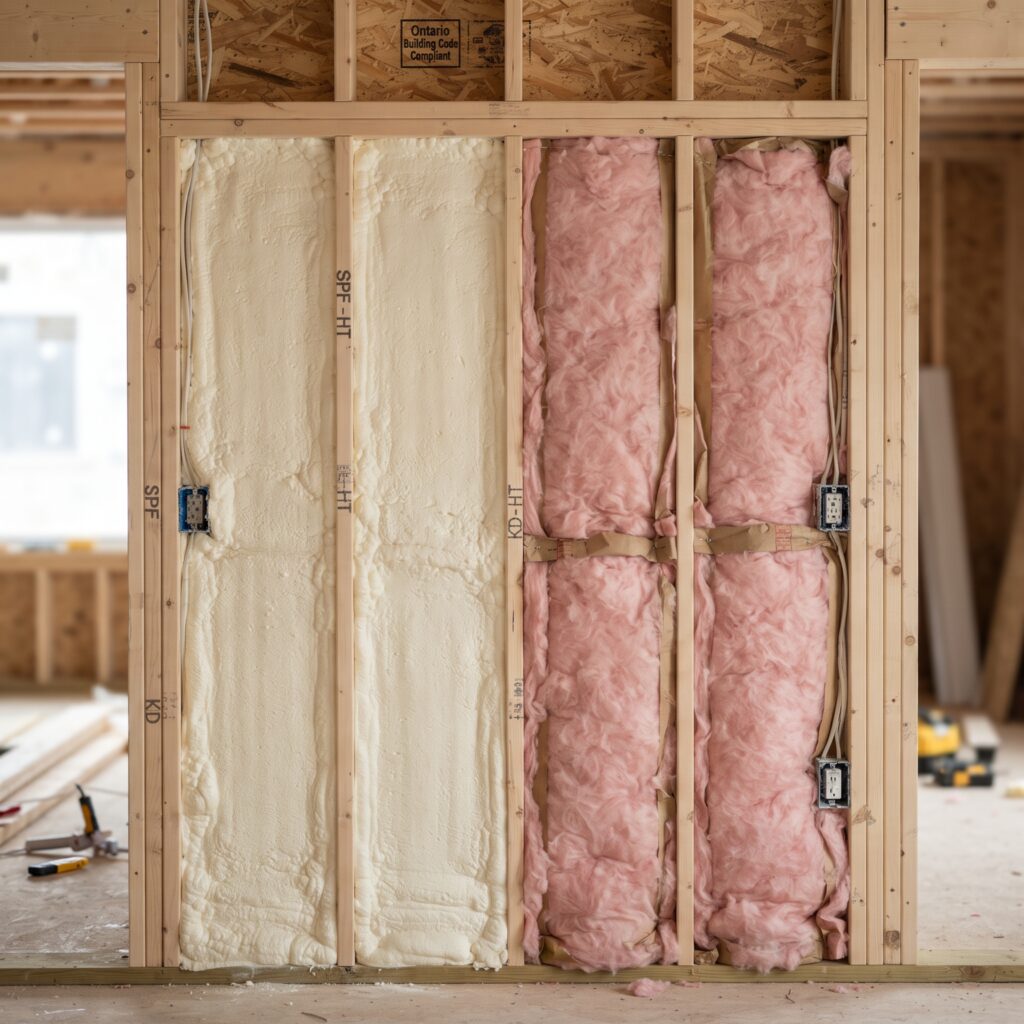
What’s the difference?
Toronto homeowners face a critical choice when upgrading insulation: spray foam or roll insulation. Both work, but they solve different problems and carry different costs, timelines, and trade-offs. Roll insulation—fiberglass or mineral wool batts—remains the traditional, budget-friendly option. It’s familiar, DIY-friendly, and fast to install. Spray foam (open-cell or closed-cell polyurethane) seals air leaks while it insulates, offering superior thermal performance and moisture control in Toronto’s freeze-thaw cycles. The decision hinges on your renovation scope, budget, timeline, and whether you’re addressing air leakage or simply meeting R-value minimums. In 2026, Toronto’s updated building code and rising energy costs make this choice more consequential. A basement retrofit in a 1970s Leslieville bungalow might benefit from spray foam’s air-sealing properties, while an attic top-up in a newer North York home might not justify the premium. This guide walks you through both sides so you can make the right call for your property and wallet.
Side-by-side comparison
| Criterion | Spray Foam Insulation | Roll Insulation (Fiberglass/Mineral Wool) |
|---|---|---|
| Material Cost (per sq ft, CAD) | $1.25–$2.50 | $0.40–$0.80 |
| Installation Cost (labour + material, 1,000 sq ft basement, CAD) | $3,500–$6,000 | $1,000–$2,000 |
| Timeline (typical project) | 1–3 days; minimal curing time | 1–2 days; can occupy space same day |
| Permit Required in Toronto | Yes (structural/moisture variance); spray application must follow fire code | No, unless part of major renovation |
| When to Choose | Basements, rim joists, irregular cavities, air-sealing priority, older homes with poor envelope | Standard attics, walls in new construction, budget constraints, easy DIY access |
| Risk if Wrong Choice | Over-spec’d for simple jobs; moisture trap if closed-cell used in wrong climate zone | Air leaks persist; cold spots in corners; inadequate vapour control in Toronto humidity |
Spray foam insulation — when it’s the right call
Spray foam excels in three scenarios common to Toronto homes. First, basements and crawl spaces where roll insulation struggles: uneven rim joists, concrete columns, and ledges become seamless with foam. The air-sealing bonus is critical in older Toronto neighbourhoods where foundations shift, creating gaps traditional batts can’t bridge. Second, irregularly framed cavities—think cathedral ceilings in Cabbagetown conversions or knee walls in attic bedrooms. Roll insulation leaves voids; foam conforms perfectly. Third, primary air-barrier duty. If your home audit flags significant air leakage (blower-door test >8 ACH50), spray foam directly addresses this, reducing HVAC strain in Toronto’s -20°C winters. Open-cell foam (0.5 lb/ft³) is hygroscopic, allowing wall assemblies to dry; it’s the safer choice for Toronto’s humid summers. Closed-cell (2 lb/ft³) offers higher R-value and acts as a vapour barrier but demands careful placement to avoid condensation traps. Budget $4,000–$8,000 for a 1,200 sq ft basement; expect 15–25% energy savings if air leakage was severe. Insurance companies often offer modest discounts for spray foam retrofits (verify your provider). The trade-off: higher upfront cost, noise during application, and mandatory professional installation. Basement spray foam retrofits in Toronto typically pay back within 8–12 years through reduced heating costs.
Roll insulation — when it’s the right call
Roll insulation remains the pragmatic choice for many Toronto projects. If you’re topping up an existing attic (adding R-20 to existing R-10 fiberglass), rolls are faster, cheaper, and require no permit. Cost: roughly $1,500 for 1,200 sq ft with labour. If your home already has a solid air barrier (new construction, recent envelope work, or low blower-door reading <4 ACH50), adding roll insulation simply meets thermal targets without unnecessary expense. Mineral wool batts have gained traction in Toronto because they're non-combustible, handle moisture better than fiberglass, and don't off-gas; they're ideal for kitchen soffits or rooms near fireplaces. Roll insulation is also the obvious choice for budget-conscious homeowners or rentals where energy recovery is less certain. DIY potential is high if you're comfortable in an attic and follow vapour-barrier rules (kraft-faced toward warm side in winter climates like Toronto). The main weakness: gaps and compression around electrical boxes, plumbing vents, and framing reduce effective R-value by 10–30%. Air leaks around rim joists or basement band boards persist. For attic insulation alone—especially in post-1990 homes—rolls work well. For whole-home envelope sealing, they’re a partial solution. Toronto’s winter performance is adequate with rolls if air-sealing is handled separately (caulk, weatherstripping, rim joist sealing).
Edge cases and Toronto-specific factors
Bylaw and Permit Landscape. Toronto’s Building Code (aligned with OBC 2020) mandates air-tightness testing in new construction; existing homes have no retrofit requirement, but additions or major renovations (>25% exterior envelope) trigger compliance. Spray foam application requires a licensed contractor and documentation; permits cost $200–$400. Rolls need no permit for standalone insulation but become relevant in registered renovation work.
Insurance and Liability. Some insurers (e.g., co-op buildings in downtown Toronto) restrict spray foam due to fire concerns; verify your policy. Spray foam contractors must carry full liability coverage; ask for a Certificate of Insurance before work begins. Roll insulation carries no special insurance implications.
Neighbourhood Considerations. Heritage homes in Rosedale, The Annex, or Leslieville may face restrictions on visible exterior changes; spray foam is interior-only, so it’s compatible, but permit variance officers may scrutinize moisture management. Victorian homes with brick walls and plaster benefit from spray foam’s non-invasive application.
Toronto’s Humidity and Freeze-Thaw. Winters drop below -15°C; springs thaw rapidly. Closed-cell foam is vapour-restrictive and can trap spring moisture in walls. Open-cell foam allows drying but offers lower R-value per inch. Roll insulation is forgiving in this climate if the air barrier (drywall, weatherstripping) is robust. Basement humidity in Toronto (often 60–70% RH) favours spray foam because it seals the concrete-frame junction, reducing vapour intrusion. Crawl space and basement moisture control are primary spray foam wins here.
Frequently asked questions
How much energy will I actually save with spray foam vs. rolls in Toronto?
Savings depend on your baseline. If your basement or rim joist is uninsulated or has gaps, spray foam can cut heating costs by 15–25% in that zone. Rolls in an already-sealed attic? 5–10% savings. Toronto’s winters (avg. heating cost ~$2,000/year for a detached home) mean even modest improvements add up, but spray foam’s premium ($3,000–$5,000 extra) may take 10+ years to recoup unless combined with air-sealing work elsewhere.
Will spray foam trap moisture in my Toronto basement?
Not if applied correctly. Open-cell spray foam (recommended for Toronto) allows vapour transmission and actually improves basement drying by sealing concrete to frame joints. Closed-cell foam is moisture-resistant but must not be used as a secondary vapour barrier on interior walls without a drainage plane. A professional assessment before application prevents costly mistakes.
Can I install roll insulation myself in my Toronto home?
Yes, attic work is DIY-friendly if you’re comfortable in tight spaces and follow vapour-barrier placement rules (kraft-faced side toward the warm, winter-side in Toronto). Basement and wall cavities are trickier—electrical hazards, moisture paths, and code compliance make professional installation safer. If your home is part of a co-op or condo, permit your landlord/board first.
Do I need a permit for spray foam or roll insulation in Toronto?
Spray foam: yes, if it’s part of a registered renovation or structural change. Rolls: only if bundled into a major renovation (>25% envelope). Standalone attic or wall top-ups with rolls typically don’t require permits, but always confirm with Toronto Building Services before starting.
What’s the lifespan of spray foam vs. rolls in Toronto’s climate?
Both last 50+ years if installed correctly. Spray foam cures fully within 24 hours and is immune to settling. Fiberglass rolls can compress over 10–15 years in attics, reducing R-value; mineral wool is more stable. In Toronto’s humid, freeze-thaw environment, spray foam’s sealed joints age better than roll seams, which can gap as houses shift.
Can I use spray foam in my heritage-listed Toronto home without violating protections?
Yes—spray foam is interior-only and doesn’t alter the building’s exterior character. However, you’ll need a Heritage Permit if your project affects interior walls visible from outside or changes exterior openings. Consult Toronto’s Heritage Preservation Services before planning; they often support energy efficiency work that preserves the structure.
Bottom line
Choose spray foam if: Your home has uninsulated or poorly insulated basements, rim joists, or crawl spaces; a blower-door test confirms significant air leakage (>6 ACH50); you’re retrofitting an older Toronto property with irregular framing; or you’re willing to invest upfront ($4,000–$8,000) for 10+ year payback. Spray foam seals and insulates simultaneously—critical for Toronto’s winter performance and humidity management. Professional air-sealing with spray foam is the most effective envelope upgrade for most Toronto homes.
Choose roll insulation if: You’re topping up an existing attic or well-sealed walls; your budget is tight; your home’s air barrier is already sound (new construction or recent envelope work); or the project is simple and DIY-accessible. Rolls are faster, cheaper, and require no permits for standalone work. They’re sufficient for meeting thermal targets in homes where air leakage isn’t the primary issue.
The real decision: Audit first. A blower-door test ($300–$600) reveals whether air sealing is your priority; if it is, spray foam wins despite higher cost. If your home is already tight and you simply need more R-value, rolls are the pragmatic choice. Many Toronto homes benefit from a hybrid approach: spray foam on basement rim joists and critical seal points, rolls in the attic.
For a free assessment and quote tailored to your Toronto property, visit sprayfoamkings.ca and describe your project. A licensed professional can perform a blower-door test, identify air-leak hotspots, and recommend the most cost-effective solution—whether that’s spray foam, rolls, or both.