
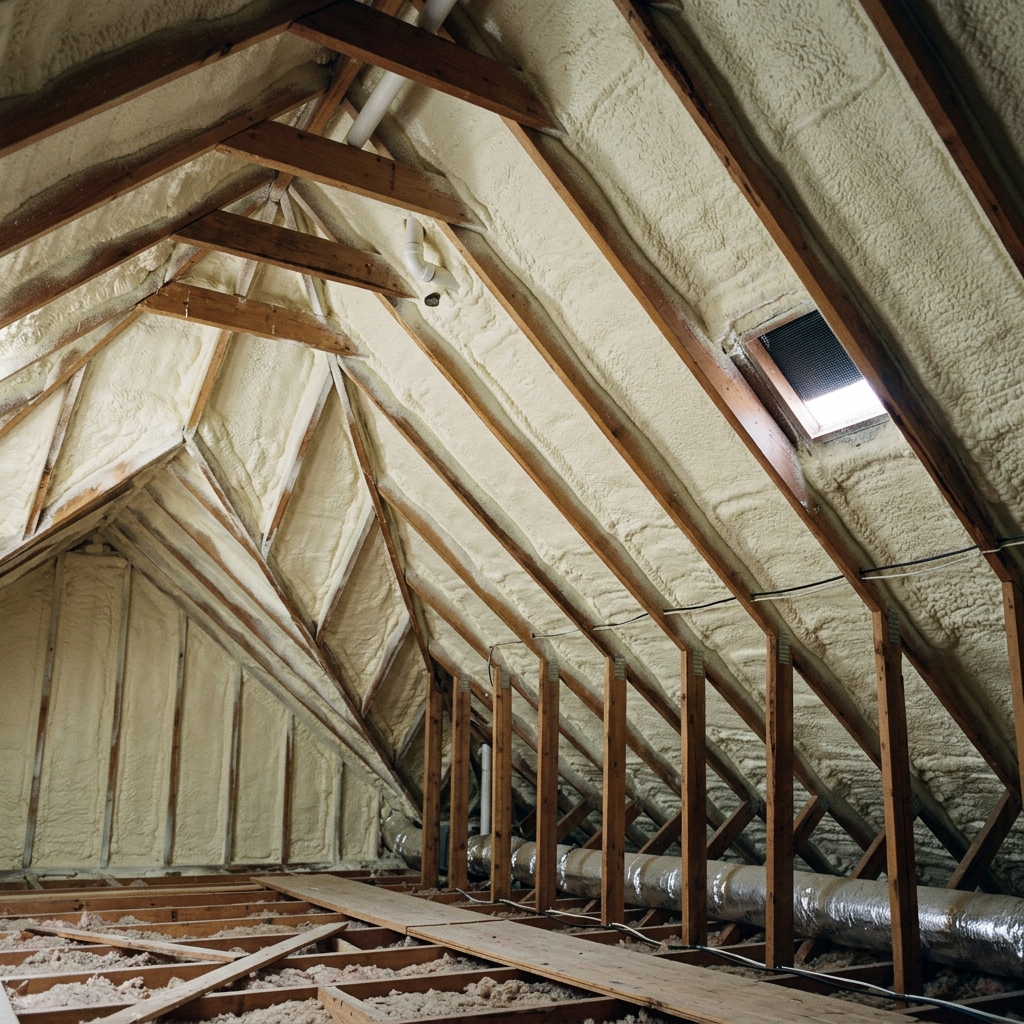
Spray Foam vs Blown-In Insulation for Toronto Homes in 2026: What You Need to Know
Published January 2026 | Updated for current Toronto building codes and pricing
What’s the difference?
Toronto homeowners upgrading insulation in 2026 face a critical choice: spray foam or blown-in fiberglass and cellulose. Both seal thermal leaks, but they work differently and suit different situations. Spray foam expands on contact, filling cavities and air gaps simultaneously—it’s applied wet and hardens into a rigid or semi-rigid barrier. Blown-in insulation (typically fiberglass or cellulose) is pumped as loose fibers into existing walls, attics, and rim joists after walls are opened or through small access holes. The decision hinges on your budget, timeline, building condition, and whether you’re renovating or retrofitting. A century home with settling walls and uneven cavities may favor spray foam’s adaptive fill; a straightforward attic upgrade often suits blown-in material and lower cost. Both approaches comply with current Toronto building code (Ontario Building Code 2020, adopted by the city), but spray foam requires specific installer certification and carries permit implications in some neighborhoods, particularly heritage districts. Understanding the trade-offs—upfront cost, installation speed, long-term R-value performance, and air-sealing capability—ensures you invest wisely in your Toronto property’s comfort and resale value.
Side-by-side comparison
| Factor | Spray Foam | Blown-In Insulation |
|---|---|---|
| Typical Cost (Toronto, CAD) | $2.50–$4.00 per sq. ft. (open cell); $4.00–$7.00 per sq. ft. (closed cell) | $0.80–$1.50 per sq. ft. (fiberglass); $1.20–$2.00 per sq. ft. (cellulose) |
| Installation Timeline | 1–3 days (average home); partial curing before drywall or enclosure | 1 day (attic); 2–4 days (walls, depending on access) |
| Permit Required (Toronto) | Yes, in most cases; certified installer mandatory | No (attic only); possible for wall retrofit or major renovation |
| When to Choose | Air sealing critical; irregular cavities; basement rim joists; crawl spaces; retrofit without major demolition | Budget-conscious attic upgrade; straightforward wall cavities; post-construction cleanup acceptable; new build framing |
| Risk If Wrong Choice | Over-spec in simple attic = wasted cost; moisture issues if open cell used in wrong climate zone | Gaps and voids in uneven cavities; poor air sealing; settling over time (fiberglass more prone than cellulose) |
| R-Value (per inch) | Open cell 3.6–4.0; Closed cell 6.5–7.2 | Fiberglass 3.2–3.8; Cellulose 3.6–3.8 (dense-packed) |
Spray foam insulation — when it’s the right call
Spray foam excels when air sealing is non-negotiable. Toronto’s cold winters and variable spring/fall humidity demand tight building envelopes; spray foam expands to fill every void, crack, and rim cavity simultaneously. This matters in older homes—Victorian semis, wartime bungalows, and 1970s condos often have irregular framing, settling foundations, and inaccessible gaps where blown-in material simply cannot reach or pack adequately. Basement rim joists are a canonical example: spray foam bonds to concrete, wood, and steel, creating an unbroken thermal and air barrier in one pass. Crawl spaces, cathedral ceilings, and band joists—areas where traditional insulation leaves thermal bridges—become seamless with spray foam.
Closed-cell spray foam is also the standard for basement insulation in Toronto, where moisture and ground contact demand a vapor-impermeable barrier. Open-cell spray foam suits interior attic work where vapor permeability is acceptable and budget pressure is moderate. The real advantage emerges in retrofit scenarios: if you’re not gutting walls, blown-in insulation requires significant wall opening or drilling; spray foam can be injected into cavities through small ports, minimizing drywall damage and reconstruction costs. For heritage-listed homes in neighborhoods like the Annex or Rosedale, this non-invasive approach often satisfies municipal heritage committees better than wholesale wall demolition. Installation takes 1–3 days, and while upfront cost ($2.50–$7.00 per square foot, depending on foam type) exceeds blown-in alternatives, energy savings—typically 15–25% on heating costs—recoup the premium over 7–10 years in Toronto’s climate.
Blown-in — when it’s the right call
Blown-in insulation is the pragmatic choice for straightforward, budget-driven projects. If your attic is unfinished, easily accessible, and has standard joist spacing, blown-in fiberglass or cellulose delivers R-value at 40–60% lower cost than spray foam. Toronto homeowners upgrading attics from R-20 (typical 1990s builds) to R-50 or R-60 (current code-recommended levels) often find blown-in the cleanest economic path: $0.80–$2.00 per square foot for material and labor, completed in a single day, no permit required for attic-only work. Cellulose, made from recycled newspaper, performs slightly better in dense-pack wall applications and resists settling better than fiberglass over 20+ years, making it a solid choice if you do plan wall retrofits.
Blown-in is also appropriate for new construction framing where cavities are uniform, straight, and fully accessible—homes built 2010 onward with standard 16-inch on-center studs and consistent joist spacing. In these scenarios, spray foam’s premium cost buys air sealing that well-framed new homes partly achieve through modern construction taping and sealing practices anyway. Fiberglass blown-in also avoids concerns about foam off-gassing or chemical sensitivity that some Toronto homeowners prioritize; it’s inert once installed and poses no long-term indoor air quality risk. If your neighborhood is cost-sensitive (e.g., suburban Toronto like Scarborough or Pickering), blown-in insulation maintains resale appeal without the “over-improved” perception that premium spray foam can sometimes trigger. One caveat: blown-in insulation settles over time (especially fiberglass), losing roughly 10–15% of initial R-value after 20 years; Toronto’s heating-dominated climate makes this a real penalty, so dense-pack cellulose is preferable if longevity matters.
Edge cases and Toronto-specific factors
Toronto’s regulatory environment adds complexity absent in other regions. Heritage Conservation Districts (HCDs) covering much of the downtown core, Yorkville, the Distillery District, and pockets of older neighborhoods require permits and heritage committee review for any exterior work, including insulation that alters visible elements. Interior spray foam insulation is less contentious than blown-in wall work involving external scaffolding, but always confirm with your local heritage planner before proceeding. The Ontario Building Code (OBC 2020) mandates blower-door testing for renovations above 25% of opaque above-grade exterior surface area; tight spray foam envelopes often exceed code air-leakage targets (3.0 ACH50 for residential), simplifying compliance.
Insurance is another consideration. Some Toronto insurers offer small discounts (1–3%) for homes with upgraded insulation, particularly if combined with air sealing; spray foam’s comprehensive sealing sometimes qualifies; blown-in alone rarely does. Condos present a special case: many Toronto condo declarations restrict alterations to common elements (exterior walls, shared rim joists); spray foam requires unit-specific permits from the condo board. Blown-in attic work, assuming the attic is unit-exclusive, usually avoids board scrutiny. Finally, supply-chain reality in 2026 means spray foam materials (polyol and isocyanate) remain imported and subject to tariff volatility affecting CAD pricing; blown-in fiberglass and cellulose are sourced domestically, offering price stability—relevant for budget-locked projects where cost certainty matters.
Frequently asked questions
1. Do I need a permit for insulation work in Toronto?
Attic-only blown-in insulation typically does not require a permit. Spray foam, wall insulation, basement work, or any project touching the building envelope almost always requires a permit and certified installer; verify with your local Toronto municipal office, as bylaws vary by ward. Heritage homes may need additional heritage approval.
2. Will spray foam off-gas or cause indoor air quality problems?
Quality closed-cell and open-cell spray foams, when installed by certified professionals and properly ventilated during cure, pose minimal long-term air quality risk; gases dissipate within 24–72 hours post-application. Choose installers certified by the Spray Polyurethane Foam Alliance (SPFA) to ensure proper application and safety protocols. Fiberglass and cellulose are inert and off-gas-free.
3. Which insulation is better for Toronto’s freeze-thaw cycles and spring moisture?
Closed-cell spray foam is superior: it’s vapor-impermeable and resists moisture intrusion, critical for basements and exposed rim joists in Toronto’s wet springs. Open-cell spray foam and blown-in insulation allow some moisture vapor transmission, which suits interior attics but is riskier in direct-contact-with-ground zones. Dense-pack cellulose is hygroscopic (absorbs moisture) but tolerates it better than fiberglass.
4. How much will I save on heating costs with new insulation?
Upgrading a Toronto home’s attic from R-20 to R-50 typically yields 10–15% heating cost reduction; comprehensive envelope sealing (spray foam in rim joists, basements, and air leaks) can reach 20–25% savings. Payback periods: blown-in attic work recoups cost in 4–6 years; spray foam retrofit with air sealing, 7–10 years, depending on current home condition and heating fuel.
5. Can I DIY insulation installation?
Blown-in fiberglass attic work is DIY-feasible (rent a blower from Home Depot for ~$50/day), though professional installation avoids gaps and settling issues. Spray foam absolutely requires certified professionals; improper application ruins efficiency and can cause moisture or safety problems. In Toronto, spray foam DIY voids most permits and builder’s risk insurance.
6. What’s the lifespan of each insulation type?
Spray foam (both cell types) lasts 50+ years if undisturbed; it does not biodegrade or settle significantly. Blown-in fiberglass typically loses 10–15% R-value over 20 years due to settling and potential moisture exposure. Cellulose, when properly installed at density 2.0–3.0 lb/cu. ft., maintains R-value longer and resists settling better than fiberglass. Both blown-in materials may require top-ups after 25–30 years in Toronto’s climate.
Bottom line
Choose spray foam if: your home is over 50 years old, has irregular cavities or settling, includes basement or rim joist work, is a condo requiring minimal disruption, or sits in a heritage district where non-invasive retrofit is mandatory. Spray foam is the right tool for air sealing and moisture-critical zones. Budget 7–10 years for full ROI but expect superior long-term comfort and durability.
Choose blown-in if: you’re upgrading an unfinished attic with standard framing, have a fixed budget under $2,000, need work completed in one day, or live in a new(ish) home with uniform cavity spacing. Blown-in delivers quick, cost-effective R-value gains for straightforward scenarios; pair with cellulose (not fiberglass) if you plan future wall work or want better settling resistance.
For Toronto homeowners uncertain about their specific situation—whether your 1920s Victorian semdetached needs spray foam rim-joist sealing, or your 2005 bungalow’s attic is a perfect blown-in candidate—request a free, no-obligation assessment from a certified local installer. Spray Foam Kings serves the Toronto area and offers complimentary energy audits to pinpoint your home’s biggest insulation gaps. Visit attic insulation services, wall insulation options, or air sealing solutions on their site to book a quote tailored to your project scope and Toronto postal code.