
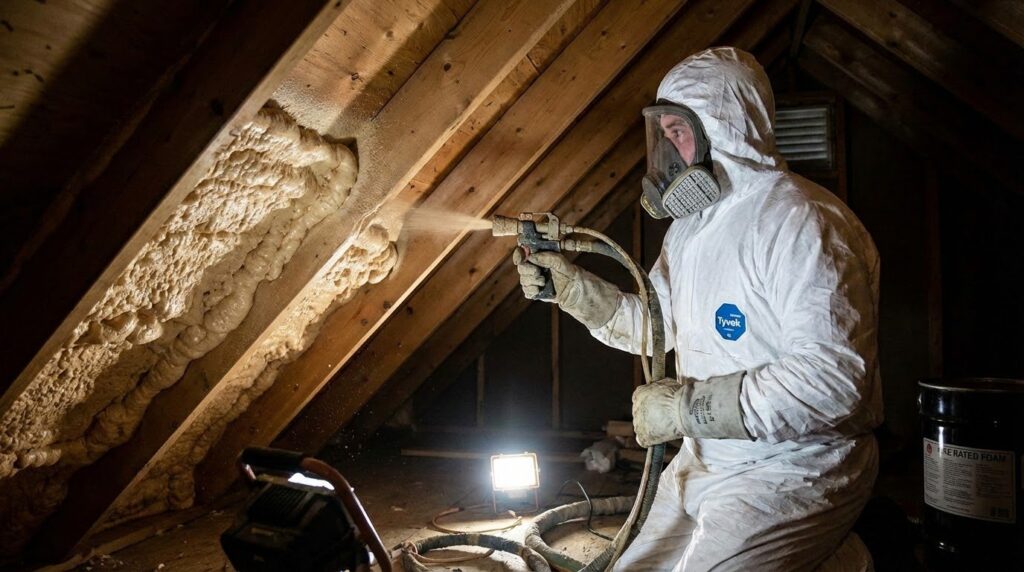
Fire-rated spray foam is spray polyurethane foam made with flame-retardant additives, used in Ontario homes where fire spread is a concern — attached garage ceilings, walls next to furnace rooms, and rim joists. Spray Foam Kings installs to Ontario Building Code SB-12 on every job and provides a free, written, itemised quote.
What Is Fire-Rated Spray Foam?
Fire-rated spray foam is a spray-applied polyurethane foam that contains flame-retardant additives. When exposed to heat it forms a char layer that slows flame spread and reduces smoke. It comes in open-cell and closed-cell formulations: open-cell provides about R-3.7 per inch, and closed-cell about R-6 per inch, with closed-cell also acting as a class-II vapour retarder at 2 inches or more.
Where Fire-Rated Spray Foam Is Used in Homes
- Attached garage ceilings and walls, between the garage and living space.
- Basement walls next to furnace or utility rooms.
- Rim joists and band boards, where gaps can carry air and smoke between floors.
- Attic areas around recessed lighting.
- New-construction building envelopes.
How Much Does Fire-Rated Spray Foam Cost?
Price depends on foam type, area and thickness, access, and whether old insulation must come out first. For reference, standard spray foam installed by Spray Foam Kings costs $1.50–$3.50 per sq ft for open-cell and $2.50–$5.00 per sq ft for closed-cell; fire-rated formulations are quoted per project. Removing old fiberglass or cellulose is a separate line item (about $400–$800 for a 1,200 sq ft attic). Every quote is free, written and itemised.
Installation and Re-occupancy
- Assessment and written quote.
- Preparation — old insulation is removed if needed; HVAC equipment, electrical panels and flooring access points are covered with plastic sheeting.
- Application to the specified thickness.
- Re-occupancy after a minimum of 24 hours with ventilation; 24–48 hours for whole-home installs.
Crews are CUFCA-trained and WSIB-covered, Spray Foam Kings carries $5,000,000 in commercial general liability insurance, and a workmanship warranty covers delamination, shrinkage and adhesion failures at no charge.
Residential Spray Foam vs Industrial Fireproofing (SFRM)
Fire-rated spray foam insulation for homes is different from industrial fireproofing. Spray Foam Kings’ industrial fireproofing service uses spray-applied fire-resistive material (SFRM) on commercial and industrial projects: we are NFCA certified for fireproofing and certified dealers of CAFCO 300 and ISOLATEK products, with fire ratings of 1–4 hours. These credentials and ratings apply to industrial SFRM fireproofing, not to residential spray foam insulation. For commercial or industrial fire-resistance requirements, see our fireproofing services in Toronto.
Fire-Rated Spray Foam FAQ
Is fire-rated spray foam the same as fireproofing?
No. Fire-rated spray foam is insulation with flame-retardant additives. Industrial fireproofing (SFRM) is a separate spray-applied fire-resistive material used on commercial and industrial structures, with fire ratings of 1–4 hours.
How long do I need to stay out after installation?
A minimum of 24 hours with ventilation; for whole-home installs, allow 24–48 hours.
How long does spray foam last?
25–30+ years under normal conditions.
What warranty do you provide?
A workmanship warranty that repairs delamination, shrinkage or adhesion failures at no charge.
Can I get a rebate?
Spray Foam Kings is a registered Enbridge HER+ partner; eligible upgrades can qualify for rebates of up to $10,600, and we handle the paperwork.
Planning spray foam insulation for your Ontario home?
Contact Spray Foam Kings for a free quote or call 647-641-6881 — serving Toronto, the GTA and Ontario.
Watch: Fireproofing Spray Application Toronto | Spray Foam Kings #toronto #shorts
What Is Fire‑Rated Spray Foam?
The product is available in both open‑cell (≈ R‑3.7 per inch) and closed‑cell (≈ R‑6 per inch) formulations.
—
Where Fire‑Rated Foam Is Typically Used
| Location | Why Fire‑Rating Matters |
|---|---|
| Attached‑garage ceilings and walls | Limits fire spread from the garage to living areas |
| Basement walls next to furnace or utility rooms | Provides a barrier where heat sources are present |
| Rim joists and band boards | Seals gaps that can carry fire and smoke between floors |
| Attic areas around recessed lighting | Reduces the risk of fire propagation through penetrations |
How Fire‑Rating Is Determined
For residential applications Spray Foam Kings installs foam that complies with Ontario Building Code SB‑12 on every job. The code requires a minimum fire‑resistance performance for assemblies such as garage walls and ceilings. In industrial projects Spray Foam Kings offers NFCA‑certified spray‑applied fire‑resistive material (SFRM) with fire‑rating tests of 1–4 hours, but those ratings do not apply to residential fire‑rated foam.
—
Cost Factors for Fire‑Rated Spray Foam
| Factor | Typical Impact on Price |
|---|---|
| Foam type | Open‑cell: $1.50–$3.50 / sq ft installed; Closed‑cell: $2.50–$5.00 / sq ft installed |
| Desired thickness | Higher R‑value requires more material per square foot |
| Access & preparation | Complex layouts or limited access can add labour time |
| Removal of existing insulation | Separate line item; approx. $400–$800 for a 1 200 sq ft attic |
All projects receive a free, written, itemised quote before any work begins.
—
Installation Process & Re‑Occupancy
- Assessment & Quote – Written, itemised estimate provided.
- Preparation – Existing insulation is removed (if required); HVAC, electrical panels and flooring access points are covered with plastic sheeting.
- Application – Foam is sprayed to the specified thickness, following CUFCA‑trained procedures.
- Curing – Foam cures within minutes; full chemical inertness is achieved after 24 hours.
- Re‑Occupancy – Minimum 24 hours of ventilation for partial installs; 24–48 hours for whole‑home applications.
The crew is WSIB‑covered, and Spray Foam Kings carries $5 000 000 commercial general liability insurance.
—
Certifications, Insurance & Warranty
- CUFCA‑trained installers – National industry standard for spray polyurethane foam.
- NFCA certification – Applies to our industrial fire‑proofing (SFRM) services.
- WSIB‑compliant crew – All workers are covered.
- $5 000 000 commercial general liability insurance – Protects homeowners.
- Workmanship warranty – Repairs delamination, shrinkage or adhesion failures at no charge.
—
Rebates & Savings
Spray Foam Kings is a registered Enbridge Home Efficiency Rebate Plus (HER+) partner. Eligible upgrades can qualify for rebates of up to $10 600. The company handles all paperwork and coordinates the post-install inspection to facilitate rebate processing.
—
Frequently Asked Questions
Is fire‑rated spray foam the same as industrial fire‑proofing? No. Industrial fire‑proofing (SFRM) is a separate, NFCA‑certified material with fire‑rating tests of 1–4 hours.
Does fire‑rated foam act as a vapour barrier? Closed‑cell foam at 2 inches or more functions as a class‑II vapour retarder. Open‑cell foam is breathable and requires a separate vapour barrier where the code mandates one.
How long will the foam last? When installed correctly, the foam remains effective for 25–30 + years under normal conditions.
Can I move back into my home the same day? Standard re‑occupancy is after a minimum of 24 hours with ventilation. For whole‑home installations, allow 24–48 hours.
Do you provide a written quote? Yes. Every project receives a free, written, itemised quote before scheduling.
—
What Is Fire‑Rated Spray Foam?
Fire‑rated spray foam is a spray‑applied polyurethane foam that contains flame‑retardant additives. When exposed to high heat the additives cause the foam to form a protective char layer, which slows flame spread and reduces smoke production. The product is available in both open‑cell (≈ R‑3.7 per inch) and closed‑cell (≈ R‑6 per inch) formulations. Closed‑cell foam also functions as a class‑II vapour retarder when installed at 2 inches or more, meeting the Ontario Building Code requirement for a vapour barrier in many assemblies.
—
Typical Residential Applications
Fire‑rated spray foam is most often used where a fire‑resistance barrier is required or where fire spread is a concern:
- Attached‑garage ceilings and walls – separates the garage from living spaces.
- Basement walls adjacent to furnaces, water heaters or utility rooms – limits flame propagation from heat sources.
- Rim joists and band boards – seals gaps that can carry fire and smoke between floors.
- Attic areas around recessed lighting or other penetrations – reduces the risk of fire travelling through openings.
- New‑construction building envelopes – provides both insulation and the fire‑rating required by code.
—
How Fire‑Rating Is Determined
For residential projects Spray Foam Kings installs foam that complies with Ontario Building Code SB‑12 on every job. SB‑12 specifies a minimum fire‑resistance performance for assemblies such as garage walls, garage ceilings and certain attic constructions. The fire‑rated foam meets these performance criteria by incorporating flame‑retardant additives that create a char layer during a fire event.
*Note:* The fire‑resistance ratings (e.g., 1‑hour, 2‑hour) that apply to industrial spray‑applied fire‑resistive material (SFRM) are not used for residential fire‑rated foam.
—
Cost Factors for Fire‑Rated Spray Foam
The price of fire‑rated spray foam depends on several variables:
| Factor | Typical Impact on Price |
|---|---|
| Foam type | Open‑cell: $1.50–$3.50 / sq ft installed; Closed‑cell: $2.50–$5.00 / sq ft installed (standard rates) |
| Desired thickness | Higher R‑value requires more material per square foot |
| Surface area | Larger areas benefit from economies of scale, but total cost scales with square footage |
| Access & preparation | Complex layouts, limited access, or extensive masking add labour time |
| Removal of existing insulation | Separate line item; approx. $400–$800 for a 1 200 sq ft attic |
Fire‑rated formulations are quoted per project after a free, written, itemised estimate.
—
Installation Process & Re‑Occupancy
- Free written quote – An itemised estimate is provided before any work begins.
- Preparation – Existing insulation (if any) is removed; HVAC equipment, electrical panels and flooring access points are covered with plastic sheeting.
- Application – Trained CUFCA‑certified crew sprays the foam to the specified thickness, following the manufacturer’s guidelines.
- Curing – The foam chemically cures within minutes; full inertness is achieved after 24 hours.
- Re‑occupancy – Minimum 24 hours of ventilation for partial installs; 24–48 hours is recommended for whole‑home applications.
—
Rebates and Warranty
Spray Foam Kings is a registered Enbridge Home Efficiency Rebate Plus (HER+) partner. Eligible upgrades can qualify for rebates of up to $10,600, and the company handles all required paperwork.
Every installation includes a workmanship warranty that covers delamination, shrinkage, or adhesion failures at no charge. The foam itself has an expected lifespan of 25–30 years under normal conditions.
—
Frequently Asked Questions
Is fire‑rated spray foam the same as industrial fireproofing? No. Fire‑rated spray foam is insulation that contains flame‑retardant additives. Industrial fireproofing (SFRM) is a separate spray‑applied material with fire‑ratings of 1–4 hours and is used on commercial or industrial structures.
Do I need a separate vapour barrier? Closed‑cell foam acts as a class‑II vapour retarder when installed at 2 inches or more. Open‑cell foam is breathable and requires a separate vapour barrier where the code mandates one (e.g., most basement walls).
How long must I stay out after the foam is applied? A minimum of 24 hours with ventilation for partial installs; 24–48 hours for whole‑home applications.
How long will the insulation last? When installed correctly, spray foam remains effective for 25 years or more without sagging, settling, or moisture absorption.
Can I get a rebate for fire‑rated spray foam? Yes, as an Enbridge HER+ partner Spray Foam Kings can process rebates up to $10,600 for qualifying upgrades.
What warranty protects my investment? A workmanship warranty covers any delamination, shrinkage, or adhesion failures at no cost to the homeowner.