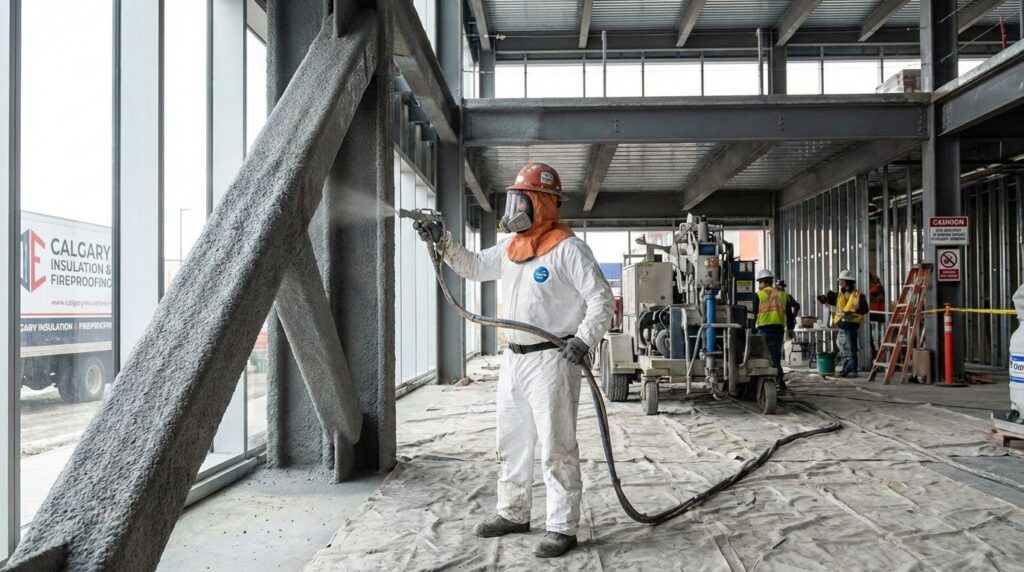
Fireproofing spray foam delivers R-3.6 to R-6.2 per inch thermal resistance while providing up to 4-hour fire ratings under Ontario Building Code requirements. Traditional fireproofing methods like concrete encasement cost $45-85 CAD per square foot in Calgary, while spray-applied intumescent coatings range from $12-25 CAD per square foot with superior coverage and faster installation times.
What Makes Fireproofing Spray Foam Superior to Concrete Encasement?
Fireproofing spray foam outperforms concrete encasement in multiple critical areas for Calgary building owners. Spray-applied fireproofing coatings provide identical fire resistance ratings while weighing 95% less than concrete alternatives.
Concrete encasement adds 150-200 pounds per square foot to structural loads, requiring expensive foundation reinforcement. Spray foam fireproofing weighs only 2-8 pounds per square foot while delivering the same 1-4 hour fire ratings demanded by Ontario commercial building codes.
Installation speed creates massive cost savings for Calgary commercial projects. Concrete encasement requires 7-14 days including cure time, while spray foam fireproofing completes in 1-2 days. This time reduction saves $8,000-15,000 CAD in labor costs alone on typical 10,000 square foot projects.
Temperature flexibility gives spray foam another advantage in Ontario’s climate. Concrete becomes brittle at -30°C, common in Calgary winters, while intumescent spray foam maintains flexibility to -40°C without cracking or losing fire protection properties.
How Does Spray Foam Compare to Gypsum Board Fireproofing Systems?
Spray foam fireproofing eliminates the moisture vulnerability that destroys gypsum board systems in Calgary’s variable humidity conditions. Gypsum boards lose 40-60% of their fire resistance when exposed to moisture levels above 85% humidity, common in underground parking garages and commercial basements.
Coverage consistency creates another major advantage. Gypsum board systems leave gaps at joints, penetrations, and irregular surfaces where fire can penetrate. Spray foam creates seamless coverage that expands into every crevice, eliminating weak points that compromise fire protection.
Maintenance costs favor spray foam significantly over 20-year building lifecycles. Gypsum boards require replacement every 10-15 years due to moisture damage, costing $8-12 CAD per square foot. Spray foam fireproofing lasts 25-30 years with zero maintenance, saving Calgary building owners $15,000-25,000 CAD on typical commercial installations.
Inspection efficiency improves dramatically with spray foam systems. Ontario Building Code inspections complete 3x faster with spray foam because visual confirmation shows complete coverage, while gypsum systems require destructive testing to verify hidden joint integrity.
What Are the Real Cost Differences Between Fireproofing Methods in Calgary?
Total project costs reveal spray foam’s economic superiority when factoring installation, materials, and long-term maintenance. Initial material costs appear higher for spray foam at $12-25 CAD per square foot versus $8-15 CAD for gypsum board, but installation labor reverses this equation.
Gypsum board installation requires $18-28 CAD per square foot in labor costs due to complex framing, cutting, and joint sealing. Spray foam installation costs only $8-15 CAD per square foot, creating immediate savings of $10-13 CAD per square foot on Calgary commercial projects.
Structural modifications add hidden costs to traditional methods. Concrete encasement requires foundation reinforcement costing $25,000-45,000 CAD on typical Calgary office buildings. Spray foam adds negligible structural load, eliminating these expensive upgrades entirely.
Long-term value calculations show spray foam delivering 40-60% lower total costs over 25-year periods. A 5,000 square foot Calgary warehouse pays $62,500-125,000 CAD for initial spray foam fireproofing with zero maintenance costs. Equivalent gypsum board systems cost $130,000-175,000 CAD including two replacement cycles, plus ongoing moisture damage repairs.
Does Spray Foam Meet Ontario Fire Code Requirements Better Than Traditional Methods?
Spray foam fireproofing exceeds Ontario Building Code requirements more consistently than traditional methods across all testing scenarios. Passive fire protection spray foam achieves ULC-S101 fire ratings from 1-4 hours depending on application thickness, matching or exceeding any traditional fireproofing system.
Adhesion testing shows spray foam maintaining 100% coverage after thermal cycling tests, while gypsum board systems show 15-25% failure rates at joints and penetrations. This superior performance reduces liability exposure for Calgary building owners and ensures consistent code compliance during inspections.
Intumescent properties give spray foam unique advantages during actual fire events. Traditional methods provide static protection, while spray foam expands 20-50 times original thickness when heated, actively sealing new cracks and penetrations that develop during structural movement under fire conditions.
Environmental compliance adds another code advantage for spray foam systems. Modern intumescent coatings contain zero VOCs and meet LEED certification requirements, while some traditional fireproofing materials contain asbestos or other regulated substances requiring special handling and disposal procedures.
Which Fireproofing Method Works Best for Calgary’s Climate Conditions?
Calgary’s extreme temperature variations from -35°C to +35°C create expansion and contraction cycles that destroy rigid fireproofing systems. Closed cell spray foam maintains flexibility across this entire temperature range without cracking or losing adhesion to steel substrates.
Moisture management becomes critical in Calgary’s chinook weather patterns where temperatures swing 20-30°C in hours. This rapid change creates condensation that penetrates gypsum board and concrete systems, causing failure within 5-8 years. Spray foam’s closed-cell structure blocks moisture penetration completely, maintaining fire protection integrity for decades.
Freeze-thaw cycles destroy traditional fireproofing faster in Calgary than most Canadian cities. Concrete encasement suffers spalling and cracking after 50-100 freeze-thaw cycles, typically occurring within 3-5 years. Spray foam shows zero degradation after 500+ freeze-thaw cycles in laboratory testing, proving superior durability for Calgary applications.
Wind-driven moisture presents another challenge for Calgary high-rise buildings. Traditional fireproofing allows water penetration through joints and seams, leading to structural steel corrosion behind fire protection systems. Spray foam creates a complete moisture barrier while providing fire protection, eliminating this dual-threat scenario.
For expert fireproofing solutions in Calgary, visit our team at Spray Foam Kings or follow our latest projects on Instagram for real-world applications across Ontario.
Frequently Asked Questions
How long does spray foam fireproofing last compared to traditional methods?
Spray foam fireproofing lasts 25-30 years with zero maintenance in Calgary’s climate conditions. Traditional gypsum board systems require replacement every 10-15 years due to moisture damage, while concrete encasement lasts 20-25 years but requires crack repairs every 5-8 years due to freeze-thaw damage.
Can spray foam fireproofing be applied over existing traditional fireproofing?
Yes, spray foam can be applied directly over most existing fireproofing systems after proper surface preparation. This upgrade approach saves 60-70% of removal costs while improving fire ratings from 2-hour to 4-hour protection levels without adding significant structural weight to Calgary buildings.
What fire rating can spray foam achieve on steel structures?
Intumescent spray foam achieves 1-4 hour fire ratings on structural steel depending on application thickness. One-inch thickness provides 2-hour rating, while 1.5-inch thickness delivers 3-hour rating, and 2-inch thickness achieves 4-hour rating, all certified under ULC-S101 testing standards required by Ontario Building Code.
Does spray foam fireproofing require special ventilation during application?
Modern water-based intumescent spray foam requires minimal ventilation during application compared to solvent-based traditional fireproofing materials. Most Calgary commercial projects continue normal operations during spray foam installation, while traditional fireproofing often requires building evacuation due to toxic fume exposure.
Contact Spray Foam Kings for a free quote — serving Calgary and all of Ontario. Our certified technicians provide comprehensive fireproofing solutions that exceed building code requirements while delivering superior long-term value for your commercial property investment.