
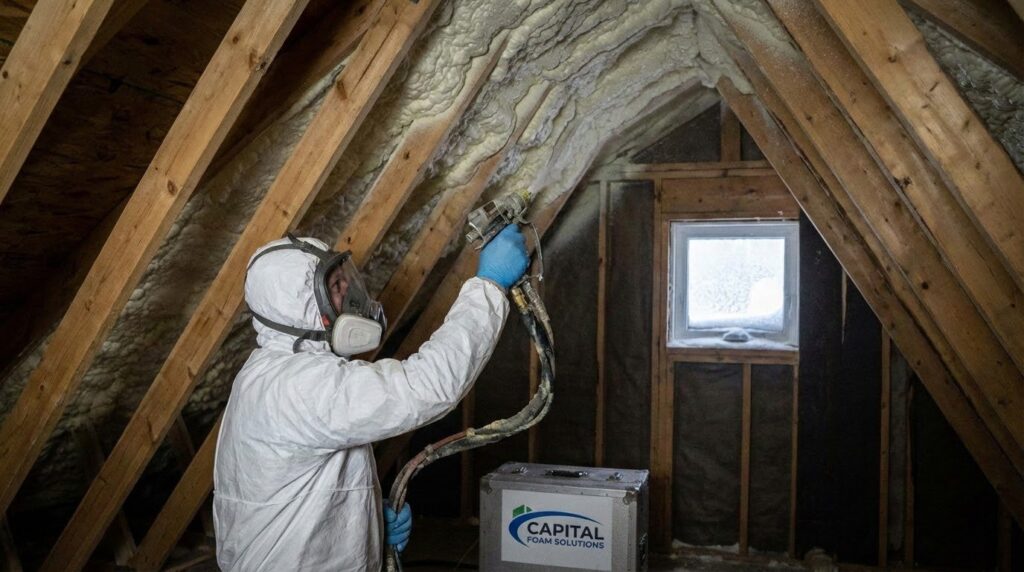
Open cell spray foam delivers R-3.6 to R-3.8 per inch at $1.50-$2.50 per square foot, while closed cell provides R-6.0 to R-6.2 per inch at $2.50-$4.00 per square foot in Ottawa. For most Ontario homeowners, closed cell offers superior moisture resistance and structural strength, making it the preferred choice for basements, crawl spaces, and exterior applications despite the higher upfront cost.
What’s the Real Difference Between Open Cell and Closed Cell Spray Foam?
The fundamental difference lies in their cellular structure. Open cell spray foam has interconnected cells that allow air and moisture to pass through, creating a softer, more flexible material. Closed cell spray foam features sealed cells that create an impermeable barrier, resulting in a rigid, dense insulation material.
Open cell spray foam expands to 3 inches thick during application and has a density of 0.5 pounds per cubic foot. It acts as an air barrier but not a vapor barrier, requiring additional vapor control in certain applications. Closed cell spray foam expands to 1-2 inches thick with a density of 2 pounds per cubic foot, functioning as both an air and vapor barrier.
In Ottawa’s climate with temperature swings from -30°C to +30°C, this structural difference significantly impacts performance. Closed cell spray foam consistently outperforms traditional insulation materials in Canadian weather conditions, providing superior thermal resistance and moisture control.
Which Spray Foam Type Offers Better Value for Ontario Homeowners?
Closed cell spray foam delivers better long-term value despite higher initial costs. At R-6.2 per inch, you need only 2 inches of closed cell to achieve R-12, compared to 3.3 inches of open cell foam. This thickness difference matters significantly in Ottawa homes where space is limited.
The moisture resistance of closed cell prevents costly mold remediation and structural damage common in Ontario’s humid summers and freeze-thaw cycles. Open cell’s moisture permeability can lead to condensation issues in basement applications, potentially costing thousands in repairs.
For energy savings, closed cell reduces heating costs by 30-50% annually in typical Ottawa homes, while open cell achieves 20-35% savings. Professional spray foam insulation increases home value significantly, with closed cell providing higher returns due to its superior performance characteristics.
Closed cell also adds structural strength to walls and roofs, providing up to 300% increased racking strength. This structural benefit isn’t available with open cell foam, making closed cell ideal for older Ottawa homes requiring reinforcement.
Where Should You Use Open Cell vs Closed Cell in Your Ottawa Home?
Closed cell spray foam excels in moisture-prone areas: basements, crawl spaces, rim joists, and exterior walls. In Ottawa’s climate, these areas experience significant temperature differentials and moisture challenges. Basement insulation requires moisture-resistant materials to prevent mold and structural issues.
Use closed cell for:
- Foundation walls and basement applications
- Rim joists and band boards
- Exterior walls in unconditioned spaces
- Roof decks and cathedral ceilings
- Areas requiring vapor barriers
Open cell works well in interior applications with controlled moisture: interior walls for soundproofing, vaulted ceilings with proper vapor control, and attic floors where vapor barriers aren’t critical. However, basement applications almost always require closed cell due to moisture concerns.
For Ottawa’s mixed climate conditions, closed cell provides year-round performance consistency that open cell cannot match in critical applications.
How Do Installation Costs Compare Between Open Cell and Closed Cell?
Material costs show closed cell at 60-80% higher than open cell, but total project costs often favor closed cell. Open cell requires thicker applications to achieve equivalent R-values, increasing labor time and material usage. For R-20 performance, you need 5.5 inches of open cell versus 3.3 inches of closed cell.
Installation complexity affects costs significantly. Closed cell’s faster cure time allows for quicker application cycles, reducing labor costs. Open cell’s longer cure time and potential need for additional vapor barriers can increase installation time by 20-30%.
Professional installation is crucial for both types. DIY spray foam installation often leads to expensive corrections and performance issues that negate any initial savings.
Total project costs in Ottawa typically range $2,000-$4,000 for average basements with closed cell, versus $1,500-$3,000 for open cell. However, closed cell’s superior moisture protection eliminates potential remediation costs that can exceed $10,000.
Which Spray Foam Performs Better in Ontario’s Climate?
Ontario’s climate demands insulation that handles temperature extremes, humidity variations, and freeze-thaw cycles. Closed cell spray foam maintains its R-value across temperature ranges, while open cell can experience thermal bridging in extreme cold.
Moisture management proves critical in Ontario’s humid summers and cold winters. Closed cell’s vapor barrier properties prevent condensation within wall assemblies, eliminating mold risks. Open cell allows moisture transmission, requiring careful vapor control design to prevent problems.
Wind resistance matters for Ottawa’s exposed locations. Closed cell provides superior air sealing at 0.02 air changes per hour, compared to open cell’s 0.05-0.08 ACH. This difference translates to 15-25% better heating efficiency in windy conditions.
Freeze-thaw durability gives closed cell significant advantages. Its rigid structure resists expansion and contraction damage, while open cell’s flexibility can lead to air gaps over time. For Ottawa homeowners, this durability means consistent long-term performance without degradation.
Stay connected with Spray Foam Kings on Facebook for the latest insulation tips and project updates.
Frequently Asked Questions
Is open cell or closed cell spray foam better for soundproofing?
Open cell spray foam provides superior sound dampening with a noise reduction coefficient of 0.70 compared to closed cell’s 0.45. The open cell structure absorbs sound waves more effectively, making it ideal for interior walls and media rooms where acoustic performance matters more than moisture resistance.
Can I use open cell spray foam in my Ottawa basement?
Open cell is not recommended for Ottawa basements due to moisture permeability. Basement applications require vapor barrier properties to prevent mold growth and structural damage. Closed cell spray foam provides necessary moisture protection for below-grade applications in Ontario’s climate.
How long does each type of spray foam last in Ontario homes?
Both open cell and closed cell spray foam last 80+ years when properly installed. However, closed cell maintains its performance characteristics better over time due to its rigid structure and moisture resistance. Open cell may experience slight settling or moisture-related degradation in challenging applications.
Which spray foam type qualifies for Ontario energy rebates?
Both open cell and closed cell spray foam qualify for Ontario energy efficiency rebates when installed by certified contractors and meeting minimum R-value requirements. Closed cell’s higher R-value per inch often helps homeowners achieve rebate thresholds more easily in space-constrained applications.
Contact Spray Foam Kings for a free quote — serving Ottawa and all of Ontario. Our certified technicians will assess your specific needs and recommend the optimal spray foam solution for your home’s unique requirements.