
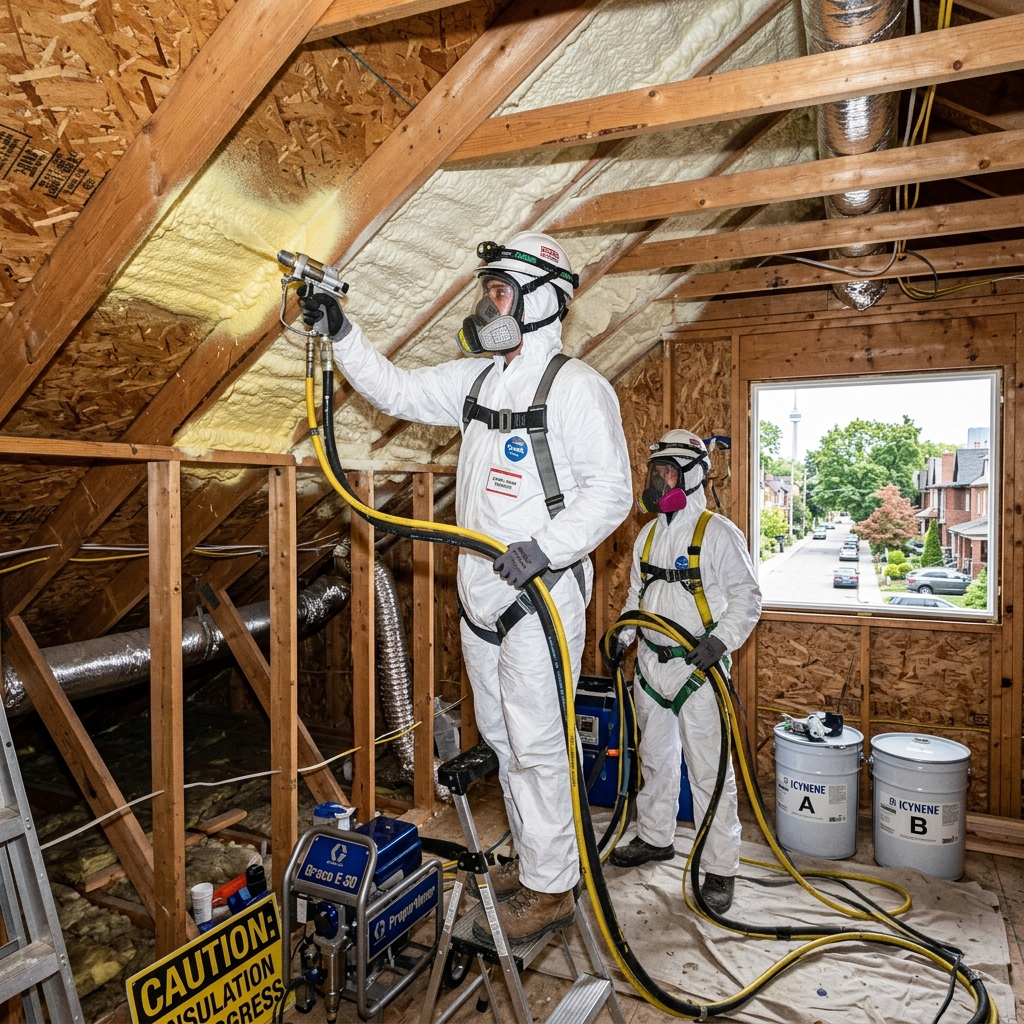
In 2026, open-cell and closed-cell spray foam insulation prices in Toronto range from roughly CAD $1.50-$7.00/sqft, with a typical single-family home project running $3,000-$12,000 all-in before rebates. Whether you’re winterizing an attic in Scarborough or sound-proofing a condo in Burlington, the choice still boils down to one question: Which foam actually saves more money and meets 2026 Ontario codes faster?
The Short Answer: Open Cell vs Closed Cell Spray Foam Toronto 2026
Choose open-cell when budget and sound-dampening rule the day—it delivers an R-3.5-3.7 per inch and costs roughly $1.50-$3.50/sqft. Choose closed-cell when maximum heat-flow resistance (R-6.0-6.8 per inch) and built-in moisture barrier are critical at $3.00-$7.00/sqft.
2026 Cost Snapshot for Toronto Homeowners
| Foam Type | Price Range (2026 CAD per sqft) | Typical Full-Home Job Range |
|---|---|---|
| Open-cell | $1.50 – $3.50 | $3,000 – $12,000 |
| Closed-cell | $3.00 – $7.00 |
DIY Kits vs Hiring a Licensed Contractor in 2026
| Metric | DIY Kit (Online Retail) | Licensed CUFCA Contractor |
|---|---|---|
| Cost | $350-$450 for 200 sqft | $3-$7/sqft, bulk pricing available |
| Time | 1-2 days per 200 sqft | 1 day per 1,000+ sqft |
| R-Value at 1″ | Same chemistry as pro | Codes require certified depth, usually 2-6″ |
| Moisture Control | No warranty on vapour barrier | Warranty-backed Class II vapour retarder |
| Ontario Code Compliance | Blower-door comps often missed | Report stamped by CUFCA-inspector |
| Air-Sealing Quality | Spotty, no thermal scan | Pro-grade mixing, infra-red QC |
Serving Every Corner of West & Central GTA
- Scarborough – older bungalows upgrading attic insulation to R-50+
- North York – split-level homes needing basement insulation Toronto solutions vapour-checked for radon
- Etobicoke – lake-effect moisture drives requests for closed-cell rim joists
- Mississauga & Brampton – rapid infill builds adding bonus-rooms and commercial spray foam atop retail units
- Hamilton & Burlington – 1890s cottages chasing envelope tightness without losing heritage walls from the outside
“SFK insulated our 1963 attic in Rexdale, Etobicoke with closed-cell at $4.80/sqft covering 750 sqft—total $3,600 CAD in March 2025. Temperature swings dropped overnight, furnace runs 18 % less. Couldn’t be happier.”
—Marissa & Devon P.
Ontario Building Code 2026 Requirements (Insulation Depth & Thermal Bridging)
If your permit is filed in Toronto 2026, inspectors will ask for:
- Attic: R-50+ (≈13-14″ open-cell or 7-8″ closed-cell)
- Walls: R-20+ (≈5-6″ open-cell or 3-4″ closed-cell)
- Basement: R-24+ (use closed-cell against concrete for double duty moisture seal)
CUFCA-certified contractors submit digital density reports, passing both CCMC and SB-12 prescriptive paths. Always insist on a CUFCA field label—it’s what insurance adjusters expected after the 2024 Flash-Freeze of February.
Why Spray Foam Kings for Open Cell vs Closed Cell Spray Foam Toronto 2026
- CUFCA Certification since 2008—every foreman is spray-technician certified and re-tested annually.
- Licensed Ontario Contractor with active TSSA fuel technician endorsement for hybrid spray rigs.
- WSIB & $5 M liability insurance in force, so you don’t risk your home policy.
- 15+ years GTA track record on >2,400 residential and commercial spray foam projects.
- In-house spray foam cost calculator that auto-factors 2026 rebate programs like HER+ and Enbridge retrofits.
Want to chat details? Call 647-641-6881 or visit our contact page—quotes emailed within 24 hrs.
Toronto-Specific FAQs 2026 (R-Values & Condo Rules Included)
1. Which spray foam is allowed on exterior condo walls in Toronto 2026?
CCMC-listed closed-cell is only choice for condo above-grade walls. Boards must hit R-12 continuous to offset thermal bridges. Open-cell does not meet non-combustibility specs set by TSSA for >3-storey buildings.
2. Can I add open-cell foam over my 1990s attic cellulose?
Yes—provided the cellulose is <40 % compressed and a baffle keeps soffit vents clear. Target R-60 total (old R-32 plus new R-28). Our attic insulation services team can run an infra-red scan first to confirm no hidden moisture pockets.
3. How thick must closed-cell be to avoid vapor retarder paint?
In Toronto’s 2026 climate zone 5B, 2″ (51 mm) of 2 lb closed-cell gives a 1 perm rating—no extra poly needed.
4. Does price per sqft change between Scarborough and Burlington?
Site-access and disposal fees add ~$0.25-$0.45/sqft in downtown Scarborough versus Halton Region. Use our 2026 spray foam cost calculator—it factors postal codes & local tipping fees.
5. Do TCHC rentals qualify for HER+ rebate?
Yes—tenants upload their utility account # and landlord consent form through the HER+ portal. Average rebate in North York renters scored $1,800 on 900 sqft attic jobs in 2025 pilot.
6. Which foam blocks garage exhaust fumes best?
- Open-cell—air-seals at rim joist but must pair with drywall fire barrier.
- Closed-cell—0 perm stops CO migration; still needs 15-min thermal barrier (3/8″ gypsum).
7. R-values for a 1973 basement renovation in Hamilton?
Code requires R-24. Use 3″ closed-cell against concrete (R-18) plus 1″ continuous foil-faced polyiso on 2×4 stud wall to exceed minimum without stealing floor area.
8. Which foam is greener under Ontario 2026 carbon tax?
Open-cell uses HFO blowing agents—97 % lower GWP than HFC closed-cell formulas. If energy model shows net savings outpace carbon cost delta over 25 yrs, closed-cell still wins due to superior envelope durability.
Hear From Your Neighbours on Google Reviews
Scan recent ratings here: Spray Foam Kings Google Reviews