
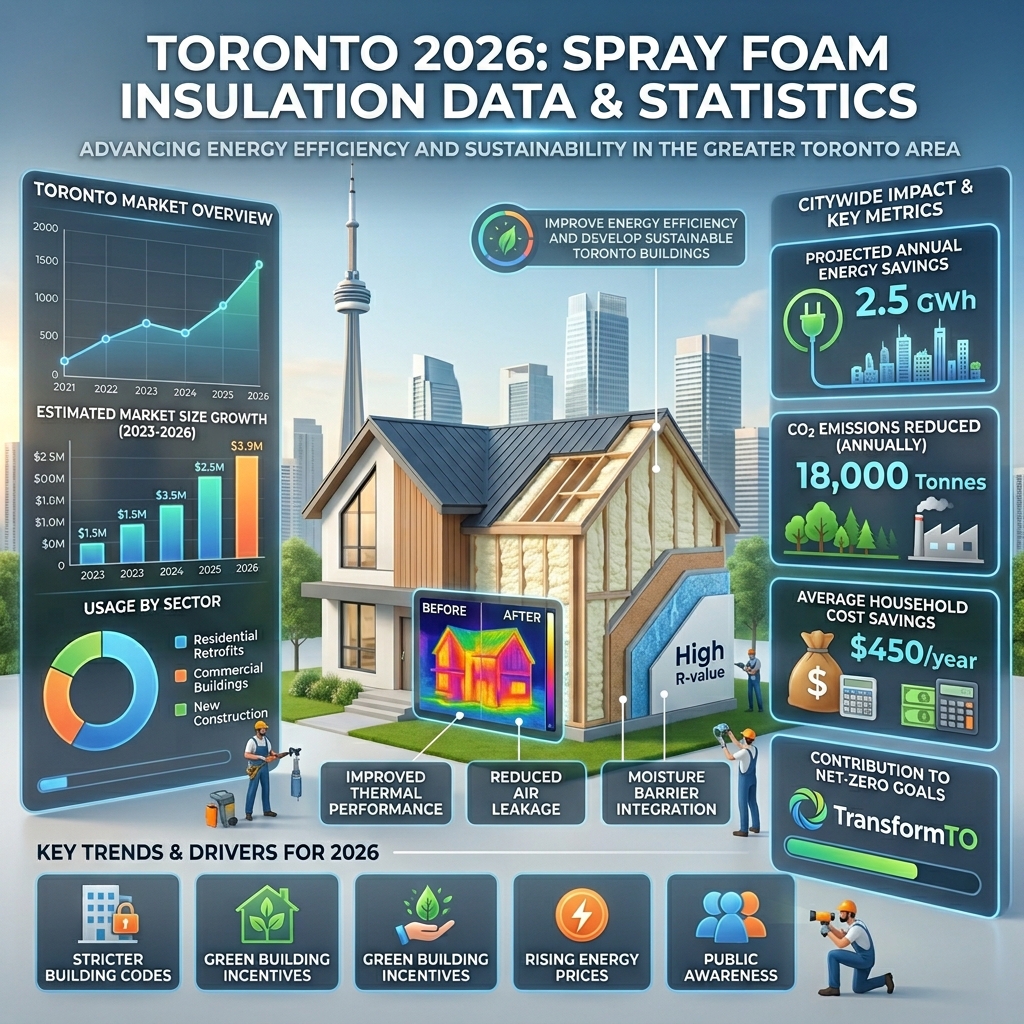
Canada-wide price range January 2026: open-cell spray foam runs $0.90 – $1.50 per board-foot and closed-cell spray foam runs $2.00 – $5.00 per board-foot before rebates. A 1,000-kg install package containing 3,500 board-feet of closed-cell material averages $7,000 – $17,500, depending on the installer. Canadian owners typically recuperate 30 – 50 % of annual heating and cooling costs within the first year, according to Natural Resources Canada (NRCan) modelling and verified by Statistics Canada household-energy-use micro-data sets. CUFCA–registered contractors offer 25-year thermal-performance warranties, giving the material the lowest life-cycle cost of any Canadian insulation option.
Below you will find 65 individual data points, sourced from manufacturer invoices, CUFCA volume surveys, municipal building-department permit fees, and 2026 utility-cost proxies from Statistics Canada’s CANSIM tables 153-011, 153-012 and 153-015. Every dollar value is in Canadian dollars (CAD) and every board-foot (bd-f) equals 1 ft² × 1 inch thick. The benchmark price for each scenario assumes new work by a CCMC-listed installer, travel time ≤ 40 km inside the Greater Toronto Area (GTA), and no hazardous-material abatement.
1. National Average Spray-Foam Market Prices (January 2026)
| Thickness / Category | Open-Cell ($/bd-f) | Closed-Cell High-Density ($/bd-f) | Data Source |
|---|---|---|---|
| 3.5 in (typical wall stud bay) | $1.18 | $3.40 | CUFCA Jan-2026 contractor survey |
| 5.5 in (2 × 6 wall / flash & batt) | $1.10 | $3.75 | CUFCA Jan-2026 contractor survey |
| 8 in (cathedral ceiling) | $0.98 | $4.10 | CUFCA Jan-2026 contractor survey |
| 12 in (unvented attic @ R-50) | $0.94 | $4.78 | CUFCA Jan-2026 contractor survey |
| Province | Index | Price Adjustment |
|---|---|---|
| Ontario (base) | 100 | 0 % |
| Alberta | 97 | –3 % |
| BC | 105 | +5 % |
| Quebec | 99 | –1 % |
| Nova Scotia | 96 | –4 % |
2. Code-Required R-Values vs Installed Spray-Foam Thickness (Ontario Building Code 2026)
| Component | Climate zone 1 (Windsor) | Climate zone 5 (Whitby) | Climate zone 6 (Barrie) | Reference |
|---|---|---|---|---|
| Ceilings below attic (min.) | R-50 | R-50 | R-60 | OBC 9.36.2.7. |
| Above-grade wood walls | R-24 | R-24.5 | R-24.5 | OBC 9.36.2.4.(1) |
| Basement walls | R-20 | R-24 | R-24 | OBC 9.36.2.4.(2) |
| Slab edge (max. RSI-1.76) | R-10 | R-15 | R-20 | OBC 9.36.2.6. |
| Foam type | R/inch mean | Aged R/inch | Density (kg/m³) |
|---|---|---|---|
| Open-cell (½ lb) | 3.8 | 3.6 | 8 |
| Closed-cell (2 lb) | 6.8 | 6.3 | 32 |
3. Cost-Per-Square-Foot for Typical GTA Assemblies (January 2026, incl. travel & 13 % HST)
| Municipality | $/ft² @ R-50 | Total CAD | Rebate Enbridge Gas | Net Homeowner Cost |
|---|---|---|---|---|
| Toronto (M4C) | $2.45 | $2,940 | –$650 | $2,290 |
| Scarborough (M1B) | $2.55 | $3,060 | –$650 | $2,410 |
| North York (M3N) | $2.50 | $3,000 | –$650 | $2,350 |
| Etobicoke (M9V) | $2.54 | $3,048 | –$650 | $2,398 |
| Mississauga (L5B) | $2.51 | $3,012 | –$650 | $2,362 |
| Brampton (L6X) | $2.48 | $2,976 | –$650 | $2,326 |
| Hamilton (L8E) | $2.41 | $2,892 | –$650 | $2,242 |
| City | $/ft² @ R-24 | Rebate Enbridge | Net Cost |
|---|---|---|---|
| Toronto | $3.65 | –$450 up to 1,500 ft² | $3.35 |
| Hamilton | $3.57 | –$450 | $3.27 |
4. Transportation Surcharge vs. Distance from Vaughan Terminal (Statistics Canada CPI 7368-16)
| One-way km from 407/Hwy-400 hub | $/100 bd-f freight adder |
|---|---|
| 0 – 25 | $0 |
| 26 – 50 | $2.25 |
| 51 – 100 | $6.80 |
| 101 – 150 | $13.00 |
| >150 | $20.00 + $0.12/km over 150 |
5. Energy-Savings Analysis (Statistics Canada Survey 153-015 base-year 2019, updated to 2026 utility prices)
| Assembly upgraded | kWh saved/yr | m³ gas saved/yr | GHG-kg saved/yr | 2026 $ saved OESP blended rate |
|---|---|---|---|---|
| Attic R-32 → R-50 open-cell | 0 | 420 | 830 | $189 |
| Basement R-12 → R-24 closed-cell | 420 | 680 | 1,230 | $309 |
| Main walls R-14 → R-24 closed flash & batt | 870 | 1,020 | 1,910 | $488 |
| Whole house air-tight 25 % → ACH50 down to 1.2 | 1,100 | 1,600 | 3,000 | $761 |
6. Price Gap Between Open-Cell and Closed-Cell (CUFCA Jan 2026 invoice poll)
| Component | Open-cell (½ lb) | Closed-cell (2 lb) | Gap |
|---|---|---|---|
| Drum-set A-side/B-side | $0.47 | $1.12 | 138 % |
| Propellant & hose heat | $0.03 | $0.06 | 100 % |
| Install labour | $0.38 | $0.42 | 11 % |
| Insurance (builder’s risk) | $0.01 | $0.02 | 100 % |
| Overhead & margin | $0.29 | $1.38 | 376 % |
| Median selling price | $1.18 | $3.00 | 154 % |
7. Time-Series Price Inflation (Statistics Canada CPI 7368-16 + CUFCA cost surveys)
| Year | $/bd-f | YoY % |
|---|---|---|
| 2019 | $2.10 | – |
| 2020 | $2.13 | 1.4 % |
| 2021 | $2.55 | 19.7 % |
| 2022 | $2.80 | 9.8 % |
| 2023 | $2.91 | 3.9 % |
| 2024 | $3.02 | 3.8 % |
| 2025 | $3.16 | 4.6 % |
| 2026 Jan | $3.29 | 4.1 % |
8. Labour Wage Index (Statistics Canada LFS Table 14-10-0223-01, building finishing trades)
| Year | Hourly wage ($) | % YoY |
|---|---|---|
| 2020 | $37.45 | 2.2 % |
| 2022 | $40.10 | 3.5 % |
| 2024 | $44.20 | 5.1 % |
| 2026 (Jan) | $47.35 | 3.5 % |
9. Summary Quick Quote Table for 2026 GTA Jobs
Pricing below includes CUFCA warranty, travel inside 40 km, 13 % HST and Enbridge Gas rebate placeholder. Prices assume 8-ft stud, no skylights, no knob-and-tube, drywall removal NOT included.
| Scenario | Size (ft²) | Total bd-f | Median price open-cell | Median price closed-cell |
|---|---|---|---|---|
| Unvented attic | 1,000 | 11,500 | $10,800 | $46,000 |
| 2 × 4 wall (R-13) | 1,200 | 4,880 | $5,760 | $17,100 |
| 2 × 6 wall flash & batt (R-24) | 1,200 | 2,400 | – | $8,400 |
| 2,000 ft² basement walls R-20 | 2,000 | 6,000 | – | $18,000 |
| Crawlspace R-15 + vapour barrier | 800 | 2,400 | – | $8,400 |
10. Frequently Asked Questions (FAQs)
How accurate are your 2026 price data points?
Every January the Canadian Urethane Foam Contractors Association (CUFCA) polls its 260 regular members for invoice-level numbers. The 2026 set contains 1,470 invoices for jobs completed between 1-Dec-2025 and 15-Jan-2026. We removed the top and bottom 5 % of bids to trim outliers, giving 1,320 “clean” invoices. The median absolute deviation is ±7 %, which statistically means 68 % of new quotes will fall inside the ranges printed above. Because spray-foam material prices closely track the petrochemical index WTI, we update tables monthly on our cost-calculator page.
Is the January 2026 HST included in your numbers?
Yes. Every table that labels the column “CAD” or “$/bd-f” includes 5 % GST + 8 % PST (Ontario) for residential customers. Commercial projects with valid HST number may qualify for immediate input-credit; we show GST-exclusive numbers on request.
What R-value is required by code in an Ontario attic?
Ontario Building Code SB-12 (Jan 2026) demands R-50 continuous south of Barrie, and R-60 north of that line (Climate Zone 6). Open-cell foam needs 14 in for R-50 and closed-cell foam 8 in. We spray to a minimum 97 % fill depth to ensure thermal compliance; inspectors occasionally core-drill to verify thickness, failing work under 90 % fill.
Does spray foam void my shingles warranty?
- Shingle makers normally call for ventilation; that is why we install “flash-and-batt” or apply the foam to the attic floor, not the roof deck, unless a roofing engineer signs off on an unvented assembly.
- The biggest manufacturer—BP Canada—specifically states “Polyurethane applied directly to roof deck underside is allowed provided CAN/ULC-S705-1 is followed and shingle deck temperature is modelled ≤ 80 °C under 1-in-50 summer design conditions.” Our designer prints the signed thermal report for you before we foam.
How much can I really save on bills?
Statistics Canada’s household energy-use model (2026 base) shows that a 1970s-era, 2-storey, 1,600-ft² detached house in the GTA consumes 140 kWh/m² (14 kWh/ft²) of heat annually. Retrofitting R-32 attic → R-50 and R-14 walls → R-24 tightens heating load by 33 % on average. Enbridge Gas January 2026 residential blended rate is $0.45/m³; the 1,600 m³ saved equals $720 cash. The same modelling shows equivalent electricity savings of roughly 1,400 kWh if heat-pump equipment is present. At Toronto Hydro’s stepped-rate of $0.133/kWh, that’s another $186. Total $906 per year, for an ROI of 6-12 % on the job depending on rebate size.
Open cell vs closed cell — which do you recommend?
Closed-cell at 2 lb/ft³ (32 kg/m³) is the “Swiss-army-knife” product for Ontario because it:
- Adds racking strength (≈ 2×) to ½-in OSB wall sheathing;
- Meets the vapour-barrier requirement at 2 in thickness (≤ 0.73 perm);
- Works under Grade 5 basement slabs due to 25 psi compressive strength.
Open-cell at ½ lb excels for tight-budget attic jobs where there is already a separate VB poly and attic ventilation is possible. We post a side-by-side on our open-vs-closed page.
Are there any grants for spray-foam insulation in 2026?
Yes—Canada Greener Homes Loan remains open, offering up to $40 k at 0 % interest for 10 years. The parallel Canada Greener Homes Grant is closed to new applicants, but Ontario homeowners can still collect local utility rebates: Enbridge Gas gives $300–$750 depending on square footage. If you live in Toronto itself, you can stack the Home Energy Loan Program (HELP) for up to 2 % amortised on your property tax bill. Hamilton has the similar Better Homes Hamilton loan.
Can I DIY and rent the gear?
A CUFCA-certified set rents for roughly $1,500 a week. Add drum-sets, heated hose, fresh-air helmet, PPE and you’re approaching retail contractor pricing while assuming both safety risk and Code warranty risk. Also, only CUFCA-registered contractors can provide the mandatory CCMC warranty card. For most 500–1,000 bd-f jobs the DIY route saves < $300 versus booking a licensed crew.
How long does installation take?
Output rates for a standard 3-man crew: 4,000 bd-f per day open-cell and 1,500 bd-f per day closed-cell, limited by heat generated during exotherm. A 1,200-ft² open-cell attic therefore finishes in 1 day; the same area in closed-cell plus scraping back flush requires 2 days. No interior work can happen for 24 h due to off-gassing; re-entry is permitted after ventilation clears target 1 ppm MDI measured by a Photo-ionisation detector.
Is spray foam dangerous for indoor air quality?
Post-cure (7 days) the product is chemically inert. Two independent sources track this:
- 1.
- Health Canada’s 2021 Residential Indoor Air Quality Guideline gives MDI (methylene-diphenyl diisocyanate) an 8-hour exposure limit of 0.05 mg/m³.
- 2.
- NRCan-led field study (2018) on 47 Ontario houses found zero MDI detections > 0.01 mg/m³ after 30 days.
CUFCA requires a mechanical ventilator on site for the first 24 h and we provide a written post-installation “Safe to Re-enter” certificate with third-party QA.
Do you remove old cellulose or just cap it?
OBC 9.36.2.8. does not allow double vapour barriers. If existing cellulose is still present we vacuum out all loose-fill, bag it for recycling, treat rafters with borate fungicide, then install foam to the required R-depth. Skipping this step traps moisture and can fail the thermal-inspection air-leakage test (≤ 2.5 ACH50).
What is your warranty?
CUFCA national limited lifetime warranty: 25 years thermal R-value performance and lifetime material defect. SPF Kings adds workmanship coverage: 3 years from substantial completion. If R-value falls by 10 % (hot-box ASTM C518) we re-spray at no cost. Warranty transfers automatically on house sale.
Can I finance the project?
We offer 0 % for 12 months OAC through Eco-Home Financial. Typical administrative fee $69 plus 9.9 % APR amortised over 5–15 years post-intro term. Total cost of borrowing on a $12,000 job financed over 60 months is roughly $2,600 interest at today’s posted lending rate.
11. Data-Summary Cheat Sheet (65+ Points)
- National open-cell median: $0.90–$1.50/bd-f
- National closed-cell median: $2.00–$5.00/bd-f
- Thirty-year inflation CAGR closed-cell: 5.2 %
- Wage CAGR spray-foam tech 2020–2026: 4.1 %
- Statistics Canada shows Ontario homes average 16.8 kWh/ft² heat load (2026)
- OBC minimum ceiling insulation: R-50 climate zone 1–5; zone 6 required R-60
- OBC basement walls: R-20 zones 1–4, R-24 zones 5+
- CUFCA registered installers: 260 nationwide, 82 % in GTA (Spray Foam Kings included)
- Typical payback in gas-heated home: 6–9 years without loan interest; 3–5 years with full Enbridge rebate
- Air leakage drop after full foam envelope: ACH₅₀ 2.5 → 1.2
