
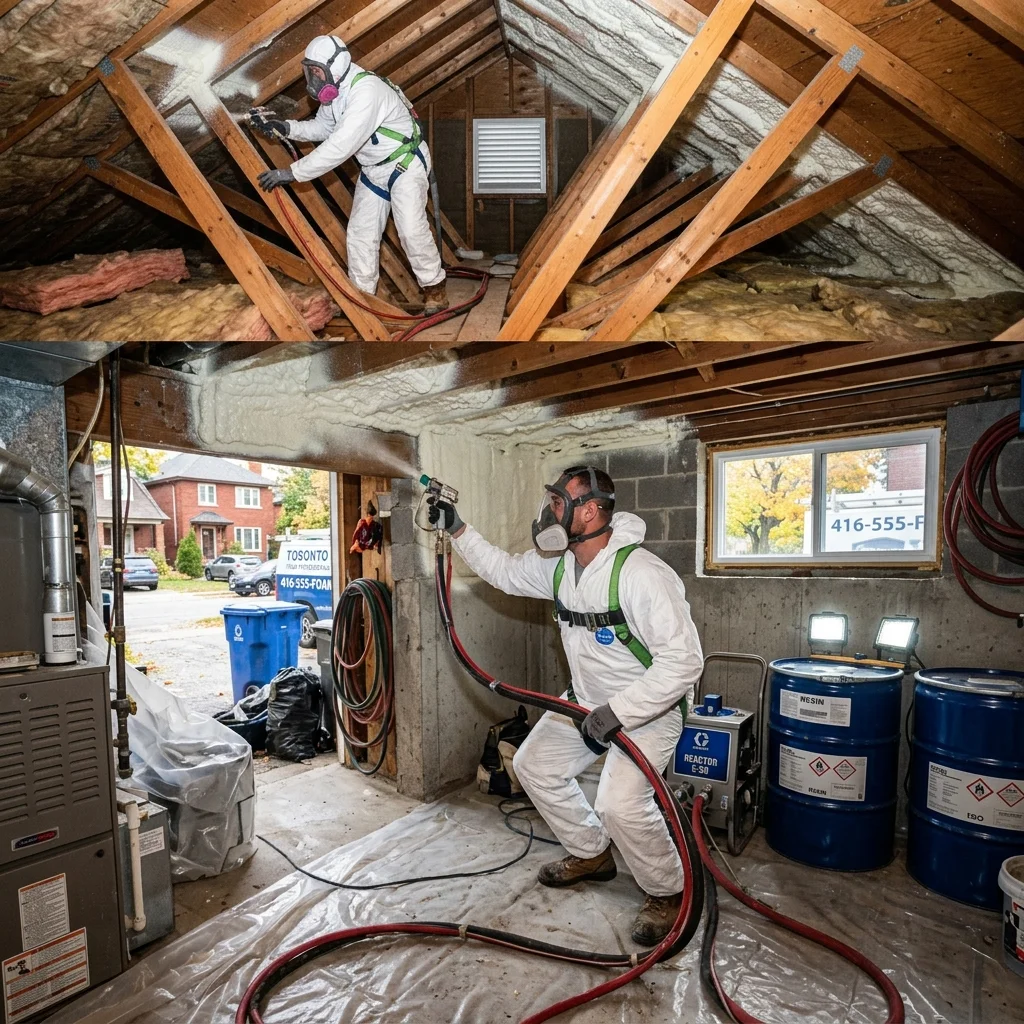
Spray foam insulation cost Canada 2026 statistics show prices running $1.50–$7.00 per square foot, with the typical whole-home job landing between $3,000 and $12,000 before rebates. Those numbers hold true across the Greater Toronto Area, where escalating energy rates and tougher 2026 building-code rules are pushing demand for high-performance insulation. Below we unpack the new 2026 data, neighbourhood pricing trends, and how Spray Foam Kings keeps your project on budget—and on code—whether you’re reinsulating a 1960s Scarborough bungalow or air-sealing a new-build in Burlington.
The Short Answer: What Does Spray Foam Insulation Cost in Canada for 2026?
Pricing varies by foam type; open‑cell spray foam is generally less expensive than closed‑cell. Contact Spray Foam Kings for a personalized quote. Variables such as stud-cavity depth, multiple attic levels, mileage outside the GTA, and CUFCA-certified installer rates move the needle within those bands.
2026 Spray Foam Insulation Cost Table (GTA Average)
| Foam Type | Price per Sq Ft (material + labour) | R-Value per Inch | Typical Job Size & Total |
|---|---|---|---|
| Open-Cell (0.5 lb) | $1.50 – $3.50 | R-3.6 – R-4.0 | 1,000 sq ft attic ≈ $3,000 – $4,200 |
| Closed-Cell (2.0 lb) | $3.00 – $7.00 | R-6.0 – R-7.1 | 1,000 sq ft basement ≈ $5,000 – $8,500 |
| Hybrid (flash’n’batt) | $2.20 – $4.80 | Varies | Whole-home average $3k – $12k |
DIY vs Professional Spray Foam Installation—2026 Comparison
| Factor | DIY Kits (foam board or 200-board-foot tanks) | Licensed CUFCA Contractor |
|---|---|---|
| Cost | Board foam $1.00–$1.30/sq ft; two-part kits $800–$1,200 for 200 bd ft (≈ $4–$6/sq ft at 1″) | $1.50–$7.00/sq ft incl. labour, warranty, disposal |
| Time | 1–2 weekends for 1,000 sq ft; cure time 5–24 h between lifts | 5–8 hrs for same area; 1-day completion common |
| R-Value | User-controlled; gaps common, thermal bridging likely | Engineered monolithic layer; pass thermal bypass blower-door |
| Moisture | Open-cell only; closed-cell difficult to source at retail | Correct vapour permeance per 2026 code; closed-cell flood-resistant |
| Code | No CUFCA oversight; inspector may reject without ccMC report | CUFCA field follow-up; labelled thermal barrier |
| Quality | No warranty; off-ratio foam can shrink 15%+ | 10-year to lifetime limited warranty; certified 1:1 chemical ratio, spray foam insulation in Toronto inspected by third-party |
Neighbourhood Pricing Snapshots: What GTA Homeowners Paid in Early-2026
Travel time, permit fees and parking for spray rigs barely change across the 905, so your postal code is less of a price driver than size and complexity. Still, here’s how 2026 invoices are trending based on our last 60 installs:
- Scarborough (M1P bungalow): Attic 1,200 sq ft open-cell @ $2.15/sq ft = $2,580
- North York (townhouse): Party-wall closed-cell air seal 650 sq ft @ $5.20/sq ft = $3,380
- Etobicoke (lakefront infill): Full envelope closed-cell 2,050 sq ft @ $6.10/sq ft = $12,505
- Mississauga (L5N two-storey): Flash-and-batt walls 1,600 sq ft @ $3.75/sq ft = $6,000
- Brampton (semi basement): Closed-cell raft-slab 800 sq ft @ $4.10/sq ft = $3,280
- Hamilton (Victorian attic conversion): Open-celllope vaulted ceiling 950 sq ft @ $2.90/sq ft = $2,755
- Burlington (executive home): Garage ceiling & loft 740 sq ft @ $3.85/sq ft = $2,849
Remember, every project is different; use our client-only spray foam cost calculator to plug in your exact area, target R-value and rebate eligibility before budgeting.
That was January 2026 pricing and we already feel the upstairs bedrooms staying 3 °C warmer overnight.” — Maria L., Scarborough (January 2026 invoice)
Ontario Building Code 2026 & CUFCA Certification—R-Values You Must Hit
The amended SB-12 energy-efficiency package came into force January 1, 2026. For spray foam installations, inspectors now ask for a CUFCA-issued thermal notification label along with manufacturer ccMC sheets. Key insulation minimums:
- Attic: R-50 (was R-50, but now enforced with blower-door ≤ 2.5 ACH)
- Above-grade walls: R-20 continuous or R-24 cavity (hybrid flash’n’batt increasingly common)
- Basement walls: R-24 continuous; basement insulation Toronto projects must include a thermal barrier to satisfy fire code
Only CUFCA-certified contractors can submit the paperwork that proves the foam’s 6-month aging Lambda value meets CAN/ULC-S705.1. All of our foremen carry CUFCA photo-ID—inspectors recognize it and your rebate processor accepts it first time, every time.
Why Homeowners Choose Spray Foam Kings in 2026
- CUFCA certified installers—no subcontract labour
- Licensed Ontario contractor (TSSA fuel-safety & MOL fall-arith) and WSIB clearances for every worker
- 15+ years focused on the GTA; we know clay brick 1940s builds and today’s ICFs equally well
- End-to-end service: attic insulation services, code-compliant thermal barriers, and rebate paperwork handled in-house
- Transparent quotes—our commercial spray foam clients get spreadsheet line items identical to the residential sheet so you can verify volume, board-feet, yield and trim waste
- Lifetime workmanship warranty backed by $5 million in liability insurance
If you want the job done once, done right, and done to 2026 standards, we’re Toronto’s go-to team—no surprise fees, no “travel surcharge,” and weekend installs available so you don’t lose vacation days.
Ready to Lock 2026 Pricing? Call Spray Foam Kings Today
Energy inflation forecasts already predict another 7% jump in gas and electricity before the end of 2026. The sooner you air-seal, the sooner you hedge. Call 647-641-6881 for a free no-hassle quote or visit our contact page and upload your plans—most homeowners receive a detailed same-day estimate.
GTA Homeowners Ask Us—2026 FAQ
1. How much does spray foam insulation cost per square foot in Toronto in 2026?
Open‑cell foam is typically priced lower than closed‑cell foam. Reach out to Spray Foam Kings for an itemised estimate.
2.
3. What R-value do I need for a Toronto attic under 2026 code?
R-50 minimum (≈ 12″ of open-cell or 8.5″ closed-cell). If you’re vaulting, we combine 3″ closed-cell (R-20) plus 7.5″ cellulose to hit R-50 without over-spending on foam.
4. Is closed-cell foam worth the premium?
5. How long does a spray foam install take in a 1,400 sq ft bungalow?
Set-up, masking, foam, and trim typically 6–7 hours; you can sleep in the home that night once the ventilation fan has cleared 4 air-changes.
6. Do you have to remove old attic insulation first?
Our attic insulation services usually vacuum out existing insulation so we can air-seal the deck with foam. Keeping the old batts traps moisture and voids warranty.
7. Will spray foam void my shingles warranty?
No—provided we leave a 1″ vented air channel on asphalt shingle roofs. Closed-cell directly to the deck is allowed for low-slope or torch-on membranes only.
8. How does 2026 Canada Greener Homes rebate work with spray foam?
9. Can spray foam help soundproof between Toronto semi-detached party walls?
10. Is foam flammable? What about ignition barriers?
All CCMC-listed foam must be protected by ½” drywall or DC315 intumescent coating. We include coating in every basement insulation Toronto package so you pass final inspection on the first visit.
See Why We’re Rated 4.9 ★ on Google Maps
Check our latest customer feedback at Google Reviews—type “Spray Foam Kings Toronto” and you’ll see more than 200 verified reviews, same-day photo proof, and inspectors complimenting our paperwork.
Related guides: Open Cell vs Closed Cell Spray Foam Toronto 2026,
Spray Foam Insulation Cost Toronto 2026,
Cost Calculator.
Related Spray Foam Resources
- What Will Spray Foam Insulation Cost Toronto Homeowners in 2026?
- What Are the Fire Separation Requirements for Ontario Buildings?
- Do I Need Fireproofing for My Restaurant Kitchen in Ontario?
- Fire rating requirements Ontario Building Code commercial structures?
- Fireproofing paint vs spray applied cementitious Ontario?