
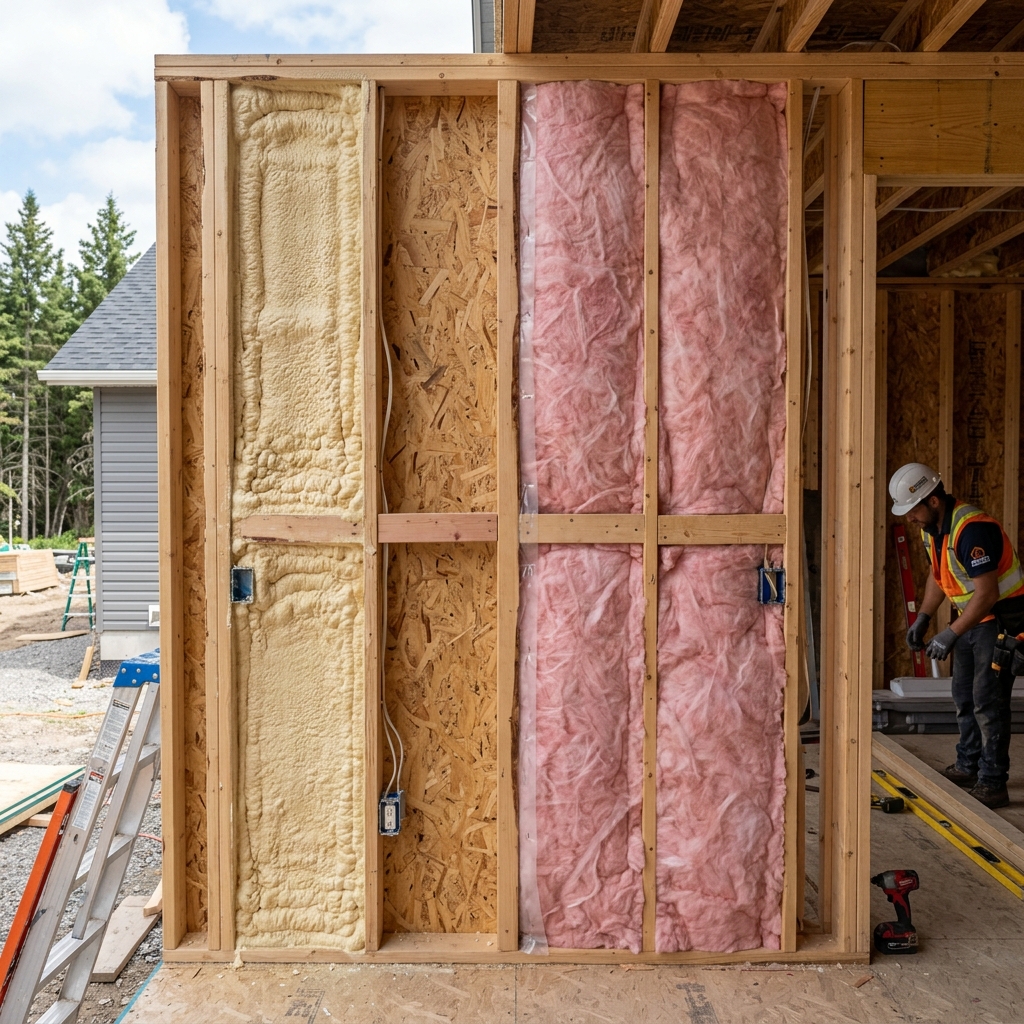
What’s the difference?
Toronto homeowners in 2026 face a critical choice when insulating basements, attics, or exterior walls: spray foam or traditional batts, rolls, and blown-in cellulose. The decision shapes your heating bills, renovation timeline, permit requirements, and long-term home value. Spray foam creates an air-seal barrier that expands into gaps, delivering R-values of 6–7 per inch and moisture resistance. Traditional insulation—fiberglass batts, mineral wool, or blown cellulose—costs less upfront, installs faster without special equipment, and requires no curing time. Neither is universally “better.” The choice depends on your budget, timeline, space constraints, and Toronto’s building code compliance. This comparison cuts through marketing claims and gives you a framework to decide which fits your 2026 renovation.
Side-by-side comparison
| Criteria | Spray Foam (Open-Cell) | Spray Foam (Closed-Cell) | Traditional Insulation (Batts/Rolls/Blown) |
|---|---|---|---|
| Material Cost (per sq. ft., Toronto 2026) | $2.00–$3.50 CAD | $4.00–$6.50 CAD | $0.50–$1.50 CAD |
| Total Install Cost (unfinished basement, 1,000 sq. ft.) | $3,500–$5,000 CAD | $6,000–$9,000 CAD | $1,000–$2,500 CAD |
| Installation Timeline | 1–2 days; 24–48 hours curing | 1–2 days; 24–48 hours curing | 1–3 days; ready same day |
| Building Permit Required (Toronto)? | Yes (Part 9 renovation, if unfinished space) | Yes (Part 9 renovation, if unfinished space) | Usually no (minor work exception) |
| When to Choose | Irregular spaces, air-sealing priority, retrofit; moisture-prone areas | Maximum R-value, below-grade/exterior; flood-prone basements | Budget-conscious, pre-finished spaces, straightforward geometry |
| Main Risk If Wrong Choice | Overspend on unnecessary premium; permit delays | Heat loss through thermal bridges; inadequate air-seal | Moisture trapped; condensation in cold climates |
Spray foam insulation — when it’s the right call
Choose spray foam if your Toronto renovation involves irregular framing, rim joists, band joists, or retrofit gaps where traditional insulation won’t fit or settle over time. Spray foam expands into cavities and adheres to surfaces, eliminating air leaks that account for 15–20% of heating loss in older Toronto homes. Open-cell spray foam ($2.00–$3.50 per sq. ft.) works well for interior walls and attics where moisture can dry; closed-cell spray foam ($4.00–$6.50 per sq. ft.) is essential for basements, crawlspaces, and exterior walls because it resists water absorption and delivers R-7 per inch.
Spray foam shines in heritage Toronto buildings where exterior walls cannot be widened and air-sealing is paramount. It also suits highly customized basement finishing where ductwork, plumbing, or electrical runs through framing; foam fills around obstacles without gaps. The upfront cost is 3–5× higher than batts, but energy savings of 15–25% annually offset the premium over 8–12 years, especially if your home was built before 1985 when air-sealing standards were minimal. Permits are mandatory in Toronto when spray foam is applied to unfinished space, but they ensure inspection and compliance with Part 9 of the National Building Code. If air-sealing and long-term performance matter more than quick installation, spray foam is the right choice.
Regular insulation — when it’s the right call
Choose batts, rolls, or blown insulation if you need to insulate a finished attic, retrofit between wall studs in a pre-finished space, or work within a tight budget. Traditional options cost 70–80% less than spray foam and install faster without curing delays; a basement can be ready for drywall the same day. Blown-in cellulose or fiberglass works well for attics and walls where space is regular and air-sealing isn’t the priority; homeowners can even hire a crew for a full attic job in a single morning.
Regular insulation is also the practical choice if your Toronto contractor is unfamiliar with spray foam or if your timeline demands immediate occupancy. Batts and rolls come in standard widths (16″ and 24″ to match stud spacing), require no special equipment beyond a stapler or adhesive, and installers are abundant and affordable. Blown insulation can settle slightly over decades, but upgrading from R-20 to R-40 in an attic remains cost-effective even if re-blown later. The trade-off is that gaps around outlets, pipes, and junctions aren’t sealed as tightly; you’ll need tape and caulk to close small air leaks. If your space is straightforward, budget is limited, and your home is already reasonably air-tight, traditional insulation meets code and delivers solid performance without the premium cost or permit complexity.
Edge cases and Toronto-specific factors
Toronto’s building code (adopted from the National Building Code) mandates air-sealing in renovations affecting more than 25% of building envelope area. Spray foam naturally complies because the application itself creates an air barrier; traditional insulation requires additional air-sealing layers (plastic sheeting, tape, caulk) to meet code. If you’re insulating a basement or attic without a pre-existing air barrier, expect to add cost and timeline for that work—or choose spray foam to do both jobs at once.
Insurance and resale: Most insurers accept both methods equally, but some flag spray foam if it contains flame-retardants or if vapour barriers weren’t properly installed. Resale appeal is neutral; buyers focus on energy efficiency ratings and overall comfort, not the insulation type. In flood-prone neighborhoods (near the Don River or Humber River), closed-cell spray foam is superior because it resists water intrusion, whereas traditional insulation saturates and loses R-value if wet. Heritage conservation districts in Toronto may restrict external modifications, making interior spray foam retrofit attractive when exterior insulation isn’t allowed. Finally, if your attic contains knob-and-tube wiring (common in pre-1950s Toronto homes), spray foam cannot be installed near live electrical—traditional insulation is your only safe option without rewiring first.
Frequently asked questions
1. Does spray foam void my homeowner’s insurance?
No, provided a licensed contractor applies it and permits are obtained. Some insurers require documentation that closed-cell foam meets fire code (CFC-free formulations are standard in Canada as of 2016). Contact your insurer before work starts to confirm coverage.
2. How much will my heating bill actually drop?
Energy savings depend on your current insulation level and air-sealing effectiveness. Toronto homeowners typically see 15–25% reductions in heating costs after comprehensive spray foam work; traditional insulation alone averages 10–15% if air-sealing is also done. Results vary by home age, envelope condition, and thermostat habits.
3. Is spray foam safe to breathe after installation?
Once fully cured (48 hours), spray foam is inert and non-toxic. During application and initial curing, crews wear respirators and the home should be ventilated. Off-gassing (if any) dissipates within 48 hours. If you have chemical sensitivities, request a low-VOC or water-blown formulation and extend ventilation time.
4. Can I install traditional insulation myself?
Yes; batts and rolls are DIY-friendly if you’re comfortable in an attic and wear protective equipment. Blown-in insulation requires equipment rental ($50–$150 per day in Toronto) and practice. Spray foam absolutely requires licensed professionals with liability insurance; DIY spray foam risks improper application, fire hazard, and code violations.
5. Will spray foam prevent moisture in my basement?
Closed-cell spray foam resists water absorption and reduces condensation if paired with proper drainage and sump pump maintenance. However, no insulation replaces grading, sump pumps, or interior weeping tiles. If your basement leaks, fix the water source first, then insulate.
6. What’s the permit cost and timeline in Toronto?
A Part 9 permit (interior renovation) costs $300–$800 CAD and takes 1–2 weeks to approve, plus 2–3 weeks for inspection after work. If your project qualifies as “minor work” (small attic insulation with no structural changes), you may skip permits. Consult your local municipal office or contractor to confirm.
Bottom line
Choose spray foam if: you’re retrofitting an older Toronto home with air leaks, insulating irregular spaces (rim joists, band joists, around ductwork), prioritize long-term energy savings over upfront cost, live in a flood-prone area, or need to meet Toronto’s air-sealing code in one application. The 8–12 year payback and 15–25% energy reduction justify the premium.
Choose traditional insulation if: budget is tight, your home has regular framing and no major air-sealing issues, you need the space finished immediately (no curing delay), you’re insulating a pre-finished space, or your contractor is unfamiliar with spray foam. Pair it with caulking and tape to meet air-sealing code, and accept a 10–15% energy reduction.
In Toronto’s 2026 climate, neither choice is wrong—only mismatched to your priorities. If you’re unsure whether spray foam will deliver value for your specific project, residential insulation assessment from a licensed contractor includes a free energy audit and detailed cost-benefit analysis. For questions about basement insulation, attic insulation, retrofit insulation, or rim joist sealing, visit sprayfoamkings.ca for a no-obligation quote.