
If you are a homeowner in Toronto, Mississauga, Brampton, or anywhere in the Greater Toronto Area, you have probably wondered about the real cost of spray foam insulation. With Ontarios harsh winters and increasingly hot summers, proper insulation is not just a comfort issue it is a financial one. In 2026, with energy prices continuing to climb and the Enbridge Home Efficiency Rebate Plus program still offering substantial incentives, understanding spray foam costs has never been more important.
As the owner of Spray Foam Kings, I have spent over a decade helping Ontario homeowners navigate the insulation landscape. I have seen the difference that quality spray foam makes on energy bills, and I have also seen homeowners waste money on the wrong type of insulation for their specific needs. This guide breaks down exactly what you can expect to pay for spray foam insulation in Ontario this year, with real numbers, contractor-level insights, and no fluff.
The Short Answer: How Much Does Spray Foam Insulation Cost in Ontario?
In Ontario during 2026, spray foam insulation typically costs between $3.00 and $5.50 per square foot for open-cell applications and $5.50 to $8.50 per square foot for closed-cell installations. For a typical 1,000 square foot attic, expect to invest $4,500 to $7,000 for open-cell or $6,500 to $10,000 for closed-cell, including professional installation. Basement and crawl space projects generally run slightly less due to easier access, while garage insulation costs depend heavily on whether you are insulating walls, ceilings, or both.
Factors That Affect Spray Foam Insulation Costs in Ontario
Project Size and Scope
The most obvious cost driver is the square footage you are insulating. However, it is not just about total area it is about complexity. A simple open attic with clear access costs significantly less per square foot than a finished basement with obstacles like ductwork, plumbing, and electrical panels to work around. Similarly, insulating a new construction home during the framing phase is considerably cheaper than retrofitting an existing home, where we need to work around existing structures and protect finished areas.
For Ontario homeowners, labor costs in the GTA typically run 15-20% higher than in smaller cities like Barrie or Kitchener. This reflects the higher cost of living and doing business in Toronto, Mississauga, and Oakville. However, the trade-off is access to more experienced contractors who understand local building codes and can navigate the specific challenges of Ontarios climate.
Material Type and Thickness
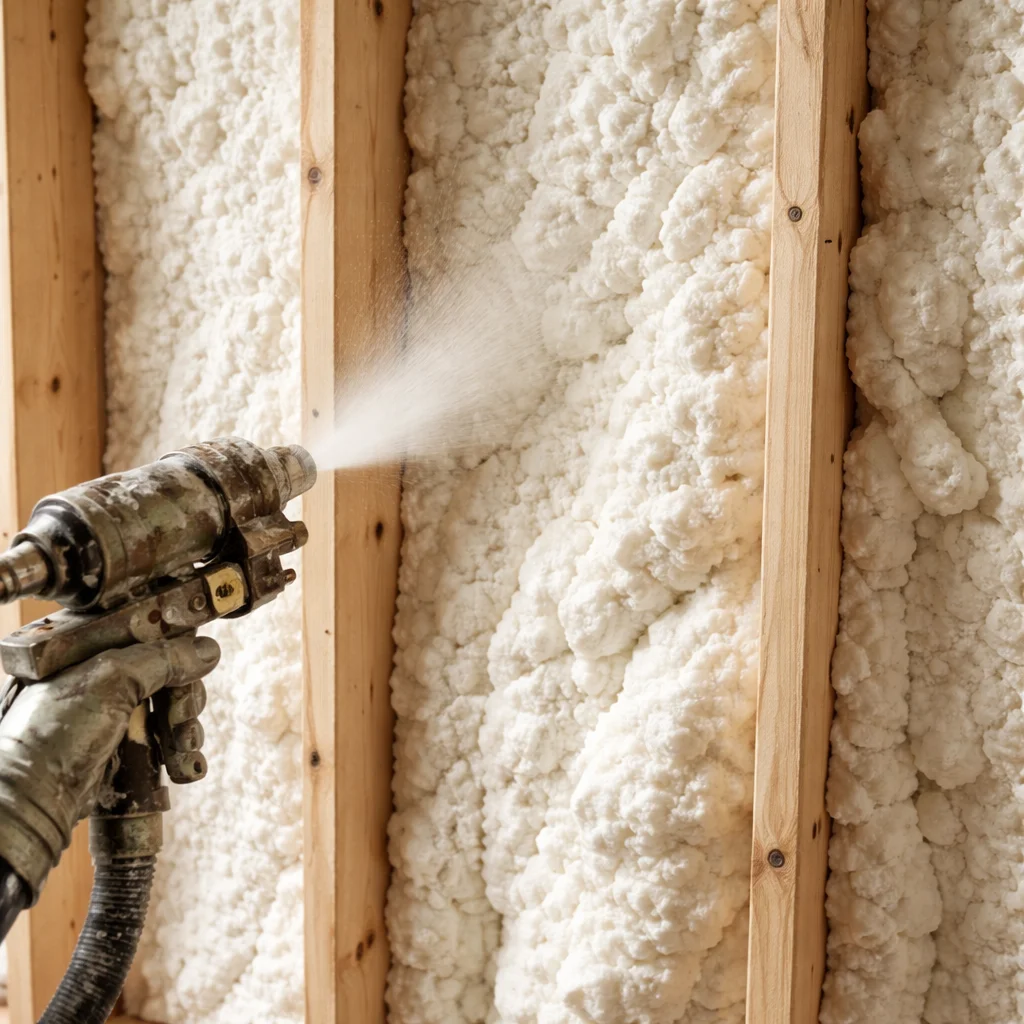
Open-cell spray foam, sometimes called half-pound foam, is less expensive than closed-cell but provides different performance characteristics. Open-cell expands significantly more (roughly 100 times its liquid volume), creating a softer, more flexible insulation that is excellent for sound dampening but has a lower R-value per inch. Closed-cell foam expands about 30 times its liquid volume, creating a rigid, dense barrier with superior R-value and moisture resistance.
In Ontarios climate, the Ontario Building Code specifies minimum R-values that vary by application:
– Attics: R-60 minimum (approximately 15-16 inches of blown cellulose, or 10 inches of open-cell foam, or 6 inches of closed-cell foam)
– Above-grade walls: R-22 effective minimum
– Basement walls: R-20 continuous insulation minimum
Meeting these requirements with spray foam means different thicknesses depending on the product. Closed-cell at R-6.5 per inch needs less depth than open-cell at R-3.6 per inch, but the material costs more per board foot.
Accessibility and Preparation
Every spray foam job requires preparation, and the extent of that preparation affects your bottom line. In an unfinished basement, we can spray directly to foundation walls with minimal prep. In a finished basement or attic with existing insulation, we need to remove old material, which adds labor costs. Similarly, if we need to install baffles in an attic to maintain ventilation, or if we need to work around HVAC equipment, expect additional charges.
For older Ontario homes particularly those built before 1980 we sometimes encounter knob-and-tube wiring or asbestos-containing materials that require special handling. This can add $500 to $2,000 to a project depending on the scope of remediation needed.
Open-Cell vs Closed-Cell: Cost Comparison
Open-Cell Spray Foam: The Budget-Friendly Choice
Cost: $3.00-$5.50 per square foot installed
R-value: R-3.6 per inch
Best for: Interior walls, attics in dry climates, soundproofing
Open-cell foam is the go-to choice for many Ontario homeowners looking to balance performance and cost. At roughly $3.50-$5.00 per square foot for a typical application, it is approximately 30-40% less expensive than closed-cell. The material expands to fill cavities completely, creating an excellent air seal and providing good thermal performance.
For attic applications in Ontario, open-cell is often sufficient when paired with proper ventilation and vapor barriers. However, it is not recommended for below-grade applications like basements or crawl spaces where moisture is a concern. Open-cell is hydrophilic it can absorb water which makes it unsuitable for areas prone to dampness or flooding.
Closed-Cell Spray Foam: The Premium Performance Option
Cost: $5.50-$8.50 per square foot installed
R-value: R-6.5 per inch
Best for: Basements, crawl spaces, commercial applications, maximum efficiency
Closed-cell foam is the workhorse of the spray foam world. Its rigid structure adds structural strength to walls, it is hydrophobic (water-repelling), and it delivers nearly double the R-value per inch compared to open-cell. For Ontario basements, where moisture management is critical, closed-cell is almost always the right choice despite the higher cost.
The density of closed-cell foam typically 2.0 pounds per cubic foot compared to open-cells 0.5 pounds means it provides a true vapor barrier at thicknesses above 2 inches. This is crucial for Ontarios freeze-thaw cycles, where moisture migration through foundation walls can lead to mold, mildew, and structural damage.
Making the Right Choice for Your Ontario Home
For most Ontario homeowners, the decision comes down to application:
– Attics with proper ventilation: Open-cell is cost-effective and performs well
– Basements and crawl spaces: Closed-cell is worth the investment for moisture protection
– Garages: Closed-cell if you want a conditioned space; open-cell if you are just taking the edge off
– Commercial buildings: Closed-cell for durability and maximum R-value per inch
At Spray Foam Kings, we offer both options and will recommend the right product for your specific situation during our free consultation. Visit our Spray Foam Kings homepage to learn more about our services across Ontario.
Ontario Building Code Requirements and R-Values
Understanding the Code
The Ontario Building Code (OBC) sets minimum insulation requirements based on climate zones and building components. As of 2026, these requirements are among the most stringent in Canada, reflecting the provinces commitment to energy efficiency and reducing carbon emissions from buildings.
For residential construction and major renovations, the OBC requires:
Above-Grade Walls:
– Prescriptive path: R-22 effective (nominal R-25)
– Performance path: Equivalent energy performance to prescriptive requirements
Attics and Roofs:
– Flat roofs: R-31
– Sloped roofs: R-31 (with some exceptions for vaulted ceilings)
Basement Walls:
– Interior insulation: R-20 continuous or R-24 cavity insulation
– Exterior insulation: R-15 continuous
Meeting these requirements with spray foam is straightforward but requires careful calculation. For example, achieving R-31 in an attic with open-cell foam (R-3.6 per inch) requires approximately 8.6 inches of material. With closed-cell (R-6.5 per inch), you need just 4.8 inches. However, the cost per board foot means the closed-cell application will still be more expensive despite requiring less material.
Compliance and Inspections
Professional spray foam contractors in Ontario must be licensed and insured, and all work should meet CSA standards for spray polyurethane foam installation. Reputable contractors like Spray Foam Kings handle permit applications when required and coordinate inspections to ensure code compliance.
For homeowners undertaking larger renovation projects, it is worth noting that the OBCs energy efficiency requirements are updated regularly. What was compliant five years ago may not meet current standards, and upgrading insulation during renovations is often the most cost-effective time to improve your homes envelope.
Average Costs by Home Area (Attic, Basement, Garage, Crawl Space)
Attic Insulation Costs
Typical Range: $4,500-$10,000 depending on size and foam type
Coverage: 1,000-1,500 square feet of attic floor or roof deck
Attic insulation is often the highest-ROI improvement you can make to an Ontario home. Heat rises, and in winter, an under-insulated attic acts like an open window, letting warm air escape and driving up heating costs. For a typical Toronto-area home with 1,200 square feet of attic space, expect:
– Open-cell (R-31): $4,500-$6,500
– Closed-cell (R-31): $6,500-$10,000
These prices include removal of existing insulation (if necessary), air sealing of penetrations, installation of baffles for ventilation, and the spray foam application itself. Learn more about our attic insulation services for Ontario homes.
Basement Insulation Costs
Typical Range: $3,500-$8,000 depending on linear footage and foam type
Coverage: 800-1,200 square feet of wall area
Basement insulation is where closed-cell foam really shines. Ontarios freeze-thaw cycles and high water tables make moisture management critical, and closed-cells water-resistant properties make it ideal for below-grade applications. For a typical full basement (approximately 120 linear feet of 8-foot walls):
– Closed-cell (R-20, 3 inches): $5,500-$8,000
– Closed-cell (R-15, 2.5 inches): $4,500-$6,500
Partial basements or crawl spaces cost proportionally less. If your basement has significant moisture issues, we may recommend additional drainage or waterproofing measures before insulation, which adds to the project cost but protects your investment long-term.
Garage Insulation Costs
Typical Range: $2,000-$6,000 depending on size and scope
Coverage: Single-car to triple-car garages
Garage insulation is increasingly popular as more Ontario homeowners use their garages as workshops, home gyms, or conditioned storage spaces. Costs vary widely based on whether you are insulating walls only, walls and ceiling, or converting the garage to a fully conditioned space.
For a typical two-car garage (20×20 feet):
– Walls only, open-cell: $2,000-$3,500
– Walls and ceiling, closed-cell: $4,500-$6,500
If you plan to heat your garage, closed-cell is the better choice for its superior R-value and air sealing properties. Unheated garages can often get by with open-cell on walls only.
Crawl Space Insulation Costs
Typical Range: $2,500-$5,500
Coverage: 500-1,000 square feet of crawl space
Crawl spaces are notorious for moisture problems, mold, and cold floors in Ontario homes. Spray foam insulation, combined with proper vapor barriers and ventilation, can transform a problematic crawl space into a clean, dry, energy-efficient part of your home.
For encapsulating a typical crawl space (applying foam to walls and rim joists, plus ground vapor barrier):
– Closed-cell on walls, open-cell on rim joists: $3,500-$5,500
– All closed-cell: $4,500-$6,500
Crawl space projects often require additional moisture management measures like sump pumps, dehumidifiers, or improved drainage, which add to the total investment but are essential for long-term performance.
Is Spray Foam Worth the Investment in Ontario?
Energy Savings ROI
The question every homeowner asks: Will spray foam pay for itself? The answer depends on your current insulation, energy costs, and how long you plan to stay in your home.
For a typical Ontario home upgrading from R-20 attic insulation to R-60 spray foam, annual heating and cooling savings range from $400 to $800 per year. At current energy prices, that puts the simple payback period at 8-15 years for attic work. However, this calculation ignores several important factors:
Increased Comfort: Spray foams air-sealing properties eliminate drafts and cold spots that fiberglass and cellulose cannot address. The comfort improvement is immediate and significant.
HVAC Downsizing: Superior insulation can allow for smaller heating and cooling equipment, saving $1,000-$3,000 on replacement costs.
Durability: Unlike fiberglass or cellulose, spray foam does not settle, compress, or degrade over time. A properly installed spray foam job will perform at 100% effectiveness for the life of the building.
Moisture Control: In basements and crawl spaces, spray foams moisture resistance prevents mold, mildew, and structural damage that can cost tens of thousands to remediate.
The 2026 Rebate Landscape
The Enbridge Home Efficiency Rebate Plus (HER+) program continues to offer substantial incentives for Ontario homeowners in 2026. Depending on your location and the scope of your project, rebates can offset 15-30% of insulation costs.
Key rebate amounts for 2026:
– Attic insulation upgrade: Up to $1,000
– Basement insulation: Up to $1,250
– Crawl space insulation: Up to $1,000
– Air sealing: Up to $350
These rebates stack with other provincial and federal incentives, making 2026 an excellent time to invest in spray foam. Visit our detailed guide on Ontario insulation rebate programs to see what you qualify for.
Long-Term Value
From a pure financial perspective, spray foam is a solid investment for Ontario homeowners planning to stay in their homes for more than 10 years. For those planning shorter stays, the improved comfort, air quality, and marketability of a well-insulated home still justify the cost.
In the Toronto real estate market, energy-efficient homes command a premium and sell faster. Spray foam insulation is a feature that discerning buyers recognize and value, particularly as energy costs continue to rise.
Frequently Asked Questions
How much does spray foam cost per square foot in Ontario?
Open-cell spray foam costs $3.00-$5.50 per square foot installed, while closed-cell runs $5.50-$8.50 per square foot. These prices include professional installation, preparation, and cleanup. Actual costs vary based on project complexity, accessibility, and current material prices. Use our free spray foam cost calculator for a personalized estimate.
Is open-cell or closed-cell spray foam better for Ontario homes?
It depends on the application. For attics with proper ventilation, open-cell offers excellent value. For basements, crawl spaces, and anywhere moisture is a concern, closed-cell is superior despite the higher cost. For commercial applications or maximum efficiency, closed-cell is the better choice. A professional assessment of your specific situation is the best way to determine the right product.
Does spray foam qualify for Ontario energy rebates?
Yes. The Enbridge HER+ program offers rebates up to $1,250 for insulation upgrades, including spray foam applications. Additional rebates may be available through the Canada Greener Homes Initiative and local utility programs. Proper documentation and pre-approval are required, so work with a contractor familiar with the rebate process.
How long does spray foam insulation last?
Spray foam insulation is designed to last the lifetime of the building. Unlike fiberglass or cellulose, it does not settle, compress, or lose R-value over time. As long as the foam is protected from UV light and physical damage, it will maintain its thermal and air-sealing properties indefinitely. Most manufacturers offer 20-30 year warranties, but the actual lifespan is much longer.
Can I install spray foam myself to save money?
DIY spray foam kits are available, but professional installation is strongly recommended. Proper application requires specialized equipment, training, and safety precautions. Improperly installed spray foam can off-gas chemicals, fail to cure properly, or create fire hazards. The cost savings of DIY rarely justify the risks, and professional work qualifies for rebates while DIY does not. For spray foam insulation services in Toronto and across Ontario, trust experienced professionals.
Get a Free Spray Foam Insulation Quote in Ontario
Ready to upgrade your insulation? Spray Foam Kings serves Toronto, the GTA, and all of Ontario with licensed, bonded, and insured spray foam insulation and fireproofing services.
Call or text us: (647) 641-6881
Find us on Google Maps: Spray Foam Kings on Google
Or use our free spray foam cost calculator for an instant estimate.
We offer free quotes with no obligation. Most projects in the GTA are booked within 5-7 business days.