
Fireproofing Paint vs. Spray Applied Cementitious Fireproofing (SFRM) in Ontario: A Contractor’s Guide
Author: Shaun Falls, Owner & Founder
Fireproofing is a critical aspect of building safety, particularly in commercial and industrial structures throughout Ontario. Choosing the right fireproofing method can significantly impact cost, application time, and overall fire resistance. This guide provides a comprehensive comparison between fireproofing paint (intumescent coatings) and spray-applied cementitious fireproofing (SFRM), focusing on their suitability for various applications within the Ontario Building Code framework.
The Short Answer
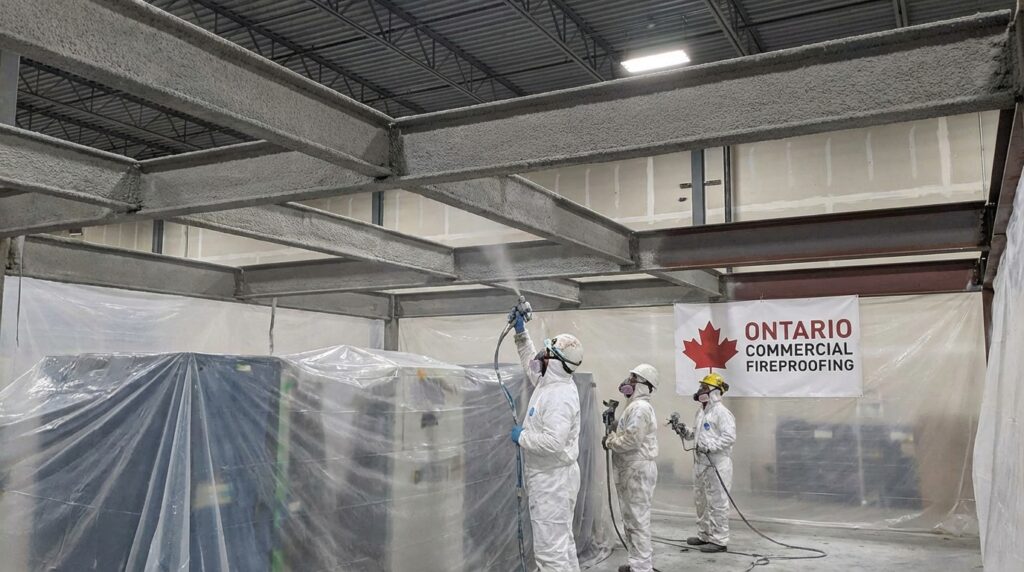
In Ontario, both fireproofing paint and SFRM are viable options, but SFRM is generally preferred for larger structural steel members needing higher fire-resistance ratings (FRR) like those found in high-rise buildings in Toronto. Fireproofing paint is often selected for its aesthetic appeal and ease of application in smaller, less demanding areas, but remember, factors like the specific steel section, the required FRR as mandated by the Ontario Building Code, and the project budget heavily influence the final decision. For example, a parking garage in Mississauga might use SFRM due to its cost-effectiveness and durability in that environment, while an exposed steel beam in a downtown Toronto office might opt for fireproofing paint to maintain a clean architectural look.
Understanding Fireproofing Methods
Before diving into a direct comparison, it’s crucial to understand the fundamental differences between intumescent fireproofing paint and spray-applied cementitious fireproofing.
Intumescent Fireproofing Paint
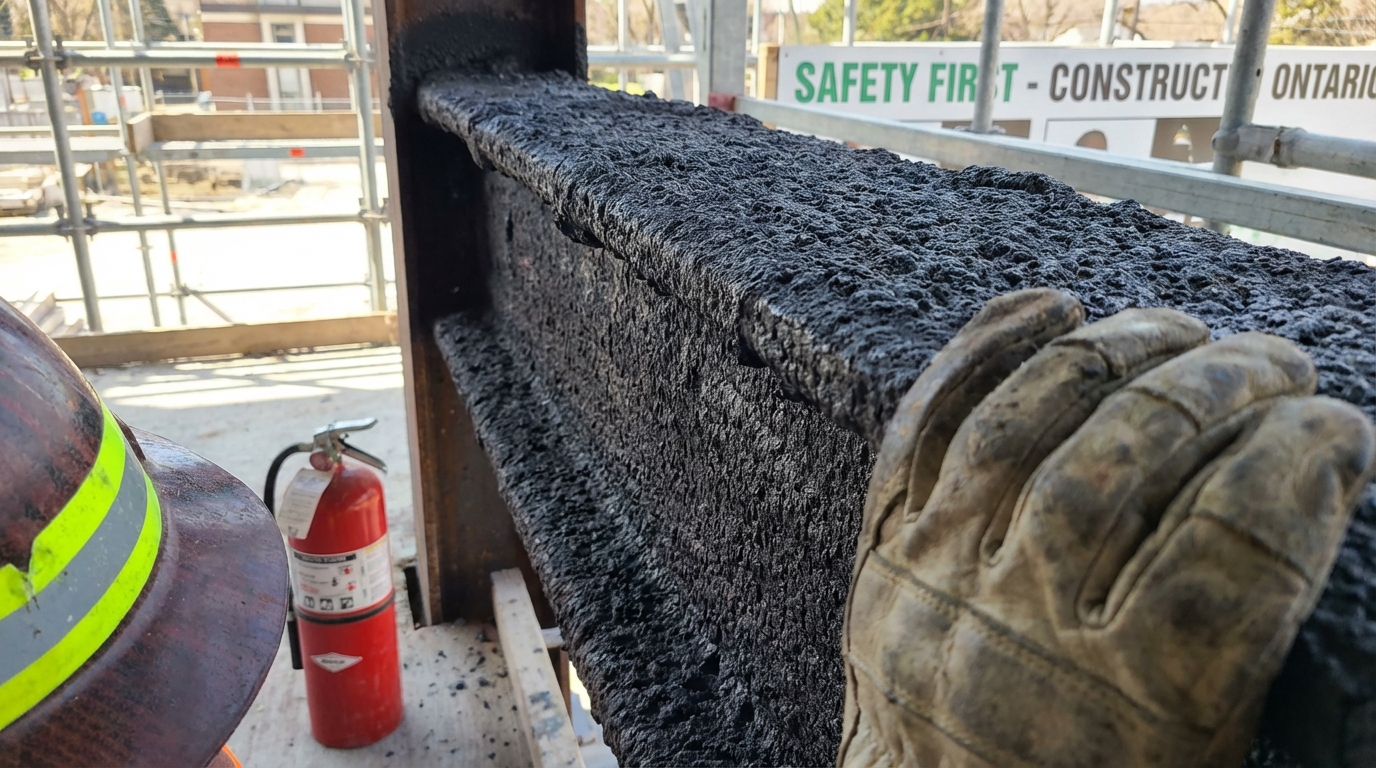
Intumescent paints are thin-film coatings that react to heat by expanding and forming a thick, insulating char layer. This char protects the underlying steel from reaching critical temperatures that would compromise its structural integrity. The thickness of the paint required depends on the desired Fire Resistance Rating (FRR) and the steel member’s size and shape (its HP/A ratio, or heated perimeter to area ratio). Learn more about our fireproofing services.
- Advantages:
- Aesthetically Pleasing: Offers a smooth, paint-like finish, making it suitable for exposed steel in architectural designs.
- Relatively Easy Application: Can be applied with standard painting equipment, reducing labor costs for smaller projects.
- Lower Material Weight: Adds minimal weight to the structure compared to SFRM.
- Disadvantages:
- Higher Material Cost: Intumescent paints are generally more expensive per square foot than SFRM.
- Application Sensitivity: Requires precise application thickness to achieve the desired FRR. Under-application can severely compromise fire protection.
- Limited FRR: Typically suitable for FRRs up to 2 hours, though some advanced formulations can achieve higher ratings.
- CAD Costs: Application costs can range from $8 to $20 per square foot, depending on the complexity of the project, required FRR, and the number of coats needed. Material costs are a significant factor, often exceeding $5 per square foot even for a basic 1-hour FRR.
Spray Applied Cementitious Fireproofing (SFRM)
SFRM is a thick, cement-based coating applied using specialized spraying equipment. It provides fire protection through its insulating properties, slowing the rate at which heat transfers to the steel. The thickness of the SFRM layer is determined by the required FRR and the steel member’s properties. Explore our insulation solutions here.
- Advantages:
- Cost-Effective: Lower material cost per square foot compared to intumescent paint, especially for high FRRs.
- High FRR Capability: Can easily achieve FRRs of 3 or 4 hours, suitable for high-rise buildings and critical infrastructure.
- Durable: Provides robust protection against physical damage and environmental factors.
- Disadvantages:
- Aesthetic Limitations: Creates a textured, often uneven finish that may not be suitable for exposed steel.
- Heavier: Adds significant weight to the structure, which must be considered during the design phase.
- Specialized Application: Requires experienced applicators and specialized equipment, increasing labor costs.
- CAD Costs: Application costs typically range from $4 to $12 per square foot, depending on the thickness required and the complexity of the project. Material costs are generally lower than intumescent paint, often around $2 to $4 per square foot.
Ontario Building Code Considerations
The Ontario Building Code (OBC) dictates the required Fire Resistance Ratings (FRRs) for various building elements based on occupancy type, building height, and construction type. Understanding these requirements is paramount when selecting a fireproofing method.
Fire Resistance Ratings (FRR)
The OBC specifies FRRs in terms of hours (e.g., 1-hour, 2-hour, 3-hour). These ratings indicate the duration for which a building element can withstand a standard fire test. For instance, a high-rise residential building in downtown Toronto might require a 3-hour FRR for structural steel columns, while a single-story warehouse in Vaughan might only need a 1-hour FRR.
Section 3.2 of the OBC outlines the specific FRR requirements for different building elements and occupancies. It’s crucial to consult with a qualified fire protection engineer to determine the appropriate FRR for your specific project. Incorrectly specifying the FRR can lead to significant safety risks and code violations.
OBC Compliance and Testing
Both intumescent paints and SFRM must be tested and listed by accredited laboratories (e.g., Underwriters Laboratories of Canada – ULC) to demonstrate compliance with the OBC. These listings specify the approved applications, thicknesses, and FRRs for each product.
The OBC references specific standards for fire testing, such as CAN/ULC-S101, “Standard Methods of Fire Endurance Tests of Building Construction and Materials.” These tests simulate real-world fire conditions to evaluate the performance of fireproofing materials. Ensure that the chosen fireproofing product has been tested according to these standards and is listed for the intended application. Contact us for a free consultation.
Sprinkler Systems and FRR Reductions
The OBC allows for reductions in FRR requirements in buildings equipped with automatic sprinkler systems. For example, a building with a fully sprinklered system might be able to reduce the FRR for certain structural elements by up to one hour.
However, it’s important to note that sprinkler system reliability is paramount. The OBC requires regular inspection and maintenance of sprinkler systems to ensure their effectiveness. Furthermore, the FRR reduction is typically not applicable to all building elements; critical load-bearing components may still require the full FRR, regardless of the sprinkler system. Learn about our company.
Cost Analysis in Ontario
The cost of fireproofing varies significantly based on several factors, including the type of material, the required FRR, the complexity of the project, and labor rates in the specific region of Ontario (e.g., Toronto vs. Thunder Bay). Understanding these cost drivers is essential for making informed decisions.
Material Costs
As mentioned earlier, intumescent paints generally have a higher material cost per square foot compared to SFRM. For example, a premium intumescent paint capable of achieving a 2-hour FRR might cost $8 to $12 per square foot, while SFRM for the same FRR might cost $2 to $4 per square foot. These are just estimates, and actual costs can vary depending on the brand, supplier, and volume purchased.
For projects requiring high FRRs (e.g., 3 or 4 hours), the cost difference becomes even more pronounced. SFRM is often the more economical choice in these situations.
Labour Costs
Labor costs also play a significant role in the overall fireproofing expense. While intumescent paints may seem easier to apply, achieving the required thickness and consistency requires skilled applicators. Multiple coats may be necessary to meet the FRR requirements, increasing labor time.
SFRM application requires specialized equipment and experienced applicators. However, the application process is often faster than applying multiple coats of intumescent paint, especially for large areas. This can offset the higher equipment costs and make SFRM more cost-effective in the long run. Expect hourly rates for skilled applicators in the GTA to range from $60 to $100 per hour, depending on experience and union affiliation.
Total Installed Cost Examples
Here are some hypothetical cost examples for fireproofing a 10,000 square foot structural steel area in Toronto:
- Project A: 1-hour FRR, Exposed Steel Beams in a Restaurant: Intumescent Paint – Total Installed Cost: $120,000 – $200,000. SFRM (not aesthetically suitable): $60,000 – $120,000 (but likely not chosen due to aesthetics).
- Project B: 3-hour FRR, Structural Steel Columns in a High-Rise Condominium: Intumescent Paint (may require specialized, expensive products): Total Installed Cost: $250,000 – $400,000 (potentially not feasible depending on product limitations). SFRM: Total Installed Cost: $80,000 – $150,000.
These are just examples, and actual costs can vary. Always obtain multiple quotes from qualified fireproofing contractors to get an accurate estimate for your specific project.
Application Considerations
Beyond cost, several application-related factors should be considered when choosing between fireproofing paint and SFRM.
Surface Preparation
Proper surface preparation is crucial for the adhesion and performance of both intumescent paints and SFRM. Steel surfaces must be clean, dry, and free from rust, oil, and other contaminants. A primer is typically required to ensure proper bonding. The specific surface preparation requirements will vary depending on the manufacturer’s recommendations and the condition of the steel. Abrasive blasting is often necessary for heavily corroded surfaces, adding to the overall project cost. Visit our homepage.
Environmental Conditions
Environmental conditions, such as temperature and humidity, can significantly impact the application and curing of fireproofing materials. Intumescent paints are generally more sensitive to environmental conditions than SFRM. High humidity can affect the drying time and adhesion of the paint, while extreme temperatures can cause cracking or blistering. SFRM is more tolerant of variations in temperature and humidity, making it a more reliable choice for projects with challenging environmental conditions.
Ontario’s climate, with its hot summers and cold winters, can pose challenges for fireproofing applications. It’s essential to choose a fireproofing material that is suitable for the specific climate conditions of the project location.
Application Process and Drying Time
Intumescent paints are typically applied in multiple thin coats to achieve the required thickness. Each coat must dry completely before the next coat is applied, which can extend the overall application time. SFRM is typically applied in a single, thick layer, reducing the number of application steps and potentially shortening the overall project timeline.
However, SFRM requires a longer curing time than intumescent paint. The curing process involves the hydration of the cementitious material, which can take several days or even weeks, depending on the environmental conditions. During the curing period, the SFRM must be protected from moisture and physical damage. This longer curing time can impact the overall construction schedule.
Frequently Asked Questions
- Q: Which is more environmentally friendly, fireproofing paint or SFRM?
- A: It depends on the specific product. Some intumescent paints contain volatile organic compounds (VOCs), while SFRM can generate dust during application. Look for products with low VOC content and sustainable manufacturing practices.
- Q: Can I apply fireproofing myself?
- A: While technically possible for small projects with intumescent paint, it’s highly recommended to hire a qualified fireproofing contractor. Proper application is crucial for achieving the required FRR, and incorrect application can compromise fire safety.
- Q: How long does fireproofing last?
- A: Both intumescent paint and SFRM can last for decades with proper maintenance. However, they can be damaged by physical impact, moisture, or chemical exposure. Regular inspections are recommended to identify and address any damage.
- Q: Does fireproofing add significant weight to the building?
- A: SFRM adds more weight than intumescent paint. The added weight must be considered during the structural design phase, especially for large projects.
- Q: Can I paint over fireproofing?
- A: You can paint over some intumescent paints with compatible topcoats. However, painting over SFRM is generally not recommended, as it can affect its fireproofing performance. Always consult with the fireproofing manufacturer before applying any topcoats.
Ultimately, the best choice between fireproofing paint and SFRM depends on the specific requirements of your project. Consider the required FRR, aesthetic considerations, budget constraints, and environmental conditions to make an informed decision. Consulting with a qualified fire protection engineer and obtaining quotes from experienced fireproofing contractors are essential steps in the process.
Ready to discuss your fireproofing needs? Contact Spray Foam Kings today for a free consultation!
Call us at 647-641-6881