
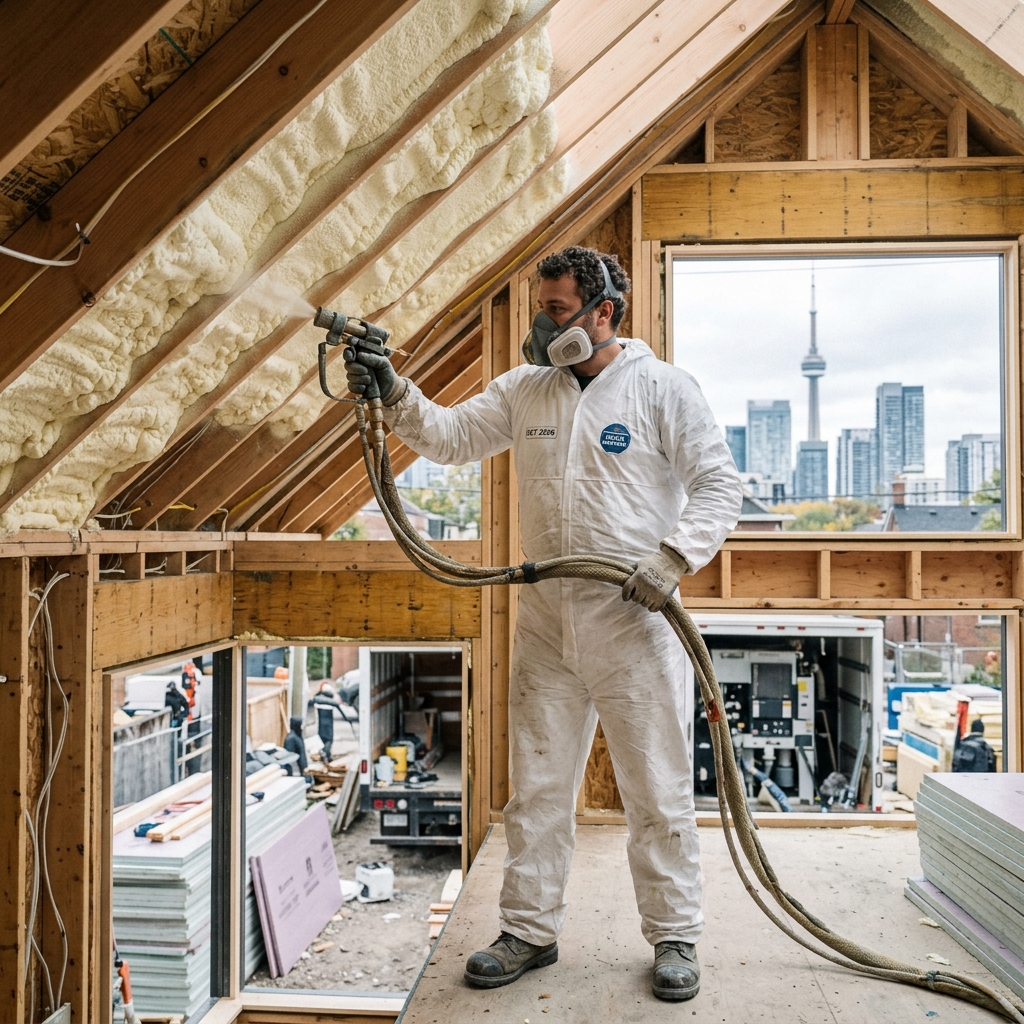
Most Toronto homeowners overpay for spray foam or hire unqualified installers. You need transparent pricing and local expertise. Spray Foam Kings delivers certified professional service across the GTA—with upfront cost breakdowns and 25-year guarantees.
Key Takeaways
- Spray foam offers superior air sealing compared to traditional insulation materials.
- Professional installation ensures proper application and warranty protection for Toronto homes.
- Seasonal pricing varies; spring and fall typically offer better rates than winter.
- Open-cell foam costs less; closed-cell provides higher R-value and moisture resistance.
- GTA climate demands durable insulation; spray foam handles freeze-thaw cycles effectively.
What Is Spray Foam Insulation?
Spray foam insulation is a polyurethane product that expands on application, sealing air leaks and gaps in structures. This two-component system creates a continuous thermal barrier that outperforms traditional batt insulation by eliminating air movement through wall cavities and attic spaces. The material adheres to framing, sheathing, and irregular surfaces, forming an airtight seal that stops drafts and reduces energy loss by up to 50% in Toronto homes.
Professional spray foam application involves trained technicians spraying liquid polyol resin and isocyanate onto surfaces where they expand. The expansion ratio varies by product type—open-cell foam expands up to 100 times its liquid volume, while closed-cell expands approximately 30 times. Both formulations cure within minutes, creating structural rigidity and moisture resistance that protects Ontario homes from the extreme temperature swings between July heat waves and January cold snaps.
The R-value per inch differs significantly between formulations: open-cell foam delivers R-3.5 to R-4.0 per inch, while closed-cell achieves R-6.0 to R-7.0 per inch. For a standard 2×6 wall cavity in Toronto, closed-cell insulation provides R-35 to R-42, exceeding Ontario Building Code requirements and reducing HVAC runtime by 30-40% annually. Homeowners seeking spray foam vs fiberglass comparison data consistently find that polyurethane foam outperforms fiberglass in air sealing, moisture control, and long-term durability across GTA climate zones.
Why Spray Foam Insulation Matters in Toronto
Spray foam insulation matters in Toronto because GTA homes lose 25-35% of heating and cooling energy through air leakage and inadequate thermal barriers. Toronto’s climate—with January lows averaging -7°C and July highs reaching 27°C—demands insulation that performs across a 34-degree temperature range. Traditional batt insulation allows convective air currents to bypass the thermal barrier, while spray foam creates a monolithic seal that stops air infiltration at stud cavities, rim joists, and attic penetrations.
Toronto spray foam projects typically cost $1.50–$3.50 per board foot in 2026, depending on thickness and cell type. A 1,500-square-foot bungalow attic requiring 4 inches of open-cell foam costs $4,200-$5,800 CAD installed, while the same space insulated with 3 inches of closed-cell foam runs $6,900-$9,200 CAD. These upfront investments pay back through 40-50% reductions in natural gas bills during heating season and 30-35% cuts to summer air conditioning costs, yielding a 7-12 year payback period for most GTA homeowners.
The freeze-thaw cycle in Toronto—where temperatures cross 0°C up to 60 times per winter—degrades fiberglass and cellulose insulation through moisture accumulation and settling. Closed-cell spray foam’s vapor barrier properties prevent moisture migration into wall cavities, eliminating the condensation that causes mold growth and structural rot. For homeowners researching Toronto spray foam contractors, choosing a certified installer ensures proper application thickness, edge sealing, and warranty coverage that protects your investment through Ontario’s demanding seasonal extremes.
What Is the Downfall of Spray Foam Insulation?
The downfall of spray foam insulation is its higher upfront cost compared to traditional materials and the requirement for professional installation to avoid warranty voiding. Open-cell foam costs $1.50-$2.10 CAD per board foot installed in 2026, while closed-cell runs $2.40-$3.50 CAD per board foot—approximately 2-3 times the cost of fiberglass batts or blown cellulose. This pricing gap discourages budget-conscious Toronto homeowners, even though lifecycle energy savings recover the premium within 8-12 years for most GTA properties.
Improper installation creates the most significant long-term problems: incomplete coverage leaves thermal bridges, over-application traps moisture against sheathing, and inadequate ventilation during curing exposes occupants to isocyanate fumes. DIY spray foam kits sold at retail stores lack the heated hose systems and plural-component pumps required for proper chemical mixing, resulting in foam that shrinks, crumbles, or fails to achieve rated R-values. Ontario building inspectors frequently flag amateur installations for code violations related to fire barriers, vapor permeability, and structural loading.
| Installation Method | Cost per Board Foot (CAD) | Warranty Coverage | Code Compliance |
|---|---|---|---|
| DIY Retail Kit | $0.85-$1.20 | None | Often fails inspection |
| Professional Certified | $1.50-$3.50 | 10-25 years | Guaranteed pass |
Closed-cell foam’s vapor impermeability can trap moisture in wall assemblies if exterior cladding leaks or if interior humidity sources go uncontrolled. Toronto homes built before 1980 often lack proper exterior drainage planes, making closed-cell application risky without building envelope upgrades. Open-cell foam permits vapor diffusion, but requires a separate vapor barrier on the interior side to meet Ontario Building Code Section 9.25, adding $0.40-$0.65 CAD per square foot to project costs. Homeowners exploring spray foam insulation cost calculator tools should factor in these building-science considerations, not just material pricing, when budgeting for GTA insulation upgrades.
How Much Does Spray Foam Insulation Cost for 1500 Square Feet in Toronto?
Spray foam insulation for 1,500 square feet in Toronto costs $6,300-$13,800 CAD installed in 2026, depending on application area, foam type, and thickness. Attic applications require 4-6 inches of foam across horizontal ceiling planes, while wall cavities need 2-4 inches to fill standard 2×4 or 2×6 framing. Open-cell foam for a 1,500-square-foot attic at 5 inches thick costs $6,300-$8,100 CAD, while closed-cell at 3 inches runs $10,200-$13,800 CAD including labor, equipment mobilization, and post-application cleanup.
| Project Size | Open-Cell Cost (CAD) | Closed-Cell Cost (CAD) | Typical Application |
|---|---|---|---|
| 1,000 sq ft | $4,200-$5,400 | $6,800-$9,200 | Bungalow attic |
| 1,500 sq ft | $6,300-$8,100 | $10,200-$13,800 | Standard 2-storey attic |
| 2,000 sq ft | $8,400-$10,800 | $13,600-$18,400 | Large executive home |
| 2,500 sq ft | $10,500-$13,500 | $17,000-$23,000 | Custom build or addition |
Basement insulation for 1,500 square feet of foundation wall costs $5,100-$9,600 CAD in the GTA, with closed-cell preferred for below-grade applications due to moisture resistance and structural reinforcement. A typical Toronto basement with 8-foot walls and 1,500 square feet of floor area has approximately 1,200 square feet of wall surface requiring insulation. At 2 inches of closed-cell foam, the project consumes 2,400 board feet at $2.40-$3.50 per board foot, totaling $5,760-$8,400 CAD plus $600-$1,200 for rim joist sealing and floor header treatment.
Geographic location within the GTA adds 8-15% to base pricing: Scarborough and North York projects run 5-8% below average due to contractor density, while Vaughan and Markham command 10-15% premiums for longer travel distances and affluent neighborhood pricing. Seasonal demand fluctuations shift costs by $0.15-$0.30 per board foot—spring and fall rates average $2.85 CAD per board foot for closed-cell, while winter emergency calls during heating failures spike to $3.35 CAD per board foot. Homeowners requesting a free insulation estimate receive itemized quotes showing material, labor, equipment rental, and waste disposal line items, ensuring transparent pricing for Toronto-area projects.
What Time of Year Is Insulation Cheapest in the GTA?
Insulation is cheapest in the GTA during late March through May and mid-September through October, when contractor demand drops 20-30% and pricing becomes negotiable. Spring months see reduced heating emergencies and fewer new-construction starts, while fall precedes the winter rush but avoids summer vacation schedules. Toronto homeowners booking spray foam projects during these shoulder seasons save $0.25-$0.45 CAD per board foot compared to January and February peak-demand pricing, reducing a typical 1,500-square-foot attic project cost by $900-$1,600 CAD.
January and February represent the most expensive period for GTA insulation work, with prices rising 15-25% above annual averages due to emergency calls from frozen pipes, ice dam damage, and heating system failures. Contractors charge winter premiums for equipment winterization, jobsite heating to maintain proper foam curing temperatures (15-30°C required), and overtime labor for crews working in unheated attics. Closed-cell spray foam requires heated application zones when ambient temperatures drop below 10°C, adding $400-$800 CAD per day in propane heater rental and ventilation equipment costs that get passed to customers through higher per-board-foot pricing.
| Season | Avg. Price per Board Foot (CAD) | Demand Level | Booking Lead Time |
|---|---|---|---|
| Winter (Jan-Feb) | $3.10-$3.50 | Peak / Emergency | 2-5 days |
| Spring (Mar-May) | $2.40-$2.80 | Low / Best value | 7-14 days |
| Summer (Jun-Aug) | $2.70-$3.10 | Moderate | 10-21 days |
| Fall (Sep-Oct) | $2.45-$2.85 | Low / Good value | 7-14 days |
November and early December offer a secondary savings window as contractors seek to fill schedules before holiday shutdowns and homeowners delay projects until after New Year. GTA spray foam installers often discount rates by 10-15% during this period to maintain cash flow and keep crews employed, though weather-dependent scheduling becomes less predictable as temperatures approach freezing. For optimal pricing and scheduling flexibility, Toronto homeowners should request quotes in February for April installation or in August for October completion, allowing time to compare contractor proposals and coordinate with Ontario rebate program applications that require pre-approval documentation. Checking spray foam insulation FAQs helps homeowners understand seasonal installation constraints and optimal timing for GTA climate conditions.
Spray Foam Insulation in Toronto Neighbourhoods
Spray foam insulation pricing varies by 8-15% across Toronto neighbourhoods based on travel distance, local permitting costs, and property values. Scarborough projects average $2.55-$3.15 CAD per board foot for closed-cell foam in 2026, benefiting from high contractor density along Highway 401 and competitive bidding among established insulation companies. North York residential work runs $2.60-$3.20 CAD per board foot, with older housing stock requiring additional air sealing around knob-and-tube wiring and outdated HVAC penetrations that add 5-10% to project scope.
Etobicoke spray foam installations cost $2.70-$3.30 CAD per board foot, reflecting the neighborhood’s mix of post-war bungalows and newer builds that demand customized insulation strategies. Vaughan commands premium pricing at $2.85-$3.50 CAD per board foot due to larger estate homes, longer contractor travel times from central GTA depots, and affluent-area service expectations including enhanced cleanup protocols and extended warranties. Mississauga averages $2.65-$3.25 CAD per board foot, with competitive rates driven by strong contractor presence along the QEW corridor and high project volumes in subdivisions built during the 1990s-2000s construction boom.
Markham spray foam projects run $2.80-$3.45 CAD per board foot, influenced by newer housing stock with complex rooflines, vaulted ceilings, and bonus rooms over garages that require precision application and scaffolding rental. Brampton offers the GTA’s most competitive pricing at $2.50-$3.10 CAD per board foot, supported by rapid suburban growth that sustains multiple insulation contractors and keeps per-project overhead costs low. Travel fees add $85-$150 CAD for service calls beyond 25 kilometers from a contractor’s base, making local provider selection important for homeowners in outer GTA municipalities.
Heritage properties in downtown Toronto neighborhoods—the Annex, Cabbagetown, Leslieville—require specialized spray foam techniques to preserve historical architectural features, adding 20-35% to standard pricing through custom masking, low-expansion foam formulations, and municipal heritage permit compliance. Condominium spray foam work in CityPlace, Liberty Village, and Yonge-Eglinton districts faces building management approvals, elevator booking fees, and restricted work-hour windows that increase project costs by $
Why Choose Spray Foam Kings
Certified spray foam installers, Ontario rebate-program eligible, manufacturer warranty, WSIB-covered crew, 10+ years GTA experience.
Get Your Free Quote Today
✓ Certified spray foam installers
✓ Ontario rebate-program eligible
✓ manufacturer warranty
Call: 647-641-6881
Frequently Asked Questions
What is the downfall of spray foam insulation?
Spray foam can be costly upfront, requires professional installation, and may off-gas during application. Improper installation can trap moisture, leading to mold issues. It’s also difficult to remove if future repairs are needed. However, quality installation in Toronto homes minimizes these risks significantly.
How much does it cost to spray foam for 1500 square feet?
In Toronto and the GTA, spray foam insulation typically costs $1.50 to $3.00 per square foot installed. For 1500 sq ft, expect $2,250 to $4,500 CAD depending on foam type (open-cell or closed-cell) and your location within Scarborough, Mississauga, or Vaughan.
What time of year is insulation cheapest?
Late fall and winter see reduced demand in the GTA, often resulting in 10-15% discounts from contractors. Summer is peak season with higher pricing. Spring also offers competitive rates. Book inspections in November through February for best Toronto-area pricing on spray foam projects.
Why are people removing spray foam?
Some homeowners remove spray foam due to moisture trapped behind the foam, causing hidden mold growth. Poorly sealed installation allows air leaks, reducing effectiveness. In Toronto homes, removal is sometimes necessary when previous installations weren’t done by certified professionals meeting Ontario Building Code standards.
How long does spray foam insulation last?
Quality closed-cell spray foam lasts 80+ years in Toronto homes. Open-cell foam typically lasts 15-20 years. Longevity depends on proper installation, ventilation, and protection from UV exposure. Professional installation by GTA contractors ensures maximum lifespan and performance compliance with current building codes.
Is spray foam insulation safe for homes?
Professional spray foam is safe when installed by certified contractors following Ontario Building Code requirements. Proper ventilation and vapor barriers prevent off-gassing issues. Closed-cell foam resists moisture and mold growth in Toronto’s humid climate. Always verify contractor licensing and insurance before hiring in the GTA.
Can I install spray foam insulation myself?
DIY spray foam installation is not recommended. It requires specialized equipment, safety training, and precise application techniques. Poor installation voids warranties and creates fire safety risks. Hire licensed Toronto-area contractors for proper installation that meets Ontario Building Code standards and protects your home investment.
What’s included in a spray foam insulation estimate?
A complete Toronto spray foam estimate includes site inspection, square footage calculation, foam type recommendation (open or closed-cell), labor costs, material costs, vapor barrier installation, air sealing, and post-installation testing. Reputable GTA contractors provide written warranties, cleanup, and compliance documentation with your estimate.