
# Frequently Asked Questions
Every week we get the same calls — “how much per square foot?”, “open-cell or closed-cell?”, “can I still get the Enbridge rebate?” We’d rather answer them once, clearly, than make you sit through a sales pitch to find out. If your question isn’t here, call us at 647-641-6881 — a real person picks up.
—
Costs & Pricing
How much does spray foam insulation cost per square foot in Toronto / GTA?
Open-cell spray foam runs $1.50–$3.50 per square foot installed; closed-cell runs $2.50–$5.00 per square foot installed. For a typical 1,200 sq ft attic in Toronto, budget $2,800–$4,200 for open-cell at R-20, or $4,500–$7,200 for closed-cell at the same thickness. Basement walls and rim joists usually fall in the $3.50–$5.00/sqft range using closed-cell. Prices shift based on foam thickness, access difficulty, and whether old insulation needs removing first. We give you a firm written number before we touch anything. Call 647-641-6881 to book your free on-site estimate. More on our spray foam insulation service page.
What’s the difference in price between open-cell and closed-cell spray foam?
Open-cell is roughly 40–50% cheaper because it’s less dense (0.5 lb/cu ft) and uses water as its blowing agent. Closed-cell uses HFO blowing agent, is denser (2 lb/cu ft), and delivers R-6 per inch vs R-3.7 per inch for open-cell. For most GTA attic floors, open-cell at 5.5 inches hits R-20 and is the cost-efficient choice. For basements, rim joists, and crawl spaces — where you need vapour control — closed-cell is the right call regardless of the price difference. Choosing the wrong product costs more in the long run. See our full open-cell vs closed-cell comparison guide.
How much would it cost to insulate a typical 1,200 sq ft attic in Toronto with spray foam?
Open-cell at 5.5 inches (R-20): $2,800–$4,200 all-in for a 1,200 sq ft attic — prep, foam, cleanup, no surprises. Closed-cell at the same depth: $6,000–$8,400, which is overkill for most Toronto attics unless you’re converting the space to conditioned living area. We’ll recommend the right product at your assessment, and we won’t upsell you on closed-cell when open-cell is what the job calls for. Call 647-641-6881 to schedule. Details on our attic spray foam insulation page.
What factors affect the final cost of my spray foam project?
Five main factors: foam type (open vs closed cell), required thickness to hit OBC minimums, total square footage, access difficulty, and old insulation removal. A finished attic with knee walls and dormers takes more setup time than a flat open attic floor. A tight crawl space costs more per square foot than a full basement wall. Old blown-in fiberglass, cellulose, or vermiculite adds a removal step. We flag every one of these during the assessment — no surprise line items when the invoice arrives.
Is there a minimum project cost or setup fee for small jobs?
We don’t publish a hard minimum, but mobilizing the rig — trucking equipment, calibrating spray temperatures, PPE — takes the same effort whether we’re spraying 100 sq ft or 2,000. Rim joist jobs typically come in around $800–$1,500. Very small isolated patches may not be cost-efficient for a full truck roll. Call us at 647-641-6881 and describe your scope — we’ll tell you honestly whether it makes sense. We’d rather save you the call-out fee than book a job that doesn’t make financial sense for you.
Do you charge extra for removing old insulation before spraying?
Yes — removal is a separate line item. Attic blow-out of existing fiberglass or cellulose runs approximately $400–$800 for a 1,200 sq ft attic depending on depth and access. If we find vermiculite in the attic (which may contain asbestos), certified abatement is required before we can spray — we flag it during the assessment and refer you to a licensed abatement contractor. We won’t spray over material that compromises the adhesion or performance of the new foam.
Do you provide written quotes?
Always. Every project gets an itemized written quote: foam type, target thickness, square footage, total price, and payment terms. No verbal estimates, no “we’ll figure it out on the day.” You sign off on the number before we schedule the install date. If scope changes on site — an extra section that wasn’t accessible during the estimate, for example — we walk you through it before doing the work, not after.
—
Open-Cell vs Closed-Cell & R-Values
Open-cell vs closed-cell — which do I need?
Quick rule: open-cell for attic floors and interior wall cavities; closed-cell for below-grade basement walls, crawl spaces, rim joists, and flat roofs. Closed-cell at 2 inches is a class-II vapour retarder — it replaces poly vapour barrier in Ontario’s climate. Open-cell is vapour-permeable, which is fine in an attic but a problem on a cold below-grade wall. Budget plays a role too — open-cell runs about half the price. We’ll recommend the right one at your assessment based on your application, not your budget. Read more in our Ontario open-cell vs closed-cell guide.
What’s the R-value of spray foam vs batt insulation?
Closed-cell spray foam: R-6 per inch. Open-cell spray foam: R-3.7 per inch. A standard R-20 fiberglass batt is rated R-20 on the label, but real-world performance often falls to R-12–R-14 due to compression, gaps around joists, and air infiltration through the batt. Spray foam adheres to the substrate and seals every gap — you get the full stated R-value, plus the air-seal bonus on top. For attic upgrades, 5.5 inches of open-cell spray foam (R-20) will outperform 8 inches of fiberglass batt in real heating season savings. See our spray foam vs batts Toronto comparison.
Does spray foam provide a vapour barrier?
Closed-cell does. At 2 inches or more, closed-cell spray foam is a class-II vapour retarder per Ontario Building Code — it replaces the poly vapour barrier on basement walls and crawl space walls. Open-cell foam breathes (it’s vapour-permeable), so a separate vapour barrier is still required where code mandates one. We’ll confirm what’s needed for your specific application when we quote — it’s not guesswork, it’s code compliance.
Is closed-cell or open-cell foam better for rim joist insulation?
Closed-cell, without question. Rim joists sit at the intersection of the exterior wall and the floor system — a cold zone with condensation risk and a common pest-entry point. Two inches of closed-cell foam (R-12+) gives you thermal performance, an integrated vapour barrier, and a complete air seal in one shot. Open-cell absorbs moisture in rim joist applications and is not recommended. Rim joist sealing is one of the highest-ROI spray foam applications a GTA homeowner can do — typically 10–15% reduction in heating costs. We do rim joist projects across Toronto, Etobicoke, Mississauga, and Vaughan.
How do I decide between open-cell and closed-cell for my project?
Work through these four questions: (1) Is the application above grade or below? Below grade → closed-cell. (2) Do you need vapour control built into the foam? Yes → closed-cell at 2 inches+. (3) Is this a cathedral ceiling / conditioned attic conversion? Either can work depending on the rafter depth. (4) What’s the budget? If both foam types fit technically, open-cell is the economical choice. We walk through this checklist at every quote — no sales pressure, just the right product for the job. Call 647-641-6881 and we’ll talk through your specific situation.
—
Material Performance & Durability
How long does spray foam insulation last?
Properly installed spray foam — open-cell or closed-cell — is effectively permanent. Expect 25–30+ years without degradation under normal conditions. It doesn’t sag, settle, or absorb moisture the way fiberglass batts or blown-in cellulose can. Closed-cell is rigid and adds structural stiffness to whatever substrate it’s applied to. The one caveat: foam left exposed to prolonged UV light will yellow and degrade — Ontario Building Code requires an ignition barrier (drywall, intumescent paint) over foam in any inhabited space. Covered correctly, spray foam outlasts every other insulation material in common use.
Can closed-cell spray foam prevent mould and moisture in a basement?
Yes. Closed-cell foam seals the concrete or block wall, eliminating the air gap where humid indoor air meets cold masonry and condensation forms. At 2 inches, it’s vapour-impermeable — humid interior air can’t reach the cold substrate. Combined with proper drainage and a functioning sump pit, closed-cell on basement walls dramatically reduces mould risk. Open-cell is not recommended below grade: it can absorb water if the wall ever experiences flooding or persistent sweating. Our basement spray foam service page has more detail.
Can spray foam handle the Ontario climate — cold winters, variable humidity?
That’s exactly what it’s designed for. Open-cell handles freeze-thaw cycles without cracking or shifting. Closed-cell is structurally rigid and dimensionally stable to -30°C and beyond. Both products are tested and certified for Canadian climate conditions. After 15+ years installing across the GTA — from January installs in Brampton to summer basement jobs in Markham — we have not seen a properly installed spray foam system fail due to climate. The materials other insulation types use (batt facing, vapour barrier poly, binder in blown-in cellulose) are far more vulnerable to our weather than spray foam is.
—
Certifications & Warranty
Are you CUFCA certified?
Yes. We’re certified through CUFCA — the Canadian Urethane Foam Contractors Association, the national body that sets training and safety standards for spray polyurethane foam in Canada. CUFCA certification means our installers are trained on proper foam chemistry, application technique, equipment calibration, and occupational health and safety. It’s the benchmark for professional spray foam in Canada. Not every GTA installer holds it — if you’re getting competing quotes, ask to see their certification documentation before signing anything.
What’s your warranty?
We warrant our workmanship. If you experience delamination, shrinkage, or adhesion failure attributable to how we applied the foam — we come back and fix it, no charge. The foam products we install carry manufacturer warranties on the materials themselves. Exact warranty terms are stated in your quote paperwork. We’ve been doing this for 15+ years in the GTA; we don’t hide from callbacks. If something isn’t right, call us at 647-641-6881 and we deal with it directly.
What insurance do you carry?
We carry $5,000,000 in commercial general liability insurance. All crew members are covered under WSIB (Workplace Safety & Insurance Board) — that protects you as a homeowner from liability if a worker is injured on your property. We provide certificates of insurance on request before the job starts. If any contractor says they can’t produce these documents, that’s a red flag — don’t let them in your attic.
Are your installers trained and licensed to work in Ontario?
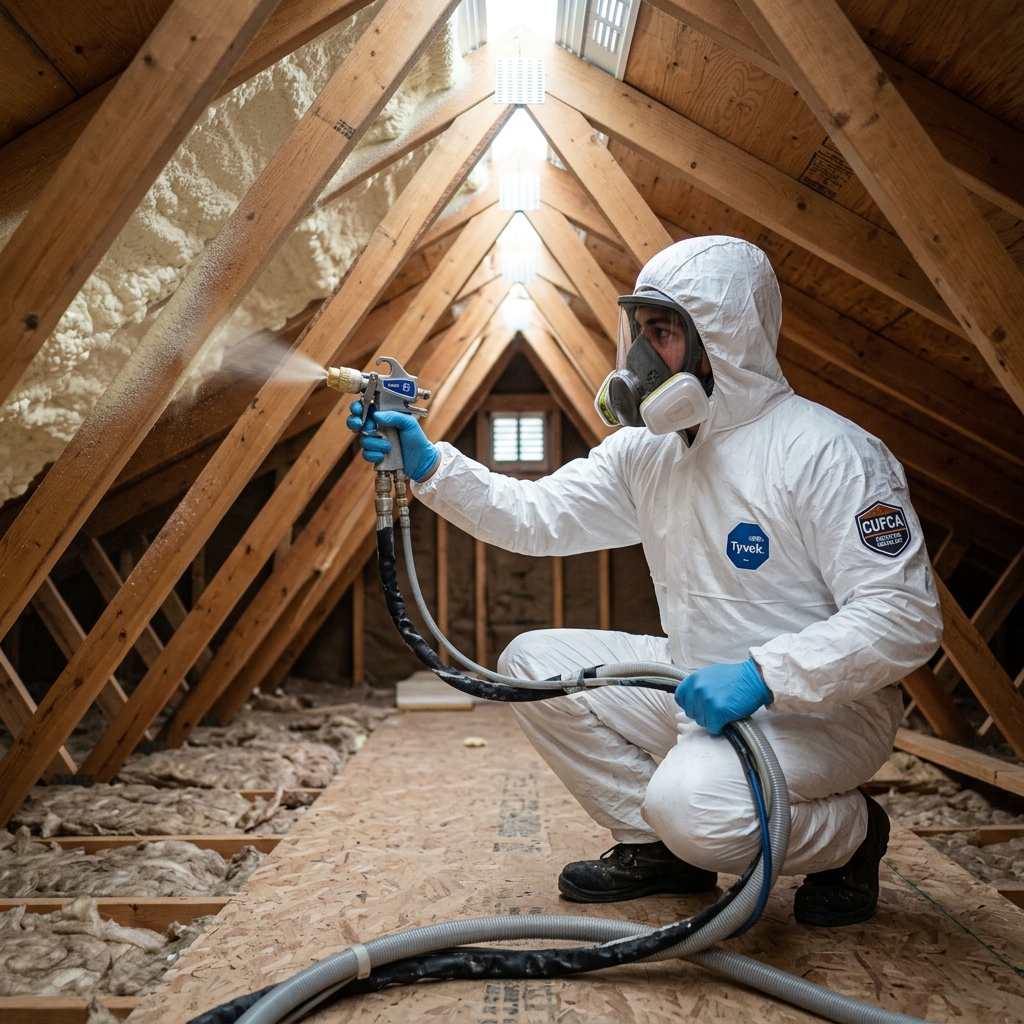
All installers are CUFCA-trained and our company is WSIB-registered. Spray polyurethane foam installation is not a licensed trade in Ontario, but proper CUFCA training is the industry standard — and we hold it. We do not use untrained sub-crews. Everyone on your job understands the equipment (heated hoses, plural-component proportioner), the chemistry (isocyanate side vs resin side), and the PPE protocols (full-face respirators, Tyvek suits, gloves). CUFCA training isn’t optional for us — it’s how we ensure every install performs the way the manufacturer designed it to.
Do you comply with Ontario Building Code (OBC SB-12) standards?
Yes. Every attic, basement, and crawl space install we do is designed to meet or exceed the OBC Supplementary Standard SB-12 minimum effective thermal resistance. For attics in most of Ontario’s climate zones, that’s a minimum of R-31 (although we often target R-40+ for new builds). For basement walls: R-12 minimum below grade. We reference the applicable SB-12 requirements in your quote documentation, so if a building inspector asks, you have the paper trail. Call us at 647-641-6881 if you need help interpreting what your permit requires.
—
Rebates & Greener Homes Grant
Can spray foam help me qualify for the Canada Greener Homes Grant?
It can, under the right conditions. The Canada Greener Homes program (now primarily a loan in 2026) requires a pre-install EnerGuide assessment by a Registered Energy Advisor, the insulation upgrade must meet program minimums, and you need a post-install audit to unlock funding. We’re familiar with the process — we’ve worked alongside energy advisors on dozens of GTA projects. Call us at 647-641-6881 and we’ll walk you through the documentation, sequencing, and what to have in place before the install date. More detail on our closed-cell attic rebate page.
Do you handle Enbridge rebate paperwork?
We’re registered with Enbridge’s Home Efficiency Rebate Plus (HER+) program. We help you navigate the process: scoping the qualifying work, providing installation documentation, and flagging pre-steps like the mandatory Home Energy Assessment. HER+ rebates can reach $10,600 depending on the combination of upgrades completed. We can’t guarantee Enbridge’s approval — that’s their call — but we make sure nothing on our end delays or disqualifies your application. Ask us about rebate eligibility when you call for a quote.
Can I stack multiple rebates — federal and utility programs?
In most cases, yes. The Canada Greener Homes Loan and Enbridge HER+ can be stacked if each program’s individual eligibility requirements are met. Stacking can bring total incentives to $10,000+. The key constraint: many programs require you to apply before work begins — starting the job first can disqualify you from the pre-install audit requirement. We’ll help you map out which programs to apply for first and how to sequence the assessment → install → post-audit → rebate claim properly so you don’t leave money on the table.
Do I need an energy audit to apply for rebates?
For Canada Greener Homes programs: yes — a pre-install EnerGuide audit by a Registered Energy Advisor is mandatory. For Enbridge HER+: a Home Energy Assessment through a participating advisor is required. We work with energy advisors regularly and can recommend the right sequence. The assessment comes first; we scope the work based on the advisor’s recommendations; we install; the post-audit unlocks your funding. Skipping the pre-assessment disqualifies you from nearly every major federal program — don’t skip it trying to save time.
How long does it take to receive a rebate after installation?
Enbridge HER+: typically 4–8 weeks after your post-install inspection is submitted. Canada Greener Homes programs: can take 8–12 weeks from post-audit submission, depending on federal processing volumes. We provide your installation documentation promptly — the delay is almost always on the program side, not ours. We’ll give you a post-install checklist of exactly what to submit to each program and when, so nothing stalls on your end.
—
Install Process & Timeline
How long does an attic spray foam job take?
A typical 1,200 sq ft open attic floor: 4–6 hours on-site, including setup, spray, and cleanup. Larger attics (2,000+ sq ft) or complex geometry — knee walls, dormers, cathedral sections — can take a full day. We book either a half-day or full-day slot depending on scope, and we give you an accurate time window when we confirm. We don’t rush; foam applied at the wrong speed or temperature doesn’t bond correctly. See our attic spray foam insulation service page for more.
What does the install process look like, start to finish?
Step 1: Free on-site assessment and written quote.
Step 2: You accept the quote and we schedule an install date.
Step 3: Prep — you clear the workspace; we arrive with the spray rig and mask surfaces that shouldn’t be coated.
Step 4: Application — we spray the foam to specified thickness, working systematically across the area.
Step 5: Cure — foam is tack-free within minutes; full structural cure within 24 hours.
Step 6: Cleanup and walkthrough — we walk you through the finished job, confirm thickness, and you sign off.
That’s the full process. No subcontractors showing up unannounced. No day-of surprises. Call 647-641-6881 to start with Step 1.
How do you protect my home during install — overspray, drop sheets?
We mask every surface that shouldn’t be coated before the first drop of foam leaves the gun. HVAC equipment, electrical panels, existing fixtures, flooring access points — all covered with plastic sheeting. Drop cloths go down on any floor area the crew walks through. Spray foam cures permanently on contact with surfaces — we treat your attic hatch, your HVAC unit, your finished basement floor with the same care we’d give a finished room. If we’ve missed masking something, we catch it before we spray, not after.
What prep work is required before you arrive?
Clear the workspace. In the attic, that means removing stored boxes and items from the spray area and providing clear access through the attic hatch. In a basement, it means pulling furniture and stored items away from the walls we’re spraying. We’ll give you a specific prep checklist when we confirm your appointment. If old blown-in insulation needs to come out first, we’ll schedule that on install day or a separate prior day depending on scope. The more accessible the area, the faster and cleaner the job.
Can spray foam be installed year-round, or only in summer?
Year-round. Spray foam chemistry is temperature-sensitive — the component chemicals need to be warm (our equipment heats them) and the substrate temperature should be above 5°C. We install through GTA winters regularly. Attic installs in January are routine; below-grade crawl spaces in extreme cold may need a bit more prep to get substrate temperature up. We’ve been managing seasonal conditions for 15+ years across the GTA — cold weather is not a reason to delay your project.
—
Health & Safety
Is spray foam safe for kids and pets after installation?
Once fully cured — yes, completely safe. Cured spray foam is chemically inert. The concern is during and immediately after application, when isocyanate compounds off-gas as part of the chemical reaction. We require all occupants — including children, pets, and anyone with respiratory sensitivities — to be out of the home during the install and for the re-occupancy window we specify. We follow Health Canada off-gas guidance on re-entry timing. If you have a family member with asthma or chemical sensitivities, tell us when you book — we’ll plan the ventilation protocol accordingly.
How do you handle off-gassing and re-occupancy timing?
During installation: our crew wears full-face air-purifying respirators and Tyvek suits. We set up exhaust ventilation — fans drawing air out and fresh-air intake running — during the spray and for the period immediately after. Our standard re-occupancy guidance is 24 hours minimum from the end of spraying, with the space well-ventilated. For larger installs (whole attic + basement combo), 24–48 hours is the safer window. We give you a written re-entry clearance specific to your job scope — we don’t give you a generic “24 hours” and walk away.
How long until I can move back in after spray foam?
Standard: 24 hours after the spray job is complete, with windows open and the space ventilated. For whole-house installs covering multiple areas, 24–48 hours is the safer guideline. We provide written re-entry instructions at the end of every job. If you have an HRV (heat recovery ventilator), run it on high during the re-entry period — it accelerates the clearance of any residual off-gas compounds. We won’t tell you it’s safe to go back in before it actually is.
What happens if I have asbestos in my current insulation?
We flag it and stop. Vermiculite insulation — common in Toronto-area homes built before the 1990s — may contain asbestos fibres. If we suspect vermiculite during our assessment, we’ll recommend testing before booking the install. Asbestos abatement requires a licensed abatement contractor; it cannot be disturbed or removed by our crew. Once abatement is certified complete, we schedule the spray foam install. This adds time and cost to the project, but it’s the only safe and legal path. We won’t spray over suspect material to save you a few weeks of scheduling.
—
Service Area & Job Types
What areas of the GTA do you service?
We cover the full Greater Toronto Area: Toronto (all neighbourhoods), Scarborough, North York, Etobicoke, Vaughan, Mississauga, Markham, Brampton, Oakville, Hamilton, and surrounding communities. If you’re not sure whether we travel to your area, call us at 647-641-6881 — we’ll tell you straight and, if we can’t get there, we’ll say so rather than waste your time.
Do you do attics, basements, crawl spaces, rim joists, and commercial jobs?
All of the above. Our core applications: attic spray foam (open-cell and closed-cell), basement wall insulation (closed-cell), crawl space encapsulation, rim joist sealing, and commercial projects including warehouses, multi-unit residential, and light industrial. We are spray-foam-only — we don’t install fiberglass, cellulose, rigid foam, or any other insulation type. That focus means we know spray foam deeply, and we’re not hedging with a catalogue of competing products.
Do you do removal of old insulation before spraying new foam?
Yes — we handle attic blow-out of existing fiberglass or cellulose as a separate quoted line item. Removal is mandatory when old insulation is contaminated, pest-damaged, or would prevent proper foam adhesion. Cost is roughly $400–$800 for a 1,200 sq ft attic depending on depth. If there’s asbestos-containing material (vermiculite), certified abatement is required first — we refer you to a licensed abatement contractor and schedule around their clearance certification. We don’t spray over material that will compromise the job. See our attic insulation service page for more.
Can you service a rental property or commercial building?
Yes. We work with landlords, property managers, and small commercial operators across the GTA. Rental properties are straightforward — we coordinate access with you, not the tenant. Commercial jobs (warehouses, cold storage, multi-unit residential) require a site visit quote and scheduling around operations. We’ve insulated commercial spaces from Brampton industrial parks to Toronto mixed-use buildings. Call 647-641-6881 to talk through your property and scope.
—
Spray Foam vs Alternatives
How does spray foam compare to blown-in insulation in terms of air sealing?
Blown-in cellulose or fiberglass insulates — it doesn’t air-seal. Spray foam does both in a single application. It adheres to the substrate and fills every gap, crack, plumbing penetration, and electrical rough-in without a second step. Air leakage accounts for 25–40% of a home’s heat loss — more than conduction through the wall assembly itself. Blowing insulation over existing air leaks is like piling blankets over an open window. If your attic has gaps around pot lights, exhaust penetrations, or a leaky hatch, blown-in doesn’t fix any of them. Spray foam does. Read our spray foam vs cellulose comparison for the full breakdown.
Is spray foam better than fiberglass batt insulation for moisture control?
Significantly better, especially for basements, rim joists, and crawl spaces. Fiberglass batts absorb and hold moisture, lose R-value when wet, and create a void behind the batt where mould can grow against cold concrete. Closed-cell spray foam seals the masonry wall, eliminates the moisture-accumulation cavity, and is inherently mould-resistant as a material. In a Toronto or Mississauga basement — where condensation on below-grade concrete is the norm, not the exception — spray foam isn’t just better; it’s the appropriate product. Fiberglass on a below-grade wall is a mould farm waiting to happen. See our spray foam vs batts Toronto 2026 guide for a full head-to-head comparison.
—
Still have a question that isn’t covered here? Call us directly at 647-641-6881 — we answer questions on the phone, no obligation. If your project needs a quote, we’ll book a free on-site assessment at a time that works for you.
Get Your Free Quote Today
Call: 647-641-6881
—