
“`html
What’s the difference?
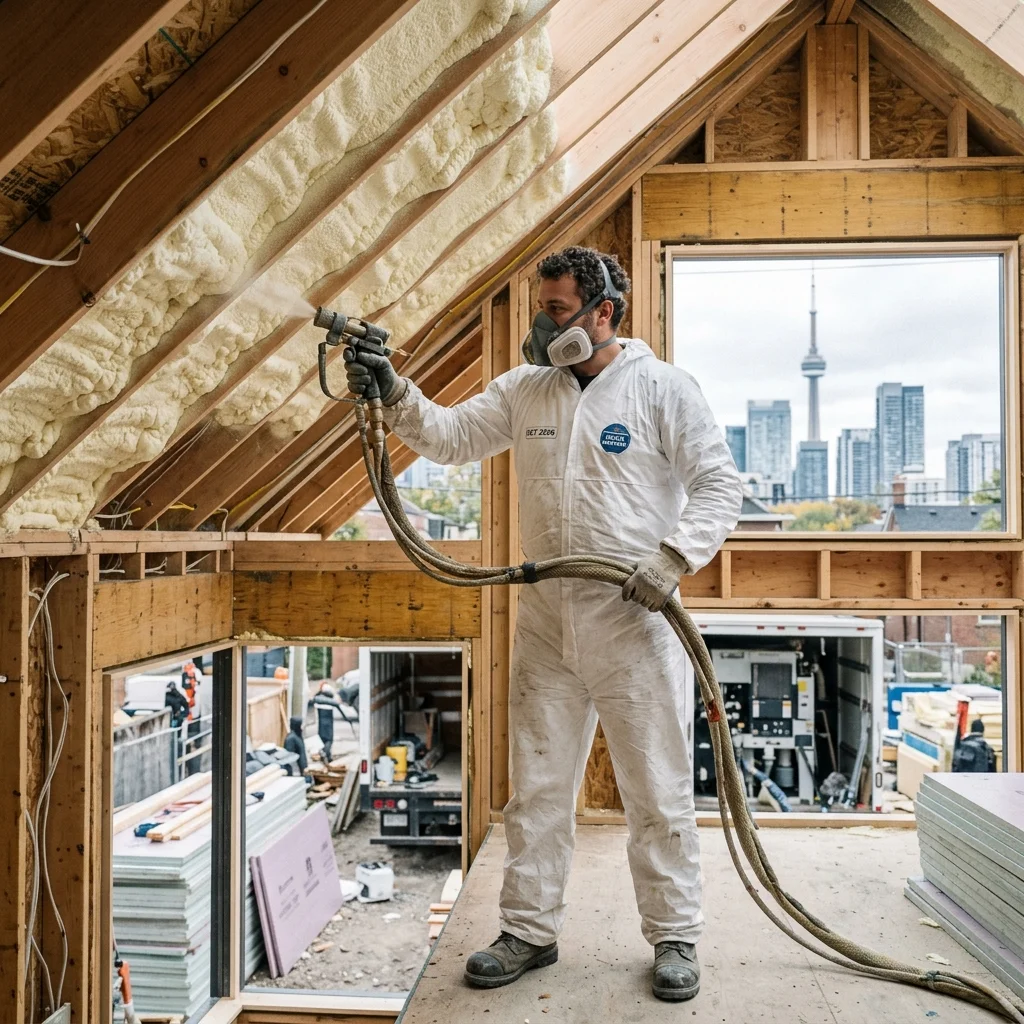
If you’re insulating a home in Ontario in 2026, the choice between closed-cell and open-cell spray foam is one of the most consequential decisions you’ll make before the drywall goes up. Both products are sprayed on-site, both expand to fill cavities, and both outperform fibreglass batts on air-sealing. That’s where the similarity ends. Closed-cell foam cures into a rigid, dense layer with an RSI of roughly 1.06 per centimetre. Open-cell foam cures soft and spongy, hitting about 0.40 RSI per centimetre. The cost gap is equally wide — closed-cell runs $2.50–$4.50 per board foot installed; open-cell sits closer to $0.90–$1.50. Neither product is universally superior. The right call depends on your wall assembly, your climate exposure, your budget, and what Ontario’s 2026 building code requires for your project type. A below-grade foundation wall in a Sudbury home that sees -35 °C winters demands a different answer than an interior attic deck in a semi-detached Toronto townhouse. Understanding the mechanical and code-driven differences — not just the marketing language — is what separates a well-insulated home from an expensive callback. This post walks through both products honestly so you can make the decision that fits your house, your municipality, and your bank account.
Side-by-side comparison
| Factor | Closed-Cell Spray Foam | Open-Cell Spray Foam |
|---|---|---|
| Typical scenario | Below-grade walls, rim joists, cold-climate exterior walls, unvented roof assemblies | Interior attic decks, interior wall cavities, soundproofing, warm-side applications |
| Installed cost (CAD) | $2.50–$4.50 per board foot; avg. 2,000 sq ft basement ~$6,000–$11,000 | $0.90–$1.50 per board foot; avg. 2,000 sq ft attic deck ~$2,200–$4,500 |
| Project timeline | 1–2 days spray + 24 hr cure before enclosure | Half-day to 1 day spray + 8–12 hr cure before enclosure |
| Permit typically needed (Ontario) | Yes — most municipalities require a building permit when adding insulation to an existing assembly or finishing a basement | Yes — same trigger; attic conversions may also need HVAC review |
| When to choose it | Moisture risk present; structural stiffening needed; exterior or semi-exterior application; high RSI target in thin wall | Budget-constrained interior project; sound attenuation priority; adequate wall depth exists; no bulk-water risk |
| Risk if wrong choice | Applied inside a warm attic without vapour analysis → traps heat, raises cooling load unnecessarily; over-budget for low-risk zone | Applied at or below grade → absorbs moisture, loses RSI, potential mould; fails to meet code minimum thickness for climate zone |
| RSI per cm (approx.) | ~1.06 RSI/cm (R-6 per inch) | ~0.40 RSI/cm (R-3.7 per inch) |
| Vapour permeance | ≤ 1 perm at 2″ — acts as vapour barrier in many assemblies | 10+ perms — vapour-open; separate vapour barrier usually required |
Closed-cell spray foam — when it’s the right call
Closed-cell foam earns its premium price tag in specific scenarios. The clearest case is below-grade and at-grade applications — foundation walls, slab edges, and rim joists. Ontario basements face ground moisture from all sides. Open-cell foam in that environment wicks water, loses insulating value, and can harbour mould behind finishes where you’ll never see it. Closed-cell’s low vapour permeance (under 1 perm at 50 mm) means it doubles as a vapour retarder, potentially eliminating a separate poly membrane where code allows.
The second strong use case is unvented roof assemblies. Ontario’s 2012 OBC supplemented by the 2020 National Building Code adoption pathway requires a minimum RSI at the roof line for unvented attics. Achieving RSI-7 in a 2×6 rafter bay is nearly impossible with open-cell; closed-cell gets there in roughly 115 mm. Roof insulation with closed-cell foam also adds measurable racking resistance to the sheathing — a practical structural benefit in ice-storm country.
Rim joists are a third slam-dunk for closed-cell. That narrow band between the top of the foundation and the floor system is responsible for a disproportionate share of infiltration losses in Ontario homes. Two inches of closed-cell in a rim joist cavity air-seals and insulates simultaneously. Rim joist insulation services are typically a half-day job with outsized energy returns.
Finally, if you’re insulating a cold-climate cottage, garage, or addition on a tight wall assembly where you need maximum RSI without furring out, closed-cell is the only spray foam product that delivers. The higher upfront cost typically pays back within 7–12 years through heating savings in northern Ontario climates.
Open-cell spray foam — when it’s the right call
Open-cell foam is not a second-tier product — it’s the right product for a well-defined set of applications. Its most natural home is the interior attic deck in a vented attic assembly. Sprayed across the ceiling joists from below, open-cell fills every gap, stops air leakage, and achieves code-minimum RSI levels at roughly half the material cost of closed-cell. Because the attic above remains ventilated and the assembly is warm-side, moisture drive is managed by ventilation rather than vapour resistance — and open-cell’s vapour-open profile fits that physics correctly. See our attic insulation options for more on this assembly.
Interior wall cavities are a second strong fit, particularly where sound attenuation matters. Open-cell’s soft, fibrous cell structure absorbs sound energy more effectively than closed-cell. For a semi-detached or row-house situation in Toronto, Hamilton, or Ottawa, wall insulation with open-cell foam can meaningfully reduce party-wall noise while hitting OBC thermal requirements when combined with a continuous interior insulation layer.
Budget is the other honest driver. A full basement wall spray with closed-cell can run $9,000–$12,000 for an average Ontario home. The same basement finished with open-cell — assuming no bulk water risk, good drainage, and an interior vapour barrier — might cost $3,500–$5,500. In a dry, well-drained lot in southern Ontario, that trade-off can be entirely rational.
Open-cell also cures faster and off-gasses more quickly, which matters for occupied homes with tight renovation schedules. It’s easier to trim flush with framing, and minor gaps can be re-sprayed affordably. Where conditions suit it, open-cell is a practical, high-performance choice — not a compromise.
Edge cases and Ontario-specific factors
Building permits: Ontario’s Building Code Act requires a permit for most insulation work that involves changing an assembly — finishing a basement, converting an attic, or altering exterior wall composition. The threshold varies by municipality. Toronto, Ottawa, and Hamilton have active permit enforcement. Skipping a permit can trigger issues at resale and void some homeowner insurance policies. Always confirm with your local building department before work begins.
Fire code and thermal barriers: All spray polyurethane foam in occupied spaces must be covered by a thermal barrier — typically 12.7 mm (½”) drywall — unless the product carries specific fire-resistance approval. This is a Provincial Fire Code requirement, not optional. Exposed foam in a finished basement is a code violation that inspectors flag.
Insurance: Some Ontario insurers ask about spray foam in home inspections, particularly in attics. An unvented closed-cell attic assembly installed without a permit can raise questions during a claim. Using a licensed, insured contractor who pulls the permit protects you. Confirm your contractor carries $2M+ liability and WSIB coverage.
Heritage and neighbourhood bylaws: Heritage-designated homes in cities like Kingston or Niagara-on-the-Lake may have restrictions on altering exterior wall assemblies. Check with your heritage planner before specifying any insulation system that changes the wall profile.
Blower door testing: New Ontario construction under Part 9 increasingly expects air-tightness testing. Spray foam — either type — dramatically improves ACH50 scores. Documenting your foam installation supports these tests and can unlock energy rebates through programs like Canada Greener Homes (verify current program status with NRCan in 2026). For a full air-sealing assessment, consult a qualified energy advisor alongside your insulation contractor.
Frequently asked questions
Is spray foam worth the cost in Ontario’s climate?
For most Ontario homes, yes — particularly closed-cell at rim joists and basement walls where air and moisture infiltration are highest. Payback periods of 6–12 years are common depending on heating fuel type and current insulation levels. Open-cell in an attic or interior walls offers a shorter payback at lower upfront cost.
How much does spray foam insulation cost in Ontario in 2026?
Closed-cell runs roughly $2.50–$4.50 CAD per board foot installed; open-cell runs $0.90–$1.50 CAD per board foot. A typical 1,200 sq ft basement with closed-cell averages $6,000–$10,000 all-in. Open-cell attic deck work on the same footprint typically runs $2,000–$4,000. Get a site-specific quote because thickness requirements and site conditions vary significantly.
Do I need a vapour barrier with spray foam?
With closed-cell foam at sufficient thickness (typically 50 mm or more), the foam itself can satisfy the vapour retarder requirement in many assemblies — confirm with your building inspector. Open-cell foam is vapour-open and almost always requires a separate vapour barrier or retarder on the warm side of the assembly to meet OBC requirements.
Can open-cell spray foam be used in a basement?
Not recommended in most Ontario basements. Below-grade environments carry persistent moisture, and open-cell foam’s vapour-open, water-absorbing properties make it a poor fit against foundation walls. If a basement is exceptionally dry with excellent exterior waterproofing and drainage, some contractors will use open-cell with a poly vapour barrier, but closed-cell is the lower-risk choice.
How long does spray foam last?
Both closed-cell and open-cell spray foam are considered permanent insulation when properly installed and protected from UV exposure. There is no degradation timeline under normal conditions. The foam does not settle, compress, or lose RSI value the way fibreglass batts do over time. Covering with drywall protects it from physical damage and fire code exposure requirements.
Will spray foam affect my home’s resale value or home inspection?
Spray foam installed with a permit, covered by a thermal barrier, and documented by a licensed contractor generally reads positively on a home inspection. Problems arise when foam is exposed, unpermitted, or improperly installed in an attic in a way that voids roof warranty or traps moisture. Buyers and inspectors look for a thermal barrier and confirmation that the correct foam type was used for the location.
Bottom line
Choose closed-cell if: your project involves below-grade walls, rim joists, unvented roof assemblies, exterior or semi-exterior applications, thin wall cavities requiring high RSI, or any location where bulk water or ground moisture is a risk. The higher cost is justified by superior moisture resistance, structural contribution, and RSI density.
Choose open-cell if: you’re insulating an interior attic deck in a vented assembly, interior wall cavities for thermal or acoustic performance, or a warm-side application with adequate wall depth and no moisture risk — and budget is a real constraint. Open-cell delivers excellent air-sealing and thermal performance at a meaningfully lower price point when conditions suit it.
When in doubt, a professional site assessment beats any rule of thumb. The team at sprayfoamkings.ca offers free quotes across Ontario and can assess your specific assembly, climate zone, and code requirements before recommending a product. Visit their spray foam insulation services page to book an evaluation and get a CAD-accurate estimate for your project.
“`