
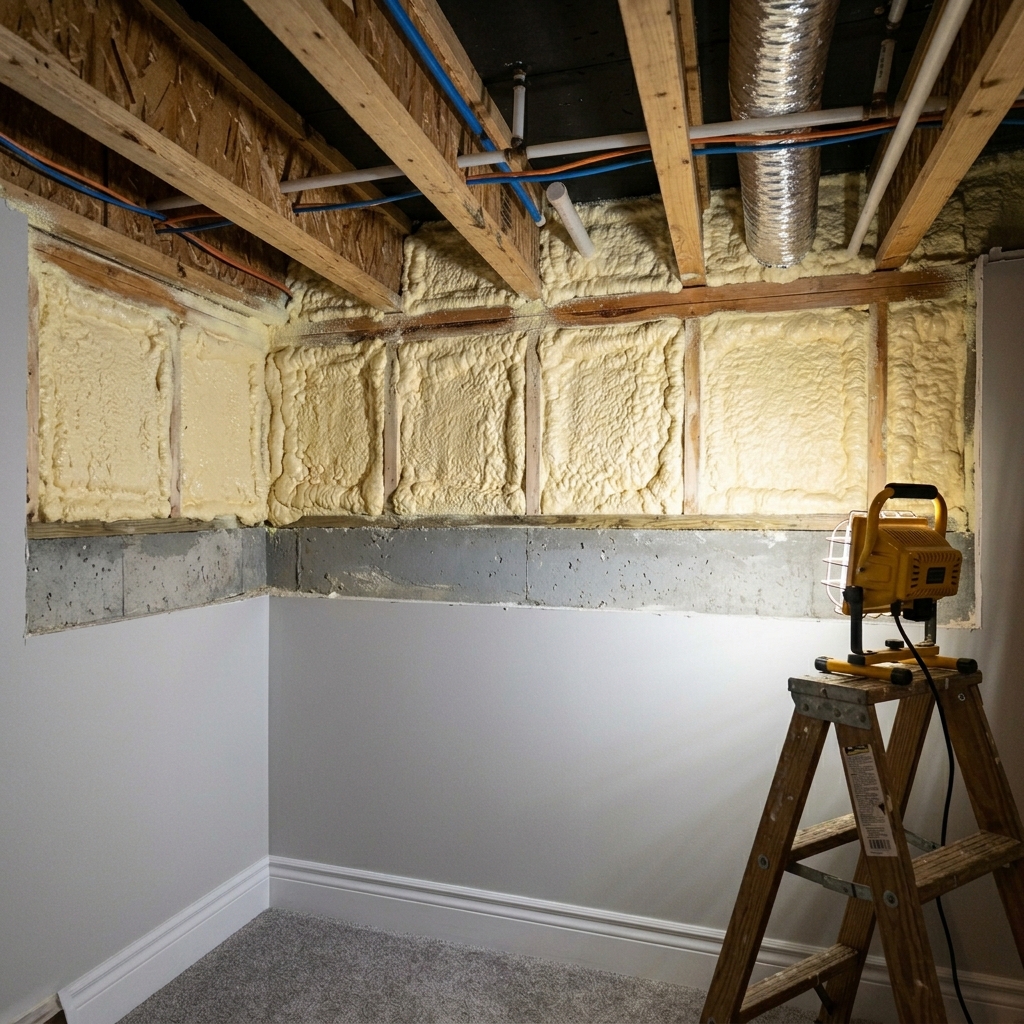
Closed-cell spray foam delivers R-6.5 per inch. Fiberglass batts deliver R-2.2–3.4 per inch — and that gap widens every winter in Toronto. If you’re comparing insulation options for your GTA home, the upfront cost difference (spray foam at $2.50–$5.00/sqft installed vs fiberglass at $0.65–$1.20/sqft) is only half the story. Factor in Toronto’s 60+ freeze-thaw cycles per season, basement humidity, ice-dam risk, and a 25-year fiberglass replacement cycle, and the math shifts decisively. This guide gives you every number you need — CAD pricing, R-value data, rebate offsets, and real project examples from Toronto, Mississauga, Vaughan, Markham, Brampton, Scarborough, North York, and Etobicoke — so you can make the right call for your home.
Spray Foam vs Fiberglass: Quick Comparison
The table below captures the key differences at a glance. We dig into each row in detail throughout this guide.
| Factor | Closed-Cell Spray Foam | Open-Cell Spray Foam | Fiberglass Batts | Blown-In Cellulose* |
|---|---|---|---|---|
| R-Value per Inch | R-6.5 | R-3.7 | R-2.2–3.4 | R-3.5–3.7 |
| Air Sealing | Complete (monolithic) | Complete (monolithic) | Poor (gaps at studs, plates) | Good (dense pack) |
| Moisture Resistance | Excellent (Class II vapour retarder) | Moderate (vapour-open) | Poor (absorbs water, loses R-value) | Moderate |
| Lifespan | 80–100 years | 80–100 years | 15–25 years | 20–30 years |
| Installed Cost (GTA, CAD/sqft) | $2.50–$5.00 | $1.50–$3.50 | $0.65–$1.20 | $0.90–$1.40 |
| OBC SB-12 Compliance (tight spaces) | Excellent | Good | Limited | Moderate |
| Ice Dam Prevention | Yes (eliminates attic heat loss) | Yes | No | Partial |
| DIY-Eligible | No (CUFCA-certified required) | No (CUFCA-certified required) | Yes (batts) | Partial |
*Cellulose included as reference point only. Spray Foam Kings installs spray foam exclusively.
R-Value Per Inch: Why Thermal Resistance Matters in Toronto’s Climate
R-value measures how effectively insulation resists heat flow. Higher is better — but the per-inch figure matters as much as the total, especially in tight spaces like rim joists, sloped cathedral ceilings, and narrow wall cavities common in Toronto’s older housing stock.
- Closed-cell spray foam: R-6.5/inch. Two inches of closed-cell in a rim joist cavity gives you R-13 — enough to meet Ontario Building Code SB-12 requirements in a fraction of the space fiberglass needs.
- Open-cell spray foam: R-3.7/inch. Four inches of open-cell in an attic rafter cavity delivers R-14.8 — competitive with much thicker fiberglass installations and with the added benefit of a complete air seal.
- Fiberglass batts: R-2.2–3.4/inch. A standard R-20 batt requires nearly 6 inches of cavity space. More critically, fiberglass R-value is a laboratory number measured at 24°C. In Toronto winters, real-world performance drops 30–50% due to moisture absorption and convective looping through the batt fibres.
The OBC SB-12 compliance implication is significant: a Scarborough basement rim joist with 2×6 framing gives you 5.5 inches of cavity. Fiberglass must fill every inch and still struggles to maintain R-value. Two inches of closed-cell spray foam achieves R-13 with room to spare — and it bonds directly to the framing, eliminating the air movement that accounts for up to 30% of heating losses in poorly sealed homes across North York, Etobicoke, and Brampton. For a direct look at how we approach attic spray foam R-value comparisons, the difference in depth requirements alone tells the story.
Cost Comparison: Initial Price vs Long-Term Savings
Installed Cost Table by Insulation Type (GTA, CAD)
| Insulation Type | Installed Cost (CAD/sqft) | Typical R-Value Achieved | Air Seal Included? |
|---|---|---|---|
| Closed-Cell Spray Foam | $2.50–$5.00 | R-13 to R-26+ | Yes |
| Open-Cell Spray Foam | $1.50–$3.50 | R-11 to R-20 | Yes |
| Fiberglass Batts (professional install) | $0.65–$1.20 | R-11 to R-22 | No |
Energy Savings Payback Analysis
Toronto households on natural gas spend an average of $2,400–$3,600/year on heating. Here’s how the two approaches compare over time:
| Metric | Spray Foam | Fiberglass Batts |
|---|---|---|
| Annual Heating Savings | $1,000–$1,800 (40–50% reduction) | $200–$400 (8–12% reduction) |
| Simple Payback Period | 7–10 years | 10–15 years (before first replacement) |
| 50-Year Cumulative Savings | $40,000–$80,000+ | $8,000–$18,000 (minus replacement costs) |
| Replacement Cycles (50 years) | 0 | 2–3 replacements |
The fiberglass payback window is deceptive: it resets with every replacement. A Vaughan homeowner who installs fiberglass today pays again around year 20, then again around year 40. Meanwhile, a Mississauga homeowner who invests in professional spray foam installation today is still running on the original installation at year 80. Use our live cost comparison calculator to run the numbers for your specific home size and energy use.
Real Toronto Project Examples
Numbers only mean something when they’re attached to real spaces. Here are three project scenarios representative of what we install across the GTA:
Scenario 1: 1,500 sqft Attic (Markham, 1980s Detached)
- Open-cell spray foam (4 inches, R-14.8): $3,750–$6,000 installed. Qualifies for HRS Attic rebate ($1,250) plus HER+ rebate stacking. Net cost after rebates: $2,500–$4,750.
- Closed-cell spray foam (3 inches, R-19.5): $6,750–$10,500 installed. Higher upfront, superior vapour control, ideal if converting to conditioned attic space. Net cost after rebates: $5,500–$9,250.
- Fiberglass batts (R-20, 6 inches): $2,250–$4,500 installed. No air seal, performance degrades within 5–8 years in humid attics. Replacement needed in 15–20 years: add another $2,000–$4,500.
Scenario 2: 1,200 sqft Basement (North York, 1960s Semi)
- Closed-cell spray foam (2 inches, R-13): $3,750–$7,200 installed. Acts as Class II vapour retarder — eliminates the chronic moisture that rots basement fiberglass within 3–5 years in Toronto’s below-grade environments. Recommended for all below-grade applications in North York, Scarborough, and Etobicoke. See our full guide to basement insulation moisture resistance.
- Fiberglass batts (R-14): $960–$1,800 installed. Absorbs basement humidity, loses R-value, and creates mould habitat within years. OBC SB-12 compliance often requires a separate poly vapour barrier — adding cost and complexity.
Scenario 3: Rim Joist Spray Foam (Etobicoke Bungalow, 80 linear feet)
- Closed-cell spray foam (2 inches, R-13): $800–$1,600. Eliminates the #1 source of air infiltration in Toronto bungalows — the perimeter gap between foundation wall and floor framing. Measurable cold-floor improvement the first winter.
- Fiberglass cut pieces: $200–$400. Commonly falls out over time, leaves gaps at corners, and provides zero air seal. Enbridge technicians typically flag this as “insufficient” during a HER+ audit.
Moisture Resistance & Air Sealing Performance
Fiberglass is a hygroscopic material — it absorbs airborne moisture. In Toronto’s basement environments and attics with bathroom exhaust penetrations, this translates to measurable R-value loss within the first heating season. Research from the National Research Council Canada documents moisture-laden fiberglass losing 30–50% of its rated R-value under conditions common in GTA homes.
Closed-cell spray foam is classified as a Class II vapour retarder under the Ontario Building Code. It doesn’t absorb water, doesn’t support mould growth, and maintains its thermal performance at temperatures down to −40°C. This is why we specify closed-cell exclusively for:
- All below-grade applications (basements, crawl spaces) in Toronto, Brampton, and Mississauga
- Rim joists across the GTA
- Cathedral ceilings and unvented roof assemblies
- Any assembly where a separate vapour barrier cannot be installed
Air sealing is the other major differentiator. Fiberglass allows air to move through it — batts laid between joists leave gaps at edges, electrical boxes, and plumbing penetrations. Natural Resources Canada attributes up to 30% of heating and cooling losses in Canadian homes to air infiltration through these gaps. Spray foam expands on contact to fill every crack, hole, and irregular cavity, creating a monolithic thermal envelope that fiberglass physically cannot replicate.
How Toronto’s Freeze-Thaw Cycle Affects Each Material
Toronto experiences 60+ freeze-thaw cycles per winter — temperatures that swing from −25°C overnight to +5°C by afternoon. This cycling is uniquely destructive to fiberglass insulation for two reasons:
- Moisture accumulation: Warm moist interior air migrates outward during cold snaps, condensing inside fiberglass batts as it hits the dew point. The batt becomes saturated, heavy, and thermally inert. When it thaws, it may partially dry — but repeated cycles cause permanent fibre matting and compression.
- Convective looping: The temperature differential across a fiberglass batt drives air circulation within the batt itself. This “thermal bypass” can reduce effective R-value by 20–40% beyond the moisture effect — a phenomenon that never occurs in spray foam’s closed-cell matrix.
Ice dams are a direct consequence of attic heat loss through inadequate insulation. When attic temperatures stay above 0°C due to heat escaping through fiberglass or gaps in the thermal envelope, snow melts at the roof surface, flows to the cold eave, and refreezes. Spray foam eliminates this heat pathway entirely by creating a continuous insulated and air-sealed boundary. We’ve remediated dozens of ice-dam-prone properties in Markham, Vaughan, and Scarborough by converting from fiberglass to spray foam — in most cases, the problem never returns. Local homeowners in Mississauga with freeze-thaw climate challenges see some of the biggest before/after performance differences after conversion.
Lifespan & Replacement Cost Analysis (80 Years vs 15–25 Years)
This is where the total-cost-of-ownership argument for spray foam becomes undeniable.
| Year | Spray Foam (Closed-Cell) | Fiberglass Batts |
|---|---|---|
| Year 0 | $6,750–$10,500 (attic, 1,500 sqft) | $2,250–$4,500 (attic, 1,500 sqft) |
| Year 1–10 | $0 maintenance; 40–50% heating savings | $0 maintenance; 8–12% heating savings |
| Year 15–20 | Still performing at original R-value | Replacement required: $2,500–$5,000 (+ disposal) |
| Year 35–40 | Still performing at original R-value | Second replacement: $3,000–$6,000 (inflation-adjusted) |
| Year 80 | Single lifetime investment, fully paid back by year 10 | 3–5 replacements; cumulative cost $9,000–$22,000+ |
CUFCA-certified closed-cell spray foam maintains structural integrity and thermal performance for 80–100 years when properly installed. Polyurethane foam does not settle, compress, or degrade under normal building conditions. Fiberglass, by contrast, is subject to gravity, moisture, and vibration — all of which cause gradual compression that reduces effective thickness and R-value over the product’s usable life.
Our SPFA-certified and CUFCA-credentialed installations across the GTA — from Thornhill homes to downtown Toronto row houses — carry a lifetime workmanship guarantee because the material itself is designed to outlast the building. That’s not something we can say about fiberglass.
Rebate Eligibility & Cost Offset (HER+, Canada Greener Homes)
The rebate landscape in Ontario significantly closes the upfront cost gap between spray foam and fiberglass. Here’s the current picture for GTA homeowners:
| Program | Max Available | Spray Foam Eligible? | Fiberglass Eligible? | Key Requirement |
|---|---|---|---|---|
| Enbridge HER+ (Home Efficiency Rebate Plus) | Up to $10,000 | Yes | Yes (if meets R thresholds) | Pre/post EnerGuide audit; Enbridge gas customer |
| HRS Attic (Home Reno Savings) | $1,250 | Yes (open-cell preferred) | Yes | Minimum R-11 upgrade in attic |
| Canada Greener Homes Grant | Up to $10,600 | Yes | Yes | EnerGuide audit; specific R-value thresholds by zone |
Rebate offset calculation — 1,500 sqft attic, open-cell spray foam:
- Installed cost before rebates: $3,750–$6,000
- HER+ rebate (attic insulation tier): up to $2,500
- HRS Attic rebate: $1,250
- Canada Greener Homes (if applicable): up to $3,500 for attic
- Net cost after rebates: as low as $0–$2,750 — making open-cell spray foam cost-comparable to fiberglass on a net basis in many GTA projects
One important distinction: fiberglass batts often fail to meet the minimum R-value thresholds required for higher-tier HER+ rebate amounts. A poorly installed fiberglass job achieving R-12 in a rim joist may qualify for a modest rebate, while a closed-cell spray foam installation hitting R-20+ qualifies for a significantly larger one. We’ve seen Mississauga homeowners receive $4,000–$6,000 in combined rebates on spray foam projects — effectively reducing their net cost below what they would have paid for fiberglass with no rebates at all. Offset spray foam cost with HER+ and HRS Attic rebates — visit our rebates page for full program details and eligibility criteria.
Why Choose Spray Foam Kings
We are a spray-foam-only contractor. That’s not a limitation — it’s a commitment to doing one thing at a professional level rather than five things at a mediocre one.
- CUFCA Certified & SPFA Member: Industry credentials that matter to your building inspector and your insurer.
- $5M Liability + WSIB: Full coverage on every job, every day — in Toronto, Scarborough, North York, Etobicoke, Vaughan, Mississauga, Markham, and Brampton.
- 15+ Years GTA Experience: We’ve insulated 1920s rubble-stone foundations, new-build Vaughan subdivisions, Etobicoke flat roofs, and everything in between.
- OBC SB-12 Compliant: Every installation is designed to meet or exceed Ontario Building Code requirements. We provide documentation for permit packages.
- HFO Blowing Agent: We use next-generation low-GWP blowing agents in our closed-cell formulations — lower environmental impact, same R-6.5 performance, same Health Canada off-gassing clearance standards.
- Rebate Navigation: We’ve processed hundreds of HER+ and Canada Greener Homes applications. We know which projects qualify, which don’t, and how to maximize your return.
“We had fiberglass in our North York attic for 22 years — it was sagging, damp, and doing nothing. SFK came in, removed the old material, and sprayed open-cell foam in one day. First winter, our heating bill dropped by $180/month. I wish we’d done it a decade sooner.”
— D. Patel, North York homeowner
We’ve seen the same story across the GTA: homeowners who chose fiberglass for the lower upfront cost, then called us 10–15 years later to fix the moisture damage, settle the sagging batts, and finally get an air seal that actually works. The comparison isn’t just R-value — it’s the difference between insulation that performs for a lifetime and insulation that needs attention every decade. For a free insulation consultation, call us or fill out the form and we’ll get back to you within one business day.
Frequently Asked Questions — Spray Foam vs Fiberglass Insulation
Is spray foam worth the extra cost over fiberglass in Toronto?
Yes — for most GTA homeowners. The upfront premium (spray foam at $1.50–$5.00/sqft vs fiberglass at $0.65–$1.20/sqft) is recovered through energy savings within 7–10 years, and the material never needs replacement. Factoring in 2–3 fiberglass replacement cycles over 50 years, spray foam’s total cost of ownership is typically $15,000–$40,000 lower on an average GTA home. After available rebates (HER+ up to $10,000, HRS Attic $1,250), the net gap narrows to near zero on many projects.
How much does spray foam cost vs fiberglass for a 1,500 sqft attic in Toronto?
Open-cell spray foam runs $3,750–$6,000 installed. Closed-cell runs $6,750–$10,500. Fiberglass batts (professional install) run $2,250–$4,500. After Enbridge HER+ and HRS Attic rebates, open-cell spray foam net cost can fall to $2,500–$4,750 — comparable to fiberglass upfront, with dramatically better lifetime performance.
What R-value does spray foam achieve vs fiberglass per inch?
Closed-cell spray foam achieves R-6.5 per inch — roughly 2× to 3× the per-inch performance of fiberglass batts (R-2.2–3.4/inch). Open-cell spray foam delivers R-3.7 per inch. Spray foam maintains its rated value across all temperatures and moisture conditions. Fiberglass loses 30–50% of its rated R-value when wet — a common occurrence in Toronto’s freeze-thaw climate.
Why does fiberglass fail in Toronto basements?
Toronto basements are permanently humid below-grade environments. Fiberglass absorbs moisture from the air and through concrete walls, losing R-value, supporting mould, and deteriorating over time. Closed-cell spray foam is a Class II vapour retarder — it does not absorb water, bonds directly to concrete or block, and prevents the moisture migration that causes fiberglass to fail in below-grade applications in Scarborough, North York, Etobicoke, and Brampton.
Can I mix spray foam and fiberglass in the same home?
Yes. A practical configuration: closed-cell spray foam on rim joists, basement walls, and cathedral ceilings (moisture-critical zones), with open-cell spray foam in the main attic flat for cost efficiency. Fiberglass can be used for interior partition wall sound damping in non-critical locations. Avoid fiberglass anywhere moisture, air infiltration, or tight R-value-per-inch requirements are factors — which rules out most primary thermal envelope applications in GTA homes.
How long does spray foam last compared to fiberglass?
CUFCA-certified closed-cell spray foam is rated for 80–100 years of service life with no degradation under normal building conditions. Fiberglass batts have a rated service life of 15–25 years before settling, moisture damage, or compression necessitates replacement. Over a 50-year homeownership period, fiberglass requires 2–3 installations; spray foam requires one.
Can I get rebates for spray foam to offset the higher upfront cost?
Yes. Ontario homeowners have access to three stackable programs: Enbridge HER+ (up to $10,000), HRS Attic ($1,250), and the Canada Greener Homes Grant (up to $10,600). Combined, these can offset 25–40% of spray foam installation cost — and in some cases bring the net cost below what you’d pay for fiberglass without rebates. Spray Foam Kings is Enbridge-registered and guides every client through the stacking process.
Which insulation is better for Toronto’s freeze-thaw climate — spray foam or fiberglass?
Spray foam, decisively. Toronto’s 60+ annual freeze-thaw cycles create ideal conditions for fiberglass failure: moisture infiltration during cold snaps, convective looping within the batt, and compression from repeated thermal cycling of the framing. Closed-cell spray foam is inert to moisture, dimensionally stable from −40°C to +80°C, and creates a monolithic air seal that eliminates the convective bypass responsible for much of fiberglass’s real-world underperformance in GTA climates.
Does spray foam improve home resale value compared to fiberglass?
Yes. A home with documented spray foam installation and verified energy savings commands a premium in the GTA market. Buyers increasingly request EnerGuide ratings and utility bill histories. Spray foam’s measurable air-sealing performance, verifiable R-value, and 80-year longevity are more persuasive to buyers than an aging fiberglass installation. Rim joist and attic spray foam are among the highest-ROI pre-sale renovations for Toronto, Vaughan, and Markham detached homes.
How long does spray foam installation take vs fiberglass?
A typical 1,500 sqft attic spray foam installation takes 1–2 days including setup, spray, and cure. Occupants vacate for 24 hours. Fiberglass batt installation takes 4–8 hours but provides no air seal and may require a separate poly vapour barrier for code compliance. Rim joist spray foam (80–120 linear feet in a GTA bungalow) typically takes 2–4 hours — often completed the same day as an attic job.
Should I consider fiberglass if spray foam is too expensive?
Consider open-cell spray foam first. At $1.50–$3.50/sqft with a full air seal included, it’s only modestly more expensive than professional fiberglass installation — and the air seal alone recovers the difference in energy savings within 2–3 years. If your project qualifies for HER+ rebates, open-cell spray foam often comes in cheaper than fiberglass net. For budget-constrained projects, we identify the highest-impact zones (rim joist + attic perimeter) to address first with spray foam.
What if I already have fiberglass — should I replace it with spray foam?
Assess condition first. If your existing fiberglass is under 10 years old, dry, and properly installed with a poly vapour barrier, it may be serviceable. If it’s compressed, wet, mouldy, or over 15 years old — or if you’re experiencing cold floors, ice dams, or high heating bills — spray foam conversion delivers immediate and compounding returns. We commonly remove and dispose of old fiberglass as part of a conversion project across Etobicoke, Markham, and Mississauga.
Is spray foam safe to install in a home with occupants?
Professional two-component polyurethane spray foam requires occupant evacuation during installation and a 24-hour cure period before re-entry. We use HFO-blown low-GWP formulations and follow full Health Canada off-gassing protocols. Our installers wear full PPE and ensure proper ventilation throughout. Isocyanates — the reactive component — are handled safely by CUFCA-certified professionals. Do not attempt DIY spray foam application.
Can spray foam help prevent ice dams on Toronto roofs?
Yes — and it is one of the most effective solutions available. Ice dams form when attic heat escapes through inadequate insulation, melts roof snow, and the meltwater refreezes at the cold eave. Spray foam eliminates the attic heat-loss pathway entirely by creating a continuous insulated and air-sealed boundary. Homes in Markham, Vaughan, and Scarborough where we’ve converted fiberglass attic insulation to spray foam consistently see ice dams eliminated in the first post-installation winter.
Does Spray Foam Kings serve my area of the GTA?
Yes. We serve Toronto, Scarborough, North York, Etobicoke, Vaughan, Mississauga, Markham, Brampton, Oakville, and Hamilton. Call 647-641-6881 for a free quote or to schedule an on-site assessment. No pressure, no obligation.
Get Your Free Quote Today
Call: 647-641-6881
Spray Foam Kings serves Toronto, Scarborough, North York, Etobicoke, Vaughan, Mississauga, Markham, and Brampton. CUFCA Certified · $5M Liability · WSIB · 15+ Years GTA Experience · Enbridge HER+ Registered. Every quote is free, every estimate is itemized, and every installation is backed by a lifetime workmanship guarantee.