
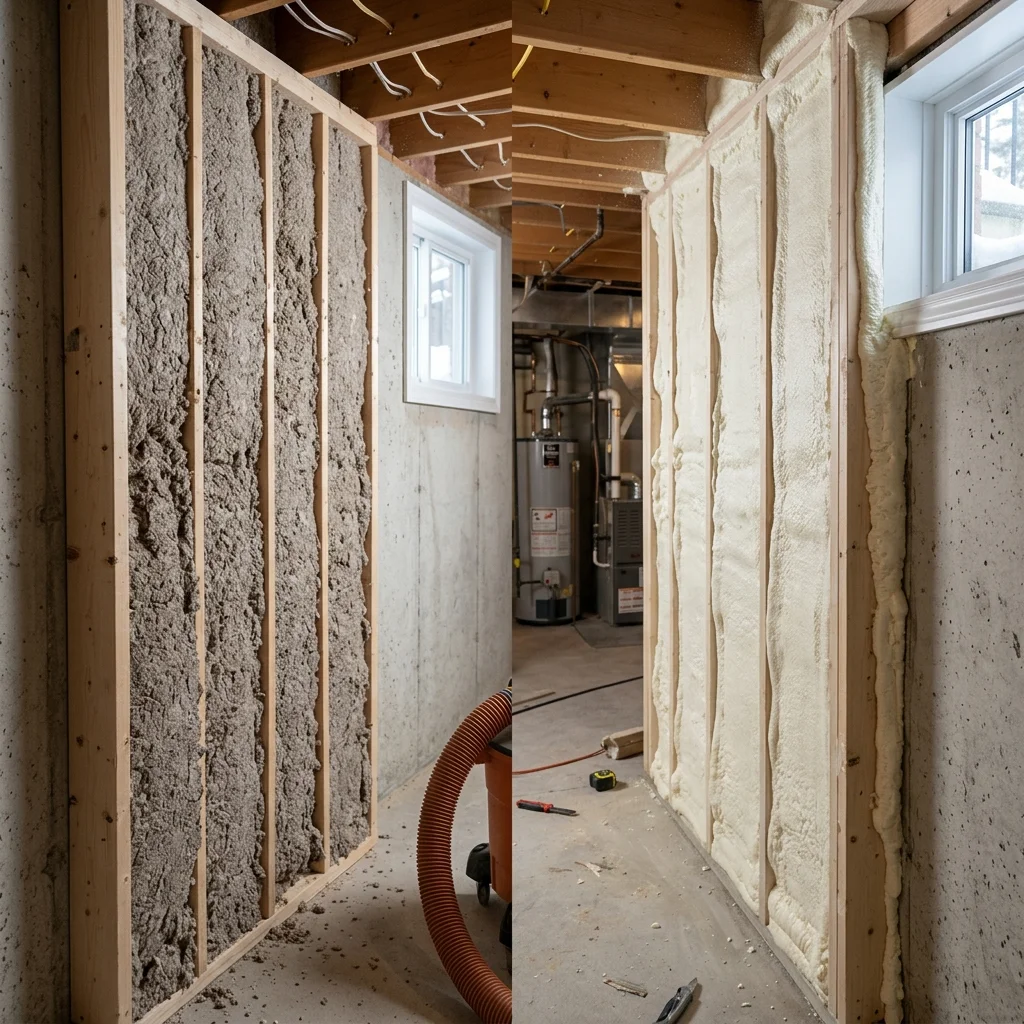
What’s the difference?
Toronto homeowners in 2026 are navigating rising energy costs, tighter building codes under the Ontario Building Code’s updated thermal performance requirements, and aging housing stock that spans Victorian semis in Leslieville to post-war bungalows in Scarborough. Choosing between spray foam insulation and cellulose insulation is rarely a simple comparison — it depends on your home’s age, air leakage profile, moisture history, budget, and whether you’re doing a targeted retrofit or a full gut renovation. Both materials can meet or exceed code minimums, but they behave differently, cost differently, and suit different scenarios. Spray foam creates an air barrier and insulation layer in one application, making it particularly effective in Toronto’s cold-humid winters where air sealing is as important as R-value. Cellulose, made from recycled paper fibre treated with borate, excels at dense-pack retrofits in finished walls and attics where disruption must stay minimal. Neither product is universally superior. The right answer depends on what your house is actually asking for — and getting that wrong means paying for a second fix within a few years. This guide breaks down both options honestly, with current CAD pricing, Toronto-specific bylaw notes, and a clear decision framework so you can walk into any contractor conversation with confidence.
Side-by-side comparison
| Scenario | Estimated Cost (CAD) | Typical Timeline | Permit Usually Required? | When to Choose This | Risk If Wrong Choice |
|---|---|---|---|---|---|
| Attic air-sealing + insulation (spray foam) | $3,500 – $7,000 | 1 day | No (retrofit, no structural change) | Older home with high air leakage, ice damming history | Over-engineering a simple job; higher upfront cost than needed |
| Attic top-up (blown cellulose) | $1,200 – $3,000 | Half day | No | Attic already air-sealed, just needs more R-value | Cellulose settles; if air sealing is poor, moisture risk rises |
| Basement rim joists (spray foam) | $800 – $2,500 | 2–4 hours | No | Cold floors, high heating bills, accessible rim area | Skipping this = continued 15–20% heat loss through rim joists |
| Dense-pack cellulose in existing walls | $4,000 – $9,000 (whole house) | 1–2 days | No (drill-and-fill, no demo) | Finished walls, heritage home, minimal disruption needed | Wrong density = settling gaps within 5 years, voiding benefit |
| New construction open-wall spray foam | $8,000 – $18,000 | 1–2 days | Yes (new build permit) | Custom build or full gut reno needing combined air + thermal barrier | Closed-cell traps moisture if vapour control layer is missed |
| Crawlspace encapsulation (spray foam) | $2,500 – $6,000 | 1 day | Rarely | Unvented crawlspace, mould history, cold floors above | Cellulose in a crawlspace absorbs moisture — wrong product entirely |
| Cathedral ceiling / roof deck (closed-cell spray foam) | $5,000 – $12,000 | 1–2 days | Yes if changing roof assembly | Vaulted ceiling with no attic space; ice dam prevention | Cellulose here requires full venting design — impractical retrofit |
Spray foam insulation — when it’s the right call
Spray foam insulation earns its higher price tag in specific, well-defined situations. The first is any location where air sealing and insulation must happen simultaneously. Toronto homes built before 1980 typically lack continuous air barriers, and blown-in products like cellulose do not stop air movement — they only slow heat transfer. If you’re seeing frost in your attic hatch, ice dams at the eaves, or a basement that feels damp regardless of a dehumidifier, the core problem is air leakage, not R-value deficit. Spray foam solves both in a single pass.
Closed-cell spray foam, applied at 2 inches or more, also acts as a vapour retarder — critical in Toronto’s climate zone 6 where interior moisture drive in winter is significant. Closed-cell applications on basement walls and crawlspace floors outperform every alternative in durability and moisture resistance. Open-cell foam works well on interior attic decks and interior wall cavities in conditioned spaces where vapour drive is managed at the wall assembly level.
Spray foam also makes sense in geometrically complex areas: rim joists, knee walls, dormer cheeks, and mechanical chases where blown products can’t achieve consistent coverage. Rim joist spray foam is one of the highest-ROI single retrofits available to Toronto homeowners — a modest investment with measurable heating bill impact in the first winter. If your renovation involves exposed framing for any reason, adding spray foam before drywall is far cheaper than revisiting later.
Cellulose insulation — when it’s the right call
Cellulose insulation is the pragmatic choice when your primary need is adding R-value to a space that is already reasonably air-sealed, and where budget or disruption constraints are real. Blown cellulose in an attic — installed over existing insulation — is one of the fastest payback retrofits available. At $1,200 to $3,000 for a typical Toronto semi, you can take an attic from R-20 to R-60 in half a day with no structural work and no permits.
Dense-pack cellulose is the go-to for retrofitting finished walls without opening them up. Installers drill small holes between studs, inject the material at high density (typically 3.5 lb/ft³ or higher), and patch. This is particularly relevant in Toronto’s older neighbourhoods — Roncesvalles, the Annex, East York — where 2×4 framed walls have no insulation at all. Homeowners in heritage-designated properties often cannot alter exterior cladding, making interior drill-and-fill the only practical upgrade path.
Cellulose also carries strong environmental credentials: it’s 85% recycled content, sequesters carbon in the material, and has a very low embodied energy compared to foam. For homeowners pursuing green insulation solutions or applying for Canada Greener Homes grants, cellulose projects qualify and can be paired with a pre- and post-retrofit EnerGuide audit. The borate fire and pest retardant treatment is non-toxic and does not off-gas, making it suitable for homes with occupants sensitive to chemical exposure. Where moisture is not the issue, cellulose often delivers equivalent thermal performance at a meaningfully lower cost.
Edge cases and Toronto-specific factors
Toronto’s regulatory and insurance environment creates a few edge cases worth knowing before you book a contractor. First, permits: the City of Toronto generally does not require a permit for insulation retrofits that don’t alter the building’s structure or fire separation. However, if spray foam is applied to the underside of roof sheathing — converting a vented attic to an unvented assembly — some inspectors classify this as a change in building assembly requiring a building permit. Clarify with your contractor and, if needed, a quick call to Toronto Building (311) before work starts.
Second, insurance: some Toronto home insurers have flagged properties with spray foam on roof decks as requiring additional underwriting review, particularly for older homes. This is not universal, but it’s worth disclosing proactively to your broker before installation rather than discovering a coverage gap at claim time.
Third, heritage properties: Toronto and East York Community Council areas include thousands of heritage-designated or adjacent properties. Dense-pack cellulose through drill-and-fill from the interior does not affect heritage attributes and avoids any Heritage Preservation Services review. Exterior spray foam applications, while rare residentially, could trigger review if they alter cladding profiles.
Fourth, the Canada Greener Homes Grant (and its successor programs in 2026) typically require an EnerGuide audit before and after work. Both spray foam and cellulose projects can qualify, but the audit adds $600–$800 CAD to your project cost — often offset by grant amounts. Ask your insulation contractor if they work with registered energy advisors. Audit-aligned insulation services can streamline this process significantly.
Frequently asked questions
Is spray foam worth the extra cost compared to cellulose in a Toronto home?
It depends on your specific air leakage problem. In homes with significant leakage — common in pre-1980 Toronto housing stock — spray foam’s dual function as air barrier and insulation delivers returns that cellulose alone cannot match. For a well-sealed attic that simply needs more R-value, cellulose is the cost-effective answer at roughly one-third to one-half the price per square foot.
What does spray foam insulation cost in Toronto in 2026?
Typical residential projects range from $800 CAD for a targeted rim joist job to $18,000 or more for a full open-wall new construction application. Mid-range whole-home retrofit projects — basement walls, attic hatch, rim joists — generally land between $4,000 and $9,000 CAD. Closed-cell foam costs more per board foot than open-cell due to material density and chemical cost.
Will cellulose insulation settle over time and lose R-value?
Properly installed dense-pack cellulose (at 3.5 lb/ft³ or higher) has minimal settling — industry data suggests less than 5% over the product’s lifetime when installed correctly. Loosely blown attic cellulose does settle somewhat, which is why installers target a higher initial depth to account for it. Hiring a contractor who installs to density spec, not just depth, is the key quality factor.
Can I use cellulose in my basement or crawlspace?
Cellulose is not recommended in below-grade applications or crawlspaces with any history of moisture intrusion. The material absorbs water readily, and saturated cellulose can promote mould growth and lose most of its thermal value. For basements and crawlspaces in Toronto’s frost-heave and groundwater environment, closed-cell spray foam is the appropriate product.
Do I need a permit to insulate my attic in Toronto?
For standard attic insulation top-ups — blown cellulose or open-cell spray foam on the attic floor — no permit is required in most Toronto cases. Converting to an unvented roof assembly using closed-cell foam on the underside of sheathing may require a building permit; confirm with Toronto Building before proceeding. Your contractor should be able to advise based on your specific assembly.
Can spray foam or cellulose help me qualify for the Canada Greener Homes rebate?
Both materials qualify for federal home energy retrofit grant programs, provided the work is recommended in a pre-retrofit EnerGuide audit and verified in a post-retrofit audit. In 2026, available rebate amounts vary by measure and home type — budget approximately $600–$800 CAD for the two audits, and confirm current rebate tiers with a registered energy advisor before committing to a scope of work.
Bottom line
Choose spray foam if: your home has confirmed air leakage issues (blower door test or visible signs like frost, ice dams, drafts); you’re insulating a basement, crawlspace, rim joist, or cathedral ceiling; you’re doing an open-wall renovation and want a combined air-and-thermal barrier; or the geometry of the space (knee walls, dormers, mechanical chases) makes consistent blown-in coverage impractical.
Choose cellulose if: your attic is reasonably air-sealed and just needs more R-value; you have finished walls with no insulation and want a drill-and-fill retrofit with minimal disruption; you’re in a heritage property with cladding restrictions; or budget is the primary constraint and moisture is not a factor in the target area.
When you’re unsure: a professional assessment almost always pays for itself. Get a contractor who will do a walkthrough and give you a straight answer about air leakage before recommending a product. For Toronto homeowners ready to get a no-obligation assessment and quote, visit sprayfoamkings.ca to book a free on-site evaluation and get accurate CAD pricing for your specific home.