
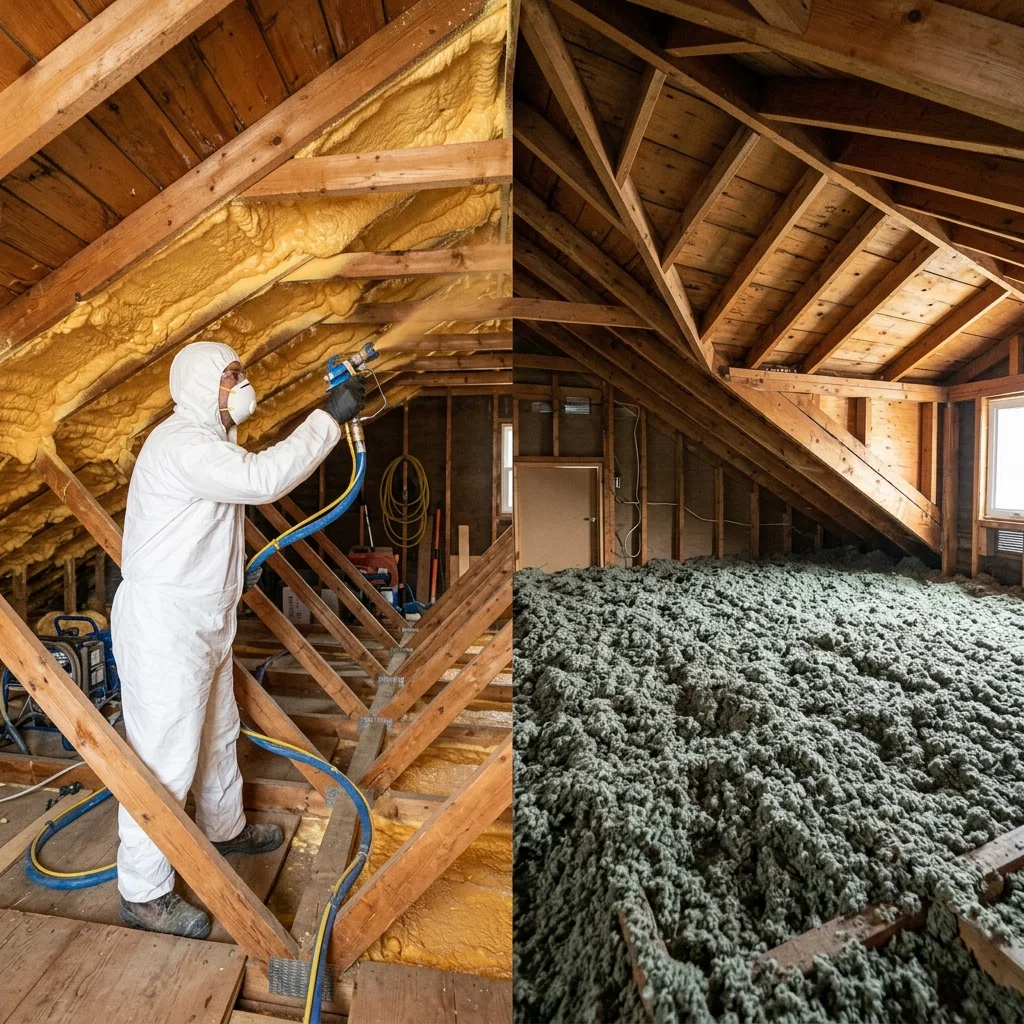
Spray foam insulation costs $1.50–$5.00/sqft in the GTA; cellulose costs $0.75–$1.50/sqft. That gap looks dramatic on an estimate — until you factor in cellulose’s 20% R-value settling, moisture vulnerability, and 20–30 year replacement cycle. For most Toronto-area homes in 2026, the real question isn’t “which is cheaper today?” but “which costs less over the next 25 years?” This guide answers that question with concrete GTA pricing, Ontario Building Code requirements, Enbridge rebate scenarios, and a hybrid strategy that gets you the best of both worlds.
Quick Comparison: Spray Foam vs Cellulose vs Fiberglass
Before diving into the details, here’s the side-by-side view Ontario homeowners are asking for:
| Feature | Open-Cell Spray Foam | Closed-Cell Spray Foam | Blown-In Cellulose | Fiberglass Batts |
|---|---|---|---|---|
| R-Value per inch | R-3.6–3.8 | R-6.0–6.5 | R-3.2–3.8 | R-2.9–3.8 |
| Air Sealing | Excellent (expands to fill gaps) | Excellent (rigid seal) | Poor–Fair (settles, gaps form) | Poor (not an air barrier) |
| Moisture Resistance | Moderate (open-cell absorbs some) | Excellent (Class II vapour barrier) | Poor (absorbs & holds water) | Poor (absorbs moisture, compresses) |
| GTA Installed Cost (per sqft) | $1.50–$3.50 | $2.50–$5.00 | $0.75–$1.50 | $0.50–$1.20 |
| Expected Lifespan | 80+ years | 80+ years | 20–30 years (if stays dry) | 15–25 years |
| R-Value Retention | Stable — no settling | Stable — no settling | Loses ~20% over 10 years | Loses ~15% when compressed/wet |
| Vapour Barrier | No (separate barrier needed) | Yes (≥2″ closed-cell) | No | No |
| Enbridge HER+ Eligible | Yes (if meets R thresholds) | Yes (if meets R thresholds) | Yes (if meets R thresholds) | Yes (if meets R thresholds) |
| OBC SB-12 Compliant | Yes | Yes (best performer) | Yes (with sufficient depth) | Yes (with sufficient depth) |
| Installed by SFK | ✅ Yes | ✅ Yes | ❌ No | ❌ No |
What Is Cellulose Insulation — And Why Homeowners Choose It
Cellulose is made from recycled newspaper and cardboard treated with borate for fire and pest resistance. It’s blown in loose-fill form into attic floors, enclosed wall cavities, and some crawl spaces. At $0.75–$1.50/sqft installed, it’s the most affordable option on an upfront basis — a 1,000 sqft Toronto attic floor costs roughly $750–$1,500 CAD for cellulose versus $3,000–$5,000 for closed-cell spray foam.
For budget-conscious homeowners doing a quick attic top-up in Brampton or Scarborough, cellulose makes sense — provided the attic is bone-dry and stays that way. Ontario’s climate doesn’t always cooperate.
The settling problem: Cellulose compresses by approximately 20% within the first 10 years. A freshly-installed 12-inch depth (R-45) becomes roughly 9.6 inches (R-36) by year 10, even without any moisture. That puts it below the OBC SB-12 Zone 6 target of R-49–60 for GTA retrofits. Installers sometimes over-fill to compensate, but this adds cost and doesn’t eliminate the long-term drift.
The moisture problem: Cellulose absorbs and holds water. In Toronto’s humid summers and freeze-thaw winters, a single roof leak, ice dam, or condensation event can saturate cellulose insulation, creating conditions for mold growth in 24–48 hours. Once wet, cellulose must be fully removed and replaced — typically costing $2,000–$5,000 for an average attic, plus any mold remediation.
What Is Spray Foam Insulation — And Why It Costs More
Spray polyurethane foam (SPF) is a two-component chemical system (polyol resin + isocyanate) that expands on contact to fill every gap, crack, and penetration. There are two types with very different performance profiles:
Open-cell spray foam expands to roughly 100× its liquid volume, producing a soft, spongy foam. At R-3.6–3.8 per inch, it rivals cellulose on R-value per inch, but with one critical difference: it air-seals completely as it expands. A 3.5-inch application (R-13) in wall cavities eliminates the air infiltration that accounts for 30–40% of heat loss in older GTA homes. Open-cell costs $1.50–$3.50/sqft installed in Toronto and surrounding areas in 2026.
Closed-cell spray foam expands to about 30× its volume and cures into a rigid, dense foam. At R-6.0–6.5 per inch, it delivers roughly twice the R-value per inch of cellulose. At just 2 inches (R-12), it qualifies as a Class II vapour barrier under Ontario Building Code — eliminating the need for separate poly sheeting in basement walls and rim joists. Installed cost runs $2.50–$5.00/sqft across GTA applications in 2026.
Neither product settles, compresses, or loses R-value over time. A properly installed spray foam job from 2026 should perform identically in 2086.
Cost Breakdown: Spray Foam vs Cellulose Across the GTA
Prices vary by neighbourhood based on travel time, parking, project complexity, and local demand. Here are 2026 benchmarks for a standard 1,000 sqft attic and a 600 sqft basement wall application:
| GTA Area | Cellulose Attic (1,000 sqft) | Open-Cell Foam Attic (1,000 sqft) | Closed-Cell Foam Attic (1,000 sqft) | Closed-Cell Basement Walls (600 sqft) |
|---|---|---|---|---|
| Toronto (core) | $950–$1,500 | $1,800–$2,800 | $3,200–$5,000 | $2,100–$3,200 |
| North York | $850–$1,400 | $1,600–$2,600 | $3,000–$4,800 | $1,900–$3,000 |
| Scarborough | $800–$1,350 | $1,550–$2,500 | $2,900–$4,600 | $1,850–$2,900 |
| Etobicoke | $850–$1,400 | $1,600–$2,600 | $3,000–$4,800 | $1,900–$3,000 |
| Mississauga | $800–$1,300 | $1,500–$2,450 | $2,850–$4,600 | $1,800–$2,850 |
| Brampton | $780–$1,280 | $1,480–$2,400 | $2,800–$4,500 | $1,750–$2,800 |
| Vaughan | $820–$1,350 | $1,550–$2,500 | $2,900–$4,700 | $1,850–$2,900 |
| Markham | $820–$1,350 | $1,550–$2,500 | $2,900–$4,700 | $1,850–$2,900 |
| Oakville | $850–$1,400 | $1,600–$2,600 | $3,000–$4,900 | $1,900–$3,000 |
| Hamilton | $750–$1,250 | $1,450–$2,350 | $2,750–$4,400 | $1,700–$2,750 |
All prices in CAD, including labour and materials. Prices for attic applications assume accessible hatch entry; complex cathedral or low-slope roofs add 15–25%.
Performance: R-Value, Air Sealing, and Moisture Resistance
R-Value: Which Insulation Hits OBC SB-12 Targets?
Ontario Building Code SB-12 Zone 6 (the entire GTA) requires a minimum effective R-31 for attic retrofits, with R-49–60 strongly recommended for new builds and deep retrofits. Here’s what each material needs in thickness to hit those targets:
- Cellulose (R-3.5/inch): 8.9 inches for R-31; 14 inches for R-49. Needs 16–17 inches to hit R-49 after accounting for 20% settling.
- Open-cell spray foam (R-3.7/inch): 8.4 inches for R-31; 13.2 inches for R-49. No settling — you install exactly what you need.
- Closed-cell spray foam (R-6.5/inch): 4.8 inches for R-31; 7.5 inches for R-49. Highest R-value per inch on the market, especially useful where space is limited.
Air Sealing: The Factor Cellulose Can’t Address
In a 1960s–1990s Toronto bungalow or semi-detached, air leakage through the attic floor — around pot lights, plumbing penetrations, and partition walls — accounts for 30–40% of total heat loss. Cellulose does not air-seal. Open-cell and closed-cell spray foam both seal as they expand, addressing air infiltration and conductive heat loss in a single step. This is why spray foam homes consistently score 30–50% better on blower-door tests compared to homes with blown-in insulation.
Moisture: The GTA’s Biggest Risk Factor
Toronto averages 831 mm of precipitation per year, and its freeze-thaw cycle (averaging 55+ freeze-thaw events annually) is hard on building envelopes. Cellulose’s borate fire-retardant treatment does not prevent moisture absorption — it prevents the paper fibres from burning. A wet cellulose attic creates conditions for Aspergillus and Penicillium mold within days. Closed-cell spray foam at ≥2 inches provides a Class II vapour barrier (≤1.0 perm) per OBC 9.25.5.1, eliminating vapour drive from below. Open-cell foam requires a separate vapour barrier on the warm-in-winter side.
Longevity and ROI: The Real Numbers for GTA Homeowners
Let’s run the numbers on a typical 1,000 sqft North York attic:
| Scenario | Install Cost (CAD) | Annual Heating Savings | Replacement Cost (Year 25) | Total 25-Year Cost | Payback Period |
|---|---|---|---|---|---|
| Cellulose (top-up at Year 15) | $1,200 | $280–$380/yr | $800 top-up + potential mold risk | $2,000–$3,500 + risk | 3–5 years (initial) |
| Open-Cell Spray Foam | $2,200 | $380–$520/yr | $0 | $2,200 | 5–7 years |
| Closed-Cell Spray Foam | $3,800 | $480–$650/yr | $0 | $3,800 | 7–10 years |
By year 10, spray foam’s cumulative energy savings typically close the upfront price gap with cellulose. By year 15–20, spray foam homeowners are ahead. The closed-cell foam installed today carries a functional lifespan of 80+ years — meaning it could outlive the mortgage, the homeowner, and one renovation cycle.
Open-Cell vs Closed-Cell Foam vs Cellulose: Where Each Wins
There is no universal answer — the right choice depends on application, budget, and building conditions:
Attic floor (accessible, dry): Open-cell spray foam is the best all-around choice for most GTA attics. It air-seals all penetrations, delivers R-3.7/inch, and costs $1,500–$2,500 for a 1,000 sqft attic. Our attic spray foam insulation service covers every GTA neighbourhood with same-week scheduling.
Attic rafter bays (conditioned attic / cathedral ceiling): Closed-cell is preferred here — its structural rigidity adds uplift resistance and its high R-per-inch hits R-31 in a shallow rafter bay. See our closed-cell spray foam service for details.
Basement walls (below grade): Closed-cell only. Below-grade concrete and block walls face constant moisture vapour pressure from the soil. Closed-cell’s vapour barrier capability at 2 inches eliminates condensation on the cold wall surface. Our basement spray foam insulation team handles full perimeter and partial applications.
Rim joists: Closed-cell at 2–3 inches. Rim joists are among the most air-leaky components in any GTA home and are exposed to outdoor temperatures. A 2-inch closed-cell application (R-12–13) in rim joists delivers the highest dollar-per-dollar energy savings of any insulation upgrade. Our open-cell spray foam service includes rim-joist scoping during every site assessment.
Cellulose: Best suited for large, dry attic floors where budget is constrained and the roof and eaves are in perfect condition. We do not install cellulose — but we frequently assess homes where existing cellulose has failed and needs to be replaced with spray foam.
The Hybrid Approach: Maximum Performance, Managed Cost
The most cost-effective strategy for many Toronto homeowners in 2026 isn’t an either/or choice — it’s a hybrid system:
- Closed-cell spray foam on rim joists (2 inches, R-12): Eliminates the #1 air and moisture leak point. Cost: $400–$700 for a typical semi-detached.
- Closed-cell flash coat on attic perimeter and penetrations (1.5–2 inches): Seals every gap around pot lights, plumbing stacks, and partition walls before any fill material goes in.
- Open-cell spray foam as the main attic fill: Cheaper than closed-cell per sqft, still air-seals, and hits R-49+ at 13 inches.
This hybrid approach costs roughly $2,800–$4,200 for a 1,000 sqft attic in the GTA — compared to $3,200–$5,000 for full closed-cell — while delivering performance that cellulose alone cannot match. Call 647-641-6881 to discuss whether a hybrid scope makes sense for your home.
Ontario Rebates: Enbridge HER+, Greener Homes Grant, and IESO in 2026
Both spray foam and cellulose can qualify for Ontario’s main residential energy-efficiency programs in 2026, but the thresholds reward higher-performance installations:
Enbridge Home Efficiency Rebate Plus (HER+): Up to $10,600 in combined rebates. For attic insulation upgrades to R-60, the rebate is $750 CAD. For comprehensive air-sealing (blower-door verified), rebates can stack with attic, basement, and wall upgrades. Eligibility requires a pre-retrofit EnerGuide assessment, installation by an Enbridge-registered contractor, and a post-retrofit assessment. Spray foam almost always delivers the verified air-leakage reduction that cellulose cannot, making it easier to unlock the full rebate stack.
Canada Greener Homes Grant: Up to $5,600 for eligible retrofits, with matching loan access up to $40,000 at 0% interest for deeper retrofits. An attic spray foam upgrade meeting R-60 qualifies; the grant process requires EnerGuide pre/post assessments through a registered energy advisor.
IESO Home Weatherization Program: Available for income-eligible Ontario households; covers 100% of insulation costs for qualifying homes. Income-eligible homeowners in Toronto, Mississauga, Brampton, and Hamilton should check IESO eligibility before paying out-of-pocket for any insulation upgrade.
Rebate scenario example: A Vaughan homeowner installs closed-cell spray foam in their attic (R-60) and basement rim joists, plus air-sealing verified by blower-door test. Total project cost: $6,800. After Enbridge HER+ rebates ($750 attic + $250 basement + $300 air sealing) and a partial Canada Greener Homes Grant ($1,200 for attic), net out-of-pocket cost drops to approximately $4,300 — a 37% reduction. Our team handles the paperwork for both programs.
Ontario Building Code SB-12: What It Means for Your 2026 Retrofit
OBC Supplementary Standard SB-12 sets minimum effective thermal resistance for all new construction and major retrofits in Ontario. For the GTA (Climate Zone 6):
- Attic/ceiling: Minimum RSI 9.25 (R-52.5) for new builds; minimum effective R-31 for retrofits
- Above-grade walls: Minimum effective R-22 (requires continuous insulation or spray foam in stud cavity)
- Basement walls: Minimum effective R-17 (full height) or R-12 (partial), requiring either continuous rigid foam or spray foam
- Vapour barrier: Required on the warm-in-winter side (closed-cell ≥2 inches qualifies as Class II under OBC 9.25.5.1)
Cellulose meets code when installed to sufficient depth — but because it settles, inspectors often require over-installation to ensure long-term compliance. Spray foam meets code with no settling concern and, in the case of closed-cell, eliminates the separate vapour barrier requirement. Our installations are designed to OBC SB-12 compliance as a baseline, not a ceiling.
What Toronto Homeowners Are Saying in 2026
“We had blown-in cellulose in our North York bungalow attic for 20 years. Last winter, after an ice dam, we discovered half of it was wet and mouldy. We had it removed and replaced with open-cell spray foam. The heating bill dropped $140/month immediately. Should have done it 10 years ago.”
— David R., North York (2026)
Serving All 10 GTA Areas — Same-Week Scheduling
Our spray foam teams cover every corner of the Greater Toronto Area with no travel surcharge within our service zone:
- Toronto (downtown, midtown, east end, west end, The Annex, Leslieville, Roncesvalles)
- North York (Willowdale, Don Mills, Lawrence Park, Bathurst Manor)
- Scarborough (Agincourt, Malvern, Wexford, Birchcliff)
- Etobicoke (Humber Valley, Mimico, Long Branch, Rexdale)
- Mississauga (Erin Mills, Meadowvale, Port Credit, Cooksville)
- Brampton (Bramalea, Heart Lake, Springdale, Mount Pleasant)
- Vaughan (Woodbridge, Thornhill, Maple, Kleinburg)
- Markham (Unionville, Cornell, Milliken, Berczy Village)
- Oakville (Old Oakville, Glen Abbey, Palermo, Bronte)
- Hamilton (Mountain, Dundas, Ancaster, Stoney Creek)
Why Choose Spray Foam Kings for Your Toronto Insulation Project
- SPFA & CUFCA Certified: Our applicators hold active SPFA certification — the North American industry standard for spray polyurethane foam installation quality and safety.
- $5M Liability Insurance + WSIB: Every job is fully covered. We carry $5 million in general liability and active WSIB coverage on all field staff.
- 15+ Years GTA Experience: We’ve insulated thousands of Toronto-area homes, from 1920s rubble-stone foundations in The Annex to new builds in Vaughan and Markham.
- Enbridge-Registered Contractor: We handle the pre- and post-assessment coordination, rebate paperwork, and program compliance so you don’t have to.
- OBC SB-12 Compliant Installations: Every job is scoped to meet or exceed current code — documented and transferable if you sell.
- Transparent, Itemized Quotes: You’ll see price-per-sqft, material, thickness, and R-value in writing before any work starts. No surprises.
- HFO Blowing Agents: We use next-generation HFO (hydrofluoroolefin) blowing agents with global warming potential <1 — significantly lower than legacy HFC formulations.
FAQ: Spray Foam vs Cellulose Insulation in Toronto
Is cellulose insulation a good choice for a Toronto attic in 2026?
Cellulose works if your attic is completely dry, the roof deck and eavestroughs are in perfect condition, and you’re on a tight budget. At $750–$1,500 for a 1,000 sqft attic, the upfront cost is attractive. The risks: 20% settling within 10 years, zero air-sealing (which accounts for 30–40% of heat loss in older Toronto homes), and catastrophic failure if moisture enters. For most GTA homes built before 2000, open-cell spray foam at $1,500–$2,500 is the better long-term investment.
How much does spray foam insulation cost compared to cellulose for a 1,000 sqft Toronto attic?
In 2026, a 1,000 sqft GTA attic costs approximately $750–$1,500 for blown-in cellulose, $1,500–$2,500 for open-cell spray foam, and $3,000–$5,000 for closed-cell spray foam. The spray foam options include air-sealing; cellulose does not. After Enbridge HER+ rebates and Greener Homes Grant, the effective cost of a spray foam attic upgrade can drop by 30–40% for eligible homeowners.
Does cellulose insulation cause mold in Toronto homes?
Cellulose itself has borate fire-retardant treatment, but this does not prevent mold growth in wet conditions. In Toronto’s climate — with 55+ freeze-thaw cycles per year and average annual precipitation of 831 mm — any moisture penetration (from a roof leak, ice dam, or high indoor humidity) can saturate cellulose and create mold conditions within 24–72 hours. Closed-cell spray foam is impermeable to water and will not support mold growth.
What R-value does Ontario Building Code require for attic insulation in 2026?
OBC SB-12 for Climate Zone 6 (the GTA) requires a minimum effective R-31 for attic retrofits and R-52.5 (RSI 9.25) for new construction. The practical recommendation for any GTA retrofit in 2026 is R-49–60 to maximize Enbridge HER+ rebate eligibility and heating bill reduction. Closed-cell spray foam at 7.5 inches hits R-49; open-cell at 13 inches also hits R-49 with no settling risk.
Can spray foam and cellulose be used together in the same home?
Yes — a hybrid system is often the most cost-effective approach. The most common configuration is closed-cell spray foam on rim joists and attic perimeter penetrations (sealing all air pathways), followed by open-cell spray foam as the main attic fill. This hybrid approach costs roughly $2,800–$4,200 for a 1,000 sqft GTA attic, versus $3,200–$5,000 for full closed-cell. We do not combine spray foam with third-party cellulose on the same application surface.
How long does spray foam insulation last compared to cellulose?
Professionally installed spray foam (open-cell or closed-cell) maintains its R-value and structural integrity for 80+ years. Cellulose in ideal dry conditions lasts 20–30 years before settling and degradation require a top-up or full replacement. In moisture-compromised conditions common in GTA attics, cellulose may need replacement in as few as 10–15 years. The long-term cost advantage of spray foam is clear in any 20+ year analysis.
Is spray foam insulation eligible for the Enbridge rebate in Ontario?
Yes. Both open-cell and closed-cell spray foam qualify for the Enbridge Home Efficiency Rebate Plus (HER+) program in 2026, provided the installed R-value meets program thresholds (≥R-22 for walls, ≥R-60 for attics to maximize rebates), a pre-retrofit EnerGuide assessment is completed before installation, and the contractor is Enbridge-registered. We are an Enbridge-registered contractor and manage all program paperwork on your behalf.
What is the payback period for spray foam vs cellulose insulation in the GTA?
For a typical 1,000 sqft North York attic: cellulose ($1,200 installed) pays back in 3–5 years based on $280–$380/year in heating savings, but requires a $600–$800 top-up at year 15 and carries moisture risk. Open-cell spray foam ($2,200 installed) pays back in 5–8 years based on $380–$520/year savings and requires no further investment. After year 10, spray foam homeowners are consistently ahead. After Enbridge rebates, the payback period for spray foam shortens to 4–6 years in most GTA scenarios.
Which is better for a Toronto basement — spray foam or cellulose?
For below-grade basement walls, closed-cell spray foam is the only appropriate choice between the two. Cellulose absorbs moisture; basement walls face constant vapour pressure from surrounding soil. Cellulose on basement walls will absorb moisture, lose R-value, and support mold growth within a few years in most GTA basements. Closed-cell spray foam at 2 inches (R-12) acts as both thermal insulation and a Class II vapour barrier. Our basement spray foam insulation service covers all GTA areas.
How do I know if my existing cellulose insulation needs replacing?
Signs that cellulose insulation has failed or is underperforming: uneven depth (visible settling), dark staining (indicating moisture infiltration), musty odour in the attic, high heating bills despite recent insulation, and cold spots on the ceiling below. A free in-home assessment includes an attic inspection and thermal performance evaluation. Call 647-641-6881 to book yours.
Get Your Free Quote Today
Call: 647-641-6881
We assess your attic, basement, or crawl space, compare your options with real GTA pricing, and scope the most cost-effective spray foam solution for your home — with full Enbridge rebate guidance included at no charge.