
Toronto homeowners who call us about spray foam insulation almost always ask the same question: “Which room should I do first — and what will it actually cost?” The answer matters because attic and basement are fundamentally different projects: different foam types, different R-value targets, different rebate pathways, and very different payback timelines.
Quick answer: Attic open-cell spray foam runs $1.50–$2.50/sqft across most of the GTA; a typical 1,200 sqft attic project costs $2,900–$5,200 installed. Basement closed-cell spray foam runs $3.00–$5.00/sqft; a typical 1,000 sqft basement walls project costs $3,200–$6,400. Attic insulation delivers 40–50% heating savings with a 7–10 year payback. Basement insulation delivers 20–30% localized energy savings plus critical moisture control, with a 10–15 year financial payback — shorter once you factor in moisture damage prevention. For most GTA homeowners, attic first wins on pure ROI; but if your basement has active moisture, cold floors, or visible mold risk, that changes the calculation entirely.
Attic Spray Foam: Cost, R-Value & Project Timeline
The attic is the single highest-impact insulation upgrade in a typical Toronto home. Heat rises, so a poorly insulated attic accounts for 25–40% of total heat loss in a 1950s–1990s GTA house. Fixing the attic first maximizes annual savings and shortens your payback window.
Attic spray foam costs at a glance (GTA, 2026 install rates):
- Open-cell attic spray foam: $1.50–$2.50/sqft (R-3.7 per inch; 14″ depth = R-52, SB-12 compliant)
- Closed-cell attic spray foam: $2.50–$4.00/sqft (R-6 per inch; 9″ depth = R-54)
- Typical 1,000 sqft attic project: $2,400–$4,200 installed
- Typical 1,500 sqft attic project: $3,200–$5,400 installed
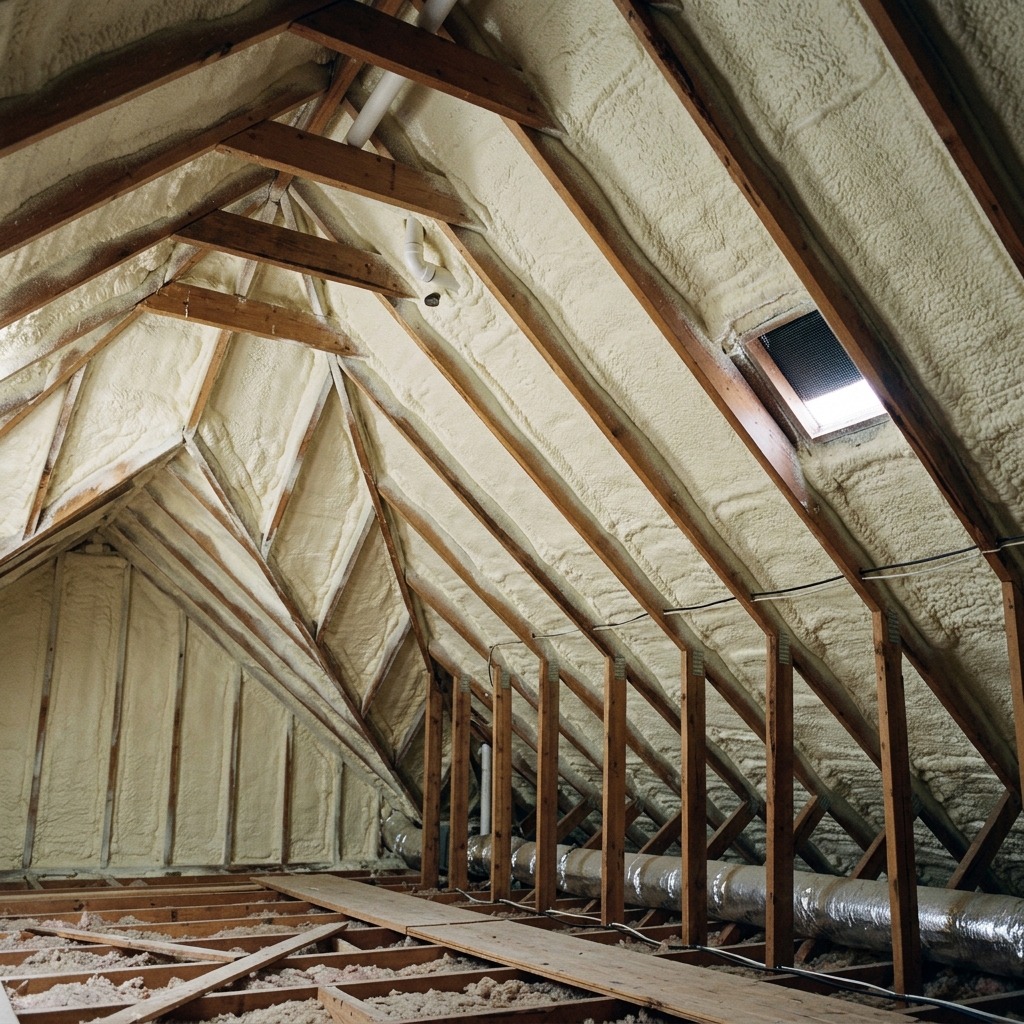
Most Toronto attic retrofits use open-cell foam applied directly to the attic floor between and over joists. Open-cell at R-3.7/inch reaches Ontario Building Code SB-12 compliance (R-50 south of Barrie) with roughly 14 inches of depth. Cathedral ceilings and finished attics where depth is limited call for closed-cell despite the higher cost — the higher R-value per inch is the only way to hit code targets in tight rafter bays.
Timeline: Most attic retrofits take one full day — prep, spray, and cure. Old insulation removal, if needed, adds 4–6 hours. Open-cell foam is typically walk-on within 1–2 hours of application. We can install the same day as removal in most cases.
Best seasonal window: Spring (April–May) and fall (September–October) are 10–15% cheaper than December–February peak. Attic foam installs year-round — cold temperatures below –10°C slow open-cell cure slightly but don’t prevent a quality application.
Attic spray foam qualifies for the Canada Greener Homes Retrofit (CGHR) grant — up to $1,250 for attic insulation upgrades meeting R-50+. Processing is faster than Enbridge’s HER+ program, and no pre-audit EnerGuide assessment is required for many streams. Details on our attic spray foam insulation page.
Basement Spray Foam: Cost, Moisture Control & Application Specifics
Basement insulation is the more technically demanding — and more expensive per square foot — of the two applications. The reason is simple: basements require closed-cell spray foam in virtually every GTA application. Concrete walls are inherently damp. Closed-cell at R-6/inch acts as both insulation and vapour barrier, blocking moisture migration from the concrete into your living space. Open-cell is vapour-permeable and would absorb moisture below grade, creating a mold factory inside your wall assembly — never appropriate for basement walls.
Basement spray foam costs at a glance:
- Closed-cell basement walls (2″–3″): $3.00–$5.00/sqft
- Rim joist closed-cell (typically 100–150 lin. ft): $800–$1,800 as a standalone job; included at a discount when combined with the basement
- Typical 800 sqft basement walls project: $2,400–$4,800 installed
- Typical 1,200 sqft basement walls project: $3,600–$6,400 installed
Closed-cell foam acts as a Class II vapour barrier when applied at 2″ or thicker — eliminating the need for a separate poly sheet. At 2″ you achieve R-12, which meets Ontario’s R-10 minimum; our standard recommendation is 2.5″ (R-15), which is where Enbridge HER+ rebate eligibility begins for basement walls.
Timeline: Basement projects typically take 2–3 days — one day for prep and moisture assessment, one to two days for spray application depending on square footage and access. Unlike attics, basement projects often require a pre-application moisture assessment ($200–$600) to confirm no active water infiltration before sealing the walls.
Best seasonal window: Spring (April–June) — basement moisture peaks in May–June as snowmelt and spring rain increase hydrostatic pressure. Catching it before summer prevents mold issues. Winter basement projects are possible but cost $200–$400 more due to heating requirements. See our basement spray foam insulation page for the full moisture assessment checklist.
Cost Comparison Matrix: Attic vs Basement Across 10 GTA Cities
Spray foam pricing varies 10–20% across the GTA based on drive time, crew availability, and local demand. Downtown Toronto commands the highest rates; Hamilton and outer suburbs like Brampton and Markham run 8–12% lower. The table below shows typical installed costs for a 1,200 sqft attic (open-cell) and a 1,000 sqft basement walls project (closed-cell) across all GTA cities we serve.
| GTA Location | Attic OC ($/sqft) | Attic CC ($/sqft) | Attic Project Total (1,200 sqft) |
Basement CC ($/sqft) | Basement Project Total (1,000 sqft) |
|---|---|---|---|---|---|
| Downtown Toronto | $2.30–$2.70 | $3.75–$4.50 | $3,500–$5,200 | $4.50–$5.50 | $4,500–$6,400 |
| Scarborough | $2.00–$2.40 | $3.25–$4.00 | $2,900–$4,500 | $4.00–$4.80 | $4,000–$5,600 |
| North York | $2.10–$2.50 | $3.40–$4.10 | $3,100–$4,700 | $4.20–$5.00 | $4,200–$5,800 |
| Etobicoke | $2.10–$2.50 | $3.40–$4.10 | $3,100–$4,700 | $4.20–$5.00 | $4,200–$5,800 |
| Vaughan | $1.80–$2.20 | $3.00–$3.70 | $2,700–$4,000 | $3.60–$4.40 | $3,600–$5,200 |
| Mississauga | $1.85–$2.25 | $3.05–$3.75 | $2,750–$4,100 | $3.70–$4.50 | $3,700–$5,200 |
| Markham | $1.75–$2.15 | $2.90–$3.60 | $2,600–$3,900 | $3.50–$4.30 | $3,500–$5,000 |
| Brampton | $1.75–$2.15 | $2.90–$3.60 | $2,600–$3,900 | $3.50–$4.30 | $3,500–$5,000 |
| Oakville | $1.80–$2.20 | $3.00–$3.70 | $2,750–$4,000 | $3.70–$4.50 | $3,700–$5,000 |
| Hamilton | $1.60–$2.00 | $2.65–$3.30 | $2,400–$3,600 | $3.20–$4.00 | $3,200–$4,600 |
Project totals include labour, materials, and equipment. Add $600–$1,800 for old insulation removal if applicable. All prices in CAD.
Which Should You Insulate First? ROI & Payback Analysis
This is the question we hear on nearly every estimate call. The honest answer: for most GTA homeowners, attic first delivers better financial ROI — but basement first is correct if you have moisture, cold floors on the main level, or a partially finished basement you’re planning to complete.
Scenario A: Attic First
- Typical project cost: $3,500 (1,200 sqft, open-cell, suburban GTA)
- Annual heating savings: $700–$1,100 (40–50% reduction on heating component of energy bill)
- Simple payback: 7–10 years
- After CGHR $1,250 rebate — effective cost $2,250 → payback 5–7 years
- Added benefit: eliminates ice dams, reduces air conditioning load 15–20% in summer, improves indoor comfort year-round
Scenario B: Basement First
- Typical project cost: $4,000 (1,000 sqft walls, closed-cell, suburban GTA)
- Annual energy savings: $300–$550 (20–30% reduction — smaller than attic because less total heat moves through basement walls)
- Simple payback: 10–15 years
- After HER+ rebate ($1,500–$5,000 depending on scope) → payback compresses to 8–12 years
- Added benefit: eliminates moisture intrusion, protects framing from rot, prevents mold — health and structural benefits that don’t appear in energy savings alone
Scenario C: Both at Once (Recommended When Budget Allows)
Bundling attic and basement in a single mobilization cuts per-sqft cost by 8–12% — one crew, one setup, one travel charge. A whole-home package (attic + basement + rim joist) for a typical GTA semi-detached runs $7,500–$13,000 before rebates. After CGHR ($1,250) + HER+ ($3,500–$5,000 for combined scope), net cost can drop to $4,000–$7,000 — making the combined payback 6–9 years. This is the strongest ROI scenario we see.
The moisture exception: If your basement has active condensation, efflorescence on the walls, or a history of flooding — spray foam the basement first. Installing attic foam on a home with ongoing moisture problems can trap humidity inside the envelope and accelerate mold growth in wall cavities. Fix moisture before adding attic R-value.
Foam Type Decision: Open-Cell Attic vs Closed-Cell Basement
The application dictates the foam. Here’s the side-by-side breakdown:
| Property | Open-Cell (Attic) | Closed-Cell (Basement) |
|---|---|---|
| R-value per inch | R-3.7 | R-6.0 |
| Typical installed depth | 8″–14″ (attic floor) | 2″–3″ (basement walls) |
| Cost per sqft (GTA) | $1.50–$2.50 | $3.00–$5.00 |
| Vapour barrier | No — permeable | Yes — Class II at 2″+ |
| Moisture resistance | Low — absorbs moisture | High — blocks moisture |
| Sound dampening | Excellent | Good |
| Structural reinforcement | None | Moderate — adds wall rigidity |
| Best application | Attic floors, interior wall cavities | Basement walls, crawl spaces, rim joists |
| OBC SB-12 compliance | R-50+ with ~14″ depth | R-10+ with 2″ (R-12); R-15 at 2.5″ |
For a broader look at open-cell vs closed-cell foam properties, see our closed-cell spray foam page and open-cell spray foam page.
Here is how spray foam compares to alternative insulation types specifically in attic and basement applications:
| Metric | Spray Foam (OC/CC) | Fiberglass Batts | Cellulose (Blown) |
|---|---|---|---|
| Air sealing | Complete — monolithic seal | Poor — gaps at framing | Fair — settles 15–20% |
| R-value per inch | 3.7–6.0 | 2.2–3.8 | 3.2–3.7 |
| Moisture control (basement) | Excellent (CC) | None | Poor — absorbs moisture |
| Life expectancy | 80+ years | 15–25 years | 20–30 years |
| Mold resistance | Excellent (CC) | Poor | Poor |
| Installed cost (GTA, $/sqft) | $1.50–$5.00 | $0.75–$1.50 | $1.00–$2.00 |
Fiberglass and cellulose cost less upfront but require air sealing as a separate step, degrade over time, and cannot serve as a vapour barrier in basement applications. The higher initial cost of spray foam is typically recovered within 5–10 years in energy savings and avoided remediation costs.
Building Code Requirements: Ontario SB-12 & Basement R-Values
Ontario’s Supplementary Standard SB-12 sets minimum effective thermal resistance for both attic and basement assemblies. Here’s what applies to a typical GTA retrofit:
Attic (SB-12, Table 2)
- Toronto and southern Ontario (Climate Zone 6): Effective R-50 minimum
- North of Barrie (Climate Zone 7): Effective R-60 minimum
- Most GTA homes need 13–14 inches of open-cell foam, or 8–9 inches of closed-cell, to achieve SB-12 compliance
- SB-12 compliance is mandatory for new construction and additions with building permits; strongly recommended for retrofits targeting CGHR and HER+ rebate eligibility
Basement Walls (SB-12 + OBC 9.25)
- Heated basement walls in contact with soil: R-10 effective minimum
- GTA market standard: R-15 (2.5″ closed-cell) — confirmed best practice by energy advisors across the region
- Rim joist: R-10 minimum; 2″ closed-cell (R-12) meets and exceeds this
- Important: Under OBC, spray polyurethane foam in an occupied space must be covered with a code-approved ignition barrier — typically 12.7mm (½”) drywall. We specify this on every job.
We install to SB-12 on every project — not approximate, not minimums-only. Our CUFCA certification requires it, and it’s the only way to guarantee rebate eligibility for your documentation package. See our Toronto spray foam insulation page for city-specific code notes.
Rebate Eligibility & Stacking: CGHR Attic Stream + HER+ Basement Options
Three rebate pathways apply to GTA spray foam projects:
1. Canada Greener Homes Retrofit (CGHR) — Attic
- Amount: Up to $1,250 for attic insulation upgrades meeting R-50+ effective thermal resistance
- Fastest processing stream — no mandatory pre-audit EnerGuide assessment in many cases
- Typical processing time: 6–12 weeks after installation documentation submitted
- Stackable with HER+ when attic and basement are distinct project scopes
2. Enbridge Home Efficiency Rebate Plus (HER+) — Basement / Combined
- Amount: $1,500–$5,000 depending on measures completed
- Basement wall insulation alone (R-15+): $1,500 typically
- Attic + basement combo: $3,500–$5,000 if linked to a heating system upgrade (furnace, heat pump, hot water heater)
- Requires pre- and post-installation EnerGuide home energy assessment (~$450–$600, often partially rebated)
- Key eligibility: R-15+ on basement walls (2.5″ closed-cell) and R-50+ on attic
3. HELP Toronto Loan — Both Applications
- Home Energy Loan Program: 0% interest financing, up to $125,000 (confirm current funding cycle at time of application)
- Available to Toronto homeowners; covers attic, basement, mechanical upgrades in a single loan
- Can be combined with CGHR grants and HER+ rebates — stack all three for maximum offset
Realistic rebate stack (1,200 sqft attic + 1,000 sqft basement, suburban GTA):
- Project total before rebates: ~$8,500
- CGHR grant: –$1,250
- HER+ (basement + combo scope): –$3,500
- Net out-of-pocket after grants: ~$3,750
- HELP loan covers remainder at 0% interest over 10 years
Our Ontario spray foam rebates guide covers current eligibility thresholds, application timelines, and the documentation package we provide with every CGHR- and HER+-eligible install.
Hidden Costs: Removal, Assessment & Seasonal Pricing
The per-sqft rates above assume a clean substrate ready for foam application. Several line items can add to your final invoice:
Old Insulation Removal
| Application | Removal Type | Additional Cost |
|---|---|---|
| Attic | Fiberglass batts (manual removal) | $0.50–$1.00/sqft |
| Attic | Blown-in cellulose or mineral wool (vacuum extraction) | $0.80–$1.50/sqft |
| Basement | Fiberglass batt removal from stud walls | $1.00–$1.75/sqft |
| Basement | Damp or contaminated batt removal (disposal premium) | $1.50–$2.00/sqft |
| Basement | Old spray foam top-up (existing foam, re-coat) | $0.50–$1.00/sqft |
A 1,200 sqft attic with blown-in cellulose removal adds $960–$1,800 to your project. Our attic insulation removal cost guide breaks down pricing by material type and includes asbestos identification protocol for pre-1980 Toronto homes.
Moisture Assessment (Basement)
- Visual moisture inspection: included at no cost with every estimate
- Infrared thermal imaging scan: $200–$400
- Calcium chloride vapour emissions test (concrete floor): $150–$300
- Full assessment package: $250–$600
- Required when: visible efflorescence, past flooding history, or basement-finishing work planned
Seasonal Pricing Variance
- January–March (winter peak): standard rates; higher demand, winter prep
- April–May (spring shoulder): 10–15% lower — best time to book
- June–August (summer moderate): 5–10% lower; crews available, demand dips for heating-focused projects
- September–October (fall busy): return to peak rates; most homeowners book before first frost
Why Choose Spray Foam Kings
We’ve insulated attics and basements across every GTA neighbourhood covered in this article — from 1960s Scarborough bungalows with 14 inches of blown-in cellulose to remove, to new-build Vaughan townhouses needing rim joist and basement insulation before occupancy. Here’s what makes a difference when you’re choosing who does this work:
- CUFCA certified — Canada’s professional spray foam association, held by fewer than 5% of Ontario installers
- $5M commercial liability insurance + WSIB coverage — both applications, all GTA zones
- 15+ years of GTA installations — we know the building stock: Toronto’s 1950s–1980s housing, Mississauga slab-on-grade bungalows, Vaughan’s deep-basement semis
- Ontario Building Code SB-12 compliant on every job — not approximate, not minimums-only
- Enbridge HER+ and CGHR rebate documentation — we provide everything your energy advisor needs; you don’t navigate that paperwork alone
“We got three quotes for our attic. Spray Foam Kings was the only company that explained our open-cell depth needed to hit 14 inches for SB-12 compliance — the others just said ‘R-20’ without explaining what that meant in practice. They did the attic and rim joist in one day. Our heating bill dropped $780 in the first winter.”
Frequently Asked Questions
Should I insulate my attic or basement first in the GTA?
For most GTA homeowners, attic first delivers the better financial ROI: 40–50% heating savings, 7–10 year payback before rebates (5–7 years after CGHR $1,250). If your basement has active moisture, visible mold risk, or cold floors on the main level, prioritize the basement first — moisture in the building envelope compromises all downstream insulation work.
How much does attic spray foam cost in Toronto?
Open-cell attic spray foam in Toronto runs $1.50–$2.50/sqft in suburban GTA and $2.30–$2.70/sqft downtown. A typical 1,200 sqft attic project costs $2,900–$5,200 installed, all-in, before rebates. Closed-cell attic work runs $2.50–$4.50/sqft depending on location and ceiling type.
How much does basement spray foam cost in the GTA?
Closed-cell basement spray foam runs $3.00–$5.00/sqft in suburban GTA and $4.50–$5.50/sqft downtown Toronto. A typical 1,000 sqft basement walls project is $3,200–$6,400 installed. Rim joist only (100–150 linear feet) typically runs $800–$1,800 as a separate line item.
Can I do attic and basement spray foam in one project for a discount?
Yes — and we recommend it. Bundling attic and basement in a single mobilization reduces per-sqft cost by 8–12%. A combined attic + basement + rim joist project for a typical GTA semi-detached runs $7,500–$13,000 before rebates. Stacked CGHR ($1,250) + HER+ ($3,500–$5,000) rebates can bring net cost to $4,000–$7,000, with a combined payback of 6–9 years.
What rebate covers basement spray foam in Ontario?
Enbridge’s Home Efficiency Rebate Plus (HER+) is the primary program for basement wall insulation. Expect $1,500 for a standalone basement project at R-15+, up to $5,000 if combined with a heating system upgrade. The Canada Greener Homes Retrofit grant ($1,250) covers attic insulation — both can be stacked on a combined project.
What R-value does Ontario Building Code require for basement walls?
Ontario Building Code requires a minimum effective R-10 for basement walls in heated spaces (SB-12 + OBC 9.25). The GTA market standard is R-15 (2.5″ of closed-cell foam) — this is what energy advisors confirm as best practice and what HER+ rebate eligibility requires. At 2″ (R-12) you meet code minimum; 2.5″ is our standard recommendation.
Why can’t I use open-cell foam in my basement?
Open-cell spray foam is vapour-permeable — it absorbs moisture from concrete walls rather than blocking it. In a below-grade environment, this leads to mold growth inside the foam within 3–7 years. Closed-cell at 2″+ is the only spray foam type appropriate for basement walls, crawl spaces, and rim joists. Open-cell belongs in attic floors and interior wall cavities only.
Will closed-cell spray foam solve my basement moisture problems?
Closed-cell foam prevents condensation moisture — humid interior air reaching cold concrete — which is the most common basement moisture source. It does not fix bulk water infiltration (active leaks, failed drainage tile, high water table). If you have visible water entry during rain events, that must be addressed by a waterproofing contractor before spray foam is applied. We include a moisture assessment with every basement estimate to distinguish the two.
How long does attic spray foam installation take?
Most attic retrofits are completed in one full day. Old insulation removal adds 4–6 hours. Open-cell foam is walk-on within 1–2 hours of application, and we can return the same day as removal for most attic projects. Cathedral ceiling applications may require 2 days depending on access complexity.
How long does basement spray foam installation take?
Basement wall projects typically take 2–3 days: half a day for prep and moisture assessment, 1–2 days for foam application and quality inspection. Allow a minimum 24 hours before installing drywall over the foam. Winter projects may require a pre-heat period of 2–4 hours to bring the concrete surface above 5°C before application.
What is the payback period for basement spray foam in the GTA?
Typical financial payback for a GTA basement spray foam project is 10–15 years based on energy savings alone ($300–$550/year). With HER+ rebates reducing net cost by $1,500–$5,000, payback compresses to 8–12 years. The non-financial benefits — moisture control, structural protection, mold prevention — have real dollar value that doesn’t appear in energy calculations but does appear at resale.
Do attic and basement spray foam projects carry the same warranty?
Spray Foam Kings provides a 10-year workmanship warranty on all applications. The foam manufacturer (e.g., Lapolla, Huntsman, BASF) provides a lifetime material warranty on properly applied closed-cell and a 10–20 year warranty on open-cell, subject to correct substrate preparation and application thickness. Both warranties are transferable to a new homeowner, which adds measurable value at resale in GTA markets.
What does old insulation removal cost before attic or basement spray foam?
Attic insulation removal: $0.50–$1.00/sqft for fiberglass batts; $0.80–$1.50/sqft for blown-in cellulose (vacuum extraction). A 1,200 sqft attic with blown-in costs $960–$1,800 to clear. Basement batt removal: $1.00–$1.75/sqft, higher ($1.50–$2.00/sqft) if the material is damp and requires special disposal. These costs are always quoted separately and itemized on your estimate.
Does Enbridge HER+-eligible installation cost more than standard spray foam?
Slightly — approximately $200–$400 more per project for documentation, pre/post installation photos, code-compliant depth verification, and certified installer sign-off. That premium is almost always recovered in the HER+ rebate ($1,500–$5,000 depending on scope). Never decline rebate-eligible installation to save $300 on setup costs — the math never favours that choice.
Which application qualifies for the Canada Greener Homes Retrofit grant?
Attic insulation upgrades meeting R-50+ effective thermal resistance qualify for CGHR grants up to $1,250 per property. Basement wall insulation is covered under Enbridge HER+ — the two programs are application-specific. A combined attic + basement project can access both simultaneously. Confirm current grant amounts at time of application, as program funding and eligibility thresholds are updated periodically.
Get Your Free Quote Today
Whether your priority is attic ROI, basement moisture control, or a whole-home insulation package that stacks every available rebate — we’ll walk you through the numbers on a free on-site estimate. Serving Toronto, Scarborough, North York, Etobicoke, Vaughan, Mississauga, Markham, Brampton, Oakville, and Hamilton.
Call: 647-641-6881