
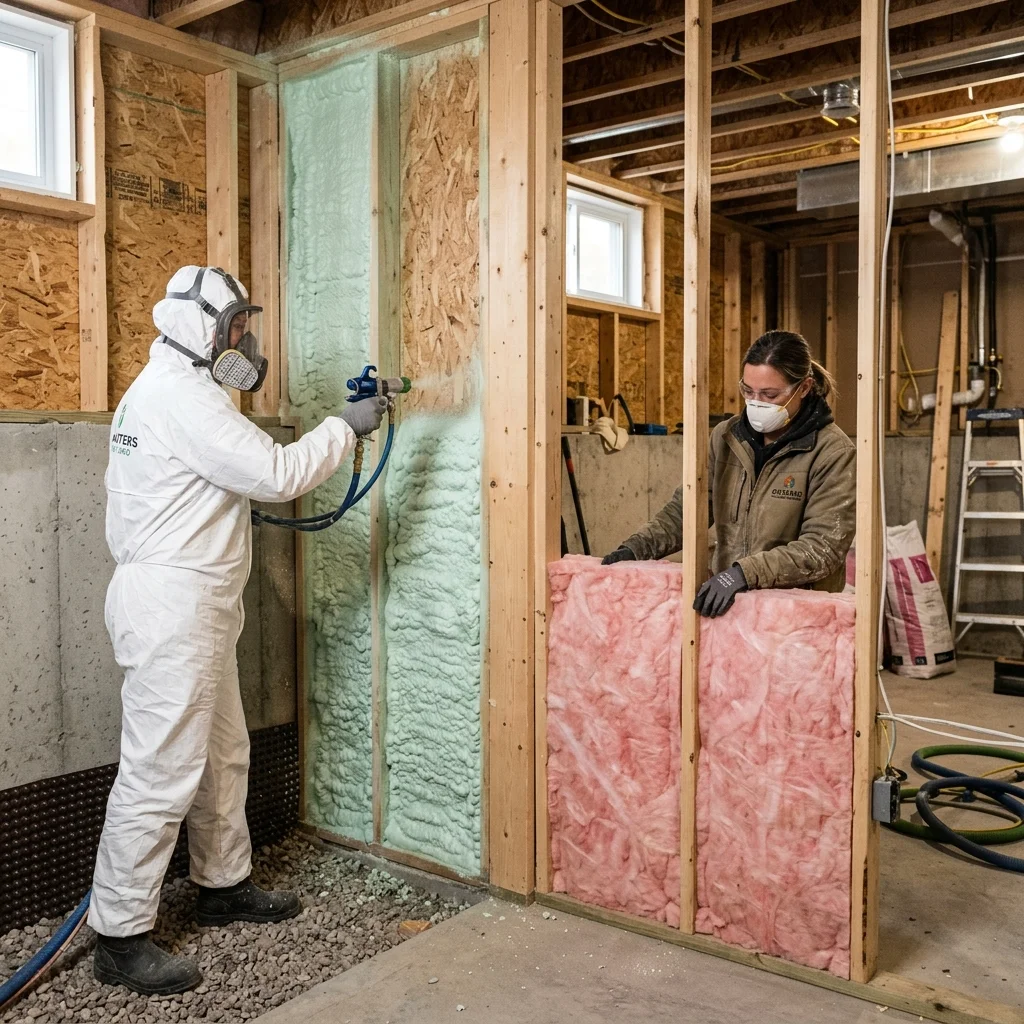
What’s the difference?
If you own a home in Toronto in 2026, choosing between spray foam and fiberglass insulation is one of the most consequential decisions you’ll make for comfort, energy costs, and long-term durability. Spray foam is a chemical mixture applied on-site that expands to fill cavities, creating an air-tight seal. Fiberglass batts or rolls are pre-cut fibrous sheets installed between wall studs and floor joists. The choice isn’t about which is universally “better”—it’s about matching the material to your home’s specific needs, your budget, and Toronto’s climate and building code environment. Toronto winters routinely drop below -15°C, and older homes often have air-leakage problems that spray foam addresses more completely. However, fiberglass remains viable for renovation budgets, simpler projects, and homes where vapor permeability matters. This guide walks homeowners through the real trade-offs so you can make an informed decision without overpaying or under-insulating.
Side-by-side comparison
| Scenario | Spray Foam (Open-Cell) | Spray Foam (Closed-Cell) | Fiberglass Batts |
|---|---|---|---|
| Cost (CAD/sq ft) | $1.50–$2.50 | $2.50–$4.00 | $0.40–$0.80 |
| R-Value per inch | R-3.5 to R-3.7 | R-5.8 to R-6.5 | R-3.2 to R-3.8 |
| Installation timeline | 1–2 days (average home) | 1–2 days (average home) | 2–5 days (average home) |
| Permit required (Toronto) | Usually (major renovation) | Usually (major renovation) | Usually (major renovation) |
| When to choose | Irregular spaces, moisture concerns, air sealing priority | Maximum insulation, moisture/vapor barrier needed | Budget-conscious, straightforward cavities, retrofit friendliness |
| Risk if you choose wrong | Open-cell can absorb moisture; closed-cell expensive upfront | Off-gassing concerns; overkill for some applications | Air leaks continue; settling over 5–10 years; moisture traps |
Spray foam insulation — when it’s the right call
Spray foam excels in Toronto homes where air sealing and moisture control are non-negotiable. If you have a basement that floods seasonally or a crawlspace with dampness, closed-cell spray foam creates a vapor barrier while insulating—a critical advantage that fiberglass cannot match. Older brick or stone Toronto homes often have irregular wall cavities and thermal bridging through rim joists; spray foam fills these gaps completely, eliminating the 10–15% energy loss that batts allow. It’s also ideal for attic insulation in homes where proper air flow ventilation is impossible due to soffits or roof geometry. Open-cell spray foam is breathable, allowing vapor to migrate outward in winter, reducing condensation risks in wood-frame walls. Closed-cell spray foam is denser, provides higher R-value per inch (useful in shallow cavities), and resists moisture ingress—perfect for rim joists, band boards, and basement insulation where groundwater exposure is real. Installation is fast—typically one to two days for a whole-home project—minimizing disruption. The upfront cost is higher than fiberglass, but energy savings of 15–25% annually often offset the premium within 7–10 years, especially in Toronto’s heating-dominated climate.
Fiberglass — when it’s the right call
Fiberglass batts remain the practical choice for budget-conscious homeowners and straightforward renovation projects. If you’re insulating a new partition wall, secondary bedroom addition, or finished basement room with standard 16-inch stud spacing, batts are economical and quick to install yourself or with a contractor. Fiberglass does not require special equipment, licensing, or off-site cure time, making it accessible for phased renovations. It’s also the standard retrofit option in Toronto’s many semi-detached and row-house communities where interior walls are narrow and spray foam creates precision challenges. Fiberglass is vapor-permeable, which can be an advantage in wood-frame walls where you want moisture to dry outward rather than accumulate at a vapor barrier. If your home’s envelope is already reasonably tight—for example, newer construction or recently updated windows and doors—the added air-sealing benefit of spray foam may be marginal. Fiberglass’s cost ($0.40–$0.80 per square foot) makes it appealing for large projects like finishing a full basement. The main trade-off is that batts settle over 5–10 years, potentially losing 10–15% of R-value, and they do not seal gaps around pipes, wires, or ductwork. For Toronto homes where heating efficiency is prioritized over perfection, fiberglass is defensible, especially if combined with strategic air-sealing work on doors, windows, and mechanical penetrations.
Edge cases and Toronto-specific factors
Toronto’s building code and permit regime matter. Any renovation involving structural changes, roof work, or exterior walls typically requires a city permit and inspection. Both spray foam and fiberglass applications in permitted work will be reviewed for proper installation, clearance from electrical, and conformance to the Ontario Building Code. Insurance is another factor: some insurers offer small discounts for closed-cell spray foam due to its fire-resistance and structural reinforcement properties, but this is not universal—ask your broker. Neighborhood considerations include noise and odor: spray foam installation involves pump trucks and chemical odor (minimal if open-cell, more pronounced with closed-cell) that can affect neighbors in tight urban blocks; fiberglass is quieter and odor-free. Historic homes in areas like the Annex or Leslieville may face aesthetic or heritage restrictions that favor interior fiberglass over external spray foam. Moisture is a critical variable: Toronto’s humidity and freeze-thaw cycles mean homes with poor drainage or aging foundations should avoid open-cell spray foam in basements; closed-cell or fiberglass with careful drainage design is safer. Finally, resale value: while energy efficiency improvements generally add value, fiberglass retrofits are invisible and commoditized, whereas spray foam’s air-sealing benefits are harder to quantify for buyers—don’t assume spray foam will increase appraisal. Get a professional energy audit before committing to either option; Toronto Hydro and the City often subsidize these, helping you identify the highest-ROI upgrade.
Frequently asked questions
Q: Will spray foam off-gassing make my family sick?
A: Modern spray foams (open and closed-cell) are formulated to minimize VOC emissions and are typically cured within 24 hours. Toronto contractors follow industry standards that include adequate ventilation post-application. Some people report odor sensitivity, especially with closed-cell; keeping windows open for 48 hours mitigates this. If anyone in your home has chemical sensitivities, disclose this to your contractor and consider fiberglass or a longer post-cure period.
Q: Can I install fiberglass batts in my basement if I have a sump pump?
A: Yes, but only on walls above the water table and with proper moisture management. If your basement floods or seeps regularly, fiberglass will absorb water and degrade. Closed-cell spray foam is the better choice for basements with a history of moisture. If you use fiberglass, pair it with interior drainage matting and ensure your sump pump and perimeter drain are working.
Q: How much will spray foam insulation cost for my 1,500 sq ft Toronto home?
A: A typical 1,500 sq ft home project (walls, ceiling, and rim joist) runs $8,000–$15,000 CAD for open-cell spray foam and $12,000–$22,000 CAD for closed-cell, depending on accessibility and whether you’re doing interior or exterior application. Fiberglass for the same scope is $2,500–$5,000 CAD. Request a free quote to get exact numbers for your home’s layout.
Q: Do I need a permit to insulate my attic?
A: In Toronto, if you’re adding insulation to an existing attic without altering the roof structure or ventilation, a permit is usually not required. However, if you’re creating new skylights, changing soffit vents, or undertaking major renovation work, a permit is mandatory. Always check with the City of Toronto before starting; an illegal retrofit can complicate future sales or insurance claims.
Q: Is spray foam worth the extra cost versus fiberglass for a 40-year-old brick Toronto row house?
A: Likely yes. Older row houses have single-brick walls with no cavity insulation, poor window seals, and significant air leakage through rim joists and foundation cracks. Spray foam’s air-sealing capability can reduce heating costs by 20–25% in these homes. Fiberglass alone won’t address the foundational air-leakage issues. A hybrid approach—closed-cell spray foam for rim joists and basement, fiberglass for interior wall cavities—often balances cost and performance.
Q: How long does insulation last?
A: Closed-cell spray foam lasts 30+ years if undamaged. Open-cell spray foam also lasts 30+ years but is more vulnerable to moisture saturation if exposed to flooding. Fiberglass batts typically remain effective for 15–20 years but settle and can lose R-value after 10 years. Neither material requires replacement in normal conditions; degradation is usually environmental (water damage, settling) rather than age-related.
Bottom line
Choose spray foam if: your Toronto home has moisture concerns (basement seepage, high humidity, freeze-thaw exposure), irregular or hard-to-access cavities, older single-brick construction, or if you prioritize air-sealing and long-term durability. Closed-cell is better for moisture-prone areas; open-cell for standard walls where breathability matters. The upfront cost is offset by energy savings in Toronto’s cold climate over 7–10 years.
Choose fiberglass if: you have a modest renovation budget, standard wall cavities and straightforward geometry, a newer or already-tight envelope, or you’re doing a phased project. Fiberglass is also appropriate for interior partitions and secondary spaces where air-sealing is less critical. Pair it with window/door weatherstripping and blower-door testing to maximize efficiency.
Next step: Schedule a home energy assessment (often subsidized in Toronto) and get a free estimate from a licensed contractor. If spray foam aligns with your home’s needs, visit sprayfoamkings.ca for a no-obligation quote. Request references, verify licensing, and confirm that your contractor follows Ontario Building Code and proper installation protocols. The right insulation choice depends on your home’s condition, climate exposure, and goals—not on price alone.