
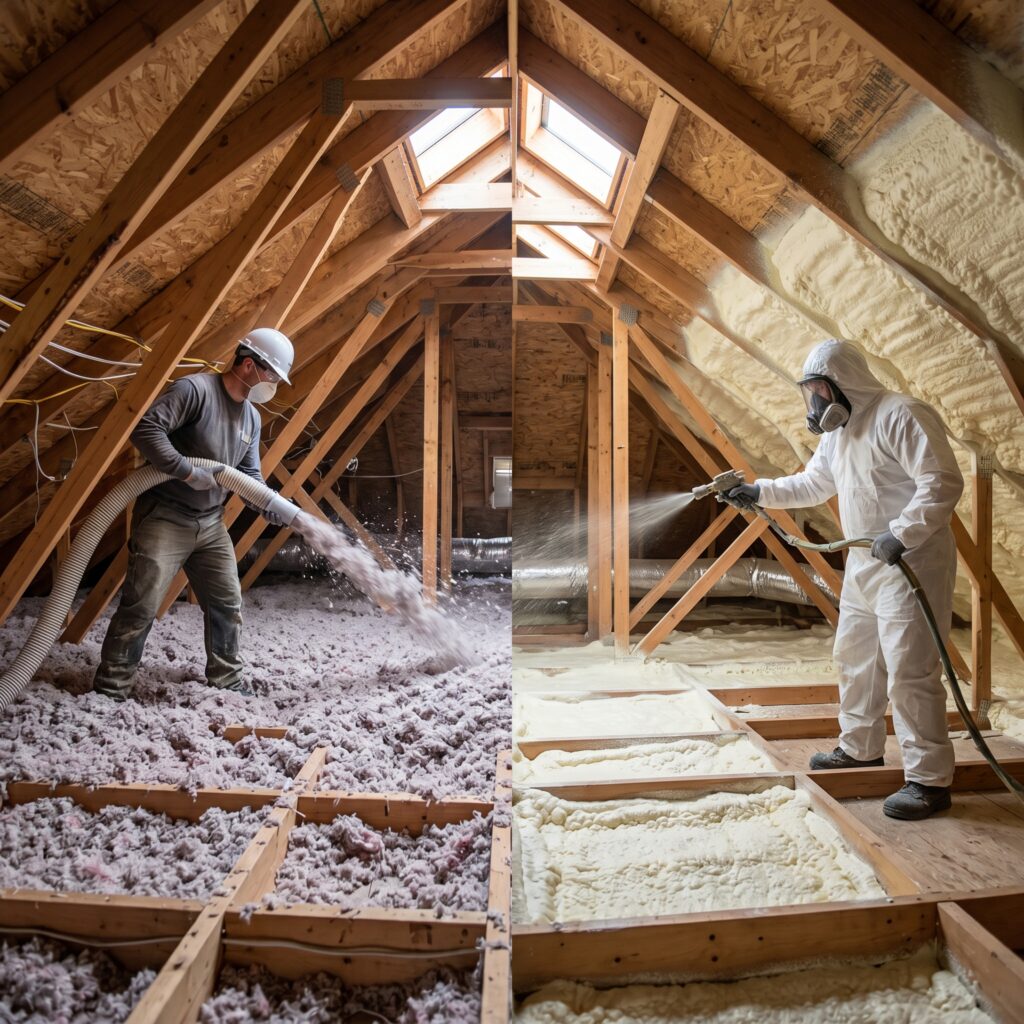
What’s the difference?
Ontario homeowners in 2026 face a critical insulation choice: spray foam or blown-in cellulose and fiberglass. The decision hinges on budget, property type, timeline, and long-term performance expectations. Spray foam—applied as liquid that expands and hardens—seals air gaps, stops moisture infiltration, and can boost R-value per inch. Blown-in insulation (loose-fill cellulose or fiberglass) is pneumatically sprayed into walls and attics, offering lower upfront cost and easier installation in existing homes. Both meet Ontario Building Code (OBC) requirements, but they perform differently in Ontario’s freeze-thaw cycles, humid summers, and aging building stock. The right choice depends on whether you prioritize air sealing and energy efficiency (spray foam), or cost and speed (blown-in). This guide walks Ontario homeowners through the trade-offs, real pricing in 2026 CAD, permit requirements, and when each solution wins.
Side-by-side comparison
| Criterion | Spray Foam | Blown-In Insulation |
|---|---|---|
| Cost (attic, 1200 sq ft) | CAD $4,500–$7,200 (closed-cell); CAD $2,800–$4,500 (open-cell) | CAD $1,200–$2,400 |
| Installation timeline | 1–3 days | 4–8 hours |
| Permit required (Ontario) | Yes, if >50 sq m or structural change | Rarely; check local municipality |
| When to choose | Air leaks, moisture control, renovation budgets, new construction, basements, cathedral ceilings | Tight budgets, attic-only upgrades, existing attic insulation, rental properties, quick projects |
| Risk if wrong choice | Over-spec and overspend; improper application voids warranty | Air leaks persist; moisture issues in Ontario humidity; poor R-value in walls; settling over time |
| R-value per inch | R-6.5–7 (closed-cell); R-3.5–3.6 (open-cell) | R-3.2–3.8 (fiberglass); R-3.6–3.8 (cellulose) |
Spray foam insulation — when it’s the right call
Spray foam dominates when air sealing and moisture control outweigh cost. Ontario’s humidity and seasonal temperature swings make air leakage expensive; spray foam expands to fill cracks, stopping drafts and condensation. Choose spray foam if your home has:
- Basements or crawl spaces: Closed-cell foam resists moisture and adds structural rigidity.
- Cathedral or vaulted ceilings: Complex geometry demands seamless coverage; blown-in settles unevenly.
- New construction or major renovations: Permits are already required; spray foam locks in performance from day one.
- Rim joists and band board gaps: These thermal weak spots are spray foam’s sweet spot—one application seals air and adds R-value.
- Attached garages or mechanical rooms: Spray foam isolates conditioned space and stops frost-heave in Ontario winters.
Open-cell spray foam (CAD $2,800–$4,500 for 1200 sq ft attic) is cheaper than closed-cell and vapor-permeable, suitable for attics in temperate zones. Closed-cell (CAD $4,500–$7,200) offers higher R-value, moisture resistance, and structural benefit—worth the premium if you need humidity control or plan to finish a basement. One caveat: improper spray foam application can trap moisture if not paired with adequate ventilation. Hire certified installers following OBC protocols. Spray foam also adds resale value; many Ontario buyers see it as a mark of quality energy retrofits.
Blown-in insulation — when it’s the right call
Blown-in insulation wins on speed, cost, and simplicity. If your goal is to boost attic R-value quickly without structural concerns, blown-in (cellulose or fiberglass) reaches CAD $1,200–$2,400 for 1200 sq ft—often half spray foam’s price. Choose blown-in if:
- Budget is the primary constraint: Tight renovation timeline or modest energy-efficiency targets.
- Attic insulation is your only need: Blown-in excels in flat or gently sloped attics with existing framing.
- You have existing attic insulation: Adding blown-in on top (overblow) is faster and cheaper than full removal and spray application.
- Rental property or quick flip: Blown-in adds R-value, improves EnerGuide score, and closes faster than foam curing.
- Ontario code compliance at minimal cost: Blown-in meets OBC thermal requirements without elaborate permitting.
Cellulose blown-in (made from recycled paper) offers R-3.6–3.8 per inch and is eco-friendly; fiberglass offers R-3.2–3.8 and resists moisture slightly better. Both settle 15–20% over time in Ontario’s temperature swings, so contractor calculations must overblow. Neither seals air leaks—gaps around vents, pipes, and penetrations remain problems. If your home has drafts or moisture issues, blown-in is a band-aid; spray foam addresses root causes. Blown-in also requires careful attention to moisture barriers and ventilation in Ontario’s humid climate.
Edge cases and Ontario-specific factors
Permits and bylaws: Ontario municipalities vary widely. Toronto, Ottawa, and GTA suburbs typically require permits for spray foam in basements, attics, or any project affecting >50 sq m of insulation. Blown-in rarely triggers permits unless tied to a larger renovation. Contact your local building department before quoting; permits add 2–3 weeks and CAD $200–$600.
Insurance and warranty: Some Ontario home insurers offer premium discounts (2–5%) for spray foam in basements or attics, citing reduced moisture and mold risk. Check your policy. Spray foam carries 25–30 year warranties if applied by certified pros; blown-in typically 10–15 years. In Ontario’s freeze-thaw climate, warranty validity depends on proper ventilation—poorly ventilated attics void both.
Neighborhood and historic considerations: Older Ontario neighborhoods (e.g., central Toronto, Ottawa’s Glebe) may have heritage restrictions on exterior work. Interior spray foam or blown-in avoids issues, but sealed attics can trigger bylaw complaints if condensation causes roof damage later. Consult a local contractor familiar with heritage rules.
Energy code and EnerGuide: Ontario’s Building Code (OBC 2020) mandates minimum R-values: R-40 for attics, R-20 for walls, R-30 for basement slabs. Spray foam reaches these faster; blown-in often requires deeper cavities or supplementary rigid insulation. If selling within 5 years, an EnerGuide audit before retrofit clarifies which upgrade gives best ROI.
Frequently asked questions
Q: Will spray foam or blown-in insulation help me save on heating bills in Ontario winters?
A: Yes, but spray foam outperforms blown-in by 15–25% due to air sealing. In Ontario’s cold snaps, air leaks account for 20–30% of heating loss; spray foam eliminates them. Blown-in raises R-value but doesn’t stop drafts. Expect CAD $200–$400 annual savings with spray foam; CAD $80–$150 with blown-in, assuming proper installation and duct sealing.
Q: Can I apply blown-in insulation over existing insulation in my attic?
A: Yes, and it’s recommended if old insulation is in good condition. Overblow to achieve target R-value (R-40 minimum in Ontario). Ensure existing insulation is dry and attic ventilation is adequate—inadequate venting traps moisture, causing rot. Have a contractor inspect first; hidden mold or settling invalidates the approach.
Q: Is closed-cell or open-cell spray foam better for Ontario basements?
A: Closed-cell (R-6.5 per inch, moisture-resistant) is preferred for below-grade Ontario basements where humidity and seasonal water intrusion are risks. It blocks vapor and provides structural stiffness. Open-cell (R-3.5 per inch, vapor-permeable) works if your basement is dry and well-drained, but closed-cell is safer in Ontario’s variable groundwater and spring melt seasons.
Q: How long does spray foam installation take compared to blown-in?
A: Spray foam typically takes 1–3 days for a full attic or basement (including prep and curing). Blown-in takes 4–8 hours for the same space. If you need fast turnaround for a sale or rental turnover, blown-in wins. Spray foam’s curing time (24–48 hours before drywall) can delay project timelines.
Q: What are the environmental impacts of spray foam vs. blown-in in 2026?
A: Open-cell spray foam uses water-blown propellants (lower GWP), while closed-cell traditionally used HFC or HCFC blowing agents. Modern closed-cell uses HFO or hydrofluoroolefin blowing agents with near-zero GWP. Blown-in cellulose is recycled paper (highest environmental score); blown-in fiberglass is virgin glass (moderate impact). All reduce operational carbon (heating/cooling) over 50 years, outweighing manufacturing impact. Choose based on performance need, not guilt.
Q: Do I need a permit for spray foam in Ontario?
A: If your project triggers a renovation permit (>25% of home’s exterior surface, >50 sq m insulation, or structural change), yes. Standalone attic insulation in some Ontario municipalities doesn’t require permits, but Toronto, Ottawa, and GTA do. Check with your city before starting. Spray foam contractors usually handle permitting for a fee (CAD $300–$600 markup). Blown-in rarely requires permits, giving it a bureaucratic advantage.
Bottom line
Choose spray foam if: Air leaks, moisture control, or structural performance are priorities; you’re renovating or building new; you have a basement, crawl space, or cathedral ceiling; and budget allows CAD $2,800–$7,200. Spray foam delivers 25–30 year energy savings and resale value in Ontario’s climate. For a free assessment, visit attic insulation services or contact the team at sprayfoamkings.ca for a detailed quote.
Choose blown-in if: You’re budget-constrained (CAD $1,200–$2,400), targeting attic insulation only, need a fast turnaround, or are retrofitting an existing attic without air-sealing issues. Blown-in meets Ontario code and works for rentals, flips, and incremental energy upgrades. Hire a certified contractor to ensure proper depth, density, and ventilation compliance.
Hybrid approach: Some Ontario homeowners combine both. Spray foam the rim joists, band board, and basement walls—high-impact air leak zones—then blow cellulose in the attic for cost efficiency. This balances performance and budget over a phased timeline. Consult a local energy auditor or contractor familiar with basement insulation, wall insulation, and rim joist insulation to determine which zones deliver the best return in your Ontario home’s specific envelope.