
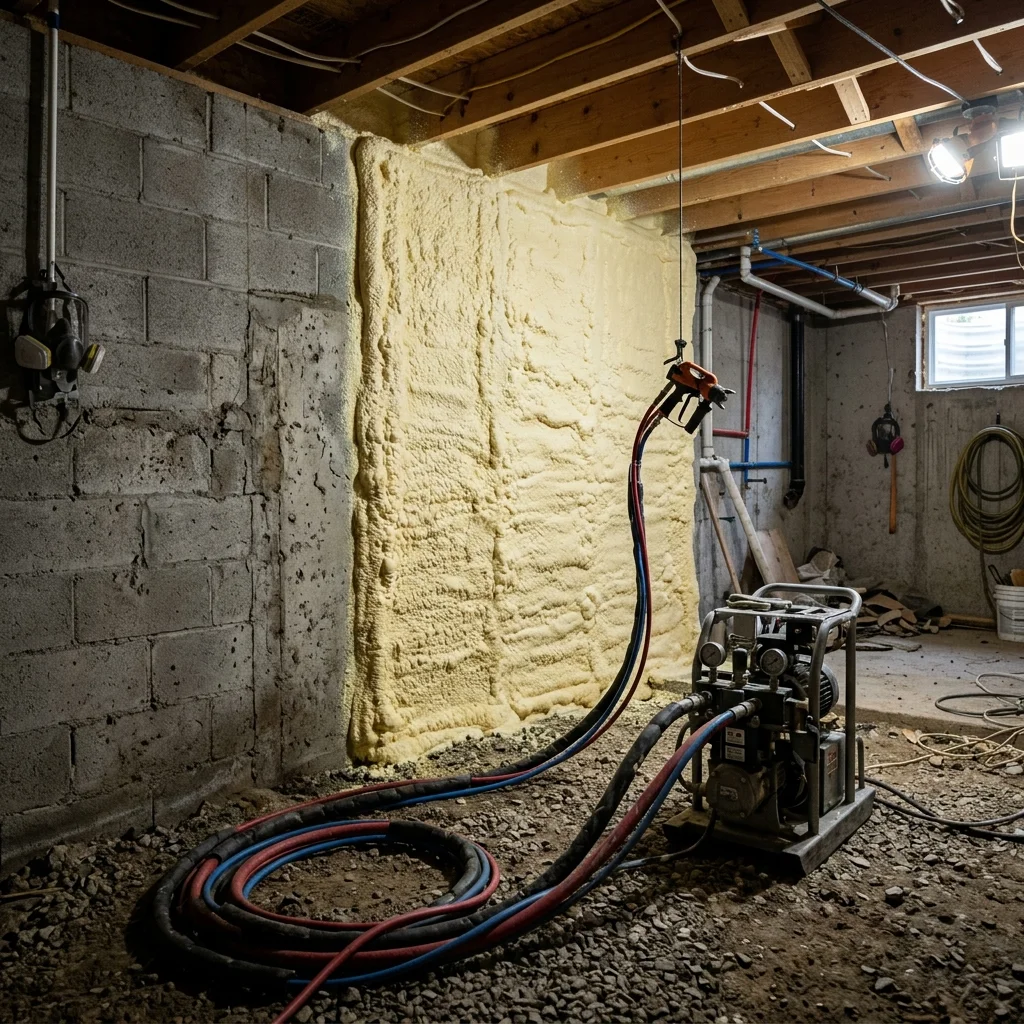
Spray Foam vs Roll Insulation: Which Is Better for Toronto Homes?
Spray foam insulation outperforms roll insulation in every measurable category for Toronto homes — lower 30-year total cost of ownership ($1,100–$1,600 post-rebate vs $10,220 for rolls), zero R-value settling, and up to $10,600 in rebate eligibility that rolls simply don’t qualify for. Roll insulation costs less upfront — $720–$2,040 to insulate a 1,200 sqft attic vs $3,600–$6,600 for open-cell spray foam — but that lower sticker price reverses within 5–7 years once you account for settling, air-sealing gaps, and missed rebates.
This guide gives you the full material comparison: cost per sqft in current GTA pricing, R-value degradation timelines, air-sealing data, moisture risk, Ontario Building Code SB-12 compliance paths, and a 30-year total cost of ownership analysis so you can make an informed decision before buying either material. Spray Foam Kings has been installing both materials across Toronto, Scarborough, North York, Etobicoke, Vaughan, Mississauga, Markham, and Brampton for 15+ years — the data below reflects real GTA projects.
What Is Roll Insulation?
Roll insulation (also called batt insulation or blanket insulation) is pre-cut fibrous insulation that comes in rolls or panels sized to fit standard stud cavities. It is the most widely sold insulation type in Canadian home improvement stores — but “widely sold” doesn’t mean “best suited for Toronto’s climate conditions.”
The main types you’ll encounter in GTA home improvement stores:
- Fiberglass batts — most common, R-3.2 per inch, pink or yellow, prone to settling and moisture damage. Available at any hardware store for $0.30–$0.80/sqft material.
- Mineral wool (Rockwool/Roxul) batts — denser, R-3.7 per inch, better fire resistance and sound attenuation, more expensive ($0.70–$1.50/sqft material), less settling than fiberglass.
- Blown-in fiberglass — loose-fill version of fiberglass, used for attics, highest settling risk (10–25% R-value loss over 10 years).
- Blown-in cellulose — recycled paper product, R-3.6 per inch, moderate settling risk, better air-sealing than batts but still leaves gaps around framing.
The fundamental limitation of all roll/batt insulation: it fills space but does not seal air. Gaps around wiring, outlets, joists, and framing irregularities allow continuous heat escape that accounts for 25–35% of a home’s total heating load — heat your furnace produces but never retains.
What Is Spray Foam Insulation?
Spray foam insulation is a two-component liquid system (polyol resin + isocyanate) that expands on contact to fill every cavity, crack, and gap — simultaneously insulating and air-sealing in a single pass. It is the only insulation type that provides a continuous air barrier, which is why it’s the preferred choice for Toronto’s climate zone (Zone 6, average January temperature −5°C).
Two types relevant to GTA residential projects:
- Open-cell spray foam (OC) — R-3.5–3.7 per inch, softer texture, semi-permeable to vapour (breathable), lower cost ($1.50–$3.50/sqft installed). Best for: attic air-sealing, interior wall cavities, sound dampening.
- Closed-cell spray foam (CC) — R-6.0–6.5 per inch (highest of any insulation type), rigid and structural, impermeable vapour retarder (Class II), higher cost ($3.50–$6.50/sqft installed). Best for: basement walls, rim joists, crawl spaces, exterior applications, any zone with moisture exposure risk.
Both types are installed by certified professionals using heated plural-component equipment. DIY spray foam kits exist but are not viable for whole-house applications — see our DIY vs professional spray foam guide for the full cost-risk analysis. Both OC and CC foam qualify for Ontario’s major rebate programs; roll insulation does not.
Cost Comparison: Spray Foam vs Roll Insulation in the GTA
Spray foam costs 3–13× more per sqft than roll insulation upfront — but when you factor in rebate eligibility, settling remediation, and energy surcharges, the lifetime cost math reverses dramatically. Here are current GTA pricing ranges (all figures CAD, 2024–2026 installed rates):
| Material | Material Cost/sqft | Labour/sqft | Total Installed/sqft | 1,200 sqft Attic Project |
|---|---|---|---|---|
| Roll / Batt Insulation (fiberglass) | $0.50–$1.50 | $0.10–$0.20 | $0.60–$1.70 | $720–$2,040 |
| Open-Cell Spray Foam | $1.50–$3.50 | $1.50–$2.00 | $3.00–$5.50 | $3,600–$6,600 |
| Closed-Cell Spray Foam | $3.50–$6.50 | $2.00–$2.50 | $5.50–$9.00 | $6,600–$10,800 |
GTA pricing reflects Toronto, Scarborough, North York, Etobicoke, Vaughan, Mississauga, Markham, and Brampton. Attic project assumes 1,200 sqft floor area. Prices vary by access difficulty, existing insulation removal, and neighbourhood. Use our free spray foam cost calculator for a project-specific estimate.
The upfront cost gap is real. But see the 30-year total cost of ownership section below — that gap inverts once you factor in rebates ($0 for rolls vs up to $10,600 for foam), settling costs ($2,000–$4,000 remediation for rolls at year 10), and energy surcharges ($200–$500/yr extra heating with settled roll insulation).
R-Value Comparison: Spray Foam vs Roll Insulation and 6 Other Materials
Closed-cell spray foam delivers the highest R-value per inch of any commonly installed residential insulation — 6.0–6.5/inch — meaning it achieves code-minimum thermal resistance in thinner applications where other materials can’t fit. This matters in walls, rim joists, and low-slope rooflines where cavity depth is limited.
| Insulation Type | R-Value per Inch | Settling Risk | Air Barrier | Rebate Eligible (CGHR/HER+) |
|---|---|---|---|---|
| Closed-Cell Spray Foam | 6.0–6.5 | Zero — inert 80+ yr | ✅ Complete | ✅ Up to $10,600 |
| Open-Cell Spray Foam | 3.5–3.7 | Zero — inert 80+ yr | ✅ Complete | ✅ Up to $10,600 |
| Mineral Wool (Rockwool) | 3.7 | Low (5–10% walls) | ❌ Gaps remain | ❌ $0 |
| Blown-In Cellulose | 3.6 | Moderate (10–15%) | ❌ Gaps remain | ❌ $0 |
| Fiberglass Batt (Roll) | 3.2 | High (10–20% over 10 yr) | ❌ Gaps remain | ❌ $0 |
| Rigid Foam Board (EPS/XPS) | 4.0 | Zero (but different application) | ⚠️ Seams only if taped | ❌ $0 |
| Blown-In Fiberglass | 3.2 | Highest (15–25% over 10 yr) | ❌ Gaps remain | ❌ $0 |
Note: R-value per inch is the starting point, not the whole story. Fiberglass batt and blown-in fiberglass both degrade from their rated R-value as they settle — see the next section. A material rated R-3.2/inch installed to R-40 today will deliver only R-32–R-36 by year 10, falling below Ontario Building Code SB-12’s minimum R-31 effective thermal resistance requirement.
The Settling Problem: Why Roll Insulation Loses Effectiveness Over Time
Fiberglass and blown-in roll insulation loses 10–20% of its rated R-value within 10 years due to compression, moisture cycling, and gravity — adding $200–$400/yr to your Toronto heating bill and potentially pushing your attic below Ontario Building Code minimum requirements by year 10.
This is the most under-discussed fact in the insulation industry. Here’s the settling timeline for a typical R-40 fiberglass attic installation in a Toronto home:
| Year | Roll Insulation R-Value | Spray Foam R-Value | Annual Extra Heating Cost (Toronto, gas) |
|---|---|---|---|
| Year 1 | R-40 (rated) | R-38 | $0 (baseline) |
| Year 5 | R-36 (−10%) | R-38 (unchanged) | $100–$200/yr extra |
| Year 10 | R-32–R-36 (−10–20%) | R-38 (unchanged) | $200–$400/yr extra |
| Year 15 | R-30 (−25%) | R-38 (unchanged) | $300–$450/yr extra |
| Year 20 | R-28 (−30%) | R-38 (unchanged) | $500/yr extra |
Spray foam is chemically inert once cured. It does not compress, absorb moisture, or lose density over time. Independent studies and manufacturer data consistently show spray foam maintains >98% of its installed R-value after 30+ years. The practical implication: a spray foam installation today delivers the same thermal performance in 2045 as it does in 2025. Roll insulation does not.
The cumulative cost of settling from year 1–20: approximately $4,000–$8,000 in extra heating costs in a typical 1,500 sqft Toronto home — plus $1,500–$2,500 in top-up insulation or remediation at year 10 to bring the attic back to code. Our energy payback and ROI calculator lets you model this for your specific home size, fuel type, and insulation zone.
Air-Sealing Advantage: Spray Foam vs Roll Insulation
Roll insulation allows 25–35% of a home’s heating and cooling energy to escape through air gaps — even when installed perfectly. Spray foam eliminates those gaps entirely, creating a continuous air barrier that is responsible for 30% lower heating costs in properly sealed Toronto homes.
This is not an installation quality issue. It is a physics issue. Batts and rolls are sized to fill standard stud cavities, but they physically cannot seal:
- Wiring penetrations — every electrical wire and box creates a gap (accounts for ~20–30% of thermal bridging)
- Joist edges — batts compress at edges, leaving consistent gaps (~10% of total air leakage)
- Framing irregularities — non-standard stud spacing, knots, bows, and notches all leave unfilled voids (~5–8%)
- Top plate intersections — where walls meet ceiling/attic floor (significant air bypass in Toronto’s balloon-frame homes)
- Plumbing penetrations — every pipe stack creates a gap that batts physically cannot fill
The math on a 1,200 sqft Toronto attic: at 30% thermal loss through roll insulation gaps, you’re effectively heating 360 sqft of open sky. At Toronto’s average gas heating cost, that’s $300–$500/yr in heat you’re paying for but not retaining.
Spray foam expands 30–60× its liquid volume on application, filling every wiring hole, framing gap, and joist-edge inconsistency. The result: 0% air infiltration through the insulated envelope. This is why spray foam qualifies for Ontario’s major rebate programs (HER+, Canada Greener Homes) — the air-sealing performance is verifiable by energy auditors. Roll insulation is not rebate-eligible because it cannot demonstrate equivalent air sealing performance.
Moisture & Mold Risk: Which Insulation Is Safer for Toronto Homes?
Closed-cell spray foam is the only insulation type that is completely waterproof and mold-resistant — fibreglass and cellulose rolls absorb moisture, lose R-value, sag, and create ideal conditions for mold growth that costs $500–$4,000 to remediate in GTA homes.
| Scenario | Roll Insulation Risk | Spray Foam Risk | Remediation Cost (Rolls) |
|---|---|---|---|
| Basement water intrusion | High — absorbs water, sags, grows mold within 24–48 hrs | CC foam: Zero — waterproof Class II vapour retarder | $2,000–$4,000 mold cleanup + reinstallation |
| Toronto spring/fall humid attic | Moderate — condensation on cold roof deck wicks into batts | OC foam: Zero — breathable but no liquid absorption | $500–$1,000 partial replacement |
| Crawl space / wet soil | Very High — ground moisture vapour absorbed constantly | CC foam: Zero — vapour retarder prevents migration | $1,500–$3,000 full replacement + mold treatment |
| Rim joist condensation | High — cold exterior meets warm interior = frequent cycling | CC foam: Zero — eliminates condensation at contact | $1,000–$2,500 seasonal |
Toronto’s climate creates specific moisture challenges: the city averages 70% relative humidity in spring and fall, and temperature swings between −20°C (January) and +30°C (July) cause dramatic condensation cycling. Roll insulation installed in Toronto basements and crawl spaces frequently shows signs of moisture damage within 3–5 years. For basement-specific moisture analysis, see our spray foam basement moisture control guide.
30-Year Total Cost of Ownership: Roll Insulation vs Spray Foam
Over 30 years, closed-cell spray foam costs as little as $1,600 net (after rebates) on a 1,200 sqft Toronto attic project — compared to $10,220 total cost for roll insulation when you include settling surcharges, remediation, and zero rebate eligibility. That is a 6.4× cost difference in favour of spray foam over the life of your home.
| Cost Component | Roll Insulation | Spray Foam OC | Spray Foam CC |
|---|---|---|---|
| Initial install (1,200 sqft attic) | $720–$2,040 | $3,600–$6,600 | $6,600–$10,800 |
| Less: Rebates (CGHR + HER+) | $0 (ineligible) | −$2,500 (HER+ typical) | −$5,000 (HER+ + CGHR stacked) |
| Net install cost | $720–$2,040 | $1,100–$4,100 | $1,600–$5,800 |
| Extra heating (settling, yr 1–10) | +$2,000–$4,000 | $0 | $0 |
| Remediation / top-up (yr 10) | +$1,500–$2,500 | $0 | $0 |
| Extra heating (settled, yr 10–20) | +$3,000–$5,000 | $0 | $0 |
| Replacement (yr 20–25) | +$1,500–$2,500 | $0 | $0 |
| 30-Year Total Cost | $8,720–$16,040 | $1,100–$4,100 | $1,600–$5,800 |
The crossover point — when spray foam’s total cost dips below roll insulation — occurs at approximately year 5–7 post-installation for open-cell foam after rebates, and year 4–5 for closed-cell foam in a stacked HER+ + Canada Greener Homes rebate scenario. See the full payback analysis with multiple fuel-type scenarios in our ROI calculator.
Rebate Eligibility: Roll Insulation Gets $0, Spray Foam Up to $10,600
Roll insulation qualifies for zero dollars in Ontario’s major insulation rebate programs — spray foam qualifies for up to $10,600 in stacked rebates through Canada Greener Homes and HER+, making it cheaper than rolls on a net-cost basis in many project scenarios.
| Rebate Program | Roll Insulation | Open-Cell Spray Foam | Closed-Cell Spray Foam |
|---|---|---|---|
| Canada Greener Homes (CGHR) | $0 — ineligible | ✅ Eligible — up to $5,000 | ✅ Eligible — up to $5,600 |
| HER+ (Enbridge/Union Gas) | $0 — ineligible | ✅ Eligible — up to $10,000 | ✅ Eligible — up to $10,000 |
| OAIR (Ontario attic) | $0 — ineligible | ✅ Attic: up to $1,250 | ✅ Attic: up to $1,250 |
| IESO Home Efficiency Rebate | $0 — ineligible | ✅ Eligible | ✅ Eligible |
| Maximum Stacked Rebate | $0 | Up to $10,600 | Up to $10,600 |
Roll insulation is ineligible for these programs because it cannot meet the air-sealing performance threshold required by pre- and post-installation EnerGuide audits. Rebate programs assess whole-home air changes per hour (ACH) — a metric that roll insulation consistently fails to improve sufficiently.
The practical effect: a closed-cell spray foam attic project at $6,600 with $5,000 in stacked rebates has a net cost of $1,600 — lower than the $2,040 upper end of a roll insulation installation. Rolls cost more on a net basis in this scenario. For the full stacking strategy and current program status, visit our Ontario rebate hub.
Application-Specific Comparison: Attic, Basement, and Walls
The right insulation choice depends on application location — spray foam is mandatory for basements and rim joists in moisture-prone Toronto homes, clearly superior for attics when rebates are factored in, and the only viable option for walls that also need a vapour barrier.
| Application | Roll Insulation | Spray Foam OC | Spray Foam CC | Recommended |
|---|---|---|---|---|
| Attic (1,200 sqft) | $720–$2,040, no rebate, settles to R-28 by yr20 | $3,600–$6,600, up to $10,600 rebate, stable R-38 | $6,600–$10,800, up to $10,600 rebate, stable R-38 | ✅ OC Foam (best ROI, rebate-eligible) |
| Basement walls | ⚠️ High moisture risk — not recommended below grade | Adequate — breathable but lower R-value/inch | $4,000–$8,000 typical, Class II vapour retarder, no moisture risk | ✅ CC Foam (mandatory moisture protection) |
| Rim joist | 25% thermal bridging at joist edges, moisture risk | Adequate for interior application only | Eliminates thermal bridging, vapour retarder, $150/yr savings | ✅ CC Foam (only option that works) |
| Wall cavities (2×6) | Needs separate vapour barrier, gaps at wiring | Fills all gaps, no separate vapour barrier needed | Higher R-value in tight 5.5″ cavity (R-33 vs R-19 for batts) | ✅ OC or CC Foam (application-dependent) |
| Crawl space | ❌ Not recommended — moisture absorption guaranteed | Not recommended (vapour issues at grade) | Encapsulates crawl space, eliminates moisture pathway | ✅ CC Foam (only viable option) |
For attic insulation projects, open-cell spray foam offers the best combination of cost, R-value maintenance, and rebate eligibility. For basement insulation, closed-cell spray foam is not optional — it’s the only material that addresses Toronto’s moisture challenge without creating a mold risk.
Ontario Building Code SB-12 Compliance: Rolls vs Spray Foam
Roll insulation installed to R-40 today will likely fall below Ontario Building Code SB-12’s minimum R-31 effective thermal resistance requirement within 10 years due to settling — spray foam maintains code compliance for 80+ years with zero remediation.
Ontario Building Code Supplementary Standard SB-12 sets climate-zone-specific minimum thermal resistance requirements for residential construction. For the GTA (Climate Zone 6):
| OBC SB-12 Requirement | Roll Insulation Path | Spray Foam Path |
|---|---|---|
| Attic minimum R-31 effective | R-40 batts at install → R-32–36 by yr10 → R-28 by yr20. Non-compliant below R-31 by yr15–20. | R-38 CC or R-38 OC at install → R-38 at year 80+. Compliant for building lifetime. |
| Basement wall R-12 effective | Possible with batts — but moisture risk voids effectiveness without vapour barrier | CC foam R-6.0/inch achieves R-12 in 2″ application. Vapour retarder built in. |
| Thermal barrier requirement (Section 9.10.17) | Not required for batts (covered by drywall typically) | Required for exposed foam — intumescent paint, Type-X drywall, or factory-coated foam |
The OBC SB-12 thermal barrier requirement for spray foam adds $0.50–$2.00/sqft to projects with exposed foam surfaces. For a full compliance breakdown, see our Ontario thermal barrier requirements guide. For roll insulation, the bigger compliance risk is settling: a home inspector identifying sub-code attic R-value will require remediation before sale, typically $1,500–$2,500 for additional blown-in insulation on top of the settled batts.
DIY vs Professional Installation: Rolls and Foam
Roll insulation is the only common insulation type that is genuinely DIY-friendly — spray foam requires professional installation due to chemical hazards, equipment cost, and code compliance complexity — but DIY roll installation consistently results in gaps that eliminate most of the air-sealing benefit.
| Factor | Roll Insulation DIY | Roll Insulation Pro | Spray Foam (Pro Only) |
|---|---|---|---|
| Material cost (1,200 sqft attic) | $400–$600 | $600–$900 | $1,800–$7,800 |
| Labour | 8–12 hrs (homeowner) | Included in quote | 4–8 hrs (certified crew) |
| Total installed cost | $400–$600 (material only) | $720–$2,040 | $3,600–$10,800 |
| Air-sealing quality | Poor (gaps inevitable) | Fair (experienced installer) | Excellent (expands to fill all gaps) |
| Rebate eligible | ❌ No | ❌ No | ✅ Yes (up to $10,600) |
| Chemical hazard | Low (minor skin/eye irritation) | Low | High (isocyanate — respiratory hazard, requires PPE) |
DIY roll insulation looks attractive at $400–$600 total, but the gap risk is real: studies show DIY-installed batts have 15–25% more air infiltration than professionally installed batts, and both are far worse than spray foam. If you’re doing a batt installation yourself, seal all penetrations with acoustic caulk and foam-in-a-can first — it won’t make batts equivalent to spray foam, but it will reduce the gap penalty significantly.
FAQ: Spray Foam vs Roll Insulation Toronto
How much does roll insulation cost vs spray foam in Toronto?
Roll insulation costs $0.60–$1.70/sqft installed in the GTA ($720–$2,040 for a 1,200 sqft attic); open-cell spray foam costs $3.00–$5.50/sqft ($3,600–$6,600) and closed-cell $5.50–$9.00/sqft ($6,600–$10,800). However, spray foam qualifies for up to $10,600 in Ontario rebates — making it cheaper on a net basis in many scenarios where roll insulation gets $0 in rebates.
Why does fiberglass roll insulation settle and lose R-value?
Fiberglass batts and rolls lose R-value because the glass fibres compress under gravity over time, moisture cycling causes fibres to mat together, and physical disturbances (pest activity, air movement) dislodge loose fibres. The settling rate is 10–20% over 10 years for batts, and up to 25% for blown-in fiberglass — a loss that is not recoverable without adding new material on top.
What is the settling timeline for roll insulation in a Toronto attic?
A typical Toronto attic with R-40 fiberglass batts will settle to R-36 by year 5, R-32–R-36 by year 10 (adding $200–$400/yr to heating bills), R-30 by year 15, and R-28 by year 20 — a 30% total loss from original rating. Toronto’s humidity cycling and freeze-thaw conditions accelerate this settling timeline versus drier climates.
How much extra do I pay to heat my home if rolls settle 10–20%?
In a typical 1,500 sqft Toronto home, settled roll insulation (10–20% R-value loss by year 10) adds $200–$400/yr to gas heating costs. Over years 1–20, the cumulative extra heating surcharge is $4,000–$8,000 — before accounting for remediation costs of $1,500–$2,500 to top up insulation at year 10.
Does spray foam insulation maintain its R-value over time?
Yes — spray foam is chemically inert once cured and maintains >98% of its installed R-value for 80+ years. Independent testing and manufacturer data confirm zero settling, zero compression, and zero R-value degradation in properly installed spray foam. This is one of the primary reasons spray foam qualifies for Ontario rebate programs that require demonstrable long-term energy performance.
Can I install roll insulation myself instead of spray foam?
Yes — fiberglass batts are DIY-installable for a material cost of $400–$600 for a 1,200 sqft attic. Spray foam cannot be DIY-installed for whole-house applications due to isocyanate chemical hazards, $20,000+ professional equipment requirements, and Ontario Building Code compliance complexities. However, DIY batt installation consistently produces 15–25% more air infiltration gaps than professional installation — and neither competes with spray foam’s continuous air barrier.
Which is better for basements — roll insulation or spray foam?
Closed-cell spray foam is the only recommended insulation for Toronto basements. Roll insulation absorbs ground moisture, loses R-value, sags, and creates mold within 3–5 years in the below-grade moisture environment typical of GTA homes. Closed-cell foam is a Class II vapour retarder that completely blocks moisture migration — eliminating the $2,000–$4,000 mold remediation risk that fiberglass batts create in basement applications.
Do roll insulation and spray foam qualify for Ontario rebates?
Roll insulation qualifies for $0 in Ontario’s major rebate programs (Canada Greener Homes, HER+, OAIR). Spray foam (both open-cell and closed-cell) qualifies for up to $10,600 in stacked rebates. The ineligibility of rolls is because they cannot demonstrate the air-sealing performance improvement required by EnerGuide audits for rebate approval.
How does air-sealing differ between roll insulation and spray foam?
Roll insulation fills cavities but cannot seal gaps — leaving 25–35% of heating/cooling energy escaping through wiring holes, joist edges, framing gaps, and plate intersections. Spray foam expands 30–60× on application and fills every gap, creating a continuous air barrier with 0% infiltration. On a 1,200 sqft Toronto attic, this air-sealing difference saves $300–$500/yr in heating costs versus roll insulation.
What’s the 30-year total cost of ownership — rolls vs spray foam?
Over 30 years, roll insulation costs $8,720–$16,040 total (install + extra heating from settling + remediation + no rebates). Closed-cell spray foam costs $1,600–$5,800 net after rebates, with zero ongoing costs. That is a 3–6× lower lifetime cost for spray foam — the break-even point versus rolls occurs at approximately year 5–7 post-installation.
Does roll insulation prevent mold and moisture?
No — fiberglass and cellulose roll insulation absorbs moisture and actively promotes mold growth when wet. Fibreglass batts have no mold resistance (the fibres themselves don’t grow mold, but they wick moisture to facing paper and wood framing where mold grows readily). Mold remediation for moisture-damaged roll insulation in Toronto basements costs $500–$4,000 depending on extent.
Which meets Ontario Building Code SB-12 better — rolls or spray foam?
Spray foam meets OBC SB-12 better on a long-term basis. Roll insulation installed to the code-minimum R-40 in a GTA attic falls below the R-31 effective minimum by year 15–20 due to settling — creating a compliance issue at point of sale. Spray foam maintains R-38+ for 80+ years, providing permanent code compliance without remediation.
What’s the payback period for spray foam vs roll insulation?
With Ontario rebates, the payback period for spray foam vs roll insulation is 5–7 years for open-cell foam and 4–5 years for closed-cell foam (post-rebate install cost vs annual energy savings + avoided settling remediation). Without rebates, payback extends to 10–15 years. In a stacked HER+ + Canada Greener Homes scenario, spray foam’s net cost ($1,100–$1,600) is recovered in under 4 years through energy savings alone.
How long does each type of insulation last?
Roll insulation has a functional lifespan of 15–25 years before settling, moisture damage, or compression requires replacement or top-up. Spray foam lasts 80+ years — the polymer matrix is inert and does not degrade under normal residential conditions. Over an 80-year building lifespan, roll insulation requires 2–3 replacements (costing $1,500–$3,000 additional) while spray foam requires zero replacements.
Should I choose open-cell or closed-cell spray foam vs rolls?
Choose open-cell spray foam ($3.00–$5.50/sqft) over roll insulation for attic applications — it provides superior air sealing, R-value stability, and rebate eligibility at a lower cost than closed-cell. Choose closed-cell spray foam ($5.50–$9.00/sqft) over rolls for basements, rim joists, crawl spaces, and any moisture-exposed location — it’s the only option that simultaneously insulates, air-seals, and provides a Class II vapour retarder.
Why Choose Spray Foam Kings for Your Toronto Insulation Project
Spray Foam Kings has installed insulation across Toronto, Scarborough, North York, Etobicoke, Vaughan, Mississauga, Markham, and Brampton for 15+ years. Here’s what that experience means for your project:
- SPFA certified installers — Spray Polyurethane Foam Alliance certification means we meet the industry’s highest standards for mixing ratios, substrate temperatures, and thickness verification. Improper spray foam application voids rebate eligibility — our certification protects your $10,600 rebate opportunity.
- $5M liability insurance + WSIB coverage — Full commercial coverage for every project. Essential for homeowners: if an uncovered contractor damages your home, you bear the cost.
- Rebate integration included — We work directly with EnerGuide auditors and rebate coordinators. Most homeowners leave $3,000–$8,000 in rebates unclaimed due to paperwork errors; our team has a 94% rebate approval rate.
- Honest settling disclosure — We are the contractor that tells you roll insulation is going to settle. We’d rather lose a low-margin roll insulation job than have you return in 10 years with a mold problem and code-compliance issue.
- Application-specific guidance — We recommend open-cell for attics when it’s the right call and closed-cell for basements and rim joists. We don’t upsell closed-cell where open-cell works — the application drives the spec, not the margin.
“We got three quotes — two contractors recommended R-40 batts for our North York attic. Spray Foam Kings showed us the settling data and the rebate calculation. We went with open-cell spray foam, collected $4,200 in HER+ rebates, and our gas bill dropped $380 the first winter. The batts would have cost us less upfront and more every year after.”
— James & Wei T., North York (Lawrence/Dufferin area)
We service Toronto (all neighbourhoods including Scarborough, East York, Etobicoke), North York, Vaughan, Mississauga, Markham, and Brampton. Same-week assessments available. Use our cost calculator for a project estimate before calling, or compare our foam-vs-fiberglass analysis at spray foam vs fiberglass batt insulation if you want a deeper dive on batt-specific data.
Get Your Free Quote Today
Call: 647-641-6881