
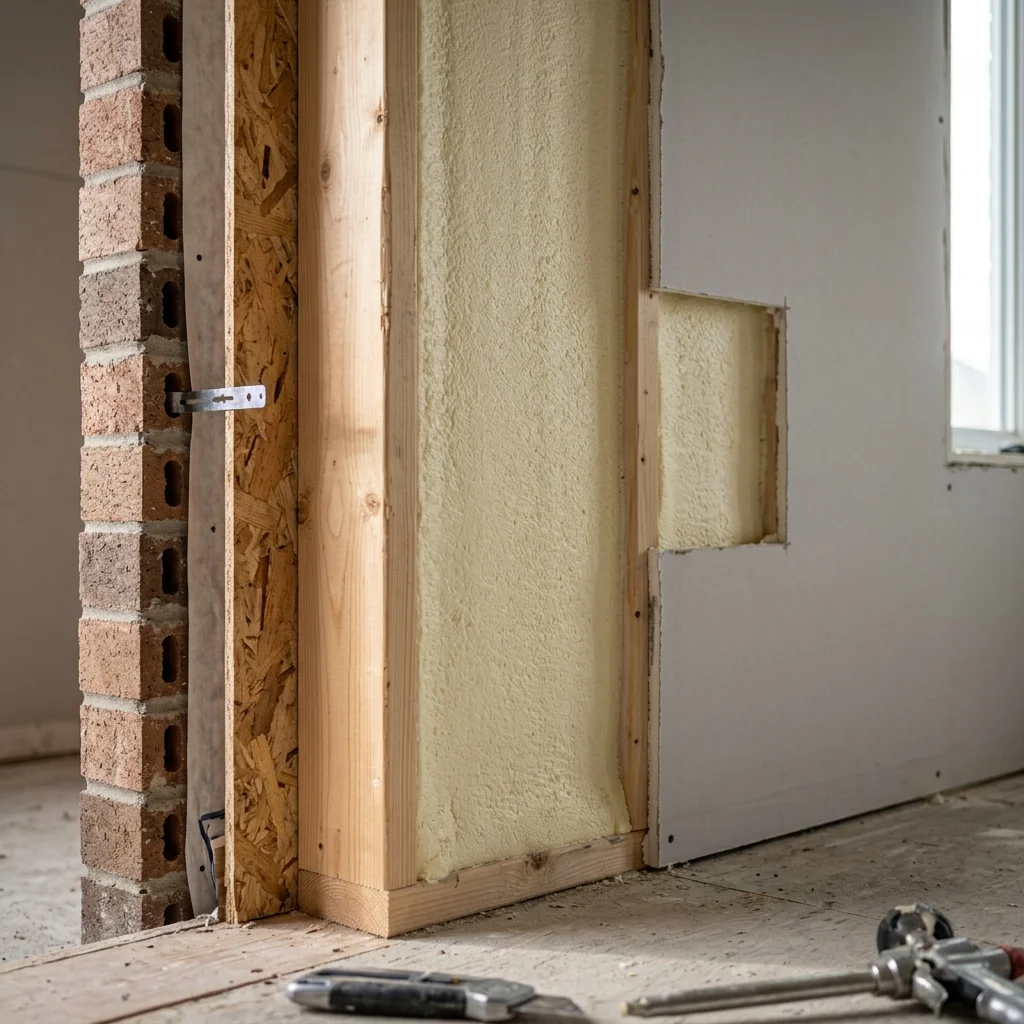
For most Ontario homeowners, professional spray foam installation costs less than DIY once you factor in rebate eligibility — and the gap is enormous. A 1,200 sq ft attic costs $2,400–$3,600 in DIY materials alone with zero rebate available, while the same professional install runs $3,600–$4,200 all-in and qualifies for up to $10,600 through the Canada Greener Homes Grant — leaving your net cost at $0–$1,500 out of pocket. Add Ontario Building Code compliance requirements, isocyanate chemical hazards, equipment limitations, and $5K–$20K remediation risk from poor application, and the decision becomes straightforward for any project over 300 sq ft. This guide breaks down every cost, risk, and quality factor with real GTA numbers so you can make a confident, informed choice.
DIY Spray Foam Kits vs Professional Installation: Which Is Right for Your Ontario Home?
DIY spray foam kits are viable only for small gaps under 300 sq ft — window frames, door penetrations, rim joist sections — but professional installation is the correct choice for any full attic, basement, or crawlspace project. Hardware store kits (Touch ‘n Foam, Handi-Foam, Tiger Foam) run $400–$600 per kit and cover roughly 200 sq ft at 2 inches. They look cheap on paper, but three factors flip the economics hard against DIY at scale: rebate disqualification (losing up to $10,600), building code violation risk (Ontario SB-12 requires a licensed installer for thermal barrier compliance), and quality failures that trigger $5,000–$20,000 in remediation costs.
Use this guide to find your project’s break-even point, understand the rebate stakes, and make a decision based on real GTA pricing data. For a full overview of professional options, see our spray foam insulation services page.
DIY Spray Foam Kit Costs: What You Actually Pay (Material Only)
A single DIY spray foam kit costs $400–$600 and covers approximately 200 sq ft at a 2-inch application depth — equating to roughly $2.00–$3.00/sq ft in material costs alone, with zero labour included.
Here’s what the material cost looks like at scale for a typical GTA home:
| Project Area | Kits Required | Material Cost | Cost per Sq Ft | Notes |
|---|---|---|---|---|
| 100–200 sq ft (gaps, rim joists) | 1–2 kits | $400–$1,200 | $2.00–$3.00 | DIY potentially viable |
| 300–500 sq ft (partial attic) | 2–4 kits | $800–$2,400 | $2.00–$3.00 | Break-even zone |
| 800 sq ft (mid attic) | 4–5 kits | $1,600–$3,000 | $2.00–$3.00 | Professional often cheaper |
| 1,200 sq ft (full attic) | 6–8 kits | $2,400–$4,800 | $2.00–$3.00 | Professional always wins |
| 1,800 sq ft (attic + basement) | 9–12 kits | $3,600–$7,200 | $2.00–$3.00 | Professional saves $3K–$7K net |
Hidden DIY material costs often overlooked: full-face respirator with organic vapour cartridges ($150–$300), Tyvek protective suit ($25–$50/use), safety glasses, nitrile gloves (multiple pairs), drop cloths and masking materials ($50–$100), wasted kits from clogged nozzles ($50–$150 per clogged kit), and rental of a foam trimming saw if over-application occurs. Add $400–$800 to any DIY material budget as a realistic contingency.
Also critical: DIY open-cell kits deliver an effective R-value 20–30% below the label due to uneven application, temperature inconsistency during mixing, and improper spray angle. A kit rated R-13 at 3.5 inches typically achieves R-9 to R-11 in real DIY conditions.
Professional Spray Foam Installation Costs in the GTA (All-In Pricing)
Professional spray foam installation in the GTA costs $1.50–$3.50/sq ft for open-cell foam and $2.50–$5.00/sq ft for closed-cell foam — all-in pricing that includes labour, surface prep, disposal, and fire barrier (intumescent paint) application where required by Ontario Building Code.
| Foam Type | R-Value per Inch | Cost per Sq Ft (All-In) | 1,200 Sq Ft Attic | Best For |
|---|---|---|---|---|
| Open-Cell Spray Foam | R-3.7 per inch | $1.50–$3.50 | $3,600–$4,200 (to R-31) | Attics, interior walls, sound control |
| Closed-Cell Spray Foam | R-6.0–R-7.0 per inch | $2.50–$5.00 | $5,000–$7,200 (to R-24) | Basements, crawlspaces, exterior walls |
| Fiberglass Batt (for comparison) | R-3.2–R-3.8 per inch | $0.80–$1.50 | $960–$1,800 | Low-budget projects, no air seal |
| Blown-In Cellulose (for comparison) | R-3.2–R-3.8 per inch | $0.60–$1.20 | $720–$1,440 | Existing attic top-up only |
GTA all-in pricing by service area:
- Toronto / North York / Scarborough: Open-cell attic (1,200 sq ft, R-31) = $3,600–$4,200. Closed-cell basement (800 sq ft) = $4,000–$5,500.
- Etobicoke / Mississauga: Similar rates; some access premium for older bungalows with low attic pitch (+$200–$400).
- Vaughan / Markham / Brampton: Open-cell attic (1,200 sq ft) = $3,400–$4,000; slight volume discount in new subdivisions with adjacent bookings.
For a detailed breakdown of professional costs including basement and rim joist pricing, see our spray foam insulation cost guide.
The Real Cost Comparison: DIY vs Professional (Including Hidden Costs)
When you include safety equipment, wasted kits, effective R-value loss, and zero rebate eligibility, the true DIY cost for a full attic project is $3,200–$5,600 — compared to $0–$1,500 net professional cost after Canada Greener Homes Grant rebate.
| Cost Factor | DIY (Open-Cell) | Professional (Open-Cell) |
|---|---|---|
| Material / Kit Cost | $2,400–$4,800 (6–8 kits) | Included in all-in price |
| Labour | $0 (your time: 20–40 hrs) | Included in all-in price |
| Safety PPE (respirator, suit, gloves) | $200–$400 | $0 |
| Wasted / Clogged Kits (typical) | $150–$300 | $0 |
| Surface Prep & Disposal | $50–$150 | Included |
| Fire Barrier (intumescent paint, OBC) | $150–$300 (DIY paint, if applied) | Included |
| Total Before Rebate | $2,950–$5,950 | $3,600–$4,200 |
| Canada Greener Homes Rebate | $0 (INELIGIBLE) | Up to $10,600 |
| Net Cost After Rebate | $2,950–$5,950 | $0–$1,500 |
For closed-cell foam applications (basement walls, 2–4 inches, 800 sq ft), the DIY material cost alone reaches $5,000–$6,000 in kit equivalent, while professional all-in pricing runs $4,000–$5,500 — meaning DIY closed-cell is already more expensive before adding PPE, failed kits, and zero rebate eligibility.
Why DIY Spray Foam Disqualifies You from CGHR & HER+ Rebates
DIY spray foam kits are 100% ineligible for every major Ontario insulation rebate — including the Canada Greener Homes Grant (up to $10,600), HER+ (up to $5,000), and OAIR (up to $1,250) — because all three programs require “licensed professional installation” as a condition of eligibility.
This is the single biggest financial consideration in the DIY vs professional decision. Here’s exactly what you lose:
| Rebate Program | Maximum Benefit | DIY Eligible? | Professional Eligible? | Requirement |
|---|---|---|---|---|
| Canada Greener Homes Grant (CGHR) | $10,600 | ❌ No | ✅ Yes | Licensed contractor installation, EnerGuide audit |
| HER+ (Home Efficiency Rebate Plus) | $5,000 | ❌ No | ✅ Yes | Registered contractor, pre/post EnerGuide |
| OAIR (On-Bill Financing) | $1,250 | ❌ No | ✅ Yes | Qualified installer, utility program rules |
| IESO Programs | Varies | ❌ No | ✅ Yes | Verified professional installation only |
For full details on stacking rebate programs and maximizing your $10,600+ return, see our Ontario insulation rebate guide and rebates overview page.
Real-world net cost scenario: A Vaughan homeowner quotes $4,200 professional open-cell attic install. After Canada Greener Homes Grant ($3,500 for attic insulation) and HER+ ($700 top-up), net out-of-pocket cost = $0. The same homeowner doing it themselves pays $2,400–$4,800 in materials with no rebate path.
Safety Concerns: Chemical Hazards, Fire Risks & Ontario Building Code
Spray foam chemicals — specifically isocyanates (MDI) and the blowing agents used in two-component kits — are classified as respiratory sensitizers and require full-face forced-air respirator protection, Tyvek suits, and a mandatory 24–48 hour occupancy ban after application. Hardware store kit packaging typically includes inadequate protection warnings.
Chemical hazard detail for DIY kits:
- Isocyanate exposure at concentrations above 0.02 ppm (ppb range) causes permanent respiratory sensitization — once sensitized, any future exposure can trigger asthma attacks.
- Hardware store kits are labelled “Professional Use Only” in their SDS (Safety Data Sheets). The included gloves and basic goggles are insufficient; a full-face respirator with organic vapour + P100 cartridges ($150–$300) is mandatory.
- Blowing agents (HFCs/HFOs in modern kits) are asphyxiation hazards in enclosed spaces without forced air ventilation.
- Uncured foam (first 24–48 hours) off-gases toxic compounds. Family members and pets must vacate the home entirely during this period.
Ontario Building Code SB-12 compliance: Section 9.25 of the OBC (SB-12 supplementary standard) requires that spray polyurethane foam installed in an occupied building must be covered by a 15-minute thermal barrier — typically 12.7mm (½-inch) drywall or an approved intumescent coating. DIY applications without a licensed installer fail the thermal barrier requirement, which means:
- Failed building inspection on renovation permits
- Potential insurance claim denial in case of fire
- Required remediation by a licensed contractor at your expense ($3,000–$8,000 for re-application + barrier installation)
Spray Foam Kings is SPFA certified with $5M liability insurance and WSIB coverage. Every install includes a compliant thermal barrier application and an installation record for building permit files. For full safety and code compliance details, review our closed-cell spray foam service page.
Equipment & Quality: Professional Rigs vs Hardware Store Hand-Canisters
Professional spray foam rigs (Graco Reactor 2 E-30, PMC PH-2) cost $20,000–$60,000 and precisely control temperature, pressure, and chemical ratio on-the-fly — the three variables that determine whether foam cures to its rated R-value. DIY hand-canisters cannot replicate these controls, resulting in effective R-values 20–30% below label.
Why equipment precision matters:
- Temperature: Both chemical components must be heated to 38–49°C (100–120°F) for optimal reaction. In a cold Ontario attic (below 10°C), DIY canisters lose temperature between nozzle and substrate, producing brittle, under-expanded foam.
- Pressure: Professional rigs maintain 600–1,200 PSI across the spray pattern. DIY canisters operate at a fraction of this pressure, leading to uneven cell structure and gaps at joist interfaces.
- Chemical ratio: Two-component foam requires a precise 1:1 mix ratio (by volume) of A-side isocyanate and B-side polyol. DIY canisters have a fixed nozzle that degrades with use; partial clogging shifts the ratio, producing under-cured, sticky foam that never achieves rated R-value.
Practical quality outcomes: A DIY open-cell application rated R-13 at 3.5 inches typically achieves R-9 to R-11 in real Ontario conditions — a 15–30% R-value shortfall that persists for the life of the insulation. A closed-cell DIY kit rated R-6/inch may achieve only R-4 to R-5/inch due to uneven density. Professional closed-cell foam consistently achieves R-6.0–R-7.0 per inch across 100% of the installed area. See our open-cell spray foam and closed-cell spray foam service pages for specification details.
When DIY Breaks Even: Project Size Threshold & Minimum Contractor Charges
The break-even point between DIY and professional spray foam is 300 sq ft — below this, DIY may be economically viable for small gap-sealing work; above this threshold, professional installation is always cheaper net of rebates.
| Project Size | DIY Total Cost | Pro All-In Cost | Pro Net (Post-Rebate) | Verdict |
|---|---|---|---|---|
| <200 sq ft (gaps, penetrations) | $400–$800 | $1,500–$2,000 (minimum charge) | $1,500–$2,000 | ✅ DIY viable (rebate not triggered) |
| 200–300 sq ft | $800–$1,200 | $1,500–$2,200 (min. charge) | $1,000–$1,700 | ⚠️ Break-even; bundle with larger work |
| 300–500 sq ft | $1,200–$2,000 | $1,800–$2,500 | $300–$1,200 | ✅ Professional wins (rebate eligible) |
| 500–800 sq ft | $2,000–$3,200 | $2,200–$3,500 | $0–$1,000 | ✅ Professional clearly better |
| 1,000–1,200 sq ft (full attic) | $2,400–$4,800+ | $3,200–$4,200 | $0–$1,500 | ✅✅ Professional always wins |
Minimum contractor charge: Most GTA spray foam contractors (including Spray Foam Kings) have a minimum project charge of $1,500–$2,000 to cover travel time, equipment setup, and fixed overhead. This means a 100–150 sq ft gap-sealing job may not justify a standalone professional call. The smart move: bundle small air-sealing work with a larger attic or basement project (attic + rim joist + basement headers = well above the threshold) to access rebate eligibility on the full combined project. Our attic insulation and basement insulation services are frequently bundled for maximum rebate capture.
Installation Quality & Long-Term Results: Warranty, Remediation & Hidden Failures
Professional spray foam installations carry 5–10 year workmanship warranties with manufacturer-backed material coverage; DIY kits are sold “as-is” with no remediation guarantee, and quality failures can trigger $5,000–$20,000 in damage costs.
Three high-cost DIY failure scenarios common in Ontario homes:
- Moisture trapping (open-cell over exterior sheathing): Open-cell foam is vapour-permeable and must not be applied directly to cold exterior sheathing in Ontario’s climate (Zones 5–6) without a proper vapour control layer. DIY applicators frequently seal open-cell foam against the OSB sheathing in attic rooflines — trapping moisture and causing wood rot. Remediation: remove foam ($2,000–$4,000), replace sheathing ($3,000–$8,000), re-insulate ($3,600–$4,200). Total exposure: $8,600–$16,200.
- North York case study: A homeowner applied open-cell foam to their cathedral ceiling in winter, sealing cold attic sheathing with DIY kits. Within 18 months, moisture accumulation caused sheathing delamination. The remediation cost was $8,500 — more than twice the original professional quote of $3,800.
- Voided roofing warranties: Major roofing manufacturers (GAF, IKO, CertainTeed) void shingle warranties when moisture-permeable foam is applied directly to roof decking without professional installation documentation. A voided $15,000–$25,000 roofing warranty is a common hidden risk of DIY foam in cathedral ceilings.
- Cured foam over electrical: DIY applicators frequently foam over electrical junction boxes, knob-and-tube wiring, and plumbing cleanouts — creating building code violations that must be corrected before any future renovation permit is issued.
Time Investment: Active Hours for DIY vs Professional Completion
A DIY spray foam application for a 1,200 sq ft attic requires 20–40 active hours across 3–7 days; a professional crew completes the same project in 4–8 hours with a 24-hour cure before the space is useable.
DIY time breakdown for a 1,200 sq ft attic project:
- Prep and masking: 4–6 hours
- Kit setup, safety gear donning, ventilation setup: 1–2 hours per session
- Spray application (6–8 kits × 30–45 min each, with 30-second nozzle swap windows): 6–12 hours active spray time
- Nozzle clogs and kit changeovers (typical 2–4 clog events): 1–3 hours lost
- Over-application trimming and touch-ups: 2–4 hours
- Cleanup, material disposal, PPE decontamination: 2–3 hours
- Cure waiting (24–48 hours, home uninhabitable): 1–2 days
Total active DIY time: 20–40 hours over 3–7 days. Professional crew: 4–8 active hours, 24-hour cure, job complete by next morning.
At Ontario’s average DIY homeowner opportunity cost of $35–$50/hour (trade or professional wage), 30 hours of DIY labour equals $1,050–$1,500 in real economic cost — money rarely included in DIY “savings” calculations.
Cost-After-Rebate: The Real Economics (Professional Nets to $0–$1.5K, DIY Stays $2.4K+)
After factoring in available Ontario rebates, professional spray foam installation for a standard GTA attic or basement project nets to $0–$1,500 out of pocket — while DIY spray foam stays at $2,400–$5,600 with no rebate offset available.
| Scenario | Professional All-In | Rebate Available | Pro Net Cost | DIY Material | DIY Net Cost |
|---|---|---|---|---|---|
| Attic only, open-cell R-31, 1,200 sq ft | $3,600–$4,200 | $3,500 (CGHR) | $100–$700 | $2,400–$4,800 | $2,400–$4,800 |
| Attic + basement, open-cell + closed-cell | $6,500–$8,500 | $10,600 (CGHR max) | $0 (fully rebated) | $5,500–$9,000 | $5,500–$9,000 |
| Closed-cell basement, 800 sq ft | $4,000–$5,500 | $3,000–$4,000 (CGHR) | $500–$1,500 | $5,000–$6,000 | $5,000–$6,000 |
| Attic + rim joists + basement combo | $7,500–$10,000 | $10,600 (CGHR) + $1,250 (OAIR) | $0 (surplus rebate) | $7,000–$11,000 | $7,000–$11,000 |
The rebate-ineligibility reality: Every $1,000 in DIY material savings is offset by losing $1,000–$10,600 in rebate value. For any project where CGHR or HER+ apply, the professional option is not just comparable in cost — it is objectively cheaper, often by thousands of dollars.
Decision Tree: Should You DIY or Hire a Professional?
DIY spray foam insulation is the right choice only if you can answer “yes” to all four criteria below — and the vast majority of Ontario homeowners cannot.
- Is your project under 300 sq ft? (Small gap fills, rim joist sections, around pipes and windows only.) If no → professional.
- Are you comfortable wearing a full-face forced-air respirator, Tyvek suit, and working in a ventilated space for 8–12 hours? If no → professional.
- Are you willing to permanently forfeit up to $10,600 in Canada Greener Homes Grant eligibility? If no → professional.
- Have you confirmed your application zone does not require Ontario Building Code thermal barrier compliance (OBC SB-12)? If no → professional (most interior applications do require it).
If you answered “no” to any question above, professional installation is the correct choice. Most Ontario homeowners answer “no” to two or more. For project-specific guidance, call Spray Foam Kings at 647-641-6881 — we’ll confirm whether your project qualifies for rebates and what the net cost looks like after government programs.
Spray Foam vs Fiberglass vs Cellulose: Quick Reference Comparison
| Factor | Open-Cell Spray Foam | Closed-Cell Spray Foam | Fiberglass Batt | Blown-In Cellulose |
|---|---|---|---|---|
| R-Value per Inch | R-3.7 | R-6.0–R-7.0 | R-3.2–R-3.8 (settles) | R-3.2–R-3.8 (settles) |
| Air Sealing | Excellent | Excellent | Poor (gaps at edges) | Fair |
| Moisture Resistance | Moderate (vapour open) | Excellent (Class II VR) | Poor (absorbs moisture) | Fair (mould risk if wet) |
| Professional Cost/Sq Ft | $1.50–$3.50 | $2.50–$5.00 | $0.80–$1.50 | $0.60–$1.20 |
| Rebate Eligible (CGHR) | ✅ Yes (pro install) | ✅ Yes (pro install) | ✅ Yes (pro install) | ✅ Yes (pro install) |
| DIY Available? | Kits available ($400–$600) | Kits available ($400–$600) | Yes (batts) | Rental blowers available |
| OBC SB-12 Compliant | With thermal barrier | With thermal barrier | Direct application OK | Direct application OK |
| Lifespan | 25–50 years | 25–50 years | 15–20 years (settling) | 20–30 years (settling) |
Ontario Rebates: What Spray Foam Homeowners Qualify For
Ontario homeowners who choose professional spray foam insulation can access up to $10,600 in rebates through three stackable programs — none of which are available for DIY installations.
- Canada Greener Homes Grant (CGHR): Up to $10,600 for eligible insulation upgrades. Requires EnerGuide pre- and post-upgrade audits plus licensed contractor installation. Attic insulation alone: up to $3,500. Combined attic + basement: up to $6,500–$10,600 depending on audit results.
- HER+ (Home Efficiency Rebate Plus / Enbridge): Up to $5,000 for natural gas customers in Enbridge service areas. Stackable with CGHR in many cases. Requires registered contractor and pre/post energy assessments.
- OAIR: Up to $1,250 in on-bill financing credits. Utility-administered, requires qualified installer.
All three programs explicitly state “licensed professional installation” as a condition. Spray Foam Kings handles the rebate paperwork process, coordinates EnerGuide audit scheduling, and ensures all invoices include the required R-value notations that prevent the 18% rejection rate for incomplete paperwork. See our full Ontario spray foam rebates page for current program deadlines and stacking guidance.
Why Choose Spray Foam Kings for Your GTA Insulation Project
Spray Foam Kings is the GTA’s professional spray foam specialist — SPFA certified, $5M liability insured, WSIB covered, with 15+ years of Ontario residential and commercial insulation experience.
- Certified: SPFA (Spray Polyurethane Foam Alliance) certified applicators — the professional standard for foam installation.
- Code-Compliant: Every install includes OBC SB-12 thermal barrier compliance documentation for your building permit file.
- Rebate-Ready: We prepare and submit all CGHR, HER+, and OAIR rebate documentation. Our invoices include every required field (R-value notation, installer credentials, material specifications) to avoid claim rejection.
- Guaranteed: 5-year workmanship warranty on all spray foam installations. If there’s a quality issue, we remediate at no cost.
- GTA Coverage: Serving Toronto, Scarborough, North York, Etobicoke, Vaughan, Mississauga, Markham, and Brampton.
“We got three quotes for our North York attic — all around $4,000. Spray Foam Kings handled the Greener Homes paperwork and we got back $3,500 in rebates. Net cost was $550. Best home improvement decision we’ve ever made.” — David R., North York
Frequently Asked Questions: DIY vs Professional Spray Foam Ontario
How much does a DIY spray foam kit cost in Ontario?
A standard DIY spray foam kit costs $400–$600 at Ontario hardware stores (Home Depot, Rona, Princess Auto) and covers approximately 200 sq ft at a 2-inch application depth — equating to $2.00–$3.00/sq ft in materials only. A full 1,200 sq ft attic requires 6–8 kits ($2,400–$4,800) plus $200–$400 in safety PPE (full-face respirator, Tyvek suit).
Can I get a rebate if I DIY spray foam insulation in Ontario?
No — DIY spray foam kits are completely ineligible for every Ontario insulation rebate program, including the Canada Greener Homes Grant (up to $10,600), HER+ (up to $5,000), and OAIR (up to $1,250). All three programs require licensed professional installation as a condition of eligibility. DIY disqualification is the single biggest financial argument against self-installation for projects over 300 sq ft.
Is DIY spray foam insulation safe for Ontario homeowners?
DIY spray foam carries serious chemical hazards that most homeowners underestimate. Both components contain isocyanates (MDI) — classified respiratory sensitizers at concentrations as low as 0.02 ppm — that require full-face forced-air respirator, Tyvek protective suit, and a mandatory 24–48 hour home evacuation post-application. Hardware store kit labelling says “Professional Use Only” in their Safety Data Sheets. The included gloves and goggles are insufficient protection.
What is the cheapest DIY spray foam kit available?
Entry-level DIY spray foam kits (Touch ‘n Foam, Great Stuff Pro Tank Kit) start at approximately $300–$400 for roughly 100–150 sq ft of coverage at 2 inches. Mid-range kits (Handi-Foam, Tiger Foam) cost $400–$600 and cover 200 sq ft. These prices are for open-cell foam; closed-cell DIY kits cost $500–$700 per unit for similar coverage but significantly less R-value per dollar vs professional closed-cell at scale.
When should I hire a professional instead of doing spray foam myself?
Hire a professional for any project over 300 sq ft, any application requiring Ontario Building Code SB-12 compliance (thermal barrier), any area where rebate eligibility matters, or any application to exterior sheathing, cathedral ceilings, or basement walls. Professional installation is also mandatory if you have existing knob-and-tube wiring, vermiculite insulation, or any asbestos-containing materials in the application area.
What are the risks of DIY spray foam application in Ontario homes?
The primary risks are: (1) chemical exposure from isocyanates causing permanent respiratory sensitization, (2) Ontario Building Code violations for missing thermal barrier (OBC SB-12 Section 9.25) requiring $3,000–$8,000 remediation, (3) moisture trapping under improperly applied open-cell foam causing wood rot and mould ($8,500–$16,200 remediation), (4) voided roofing warranty from improper foam application to roof decking, and (5) loss of up to $10,600 in rebate eligibility.
Do I need a building permit for DIY spray foam insulation?
In Ontario, spray foam insulation applied to more than 10% of a wall, ceiling, or floor assembly typically triggers a building permit requirement under the Ontario Building Code. Under a permit, a licensed inspector must verify that the thermal barrier (fire rating) has been correctly applied over the foam. DIY application without a licensed installer will fail this inspection, requiring removal and professional re-application at your expense.
Can DIY spray foam pass an Ontario building inspection?
DIY spray foam cannot pass a standard Ontario building inspection for any permitted renovation. Ontario Building Code SB-12 requires that spray polyurethane foam be installed by a licensed contractor and covered with an approved 15-minute thermal barrier. Inspectors check for installer certification documentation, not just the foam itself. Unpermitted DIY foam discovered during a future sale inspection or renovation permit is a material defect requiring remediation.
What equipment do professional spray foam contractors use?
Professional spray foam contractors use proportioning and heating rigs (Graco Reactor 2 E-30, PMC PH-2 series, Gusmer H-20/35) costing $20,000–$60,000 that precisely heat both chemical components to 38–49°C and maintain 600–1,200 PSI throughout the spray application. This precision ensures correct 1:1 chemical ratio, consistent cell structure, and full rated R-value across 100% of the installed area — something hardware store hand-canisters physically cannot achieve.
How long does DIY spray foam insulation take for an attic?
A DIY spray foam project for a 1,200 sq ft attic takes 20–40 active hours spread across 3–7 days, including surface prep (4–6 hrs), spray application (6–12 hrs for 6–8 kit changeovers), nozzle clog events (1–3 hrs lost), trimming and touch-ups (2–4 hrs), cleanup (2–3 hrs), and 24–48 hour cure with the home uninhabitable. A professional crew completes the same project in 4–8 active hours with 24-hour cure — the home is useable the next morning.
Will DIY spray foam trap moisture in my Ontario attic or walls?
Yes — moisture trapping is a real and costly risk with DIY open-cell foam applications. Open-cell foam is vapour-permeable and should not be applied directly against cold exterior sheathing (OSB, plywood) in Ontario’s climate zones 5–6 without a proper vapour control strategy. DIY applicators frequently create moisture traps in cathedral ceilings and attic rooflines, leading to wood rot and mould. Remediation in North York homes has averaged $8,500 when foam must be removed and sheathing replaced.
What is the minimum charge for professional spray foam installation in the GTA?
Most GTA spray foam contractors have a minimum project charge of $1,500–$2,000 to cover travel, equipment setup, and fixed overhead. Projects under 200 sq ft (small gap fills only) may not justify a standalone professional call — though bundling small air-sealing work with an attic or basement project easily exceeds the minimum and unlocks full rebate eligibility on the combined project. Call Spray Foam Kings at 647-641-6881 for a free quote on your specific project scope.
Can I DIY spray foam for small areas only?
Yes — DIY spray foam is viable for very small gap-sealing applications under 200 sq ft: window and door rough openings, pipe penetrations through exterior walls, rim joist sections under 100 linear feet, and air sealing around electrical boxes. For these micro-applications, a single $400–$600 kit may be cost-effective versus a professional minimum charge. However, even small applications require a proper full-face respirator and 24-hour occupancy ban — the chemical hazards are the same regardless of project size.
Is professional spray foam insulation worth the cost in Ontario?
Yes — professional spray foam is worth the cost for most Ontario homeowners, especially for projects over 300 sq ft where rebate eligibility applies. After Canada Greener Homes Grant ($10,600 maximum), many GTA homeowners pay $0–$1,500 out of pocket for a full attic and basement spray foam installation that delivers 30–40% energy savings, 25–50 year lifespan, full Ontario Building Code compliance, and a 5-year workmanship warranty. The ROI timeline on a net cost of $500–$1,500 is typically under 2 years based on Ontario energy costs.
Get Your Free Quote Today
Call: 647-641-6881
Spray Foam Kings serves the entire GTA — Toronto, Scarborough, North York, Etobicoke, Vaughan, Mississauga, Markham, and Brampton. We’ll confirm your rebate eligibility, provide transparent all-in pricing, and handle every step from EnerGuide audit coordination to final installation and rebate submission. Most GTA attic projects qualify for $3,000–$10,600 in rebates — find out what your home qualifies for today.