
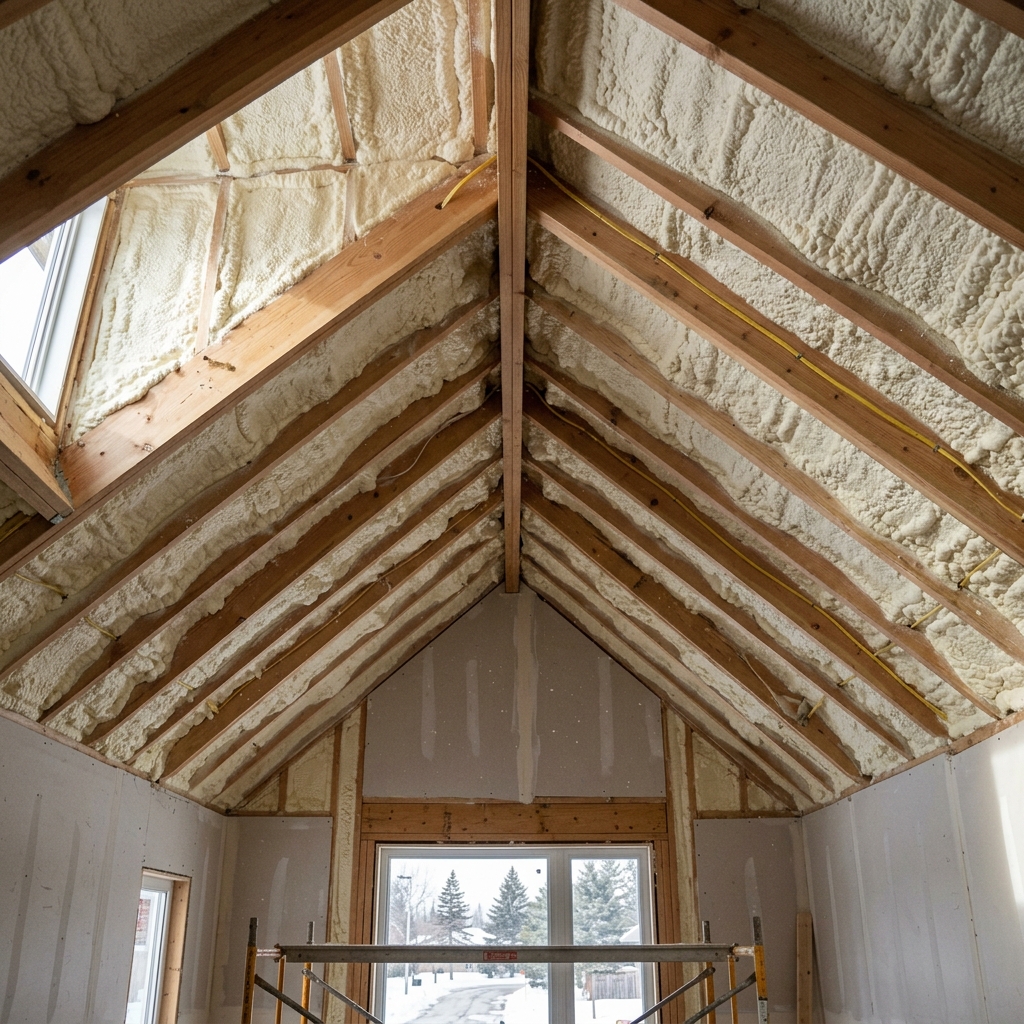
Spray foam insulation wins the net-cost comparison in Toronto — even though it costs more upfront than rigid foam boards — because spray foam qualifies for up to $10,600 in Ontario rebates while rigid foam boards qualify for $0. For a typical 1,200 sq ft GTA attic, professional spray foam runs $3,600–$4,200 all-in; after Canada Greener Homes and HER+ rebates, your out-of-pocket drops to $0–$1,500. Rigid foam costs $1,800–$3,000 and stays there. This guide breaks down every cost, performance, and application difference so you can make the right call for your home.
Spray Foam vs Rigid Foam Insulation: Which Is Right for Your Toronto Home?
For most Toronto homeowners insulating an attic, basement, or crawl space, spray foam is the better choice — it air-seals, fills every cavity, and unlocks thousands in rebates that rigid foam cannot access. Rigid foam boards (XPS, EPS, polyiso) excel in a narrow set of applications: exterior sheathing, rim-joist headers exposed to weather, and flat-roof assemblies where board installation is faster than spraying. The decision hinges on three factors: application location, rebate eligibility, and air-sealing requirement. Read through the comparison below to find your answer — or call 647-641-6881 for a free site assessment.
What Is Rigid Foam Insulation? Types, R-Value & Cost Breakdown
Rigid foam insulation comes as pre-cut boards installed in flat layers — completely different from spray foam, which is a liquid applied on-site that expands and cures into a seamless shell. There are three main types sold in the GTA:
- Expanded Polystyrene (EPS) — “beadboard”: R-3.6 per inch. Least expensive at $0.50–$1.00/sq ft installed. Moisture-permeable, so not ideal for below-grade basement walls without a drainage layer.
- Extruded Polystyrene (XPS) — “blue board” or “pink board”: R-5.0 per inch. Mid-range at $1.00–$2.00/sq ft installed. Better moisture resistance than EPS; common choice for rim joists and slab edges.
- Polyisocyanurate (polyiso): R-6.0–6.5 per inch. Most expensive rigid board at $1.50–$2.50/sq ft installed. Highest R-value per inch of any board, but degrades if exposed to UV or below-grade moisture; best for above-grade or rooftop applications.
Key limitation: rigid foam boards max out at 4-inch thickness in most residential applications, giving you R-14 to R-26 maximum per layer. For Ontario Building Code SB-12 attic targets of R-31 to R-60, you’d need to stack multiple layers with staggered joints — adding labor cost and still leaving seam gaps.
| Type | R-Value/Inch | Installed Cost (CAD/sq ft) | Max Practical Thickness | Best Application |
|---|---|---|---|---|
| EPS (beadboard) | R-3.6 | $0.50–$1.00 | 4 in (R-14) | Below-grade exterior sheathing |
| XPS (extruded) | R-5.0 | $1.00–$2.00 | 4 in (R-20) | Rim joist, slab edge, exterior wall |
| Polyiso | R-6.0–6.5 | $1.50–$2.50 | 4 in (R-26) | Flat roof, above-grade exterior |
Spray Foam Insulation Basics: Open-Cell vs Closed-Cell in Toronto
Spray foam insulation is a liquid two-component system that expands on contact and cures into a permanent air barrier — its key performance advantage over rigid boards is filling every gap, crack, and penetration with no seams. Spray foam insulation comes in two formulations:
- Open-cell spray foam (OC): R-3.7 per inch, $1.50–$3.50/sq ft installed. Expands aggressively to fill large cavities (6–9 inches deep = R-22–R-33). Soft, sound-dampening. Not a vapor barrier — requires poly vapor control in cold climates per OBC SB-12.
- Closed-cell spray foam (CC): R-6.0 per inch, $2.50–$5.00/sq ft installed. At 2 inches, acts as a Class II vapor retarder (≈1 perm). Applied 3–6 inches for R-18–R-36 in walls; 6–8 inches in attics for R-36–R-48. Rigid, structural, excellent below-grade.
Both types require a licensed contractor using heated high-pressure equipment and a thermal barrier (gypsum or intumescent paint) if exposed to a living space, per Ontario Building Code SB-12.
Cost Comparison: Spray Foam vs Rigid Foam in the GTA
Spray foam costs $1.50–$5.00/sq ft installed versus $0.50–$2.50/sq ft for rigid foam boards — but Ontario rebates flip the net-cost comparison in spray foam’s favour for nearly every GTA homeowner.
| Product | Installed Cost/sq ft (CAD) | 1,200 sq ft Project Cost | Rebate Available | Net Cost After Rebate |
|---|---|---|---|---|
| EPS rigid foam (3 in, R-10.8) | $0.50–$1.00 | $600–$1,200 | $0 | $600–$1,200 |
| XPS rigid foam (3 in, R-15) | $1.00–$2.00 | $1,200–$2,400 | $0 | $1,200–$2,400 |
| Polyiso (3 in, R-19.5) | $1.50–$2.50 | $1,800–$3,000 | $0 | $1,800–$3,000 |
| Open-cell spray foam (8 in, R-29) | $1.50–$3.50 | $3,600–$4,200 | Up to $10,600 CGHR + HER+ | $0–$1,200 |
| Closed-cell spray foam (6 in, R-36) | $2.50–$5.00 | $4,500–$6,000 | Up to $10,600 CGHR + HER+ | $0–$1,400 |
Maximum Canada Greener Homes rebate for an attic upgrade is $3,000; combined with HER+ and OAIR top-ups, total program support can reach $10,600. Visit our Ontario rebates page or call 647-641-6881 for a rebate pre-qualification check.
R-Value Per Inch: Rigid Foam vs Spray Foam — What Actually Matters
Rigid foam boards have a higher R-value per inch than open-cell spray foam — but per-inch R-value is the wrong metric; what matters is total R-value achieved across your actual cavity depth.
- Polyiso at R-6.5/inch sounds impressive, but a 4-inch board gives you R-26 maximum. Your attic truss cavity is 10–14 inches deep — you’d need to stack three layers with staggered seams to reach R-78, which is neither practical nor cost-effective.
- Open-cell spray foam at R-3.7/inch fills a 9-inch rafter cavity completely: 9 × 3.7 = R-33.3, meeting OBC SB-12 without stacking.
- Closed-cell spray foam at R-6/inch fills a 6-inch wall stud bay: 6 × 6 = R-36, exceeding Ontario code targets at half the thickness needed by rigid boards.
| Material | R-Value/Inch | Max Cavity Fill Depth | Total R-Value Achievable | Air Sealing? |
|---|---|---|---|---|
| EPS rigid foam | R-3.6 | 4 in (board) | R-14 | No — seams leak |
| XPS rigid foam | R-5.0 | 4 in (board) | R-20 | No — seams leak |
| Polyiso | R-6.0–6.5 | 4 in (board) | R-26 | No — seams leak |
| Open-cell spray foam | R-3.7 | 6–9 in (full cavity) | R-22–R-33 | Yes — seamless |
| Closed-cell spray foam | R-6.0 | 4–8 in (full cavity) | R-24–R-48 | Yes — seamless |
| Fiberglass batt | R-3.2–3.8 | 5.5–7.5 in (batt) | R-19 (settles to R-15) | No — gaps remain |
| Blown-in cellulose | R-3.5–3.7 | Up to 14+ in | R-49+ (attic) | Partial — fills gaps |
Air Sealing & Thermal Bridging: Spray Foam vs Rigid Foam Performance
Spray foam eliminates air leakage through gaps and penetrations; rigid foam boards leave seams that become thermal bridges — and air leakage accounts for 25–40% of heat loss in Ontario homes.
When rigid foam boards are installed, each board edge leaves a 1/4–1/2 inch gap to adjacent boards and framing members. Temperature cycling in Toronto’s –20°C to +35°C seasonal range causes boards to shift, widening those seams. A rim joist insulated with XPS boards in a Scarborough semi-detached will show measurable seam separation within 3–5 years.
Spray foam expands into every crack, gap, and penetration — electrical outlet boxes, HVAC duct penetrations, joist-to-sill plate connections — forming a continuous monolithic air barrier. Spray-foamed homes reduce air infiltration by 50–75% compared to rigid-board assemblies in similar cavity configurations.
Thermal bridging: Exterior continuous rigid foam (applied over the sheathing plane, covering framing members) does reduce thermal bridging better than cavity insulation alone — this is where rigid foam genuinely excels. For maximum performance, a hybrid approach — exterior rigid foam over sheathing plus interior spray foam in cavities — addresses both air sealing and thermal bridging simultaneously.
Application Guide: Where to Use Spray Foam vs Rigid Foam (Attic, Basement, Rim Joist)
The right insulation material depends on location: spray foam outperforms in cavities and below-grade; rigid foam leads in exterior continuous-insulation applications.
| Application | Best Choice | Why | Rebate Eligible? |
|---|---|---|---|
| Attic cavity (rafter/truss bays) | Open-cell spray foam | Fills full depth (R-29–R-33), air-seals all penetrations | Yes (CGHR, HER+) |
| Basement walls (above & below grade) | Closed-cell spray foam | Vapor barrier + air barrier + moisture resistance in one product | Yes (CGHR, HER+) |
| Rim joist (interior) | Closed-cell spray foam (2–3 in) | Seals all framing gaps, no seam separation, vapor barrier | Yes |
| Rim joist (exterior, exposed) | XPS rigid foam board | Structural board handles weather exposure | No |
| Exterior wall sheathing (continuous) | Rigid foam (XPS or polyiso) | Continuous layer over studs reduces thermal bridging | No |
| Flat roof / low-slope roof | Polyiso rigid foam | Tapered board system; board installation optimized for flat planes | No |
| Crawl space walls & floor | Closed-cell spray foam | Handles moisture, seals all penetrations, no seam separation | Yes |
Mixed approach: Many GTA homes benefit from a hybrid strategy — closed-cell spray foam on interior rim joist faces plus rigid foam boards on exterior sheathing. This captures spray foam’s air-sealing strength, the continuous R-value of rigid boards, spray foam’s rebate eligibility, and full OBC SB-12 compliance in one assembly.
Rebate Eligibility: Why Spray Foam Qualifies but Rigid Foam Doesn’t
Rigid foam insulation is explicitly excluded from Ontario’s major retrofit rebate programs — this single fact changes the net-cost economics for 70%+ of GTA homeowners who qualify for rebates.
- Canada Greener Homes Retrofit (CGHR): Up to $10,600 total. Eligible: spray foam, fiberglass batt, blown-in cellulose, mineral wool. Rigid foam boards: NOT eligible. Requires pre- and post-retrofit EnerGuide assessment.
- HER+ (Home Efficiency Rebate Plus, Enbridge/Union Gas): Up to $5,000 for gas-heated Ontario homes. Eligible: spray foam, batt, blown-in. Rigid foam: NOT eligible. Stacks with CGHR.
- OAIR (Ontario Accessible & Inclusive Retrofits): Up to $1,250. Same eligibility rules — spray foam qualifies, rigid foam does not.
The eligibility gap exists because these programs require insulation that provides both thermal resistance AND verifiable air-sealing performance — a combination that rigid boards cannot reliably deliver due to seam gaps. If you want to access Ontario insulation rebates, spray foam is the only foam-based product that qualifies.
Moisture Control & Durability: 20+ Year Comparison
Closed-cell spray foam is the superior moisture-control solution for below-grade and high-humidity applications, while rigid foam boards offer solid longevity in dry, protected locations but degrade when seams separate or UV exposure occurs.
- Closed-cell spray foam: Acts as a Class II vapor retarder at 2 inches (≈1 perm). Impervious to liquid water intrusion. Adheres to concrete, block, and wood framing. Expected lifespan: 20–30+ years with no degradation or settling. Off-gasses for 24–48 hours after application, then permanently stable.
- Open-cell spray foam: Air barrier only — permeable to vapor (8–12 perms). Requires a separate poly vapor barrier in Ontario per OBC SB-12. Lifespan: 20+ years with no settling.
- XPS rigid foam: Good moisture resistance in dry conditions. Seams separate in temperature-cycling zones (3–5 year risk in Toronto’s climate). UV exposure causes surface degradation within 60–90 days if left unprotected.
- Polyiso: R-value degrades in cold temperatures (R-6.5 at 75°F drops to R-5.0 at 0°F). Performs poorly below grade or in high-moisture areas. Lifespan: 30–50 years in protected, dry applications.
- EPS: Most moisture-permeable of the rigid boards. Longest theoretical lifespan (50+ years), least affected by temperature cycling, but lowest R-value per inch.
The Real Cost After Rebates: Spray Foam Net Cost $0–$1.5K, Rigid Foam Stays $1.2K+
After factoring in Ontario rebates, spray foam insulation is cheaper than rigid foam for most GTA attic and basement projects — reversing the upfront cost comparison completely.
| Scenario | Product | Project Cost (CAD) | Rebate | Net Cost | R-Value Achieved |
|---|---|---|---|---|---|
| 1,200 sq ft attic | XPS (3 in, R-15) | $1,200–$2,400 | $0 | $1,200–$2,400 | R-15 |
| 1,200 sq ft attic | Polyiso (3 in, R-19.5) | $1,800–$3,000 | $0 | $1,800–$3,000 | R-19.5 |
| 1,200 sq ft attic | Open-cell spray foam (8–9 in) | $3,600–$4,200 | Up to $3,000 (CGHR) + $2,000 (HER+) | $0–$1,200 | R-29–R-33 |
| 600 sq ft basement walls | XPS (2 in, R-10) | $600–$1,200 | $0 | $600–$1,200 | R-10 |
| 600 sq ft basement walls | Closed-cell spray foam (3 in) | $1,500–$3,000 | Up to $1,500 (CGHR) + $1,000 (HER+) | $0–$500 | R-18 + vapor barrier |
Real-world example: A Vaughan homeowner with a 1,200 sq ft attic chose open-cell spray foam over polyiso boards. All-in cost: $3,900. Post-EnerGuide CGHR rebate: $2,600. HER+ top-up: $1,500. Net paid: $0 (with $200 surplus applied to the rim joist). The polyiso alternative would have been $2,200 unrebated, achieved only R-19.5 vs R-31, and left 14 attic penetrations air-leaking.
“We got quotes for foam board and spray foam. Spray Foam Kings explained the rebate math in five minutes — after rebates, spray foam was actually cheaper AND we got better insulation. Our heating bill dropped $180 the first winter.” — David K., Vaughan homeowner
Decision Tree: Should You Choose Spray Foam or Rigid Foam?
Answer these four questions to find your answer — most Toronto homeowners choose spray foam once the rebate economics are clear.
- Is your application an exterior rim-joist face, exterior wall sheathing, or flat roof?
→ YES: Rigid foam is viable (and preferred for exterior continuous-insulation value). Proceed to Q2.
→ NO (attic, basement wall, crawl space, interior rim joist): Spray foam wins. - Do you want to access Ontario rebates (CGHR, HER+, OAIR)?
→ YES: Spray foam is mandatory for rebate eligibility. Rigid foam will not qualify.
→ NO (exterior sheathing only, commercial application): Rigid foam is a practical choice. - Is air sealing a priority?
→ YES: Spray foam provides a seamless air barrier; rigid boards leave seams.
→ NO (adding exterior continuous insulation to an already air-sealed assembly): Rigid foam works. - Summary: If you’re insulating an attic, basement, or crawl space and want Ontario rebates → choose spray foam. If you’re adding exterior continuous insulation on a new build → rigid foam is competitive. Hybrid (exterior rigid + interior spray foam) is optimal for high-performance assemblies.
Frequently Asked Questions
What is rigid foam insulation and how is it different from spray foam?
Rigid foam insulation is a pre-manufactured board product (EPS, XPS, or polyiso) cut and installed in flat layers, while spray foam is a liquid applied on-site that expands and cures into a seamless, adhered shell. Spray foam fills every cavity, crack, and penetration with no seams; rigid boards leave gaps at board edges that become air leakage and thermal bridge points over time.
How much does rigid foam insulation cost per square foot in Toronto?
Rigid foam insulation costs $0.50–$2.50/sq ft installed in the GTA: EPS $0.50–$1.00/sq ft, XPS $1.00–$2.00/sq ft, and polyiso $1.50–$2.50/sq ft. These prices are not reduced by rebates — rigid foam boards are ineligible for CGHR, HER+, or OAIR programs.
Does rigid foam insulation qualify for Ontario rebates?
No — rigid foam boards are not eligible for Ontario’s major retrofit rebate programs including Canada Greener Homes (up to $10,600), HER+ (up to $5,000), or OAIR (up to $1,250). Only spray foam, fiberglass batt, blown-in cellulose, and mineral wool qualify. A $2,000 rigid foam project stays $2,000; a $4,000 spray foam project can drop to $0–$1,500 post-rebate.
Which has a higher R-value: rigid foam or spray foam?
Rigid foam (polyiso) has a higher R-value per inch (R-6.0–6.5/inch) than open-cell spray foam (R-3.7/inch), but spray foam achieves higher total cavity R-values because it fills the full depth of a cavity (6–9 inches) while rigid boards are limited to 4-inch maximum thickness per layer. A 9-inch open-cell spray foam attic application reaches R-33; a 4-inch polyiso board reaches R-26.
Is rigid foam better for air sealing than spray foam?
No — spray foam is significantly better for air sealing. Spray foam expands into every gap and penetration and cures as a continuous monolithic barrier. Rigid foam boards leave seam gaps (1/4–1/2 inch) at board edges and framing members that cannot be reliably sealed long-term in Toronto’s temperature-cycling climate.
What is thermal bridging and does spray foam prevent it?
Thermal bridging occurs when a conductive material (wood studs, concrete framing) conducts heat through the insulation layer, bypassing its R-value. Spray foam fills cavities between framing members but does not eliminate bridging through the framing itself. Exterior continuous rigid foam installed over the sheathing plane — covering framing — reduces thermal bridging better than cavity insulation alone. The optimal approach is hybrid: exterior rigid foam plus interior spray foam.
Where should I use rigid foam vs spray foam in my Toronto home?
Use spray foam for attic cavities, basement walls, interior rim joists, and crawl spaces — anywhere air sealing and full-cavity coverage matter and Ontario rebates are desired. Use rigid foam for exterior wall sheathing (continuous insulation over framing), exposed exterior rim joist faces, and flat or low-slope roofing. For most Toronto renovation projects, spray foam covers the high-value applications and qualifies for rebates rigid foam cannot access.
How long does rigid foam insulation last compared to spray foam?
Rigid foam boards have a theoretical lifespan of 30–50 years (EPS: 50+ years), but degrade faster in practice: seam separation occurs within 3–5 years in temperature-cycling zones, polyiso loses R-value in cold conditions, and UV exposure degrades unprotected surfaces within 60–90 days. Closed-cell spray foam shows zero settling or seam separation over 20+ years in GTA conditions.
Is rigid foam fire-safe and do I need a thermal barrier?
Rigid foam is combustible and requires a 15-minute thermal barrier (minimum 12.7mm gypsum wallboard or approved intumescent coating) when exposed to a living space per Ontario Building Code SB-12. The same requirement applies to spray foam. Neither product can be left exposed in finished basements, attics with living space below, or occupied crawl spaces without a compliant thermal barrier.
What about moisture control: spray foam vs rigid foam for basements?
Closed-cell spray foam is superior for below-grade basement walls — it acts as both an air barrier and Class II vapor retarder (≈1 perm at 2 inches) in one application, resists liquid water intrusion, and adheres directly to concrete. Rigid XPS boards leave seams at the concrete interface where moisture migrates; EPS is moisture-permeable and not recommended below grade without a separate drainage plane.
Can I use rigid foam in my Toronto attic?
You can, but it’s not recommended. Rigid boards cannot fill full rafter bay depth without stacked layers, leave seam gaps at every board edge and framing member, do not air-seal attic penetrations (pot lights, HVAC chases, plumbing vents), and do not qualify for Ontario rebates. Open-cell spray foam is the standard choice for GTA attic insulation upgrades — better performance and lower net cost after rebates.
What is the payback period for spray foam vs rigid foam in Toronto?
Spray foam in a Toronto attic typically achieves payback in 2–4 years after rebates, based on $150–$250 annual heating cost reduction and a net post-rebate cost of $0–$1,500. Rigid foam payback for the same application runs 6–10 years given the $1,800–$3,000 net project cost with no rebate offset and lower energy savings due to inferior air sealing.
Is spray foam insulation worth it in Ontario compared to rigid foam?
Yes — spray foam is worth it for the vast majority of Ontario homeowners insulating attics, basements, or crawl spaces. Superior air sealing, full cavity R-value coverage, and exclusive access to up to $10,600 in Ontario rebates means spray foam delivers better performance at lower net cost than rigid foam for most residential applications. The only scenario where rigid foam clearly leads is exterior continuous sheathing — a specific use case spray foam is not designed for.
Why Choose Spray Foam Kings (SFK)?
Spray Foam Kings is the GTA’s SPFA-certified spray foam specialist — combining 15+ years of spray foam experience with active rebate navigation for every project. We serve Toronto, Scarborough, North York, Etobicoke, Vaughan, Mississauga, Markham, and Brampton.
- SPFA certified — Spray Polyurethane Foam Alliance certification, the industry’s highest technical standard
- $5M liability insurance + WSIB — full coverage on every job, no exceptions
- 15+ years GTA experience — 1,000+ completed projects across the Greater Toronto Area
- Rebate navigation included — we pre-qualify your project for CGHR, HER+, and OAIR before the first spray
- OBC SB-12 compliance — all work documented to Ontario Building Code standards for permits and resale
- Honest product recommendation — if rigid foam is genuinely right for your application, we’ll tell you so. Free assessment, no pressure.
See how we compare across every insulation type in our detailed spray foam vs foam board insulation guide, or use our Ontario insulation cost calculator to estimate your project cost and rebate eligibility before calling.
Get Your Free Quote Today
Call: 647-641-6881
Spray Foam Kings provides free, no-obligation assessments across the Greater Toronto Area — Toronto, Scarborough, North York, Etobicoke, Vaughan, Mississauga, Markham, and Brampton. We’ll evaluate your attic, basement, or rim joist application, tell you honestly which product is right for your home, and pre-qualify your project for Ontario rebates. SPFA certified. $5M liability. WSIB. OBC SB-12 compliant.