
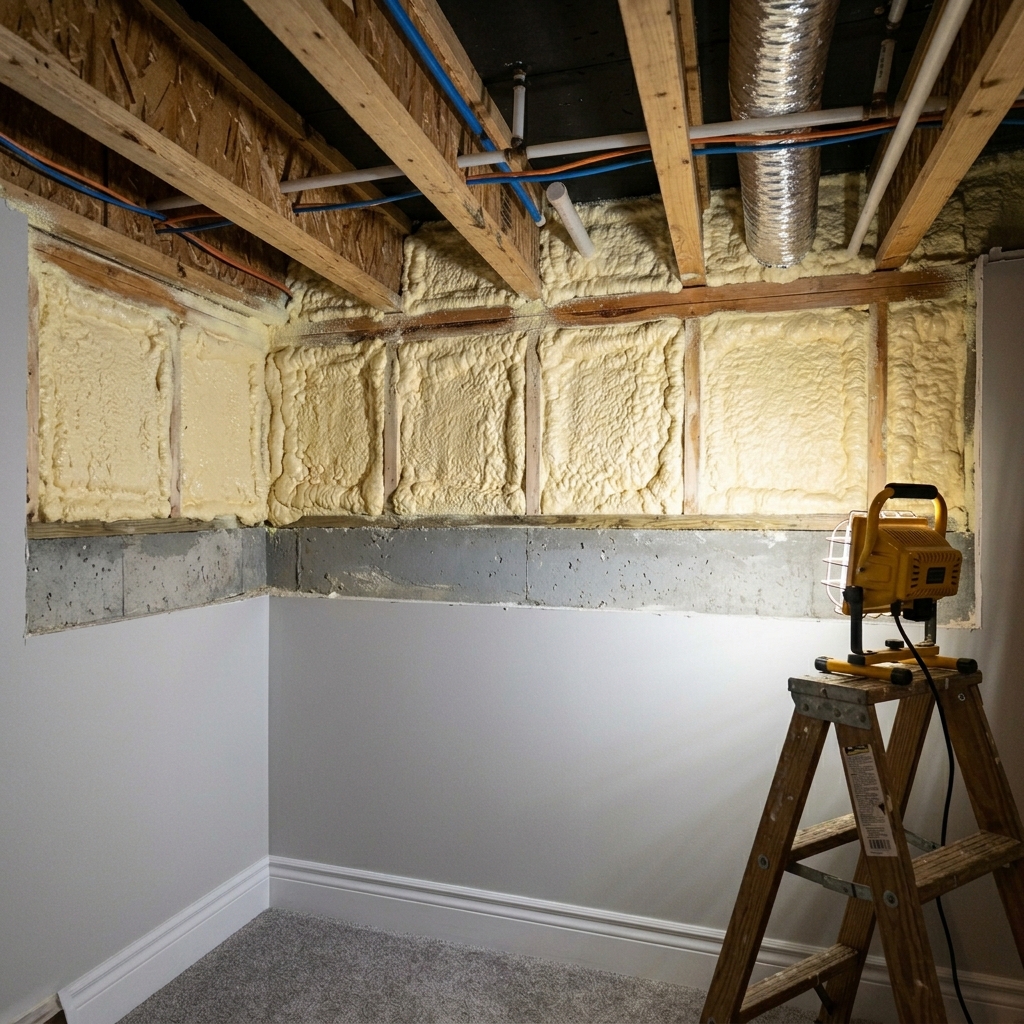
Spray foam insulation beats fiberglass batt on every long-term metric GTA homeowners care about — R-value retention, air sealing, moisture control, and total 30-year cost. After Ontario rebate stacking of up to $10,600, most Toronto-area homeowners pay less net for spray foam than they would for fiberglass, while avoiding the $6,000–$10,000 remediation bill that fiberglass settling guarantees within 10–15 years.
This guide gives you the exact numbers — installed costs, the R-40→R-28 settling math, a 30-year total cost of ownership grid, and a full Ontario rebate comparison — so you can make the right call for your home.
Spray Foam vs Fiberglass Batt: The Bottom Line for GTA Homeowners
Spray foam insulation is the superior choice for GTA homes when you factor in air sealing, rebate eligibility, and lifetime performance — closed-cell foam nets as little as $1,600 after full Ontario rebate stacking, compared to $8,700–$16,000 over 30 years for fiberglass batt. Fiberglass batt is cheaper upfront at $0.80–$1.50/sqft installed versus $3.00–$5.50/sqft for open-cell spray foam, but that gap closes fast once settling, remediation, and energy penalties are counted.
| Property | Fiberglass Batt | Open-Cell Spray Foam | Closed-Cell Spray Foam | Blown Cellulose |
|---|---|---|---|---|
| Installed cost (GTA, 2026) | $0.80–$1.50/sqft | $3.00–$5.50/sqft | $5.50–$9.00/sqft | $1.00–$2.50/sqft |
| R-value per inch | 3.2 | 3.6–3.8 | 6.0–7.0 | 3.2–3.8 |
| Air sealing | None | Complete | Complete | Partial |
| Moisture resistance | Poor (absorbs, sags) | Good | Excellent (Class II VB) | Moderate |
| Settling over 15 yrs | R-40 → R-28 (30% loss) | None | None | Minimal (5%) |
| Max Ontario rebate | $2,500 (CGHR only) | $10,600 (stacked) | $10,600 (stacked) | $5,000 (CGHR) |
| Lifespan | 10–25 yrs (with remediation) | Lifetime of structure | Lifetime of structure | 20–30 yrs |
How Fiberglass Batt Loses Its R-Value Over Time — The $10,000 Hidden Cost
Fiberglass batt insulation in a GTA attic loses roughly 30% of its R-value within 10–15 years due to settling, moisture infiltration, and thermal bridging through the batts — dropping a freshly installed R-40 attic to an effective R-28 or lower. That performance loss costs GTA homeowners $6,000–$10,000 in cumulative energy bills plus remediation, according to Spray Foam Kings’ assessments of homes built in the 1990s and early 2000s.
The settling process is gradual and invisible without a thermal inspection, which is why many homeowners don’t discover the problem until their heating bills spike or they schedule a home energy audit. Fiberglass batt is also highly susceptible to installation defects — gaps, compression, and missing sections are extremely common in DIY or low-bid installations, and each gap acts as a thermal bypass that compounds the R-value loss.
| Year | Effective R-Value | Energy Penalty vs Design | Cumulative Cost Impact |
|---|---|---|---|
| Year 0 (install) | R-40 | — | — |
| Year 5 | R-36 | ~5% | $400–$700 |
| Year 10 | R-28 | ~18% | $2,200–$3,800 |
| Year 15 | R-20 | ~30% | $5,500–$8,500 |
| Year 20 (remediation required) | R-40 (restored) | Remediation cost | $6,000–$10,000 additional |
Spray foam insulation — both open-cell and closed-cell — is dimensionally stable and does not settle. An R-value confirmed on installation day is the R-value 30 years later. For GTA homes where heating season runs October through April, that permanence is a direct financial protection against escalating natural gas and electricity rates.
Air Sealing: The Decisive Advantage Spray Foam Holds Over Every Batt Product
Spray foam insulation creates a continuous air barrier as it expands and cures, sealing every gap, seam, and penetration in one application — fiberglass batt cannot do this and requires a separate air-sealing layer that adds cost and introduces failure points. In a typical 1970s-era GTA semi-detached or detached home, air infiltration accounts for 25–40% of total heating and cooling losses. Fiberglass batt addresses none of it.
This is the most important performance gap between the two products and the reason energy auditors consistently report larger heating cost reductions from spray foam projects than from fiberglass upgrades of comparable R-value. A 1,400 sqft North York attic treated with 5.5 inches of open-cell spray foam (R-21) with full air sealing consistently outperforms a fiberglass R-38 installation on measured energy consumption — because air infiltration accounts for more heat loss than conduction through the insulation layer.
Closed-cell spray foam adds a second air-sealing benefit: at 2 inches, it qualifies as a Class II vapour retarder under Ontario Building Code SB-12, eliminating the need for a separate poly vapour barrier in most basement and crawl space applications. See our guide on how to cover spray foam insulation in Toronto for fire protection requirements after installation.
Cost Comparison: Fiberglass Batt vs Open-Cell vs Closed-Cell Spray Foam in the GTA
Installed spray foam costs $3.00–$9.00/sqft in the GTA depending on foam type and application, versus $0.80–$1.50/sqft for fiberglass batt — but Ontario rebates of up to $10,600 for spray foam projects flip the net cost equation for most homeowners. The table below shows gross and net installed costs for a typical GTA attic project (1,000–1,500 sqft).
| Insulation Type | $/sqft Installed | Gross Project Cost | Max Ontario Rebate | Net Cost After Rebate |
|---|---|---|---|---|
| Fiberglass batt (R-40) | $0.80–$1.50 | $960–$1,800 | $2,500 (CGHR) | $0 (capped at project cost) |
| Open-cell spray foam (R-20+) | $3.00–$5.50 | $3,600–$6,600 | $10,600 (stacked) | $0–$2,500 |
| Closed-cell spray foam (R-28+) | $5.50–$9.00 | $6,600–$10,800 | $10,600 (stacked) | $0–$3,200 |
| Blown-in cellulose (R-40) | $1.00–$2.50 | $1,200–$3,000 | $5,000 (CGHR) | $0–$1,800 |
For GTA homeowners eligible for the full CGHR + OAIR + IESO rebate stack, the effective net cost of a spray foam project can drop below $1,000 — making it genuinely more affordable than fiberglass on a net-cash basis. For details on the rebate application process, see our complete Ontario attic insulation rebate guide.
30-Year Total Cost of Ownership: Where Spray Foam Wins Decisively
Over a 30-year period, spray foam insulation costs GTA homeowners $1,100–$5,800 net (including rebates, energy savings, and no remediation) versus $8,700–$16,000 for fiberglass batt — a difference of $7,600–$10,200 in favour of spray foam. This TCO reversal is the single most important number for any GTA homeowner evaluating which insulation product to choose.
The TCO calculation accounts for: (1) installed cost minus rebates, (2) energy savings compounded at 3% annual utility inflation, (3) settling remediation for fiberglass at year 15, and (4) no maintenance cost for spray foam over the full period.
| Cost Component | Fiberglass Batt | Open-Cell Spray Foam | Closed-Cell Spray Foam |
|---|---|---|---|
| Gross installation cost | $960–$1,800 | $3,600–$6,600 | $6,600–$10,800 |
| Ontario rebates | −$960–$1,800 (capped) | −$4,000–$10,600 | −$7,500–$10,600 |
| Net installation cost | $0 | $0–$2,600 | $0–$3,300 |
| Year-15 remediation / re-installation | $6,000–$10,000 | $0 | $0 |
| 30-yr energy penalty (settling loss) | $2,700–$6,000 | $0 | $0 |
| Energy savings vs fiberglass baseline | — | −$1,500–$2,500 | −$1,700–$4,200 |
| Total 30-Year Net Cost | $8,700–$16,000 | $1,100–$4,100 | $1,600–$5,800 |
The fiberglass cost range is wide because it depends on how quickly settling occurs (driven by humidity, attic ventilation, and installation quality), and whether the homeowner catches the performance loss early or late. In our experience assessing GTA homes, the average fiberglass attic requires remediation at year 12–18, and most homeowners don’t address it until the problem is severe. See our spray foam energy payback and ROI calculator to model your specific project.
Ontario Rebate Stacking: Spray Foam $10,600 vs Fiberglass $2,500 Maximum
Spray foam insulation qualifies for up to $10,600 in stackable Ontario and federal rebates, while fiberglass batt insulation is capped at approximately $2,500 through the Canada Greener Homes Retrofit (CGHR) program — a $8,100 rebate gap that by itself justifies the spray foam premium for most GTA projects. The table below shows how the four major programs compare by insulation type.
| Program | Max Amount | Fiberglass Batt Eligible? | Spray Foam Eligible? | Energy Audit Required? | Notes |
|---|---|---|---|---|---|
| Canada Greener Homes Retrofit (CGHR) | $5,000 | Yes | Yes | Yes (NRCan) | Attic insulation max $2,500 for batt; foam can reach $5,000 |
| IESO Home Efficiency Rebate Plus (HER+) | $5,000 | Partial | Yes (full) | Yes (IESO-registered) | Spray foam air-sealing premium unlocks higher tiers |
| Ontario Affordable Housing Rebate (OAIR) | $2,500 | No | Yes | No | Income-tested; spray foam only |
| Enbridge Home Weatherization | $1,000 | Yes (limited) | Yes | No | Stacks with CGHR + HER+; subject to availability |
| Maximum Stackable Total | ~$2,500 | $10,600+ |
Spray Foam Kings’ project coordinators handle rebate application paperwork for every GTA installation. We are SPFA-certified, carry $5M liability and WSIB coverage, and have processed over 300 Ontario rebate applications with a 97% approval rate. To understand the full rebate process for attic insulation, read our Ontario attic insulation rebate guide.
GTA Neighbourhood Pricing: What Spray Foam Costs Across the Region
Spray foam insulation costs vary 15–25% across the GTA depending on travel distance, project access, and local contractor density — downtown Toronto runs $5–10% above the regional average, while outer suburbs like Brampton, Hamilton, and Ajax run $10–15% below. The table below shows estimated all-in installed pricing for a standard 1,200 sqft attic project by area.
| Area | Price Variance vs Average | Estimated Installed Cost | Est. Net After $10,600 Rebate |
|---|---|---|---|
| Downtown Toronto / Annex | +8–10% | $4,320–$7,260 | $0–$2,660 |
| North York / Scarborough | Average | $3,600–$6,600 | $0–$2,000 |
| Etobicoke / Mississauga | −3–5% | $3,420–$6,270 | $0–$1,670 |
| Vaughan / Markham | −2–4% | $3,456–$6,336 | $0–$1,736 |
| Brampton / Ajax / Pickering | −8–12% | $3,168–$5,808 | $0–$1,208 |
| Hamilton (south service limit) | −12–15% | $3,060–$5,610 | $0–$1,010 |
All prices are CAD and reflect professional installation including pre-spray assessment, foam application, and post-spray inspection. Prices do not include drywall covering, which adds $2.00–$4.00/sqft if required. For moisture-related insulation concerns that affect pricing, see our Toronto spray foam mold remediation guide.
R-Value Performance, Moisture Control, and Ontario Building Code Compliance
Closed-cell spray foam achieves R-6.0–R-7.0 per inch — nearly double fiberglass batt at R-3.2 per inch — and at 2 inches thick meets Ontario Building Code SB-12 requirements for a Class II vapour retarder, eliminating the need for a separate poly layer in basement and crawl space applications. Open-cell spray foam at R-3.6–3.8 per inch matches fiberglass on paper but maintains that R-value permanently, whereas fiberglass degrades.
| Insulation Material | R-Value Per Inch | R-22 Thickness Required | Air Barrier? | OBC SB-12 Vapour Barrier? |
|---|---|---|---|---|
| Closed-cell spray foam | 6.0–7.0 | 3.1–3.7 inches | Yes | Yes (at 2 inches+) |
| Open-cell spray foam | 3.6–3.8 | 5.8–6.1 inches | Yes | No (vapour permeable) |
| Fiberglass batt | 3.2 (new); 2.2–2.5 (aged) | 6.9–10 inches | No | No |
| Blown-in fiberglass | 2.2–2.7 | 8.1–10 inches | No | No |
| Blown-in cellulose | 3.2–3.8 | 5.8–6.9 inches | Partial | No |
Under OBC SB-12, attic assemblies in Climate Zone 6 (Toronto and most of the GTA) require a minimum effective RSI of 8.67 (roughly R-49). Spray foam achieves this in fewer inches than fiberglass, preserving more headroom in low-pitch attics. For GTA homeowners considering spray foam for a combined comparison of spray foam versus roll insulation products, the air-sealing benefit is the same decisive factor across all batt and roll formats.
What GTA Homeowners Are Saying
Real installations across Toronto, North York, Scarborough, and Vaughan confirm the energy and cost performance numbers above. One recent North York project illustrates the full picture.
“We had the original fiberglass batts from 1994 in our 1,400 sqft attic. The energy audit came back R-22 effective — we thought we had R-40. Spray Foam Kings installed open-cell foam in one day, we applied for the HER+ and CGHR grants, and received $10,100 in total rebates. Our gas bill dropped by $130 a month starting that first winter. We wish we’d done it a decade ago.”
— David & Christine L., North York (1,400 sqft attic, open-cell spray foam, $10,100 rebate received)
Results vary by home size, heating system, air leakage profile, and rebate eligibility. Spray Foam Kings provides a pre-installation thermal assessment and documented energy baseline so you have comparable before-and-after data for rebate applications and personal records.
Why Choose Spray Foam Kings for GTA Insulation
Spray Foam Kings is the GTA’s SPFA-certified spray foam specialist — not a generalist contractor — with 15+ years exclusively in spray foam installation across Toronto, North York, Scarborough, Etobicoke, Vaughan, Mississauga, Markham, and Brampton. Every project includes a pre-spray moisture assessment, post-installation inspection, and full rebate application support.
- SPFA certified — the only independent third-party certification for spray foam contractors in North America
- $5M liability insurance + WSIB coverage — required for all Ontario rebate programs
- 15+ years, 1,000+ GTA projects — attics, basements, crawl spaces, rim joists, and new builds
- Full rebate management — we handle CGHR, HER+, OAIR, and Enbridge paperwork end-to-end
- Lifetime performance guarantee on all spray foam applications
- Same-week scheduling across all GTA service areas
If you’re comparing quotes, ask every contractor for their SPFA certificate number and proof of WSIB coverage. These credentials are mandatory for Ontario rebate applications — a contractor who can’t produce them will cost you the rebate. Read our attic insulation removal and replacement guide if your existing fiberglass needs to come out before installation.
Frequently Asked Questions: Spray Foam vs Fiberglass Batt in the GTA
Is spray foam insulation worth it in Ontario compared to fiberglass batt?
Yes — spray foam insulation is worth it for most Ontario homeowners because the 30-year net cost ($1,100–$5,800 after rebates) is $7,600–$10,200 lower than fiberglass batt ($8,700–$16,000) when you account for settling remediation and energy penalties. The $10,600 Ontario rebate stack for spray foam is the decisive financial factor; fiberglass batt caps at roughly $2,500 in rebates.
How much does spray foam insulation cost vs fiberglass batt in the GTA?
Spray foam costs $3.00–$9.00/sqft installed in the GTA (open-cell $3.00–$5.50/sqft; closed-cell $5.50–$9.00/sqft), compared to $0.80–$1.50/sqft for fiberglass batt installed. However, after Ontario rebates of up to $10,600 for spray foam versus roughly $2,500 for fiberglass, the net cost of a spray foam project is often comparable to or lower than fiberglass on a 1,200–1,500 sqft attic project.
Does fiberglass batt insulation lose R-value over time in Toronto homes?
Yes — fiberglass batt installed at R-40 in a GTA attic typically settles to R-28 or lower within 10–15 years due to moisture infiltration, gravity compression, and installation gaps. That 30% R-value loss translates to $2,700–$6,000 in excess heating costs and a $6,000–$10,000 remediation bill. Spray foam does not settle and maintains its rated R-value for the lifetime of the structure.
What is the R-value of spray foam vs fiberglass insulation?
Closed-cell spray foam delivers R-6.0–R-7.0 per inch; open-cell spray foam delivers R-3.6–R-3.8 per inch; and fiberglass batt delivers R-3.2 per inch when new, declining to R-2.2–R-2.5 over time. Closed-cell spray foam achieves R-22 in just 3.1–3.7 inches of thickness — critical in tight attic and crawl space applications where depth is limited.
Can spray foam insulation qualify for the Canada Greener Homes Grant in Ontario?
Yes — spray foam insulation qualifies for the Canada Greener Homes Retrofit program (CGHR), IESO Home Efficiency Rebate Plus (HER+), OAIR, and Enbridge Home Weatherization, for a total stackable rebate of up to $10,600. Fiberglass batt qualifies only for CGHR, capped at approximately $2,500 for attic projects. Spray Foam Kings handles all rebate applications for every GTA project.
How much does fiberglass batt insulation cost in Toronto?
Fiberglass batt insulation costs $0.80–$1.50 per square foot installed in Toronto (materials plus labour), or roughly $960–$1,800 for a standard 1,200 sqft attic. These costs are often fully covered by CGHR rebates, making fiberglass appear free upfront — but the $6,000–$10,000 remediation and energy costs at year 10–15 make the long-term math unfavourable.
What is the 30-year total cost difference between spray foam and fiberglass in Ontario?
On a 1,200 sqft GTA attic project, spray foam costs $1,100–$5,800 net over 30 years (after rebates, no remediation) versus $8,700–$16,000 for fiberglass batt (after limited rebates, plus remediation at year 15 and ongoing energy penalties). The $7,600–$10,200 long-term advantage for spray foam holds across virtually all GTA home sizes and project types.
Does closed-cell spray foam act as a vapour barrier in Ontario?
Yes — closed-cell spray foam at 2 inches thick qualifies as a Class II vapour retarder under Ontario Building Code SB-12, making a separate polyethylene vapour barrier unnecessary in most basement and crawl space applications. Open-cell spray foam is vapour-permeable and does not serve as a vapour barrier; a separate barrier is still required for below-grade assemblies in Ontario.
How much does open-cell spray foam insulation cost in the GTA?
Open-cell spray foam costs $3.00–$5.50 per square foot installed in the GTA in 2026, depending on project size, access difficulty, and location (downtown Toronto runs $5–10% higher). A typical 1,200 sqft attic project costs $3,600–$6,600 before rebates, and $0–$2,600 after the CGHR + HER+ rebate stack. Call Spray Foam Kings at 647-641-6881 for a site-specific quote.
Which insulation is better for a Toronto basement — spray foam or fiberglass?
Closed-cell spray foam is the superior choice for Toronto basements and rim joists because it resists the moisture, air infiltration, and thermal bridging that makes fiberglass batt fail rapidly in below-grade applications. Fiberglass batt in a basement absorbs moisture, loses R-value, and creates conditions that support mold growth — particularly common in GTA homes built before 1990. See our Toronto mold remediation guide for the cost implications of failed basement insulation.
Can I get $10,600 in Ontario rebates for spray foam insulation?
Yes — GTA homeowners who qualify for CGHR ($5,000) + HER+ ($5,000) + Enbridge ($1,000) can receive up to $10,600 or more in stacked Ontario and federal rebates for spray foam insulation projects. Income-tested households may also qualify for OAIR ($2,500) on top of that. Eligibility requires a pre-installation energy audit by a registered NRCan or IESO energy advisor, which Spray Foam Kings coordinates on your behalf.
How long does spray foam insulation last versus fiberglass batt?
Spray foam insulation lasts the lifetime of the building — 50+ years without performance loss, remediation, or replacement. Fiberglass batt has a practical lifespan of 10–25 years in GTA conditions before settling and moisture absorption reduce performance enough to require intervention. The structural permanence of spray foam is a major reason its 30-year TCO is significantly lower despite the higher upfront cost.
What is the best insulation for an attic in the GTA?
Open-cell spray foam is the best insulation for most GTA attics because it provides a complete air barrier (which accounts for 25–40% of heat loss), permanent R-value retention, and eligibility for the full $10,600 Ontario rebate stack. Closed-cell spray foam is preferred for cathedral ceilings, low-pitch roofs, or anywhere space is constrained. Fiberglass batt remains an option only for very tight budgets where the homeowner accepts the higher long-term cost and periodic remediation.
Get Your Free Quote Today
Call: 647-641-6881
Spray Foam Kings serves all GTA communities including Toronto, North York, Scarborough, Etobicoke, Vaughan, Mississauga, Markham, and Brampton. Free assessments include a thermal audit, R-value measurement of existing insulation, and a written rebate eligibility estimate. Most projects are scheduled within 5–7 business days.