
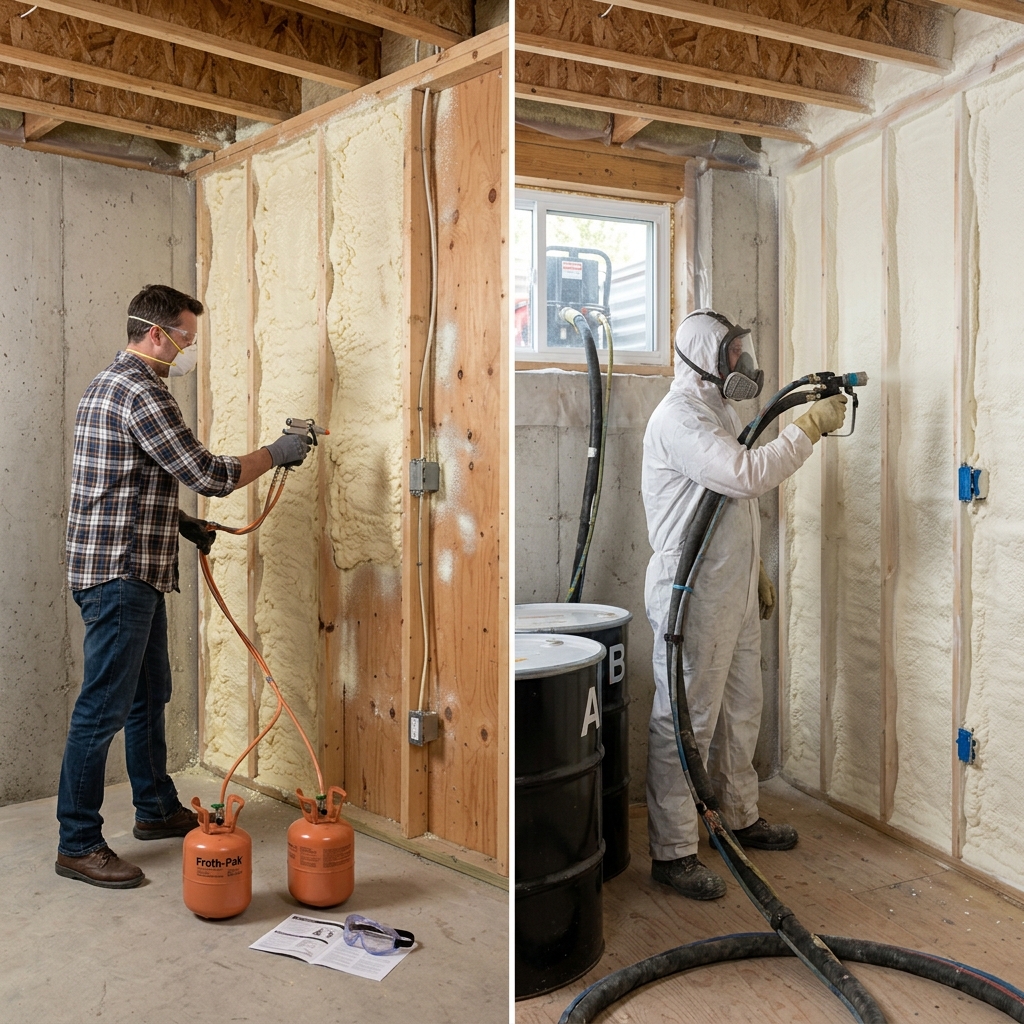
What’s the difference?
Ontario homeowners in 2026 face a genuine fork in the road: buy a DIY spray foam kit from a big-box store or hire a professional crew. The choice hinges on scope, skill, budget, and risk tolerance. DIY kits—typically closed-cell or open-cell foam cartridges—cost $200–$800 CAD and work for small gaps, basement rim joists, or attic patches. You apply them yourself, no permit required in most cases, but coverage is patchy and R-value inconsistent. Professional spray foam runs $1,200–$4,500 CAD depending on square footage, includes warranty, meets Ontario building code, and delivers uniform density and thermal performance. The real question isn’t “Can I save money?” but “Can I afford to get it wrong?” A botched DIY job in a load-bearing cavity or crawlspace can trap moisture, void insurance, or create thermal bridging that defeats the entire purpose. This post cuts through the noise and helps you decide which path makes sense for your home, your timeline, and Ontario’s regulatory landscape.
Side-by-side comparison
| Scenario | Cost (CAD) | Timeline | Permit Needed? | When to Choose | Risk if Wrong |
|---|---|---|---|---|---|
| DIY Kit (Small Area) Rim joist or attic hatch, <50 sq ft |
$250–$500 | 1–2 hours | No (under 50 sq ft) | Isolated gaps, non-structural, experienced with spray tools | Incomplete seal, drafts remain, foam shrinkage |
| DIY Kit (Medium Area) Basement cavity, 50–200 sq ft |
$500–$1,200 | 2–4 hours | Possibly (varies by municipality) | Comfort project, non-critical zone, accept variable R-value | Overspray damage, moisture trapping, insurance claim denial |
| Professional (Small) Rim joist or foundation band, <100 sq ft |
$800–$1,400 | 1 day (mobilization + cure) | No | Peace of mind, warranty, single-zone fix | None; guaranteed coverage |
| Professional (Medium) Basement, crawlspace, 200–500 sq ft |
$1,500–$2,800 | 1–2 days | Depends on scope; inspector may visit | Structural zones, moisture-prone areas, resale value | None; code compliance + 10-yr warranty |
| Professional (Large) Full attic or exterior wall, 500+ sq ft |
$2,500–$4,500 | 2–4 days | Yes (building permit required) | New construction, major renovation, energy audit recommendation | None; licensed contractor, insured |
| Hybrid (Combo) Professional for critical zones + DIY for trim |
$1,200–$2,200 | 2–3 days total | Only for pro portion | Budget-conscious, mixed-risk areas | Low, if pro handles structural/moisture zones |
DIY spray foam kits — when it’s the right call
DIY spray foam makes sense for small, non-critical repairs. You’re filling a gap around a basement window, sealing rim joists in a non-conditioned attic, or plugging holes around utility penetrations. The upfront cost is low—a two-component kit runs $200–$400 CAD—and the learning curve is manageable if you’ve used a caulk gun or spray applicator before. Most kits come with trigger-spray or cartridge guns that don’t require compressors or licensing. You control the schedule: buy it, use it, finish in an afternoon.
The real sweet spot is the homeowner who has a clear-cut problem—say, a drafty rim joist in a finished basement—and the confidence to prep the area properly: vacuum dust, mask off surfaces, wear a respirator and gloves, and follow the manufacturer’s instructions to the letter. Open-cell foam is more forgiving than closed-cell; it expands and is easier to trim. If you’re not adding structural insulation or dealing with high-moisture crawlspaces, and you’re okay with an R-value of 4–6 per inch (compared to professional 6–8), then a kit is a legitimate low-risk option. Ontario municipal bylaws generally don’t mandate permits for DIY foam in small cavities, so you avoid the paperwork. Just document your work with photos in case an insurance claim or home sale inspection arises later.
Professional spray foam — when it’s the right call
Hire a professional when the stakes are high: structural cavities, crawlspaces with moisture history, full attic or wall insulation, or any project over 200 square feet. Licensed contractors in Ontario carry liability insurance, use commercial-grade closed-cell or open-cell foam, and achieve uniform density and R-value. They’ll pull a permit if required, coordinate with municipal inspectors, and provide a warranty—typically 10 years—that protects your investment and resale appeal. Professional-grade closed-cell foam delivers R-7 to R-8 per inch, outperforming DIY kits, and creates an air and vapor barrier in one pass, critical for foundation zones and rim joists where condensation can cause rot.
Professionals also diagnose problems DIYers miss: air leaks that foam alone won’t seal, mold or water ingress that must be addressed first, or HVAC-duct interference that requires repositioning. They have proper ventilation setups, ensuring no off-gassing affects your family, and they manage overspray and cleanup. For Ontario homes built before 1980 (when insulation standards were looser), a professional energy audit often recommends strategic professional spray foam to unlock 15–25% heating savings. If you’re selling soon or planning to stay long-term, the $1,500–$3,000 cost difference between DIY and pro is easily recovered in energy savings, insurance peace of mind, and buyer confidence. Professional work is non-negotiable for load-bearing cavities, attics with existing vermiculite (asbestos risk), or any zone where failure could compromise structural integrity.
Edge cases and Ontario-specific factors
Ontario’s building code (Ontario Regulation 332/12) governs spray foam in certain contexts. Basement rim joists and crawlspaces require air sealing; spray foam qualifies, but only if installed correctly and documented. Many Ontario municipalities require a permit and final inspection for spray foam projects over 100 square feet—check your local authority having jurisdiction (AHJ) before starting. Ignoring this can delay a future sale or renovation permit, so call your city’s building department or use the Municipal Property Assessment Corporation (MPAC) website to confirm local rules.
Insurance is another landmine. Some Ontario home insurers won’t cover water damage in a crawlspace if DIY foam failed to create a proper vapor barrier. Conversely, a professional certificate of completion can lower your premiums or satisfy a lender’s mortgage insurance requirements. Toronto, Ottawa, and the GTA have stricter bylaws than rural areas; townhouses often have shared walls, where spray foam overspray or fume migration can trigger disputes with neighbors. If you’re in a condo or townhouse, check your declarations and notify the board before any foam work. Finally, resale: a home inspector in 2026 will look for code-compliant insulation. A professional foam job with permits and documentation is a plus; a DIY patch-job may raise red flags or require a re-do at closing.
Frequently asked questions
1. Do I need a permit for DIY spray foam in Ontario?
Not always. Projects under 50 square feet in non-structural zones (attic hatch, rim joist) typically don’t require a permit, but municipalities vary—Toronto, Mississauga, and Ottawa have different thresholds. Call your local building department or check your city’s website; when in doubt, apply for a permit to protect yourself at resale or insurance claim time.
2. Can spray foam damage drywall or siding?
Yes, if overapplied or misdirected. DIY kits expand unpredictably and stick to everything; overspray on finished surfaces is nearly impossible to remove. Professional crews mask and control spray patterns, minimizing collateral damage. If you DIY, tape and plastic-sheet all nearby surfaces and work in short bursts with ventilation running.
3. How long does spray foam last?
Properly installed closed-cell foam lasts 80+ years; open-cell lasts 20–30 years and degrades faster in high-UV or wet conditions. Ontario’s freeze-thaw cycles can stress foam if it’s exposed to weather, so outdoor applications need a protective coating. Professional work includes longevity warranties; DIY kits don’t.
4. Will spray foam help my heating bill in Ontario?
Absolutely. Sealed rim joists and attics can reduce heating costs by 10–15% on typical Ontario homes; crawlspaces by 5–10%. The payback period for professional spray foam is 4–7 years in Ontario’s climate. DIY applications deliver inconsistent results, so savings may be half that.
5. Is spray foam safe if I have kids or pets?
Once fully cured (24–48 hours), both DIY and professional foam are inert and safe. During application, fumes are present, so ventilation and respirators are mandatory. Professional crews use commercial-grade equipment and ventilation; DIY applicators sometimes underestimate vapor exposure. Ask your kit manufacturer for off-gassing times and keep occupants out of the room until complete.
6. What if spray foam leaks into my basement or attic?
Cured foam doesn’t “leak”; it’s a solid. But if it’s under-cured or exposed to standing water, it can absorb moisture and degrade. Poor application can trap water between foam and substrate, causing mold. Professional installation includes moisture assessment beforehand and proper underlayment if needed; DIY applications often skip this step. Damage liability is on you if you DIY and something goes wrong.
Bottom line
Choose DIY spray foam if: You’re tackling a small area (under 100 sq ft), non-structural zone, isolated gap with no moisture history, and you have prior experience with spray tools or caulking. Budget is tight, timeline is flexible, and you accept variable R-value and no warranty. You’re comfortable with a potential re-do if sealing is incomplete.
Choose professional spray foam if: The project exceeds 100 square feet, involves structural cavities, crawlspaces, rim joists, or any zone with moisture or past water damage. You’re selling in the next 3 years, require a permit, want code compliance and a warranty, or need to satisfy insurance or lender requirements. You value peace of mind and long-term energy savings over upfront cost.
Hybrid approach: Hire a professional for critical zones (foundation, structural cavities) and DIY smaller, clearly non-critical gaps afterward. This balances cost and risk.
In Ontario’s climate, where heating represents 60% of home energy use and freeze-thaw cycles stress materials, professional spray foam is the safer bet for anything load-bearing or moisture-prone. For isolated small repairs, a quality DIY kit is acceptable if you prep carefully and document everything.
Ready to explore your options? Visit sprayfoamkings.ca for a free quote on professional spray foam insulation tailored to your Ontario home. Our team can also help you decide whether a hybrid approach makes sense for your project.