
Spray Foam Insulation in Toronto & Ontario
Spray foam insulation Toronto homeowners choose for an airtight seal, higher R-values per inch, and long-term energy savings. We install open-cell and closed-cell spray foam for attics, basements, rim joists, garages, additions, and commercial buildings across Toronto and Ontario.
- Open-cell & closed-cell spray foam
- Residential & commercial projects
- Ontario building code compliant
- Licensed & insured installers

Code-Compliant Spray Foam Insulation in Ontario
All spray foam insulation is installed to meet Ontario Building Code requirements and applicable CAN/ULC standards (S705.1 / S705.2 when required). We follow manufacturer specifications, jobsite safety standards, and proper ventilation practices on every residential and commercial project. Our installations follow applicable Ontario Building Code requirements as outlined by the Government of Ontario.
Why Choose Spray Foam Insulation in Toronto?
Spray foam insulation outperforms traditional fiberglass and cellulose by creating a continuous air and moisture barrier. It expands on application to seal cracks, gaps, and penetrations that cause heat loss, drafts, and moisture problems in Ontario homes and commercial buildings. As a trusted provider of spray foam insulation Toronto homeowners and businesses rely on, we focus on performance, durability, and code compliance.
- Ontario Building Code compliant (CAN/ULC S705.1 & S705.2)
- High R-value per inch for maximum energy efficiency
- Seals air leaks, cracks, and moisture pathways
- Suitable for residential & commercial applications
- Installed by licensed & insured professionals
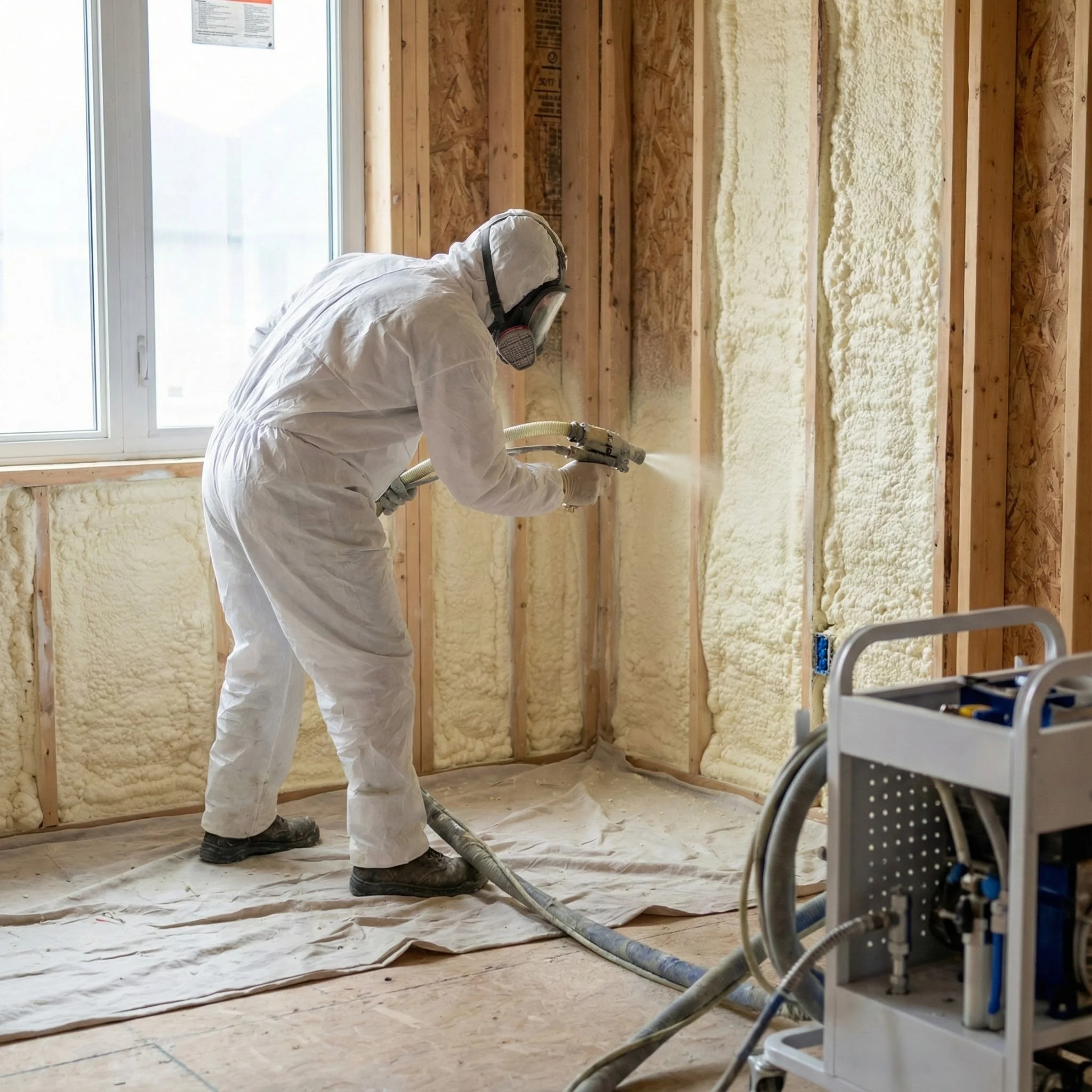
How Spray Foam Works
Spray foam insulation expands on application to fill gaps, seal cracks, and block air leakage—creating a tight building envelope that reduces drafts, moisture movement, and heat loss. Because it bonds directly to wood, concrete, and masonry, it outperforms traditional insulation materials and delivers long-term results in Ontario homes and buildings. This makes spray foam ideal for attic insulation, basement insulation, and rim joist insulation, where air leaks and moisture issues are most common. Spray foam is also widely used in commercial spray foam insulation projects where energy efficiency, durability, and building performance matter. When paired with professional fireproofing services, it helps improve fire resistance and meet Ontario building code requirements, making it a reliable solution for both residential and commercial applications
- Expands on contact to fill gaps and cracks
- Seals air leaks and moisture movement
- Bonds directly to wood, concrete, and masonry
- Delivers long-term insulation performance
Ready to Upgrade Your Insulation?
Get professional spray foam insulation installed by licensed experts serving Toronto and communities across Ontario.
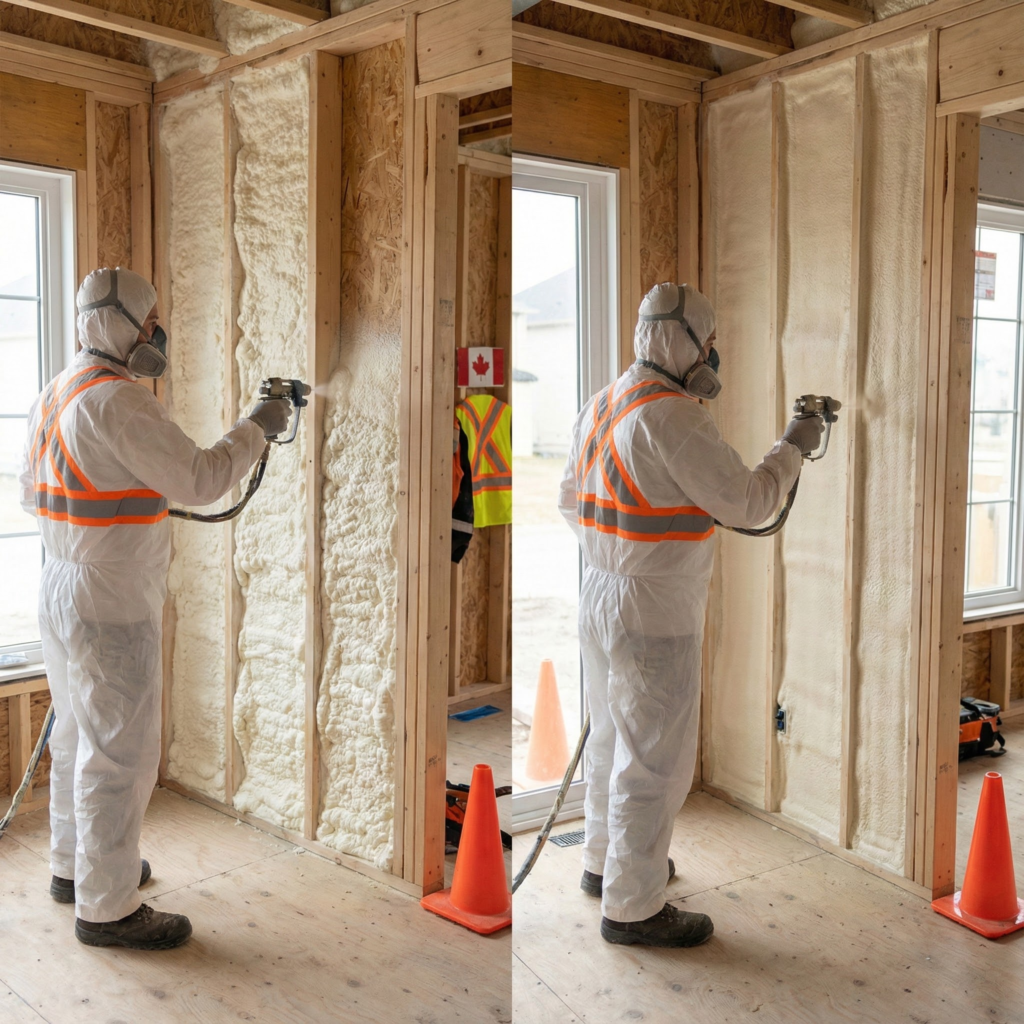
Open-Cell vs Closed-Cell Spray Foam
Open-Cell Spray Foam
Open-cell spray foam is a lighter, more flexible insulation that expands to fill wall cavities and irregular spaces. It provides excellent air sealing and sound reduction, making it a popular choice for interior walls, attics, and residential applications where breathability is important.
- Expands easily into wall cavities
- Excellent air sealing and sound reduction
- More flexible and breathable material
- Commonly used in attics and interior walls
Closed-Cell Spray Foam
Closed-cell spray foam is a dense, rigid insulation with a higher R-value per inch. It adds structural strength, resists moisture, and creates a strong vapour barrier, making it ideal for basements, crawl spaces, rim joists, and commercial or industrial buildings.
- Higher R-value per inch
- Acts as a moisture and vapour barrier
- Adds strength to walls and structures
- Ideal for basements, rim joists, and commercial buildings

Where We Install Spray Foam Insulation
Ideal for reducing heat loss, improving comfort, and increasing energy efficiency in homes.
Helps control moisture, air leaks, and temperature fluctuations in below-grade spaces.
Seals one of the most common sources of air leakage in residential homes.
Improves comfort and insulation performance in attached garages and home additions.
Designed for offices, retail spaces, warehouses, and commercial buildings.
Custom spray foam solutions for specialized and industrial insulation needs.
Spray Foam Insulation Pricing Factors
Spray foam insulation pricing can vary depending on the scope of the project and the conditions of the space. Rather than using flat pricing, we assess each job individually to ensure accurate estimates and long-term performance.
- Area being insulated (attic, basement, rim joist, garage, or commercial space)
- Total square footage of the project
- Type of spray foam used (open-cell or closed-cell)
- Accessibility and condition of the space
- Residential vs commercial application
As a general reference, spray foam insulation projects in Toronto and across Ontario typically range from a few thousand dollars for smaller residential areas to higher costs for larger homes or commercial buildings. Final pricing depends on site conditions, insulation type, and project scope, which is why we provide custom estimates after an on-site assessment.
Spray Foam Insulation FAQs
How much does spray foam insulation cost per square foot in Toronto?
Most quotes depend on foam type, thickness, and access. As a general Toronto reference, professional installation is often cited in the range of about $1.50 to $4.90 per sq ft (varies by project and specs). The fastest way to get an accurate number is an on-site assessment.
How much does it cost to spray foam 1000 sq ft in Toronto / GTA?
For a 1,000 sq ft project in the Toronto area, you’ll commonly see totals in the $2,500 to $6,000 range depending on thickness, open vs closed-cell, and prep work. Exact pricing changes based on how many inches you need and what surfaces are being sprayed.
How much does it cost to spray foam a 24x24 garage?
A 24’ x 24’ (2-car) garage is commonly estimated around $3,000 to $8,000, with many examples citing an average near $6,000 when walls + ceiling + labor are included. Final cost depends on whether it’s attached, the coverage areas, and required R-value.
How much does 2 inches of spray foam cost?
Spray foam is often priced by the board foot (1 sq ft × 1 inch thick). At 2 inches, you’re using 2 board feet per sq ft. Published Canadian ranges often show roughly $0.50–$1.00/board foot (open-cell) and $1.25–$1.65/board foot (closed-cell) as reference pricing points—then installation, prep, and access affect your final installed rate.
Is open-cell or closed-cell spray foam more expensive?
Closed-cell is typically more expensive because it’s denser and delivers a higher R-value per inch. Common published references show open-cell around $0.50–$1.00/board foot and closed-cell around $1.25–$1.65/board foot, with installed project totals varying by thickness and scope.
What factors affect spray foam insulation pricing?
Pricing usually depends on:
Area type (attic, basement, rim joist, garage, commercial)
Square footage + thickness (inches / R-value)
Open-cell vs closed-cell
Access & prep work (old insulation removal, tight areas)
Residential vs commercial requirements
How thick should spray foam insulation be in Ontario?
Thickness depends on where it’s installed and target performance. Published guidance often suggests roughly 5–6 inches for open-cell or 3–4 inches for closed-cell for many Canadian climates, with adjustments based on code and building design. We confirm the right build-up during the estimate.
Are there rebates for insulation upgrades in Ontario?
Some Ontario homeowners may qualify for utility rebate programs (availability and eligibility vary). For example, Enbridge promotes home efficiency rebates that can apply to insulation/air sealing in certain cases.
Ready to Upgrade Your Insulation?
Get professional spray foam insulation installed by licensed experts serving Toronto and communities across Ontario.
Spray Foam Insulation Service Areas
Spray Foam Kings proudly serves Toronto, the GTA, and surrounding communities across Ontario. If you don’t see your city listed below, contact us to confirm availability.
- Toronto
- Mississauga
- Brampton
- Vaughan
- Markham
- Richmond Hill
- Oakville
- Milton
- Scarborough
- North York
Get a Free Spray Foam Insulation Estimate
Serving Toronto, the GTA, and communities across Ontario. Fast quotes. Licensed professionals. No obligation.
What Spray Foam Insulation Covers
We install spray‑foam insulation in a range of residential and commercial locations across the Greater Toronto Area and the wider Ontario market, including:
- Attic floors, slopes and cathedral ceilings
- Basement walls, crawl‑space ceilings and rim joists
- Garage walls, ceilings and doors
- New‑home additions and remodels
- Commercial office, retail and warehouse spaces
Both open‑cell and closed‑cell foams are available, allowing us to match the material to the performance needs of each area (air sealing and sound reduction for interior walls and attics; higher R‑value, moisture barrier and structural strength for basements, rim joists and flat roofs).
—
How Pricing Is Determined
Our pricing is based on three primary factors:
- Scope of work – the total square footage and the specific locations (attic, basement, rim joist, garage, commercial area).
- Foam type – open‑cell (R‑3.7 per inch) typically ranges from $1.50 to $3.50 per sq ft installed; closed‑cell (R‑6 per inch) ranges from $2.50 to $5.00 per sq ft installed.
- Site conditions – accessibility, existing insulation removal, and any special preparation (e.g., vermiculite abatement) can affect labour time and material usage.
For reference, a 1,200 sq ft attic insulated to R‑20 with open‑cell foam costs roughly $2,800–$4,200 CAD, while the same job with closed‑cell foam is about $6,000–$8,400 CAD. Small residential jobs often fall between $1,500–$3,000 CAD, medium projects $3,000–$5,000 CAD, and full‑home installations $10,000–$20,000 CAD or more.
All estimates are provided in a written, itemised quote before any work begins.
—
Getting Started – Your Next Steps
- Contact us – Call 647‑641‑6881 or email info@sprayfoamkings.ca to request a free, written quote.
- On‑site assessment – One of our CUFCA‑trained technicians will visit the property, measure the area, and discuss material options.
- Quote review – You’ll receive an itemised estimate that includes labour, material, any required removal, and applicable rebates.
- Rebate assistance – As an Enbridge HER+ partner, we can help you apply for up to $10,600 in rebates and guide you through the Canada Greener Homes program paperwork.
- Installation – Our WSIB‑covered, insured crew completes the install, following Ontario Building Code SB‑12 requirements and manufacturer specifications.
- Re‑occupancy – The space is safe to re‑enter after a minimum of 24 hours of ventilation (48 hours for whole‑home projects).
—
Frequently Asked Questions
What is the expected lifespan of spray‑foam insulation? When installed according to Ontario Building Code standards, the foam maintains performance for 25–30 years or longer under normal conditions.
Do you provide a warranty? Yes. Our workmanship warranty covers delamination, shrinkage or adhesion failures at no charge.
Is the foam fire‑rated? Closed‑cell foam acts as a Class‑II vapour retarder and, when combined with our NFCA‑certified fire‑resistive material (CAFCO 300 or ISOLATEK), can meet fire‑rating requirements for commercial projects.
Can you work on homes with existing vermiculite insulation? Vermiculite removal requires licensed abatement. We will coordinate with a qualified contractor before applying spray foam.
How soon can I schedule an installation? Project timelines depend on the size of the job and current crew availability. After the on‑site assessment, we provide an estimated start date in the written quote.
—
Which Parts of Your Home Can Be Insulated?
Spray Foam Kings can apply spray‑foam insulation to a range of locations, including:
- Attic floors, slopes and cathedral ceilings
- Basement walls, crawl spaces and full‑basement floors
- Rim joists and other perimeter framing members
- Garage walls, ceilings and doors
- Additions, remodel walls and interior cavities
- Commercial and industrial spaces such as offices, warehouses and retail units
During the free, written estimate we ask you to identify the specific area(s) you want insulated and the approximate square footage. This helps us select the appropriate foam type (open‑cell or closed‑cell) and provide an accurate cost estimate.
—
New Build or Renovation – Does It Matter?
Both new‑construction projects and retrofits of existing homes are eligible for spray‑foam insulation. For new builds, the foam can be installed before interior finishes are applied, which often reduces the time needed for site preparation. For renovations, our crew follows Ontario Building Code SB‑12 requirements and protects existing finishes with plastic sheeting before spraying. Whether you are upgrading an older Toronto property or finishing a new house, we handle the same safety, ventilation and code‑compliance procedures.
—
What Information Do We Need to Quote Your Project?
To generate a detailed, itemised quote we request:
- Location of the work – attic, basement, rim joist, garage, addition, or commercial area.
- Approximate square footage – a rough measurement (e.g., 1,200 sq ft) is enough for the initial estimate.
- Desired foam type – open‑cell (R‑3.7 per inch) is common for attic floors and interior walls; closed‑cell (R‑6 per inch) is required for below‑grade walls, rim joists and flat roofs.
- Access considerations – any obstacles such as HVAC equipment, electrical panels or limited entry points.
Providing these details lets us calculate material quantities, labour time (a typical 1,200 sq ft attic takes 4–6 hours on‑site) and any additional services such as old‑insulation removal.
—
How to Get Your Free, Written Estimate
Call us at 647‑641‑6881 or email info@sprayfoamkings.ca to schedule a site visit. Our CUFCA‑trained installers will walk through the identified areas, confirm square footage and discuss any special conditions (e.g., presence of vermiculite insulation, which requires licensed abatement). After the assessment you will receive a written, itemised quote before any work begins. The quote includes labour, foam material, disposal of old insulation (if required) and any applicable rebates.
—
Rebate and Warranty Information
Spray Foam Kings is a registered Enbridge HER+ partner; eligible projects can qualify for rebates up to $10,600. We also assist with the Canada Greener Homes program paperwork. All installations carry a workmanship warranty that covers delamination, shrinkage or adhesion failures at no charge. The foam itself has a lifespan of 25–30 years under normal conditions, and re‑occupancy is safe after 24 hours (24–48 hours for whole‑home jobs) with proper ventilation.
—
How We Size Your Spray Foam Project
When you request a free, written quote, we ask for two key pieces of information: the area of the home you want to insulate (attic, basement, rim joist, garage, addition, etc.) and the approximate square footage of that space. Knowing the exact location and size lets us calculate the foam thickness required to meet the Ontario Building Code and your desired R‑value, and it enables us to give you an accurate, itemised estimate before any work begins. If you’re unsure of the square footage, our on‑site assessment will measure the space and confirm the numbers for you.
—
New Construction or Renovation?
The installation approach differs slightly between a new build and a retrofit of an existing Toronto property. For new construction, spray foam can be applied directly to framing before drywall or interior finishes are installed, which often reduces labour time. In a renovation, we first protect existing finishes, remove any old insulation if required (e.g., fiberglass, cellulose), and then apply the foam to seal gaps that have developed over time. In both cases, our CUFCA‑trained crew follows the Ontario Building Code (SB‑12) and manufacturer specifications to ensure a compliant, long‑lasting result.
—
Which Parts of Your Home Can Be Insulated?
Spray foam works well in a variety of locations. Below is a quick guide to help you decide which areas you may want to include in your project:
- Attic floors and slopes – Open‑cell foam provides excellent air sealing for attic floors; closed‑cell can be used where a vapour barrier is required.
- Basement walls and crawl spaces – Closed‑cell foam acts as a class‑II vapour retarder and helps prevent mould.
- Rim joists – Closed‑cell foam seals one of the most common sources of air leakage; typical cost is $800–$1,500 CAD.
- Garage walls and ceilings – Both foam types improve comfort and can be applied to attached or detached garages.
- Additions and remodels – Foam can be sprayed into new wall cavities or over existing structures to improve energy performance.
- Commercial spaces – Open‑ or closed‑cell foam can be used in offices, retail, warehouses, and other multi‑unit buildings.
If you are planning to insulate more than one area, simply list each location and its approximate size in your request. We will combine the data into a single, comprehensive quote.
—
Get a Precise Quote in Three Simple Steps
- Tell us the location(s) – Attic, basement, rim joist, garage, addition, or commercial area.
- Provide an estimate of square footage – Approximate numbers are fine; we will verify on site.
- Specify new build or renovation – This helps us plan the installation sequence and any necessary prep work.
You can share this information via phone (647‑641‑6881), email (info@sprayfoamkings.ca), or the online form. Once we have the details, we’ll schedule a free, on‑site assessment, confirm the measurements, and deliver a written, itemised quote. We also handle Enbridge HER+ rebate paperwork if your project qualifies for up to $10,600 in savings.
—
What Information We Need for an Accurate Quote
To provide a written, itemised quote we ask for three key pieces of information:
- Location of the work – Identify the area you want insulated (attic floor, attic slope, basement walls, rim joists, garage, addition, or a commercial space).
- Approximate square footage – A rough measurement of the surface to be covered helps us estimate material quantities and labour time.
- Project type – Let us know whether the work is part of a new construction or a retrofit of an existing building.
The result is a clear, itemised quote before any work begins.
*Sources: COMPANY FACTS (free quotes, written itemised quotes), CURRENT PAGE (general description of services).*
—
New Build or Renovation – Why It Matters
The choice between open‑cell and closed‑cell spray foam often depends on the stage of the building:
- This is useful for below‑grade walls, rim joists, and flat roofs that will be exposed to the ground or moisture.
Both foam types meet Ontario Building Code (SB‑12) requirements when installed by our CUFCA‑trained crew. During the assessment we verify the building’s age, existing insulation, and any moisture concerns to recommend the most appropriate solution.
*Sources: COMPANY FACTS (open‑cell vs closed‑cell specs, code compliance), CURRENT PAGE (general description of applications).*
—
Which Parts of Your Home Can Be Insulated
Common residential areas we service include:
- Attic floor – Open‑cell foam creates an airtight seal that reduces heat loss and drafts.
- Attic slope or cathedral ceiling – Closed‑cell foam adds structural strength and acts as a vapour barrier.
- Basement walls and crawl spaces – Closed‑cell foam controls moisture and prevents mould growth.
- Rim joists – Closed‑cell foam eliminates one of the most common sources of air leakage.
- Garage walls and ceilings – Either foam type can improve comfort and energy efficiency.
- Additions and remodels – Foam can be sprayed directly onto new framing or existing surfaces.
*Sources: COMPANY FACTS (list of services), CURRENT PAGE (areas of installation).*
—
Frequently Asked Questions About Project Scope
Q: How do I tell you the square footage of my project? If you are unsure, we can measure it during the free assessment.
Q: Does the type of building affect the foam choice? A: Yes.
Q: Can I have multiple areas insulated in one job? A: Absolutely.
*Sources: COMPANY FACTS (free quotes, foam types), CURRENT PAGE (FAQ format).*
—
Related guides
Cost and rebates
- Spray Foam Insulation Cost Calculator Ontario
- Ontario Insulation Rebate 2026
- Spray Foam Insulation Cost Canada 2026 Statistics: GTA Pricing Breakdown & What Homeowners Should Budget –
- How Much Does Spray Foam Insulation Cost in Ontario in 2026? –
- Spray Foam Insulation Toronto Cost Per Square Foot: Complete Pricing Guide –
- Spray Foam Insulation Rebate Ontario 2026: How to Get Up to $10,000 Back on Your Upgrade –
Open-cell, closed-cell and R-value
- Spray Foam Insulation R-Value: Open vs Closed Cell Guide –
- Open Cell vs Closed Cell Spray Foam Insulation: Which Is Better for Ottawa Homes –
- Closed-Cell Spray Foam vs Open-Cell Spray Foam in Ontario –
Vapour barriers, moisture and air sealing
- Do You Need a Vapor Barrier with Spray Foam Insulation in Ontario? –
- Does Spray Foam Insulation Need a Thermal Barrier in Ontario? –
- Air sealing a house in Ontario
- Fire Dampers vs Fire Barriers: What Is the Difference? –
Spray foam compared with other insulation
- DIY Spray Foam Kits vs Professional Installation in Ontario
- Spray Foam vs Rockwool Insulation: Toronto Cost & ROI –
- Spray Foam vs Batts: Toronto Insulation Guide –
Installation and safety
- Can I Sleep in My House After Spray Foam Insulation? –
- Does Spray Foam Insulation Need to Be Covered in Ontario? –
Where spray foam is used
- Is Spray Foam Insulation the Right Choice for Your Metal Roof?
- The Best Types of Insulation for Your Home –
- Does Spray Foam Insulation Increase Home Value in Ontario? –
- Concrete Wall Insulation Solutions